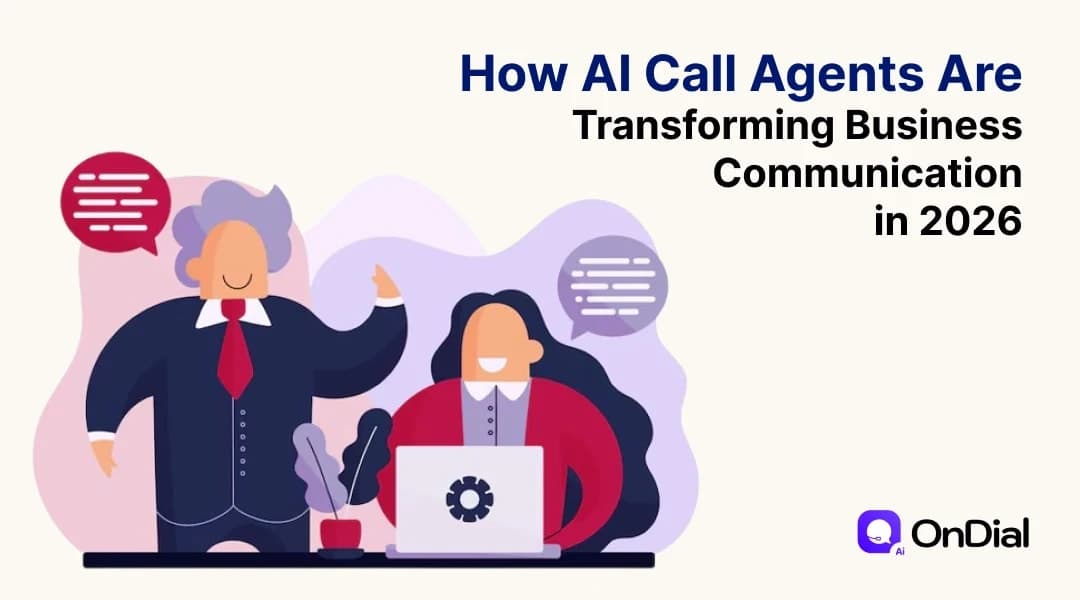
Business communication has changed dramatically, but phone calls remain one of the most important ways customers interact with companies.
Customers still call to ask questions, schedule appointments, check orders, request support, qualify services, make payments, and speak with sales teams. The challenge is that call volume can grow much faster than a business can grow its human support operation.
AI call agents offer a different approach. Instead of using phone automation only to route callers through rigid menus, modern AI voice systems can understand spoken requests, maintain conversational context, access approved business information, complete defined tasks, and transfer complex situations to human employees.
The value is not simply that an AI system can talk. The value comes from connecting a conversation to a useful business action.
What Are AI Call Agents?
An AI call agent is a software system designed to conduct phone conversations using artificial intelligence.
A typical interaction combines speech recognition, language understanding, conversational AI, text-to-speech, business rules, and integrations with systems such as CRMs, calendars, helpdesks, and databases.
The difference between a basic voice bot and a capable AI call agent is what happens during and after the conversation.
A basic system may recognize a few commands and route the caller. An AI call agent can potentially understand intent, ask follow-up questions, retrieve approved information, collect customer details, schedule an appointment, qualify a lead, create a record, or escalate the conversation.
This makes voice AI less about replacing a phone system and more about connecting customer conversations with business workflows.
Why Traditional Business Communication Struggles to Scale
Many businesses still depend on human teams to handle every inbound and outbound call.
That model works when call volume is predictable. It becomes difficult when demand increases suddenly, customers call outside business hours, or employees have to spend large portions of their day answering repetitive questions.
Customers may encounter busy lines, long waiting times, voicemail, inconsistent answers, or repeated transfers between departments.
The operational problem is not always a lack of employees. Often, highly trained employees are spending time on calls that follow predictable patterns.
AI call agents can take over appropriate repetitive interactions while allowing human employees to concentrate on situations that require judgment, negotiation, empathy, or specialist knowledge.
Modern voice AI implementations increasingly focus on completing real support tasks rather than simply producing natural sounding conversations. Production performance depends on factors such as speech recognition, latency, integrations, escalation logic, and access to reliable business information.
How AI Call Agents Transform Business Communication
1. Faster Customer Response
A phone call creates an immediate expectation of interaction.
When customers call a business, they generally want an answer or a next step without navigating several layers of delay.
AI call agents can provide an always available first point of contact for routine requests. They can answer common questions, collect information, check approved records, or route the caller to the appropriate employee.
This can be particularly useful for businesses receiving calls outside standard working hours or experiencing temporary spikes in demand.
2. More Efficient Inbound Call Handling
Inbound calls often contain repetitive requests.
Customers may ask about business hours, appointment availability, order status, delivery information, account processes, or service details.
An AI call agent can handle defined categories of these conversations without requiring an employee to answer every call manually.
The objective should not be to automate everything. A better approach is to identify call types where the process is predictable, the information is reliable, and the consequences of an incorrect answer are manageable.
3. Scalable Outbound Calling
AI call agents can also support outbound communication.
Businesses can use them for appointment reminders, lead qualification, customer surveys, payment reminders, follow-ups, notifications, and other structured conversations.
Outbound automation can reduce the amount of manual calling required from employees while maintaining a consistent process.
For sales teams, for example, an AI agent can collect basic qualification information before a salesperson becomes involved. The human representative then receives a more relevant conversation instead of starting every interaction from zero.
4. Better CRM and Workflow Integration
A phone conversation becomes considerably more useful when it connects directly to the systems a business already uses.
Instead of ending with a disconnected conversation, an AI call agent can be configured to capture information and trigger an appropriate workflow.
For example, a sales conversation could create or update a lead. An appointment call could update a calendar. A support conversation could create a ticket or route an issue to the correct team.
This is where voice AI moves beyond answering calls. It becomes part of the operational workflow.
5. Multilingual Customer Communication
Language can become a significant challenge for businesses serving diverse customer groups.
India alone has customers who may prefer English, Hindi, Gujarati, Marathi, Tamil, Telugu, Bengali, or other languages. Global businesses face an even broader range of language and regional communication requirements.
Multilingual AI voice agents can help businesses provide phone-based interactions across multiple languages without requiring every employee to speak every language.
The quality of multilingual communication still depends on speech recognition, pronunciation, context handling, and appropriate language configuration. Simply adding more languages does not automatically produce a good customer experience.
For businesses serving multilingual markets, the objective should be consistent communication while preserving the ability to transfer conversations to humans when required.
Practical AI Call Agent Use Cases
AI call agents can support different functions depending on the business model and the complexity of its conversations.
Customer Support
Customer support teams can use AI agents to answer frequently asked questions, check order information, provide basic troubleshooting, collect issue details, and route complex problems.
The agent can also summarize the conversation before a human takes over, reducing the need for customers to repeat their situation.
Sales and Lead Qualification
Sales teams can use AI calling for initial outreach and qualification.
The agent can ask predefined qualification questions, identify customer requirements, collect contact information, and determine whether the prospect meets specific criteria.
High intent prospects can then be transferred to a salesperson.
Appointment Scheduling
Appointment based businesses can automate booking, confirmation, cancellation, and rescheduling calls.
Healthcare providers, professional services, education companies, real estate businesses, and other appointment driven organizations can use this approach to reduce repetitive scheduling work.
For healthcare organizations, for example, AI phone workflows can support appointment scheduling and routine patient communication while routing sensitive or clinically complex matters to appropriate staff.
Surveys and Customer Feedback
Businesses often want customer feedback but struggle to collect it consistently.
AI call agents can conduct structured surveys, ask follow-up questions, record responses, and identify conversations that require human attention.
This can turn phone conversations into structured operational feedback rather than isolated interactions.
Notifications and Reminders
Businesses can automate calls for appointment reminders, service notifications, follow-ups, delivery updates, and other time-sensitive communication.
The advantage is consistency. A defined workflow can operate according to business rules without relying on an employee to remember every individual follow-up.
AI Call Agents and Human Employees Should Work Together
One of the biggest mistakes businesses can make is treating AI and human communication as an either-or decision.
Not every conversation should be automated.
Some customers need empathy. Others have unusual requests, complex complaints, sensitive situations, or issues that require human authority.
A strong AI call strategy therefore includes clear escalation rules.
The AI can handle the predictable first layer of communication, identify the customer's intent, gather relevant information, and then transfer the conversation when human involvement is appropriate.
The human employee receives context rather than a cold transfer.
This hybrid model can make automation more useful because customers are not forced to continue speaking with an AI when the situation has moved beyond its defined capabilities.
What Businesses Should Evaluate Before Deploying AI Call Agents
Choosing an AI voice solution should involve more than listening to a demonstration call.
Conversation Quality
The system needs to understand interruptions, accents, incomplete sentences, corrections, and changes in intent.
Real customers rarely speak like scripted examples.
Testing should therefore involve realistic conversations rather than only ideal scenarios.
Business Integrations
Ask what systems the AI agent can access and what actions it can perform.
CRM connectivity, calendars, ticketing platforms, knowledge bases, analytics systems, and communication tools can determine whether an AI agent actually improves operations.
Human Handoff
Every production deployment needs a clear answer to one question: what happens when the AI should stop?
Human escalation should be based on defined conditions such as customer frustration, sensitive requests, low confidence, complex cases, or explicit requests for an employee.
Security and Data Governance
Phone conversations can contain personal, financial, healthcare, or business-sensitive information.
Organizations should understand how recordings, transcripts, customer data, authentication, access controls, retention, and integrations are handled.
Compliance requirements also vary by industry and geography, so businesses should evaluate their specific regulatory obligations before deployment.
Analytics
A good AI call system should provide more than call counts.
Businesses should be able to understand why customers are calling, where conversations fail, which intents are increasing, when transfers occur, and what actions follow each conversation.
That information can improve both the AI workflow and the broader customer experience.
How to Start With AI Call Automation
Businesses do not need to automate their entire phone operation on day one.
A better starting point is one clearly defined workflow.
Begin by reviewing call data and identifying repetitive conversations with predictable outcomes.
Next, document the information the AI needs, the actions it is allowed to take, and the situations that require human involvement.
Then test the workflow with real conversation patterns.
Measure useful operational outcomes such as answer rate, successful task completion, transfer rate, customer satisfaction, resolution rate, and employee time saved.
Once the first workflow performs reliably, the business can expand into additional use cases.
This approach reduces implementation risk and creates a measurable path from experimentation to broader automation.
The Future of Business Communication Is Conversation Plus Action
The next stage of business communication is not simply about making AI voices sound more human.
The more important shift is connecting conversations with actions.
A customer should be able to explain what they need without navigating a complicated menu. The system should understand the request, access the information it is authorized to use, complete the appropriate workflow, and involve a human when necessary.
That can turn the phone from a communication channel into an operational interface.
AI call agents are particularly valuable when they solve a specific business problem: reducing repetitive call volume, improving response availability, accelerating lead qualification, simplifying appointment management, or giving employees better context when they take over a conversation.
The strongest deployments will not be the ones that automate the most calls. They will be the ones that automate the right calls while making human interactions more focused and useful.
Conclusion
AI call agents are changing how businesses approach phone communication by combining conversational AI with automation, integrations, analytics, and human escalation.
They can support inbound customer service, outbound calling, sales qualification, appointments, reminders, surveys, and multilingual communication.
But successful implementation requires more than deploying an AI voice.
Businesses need clear use cases, reliable information, appropriate integrations, security controls, measurable goals, and a human handoff strategy.
For companies ready to modernize how they handle customer conversations, OnDial provides an AI voice platform designed to connect phone conversations with business workflows.