In today’s digital era, businesses need smarter, faster, and more efficient ways to communicate with customers, and that’s where the AI Call Assistant for Business Communication comes into play. Whether you run a startup or a large enterprise, leveraging an AI Call Assistant can reshape your customer engagement, improve operational efficiency, and transform your support framework. With evolving customer expectations, companies want reliable systems that never sleep, respond instantly, and deliver personalized experiences. This shift toward intelligent automation is not just a trend, it’s becoming the backbone of modern communication. Internal linking: tools like AI Call Assistants are now essential for streamlined communication workflows and digital scalability.
What Is an AI Call Assistant?
An AI Call Assistant refers to advanced software powered by artificial intelligence designed to automate inbound and outbound voice communication. Unlike traditional interactive voice response (IVR) systems, these assistants understand natural language, process conversational context, and can adapt in real time.
At its core, an AI Call Assistant works through:
Speech Recognition: Converts spoken language into text
Natural Language Understanding (NLU): Interprets meaning
Response Generation: Provides accurate, contextually relevant replies
Learning Feedback Loop: Improves over time with data and interactions
With these capabilities, businesses can automate repetitive tasks, handle high call volumes, and reduce response delays — all while maintaining quality interactions.
Why Intelligent Voice Automation Solutions Matter Now More Than Ever
Modern customers have zero tolerance for waiting, repetition, or miscommunication. Traditional call centers struggle with high costs, staffing constraints, and inconsistent service quality. This is why Intelligent Voice Automation Solutions are rapidly becoming mainstream.
Here’s why they matter:
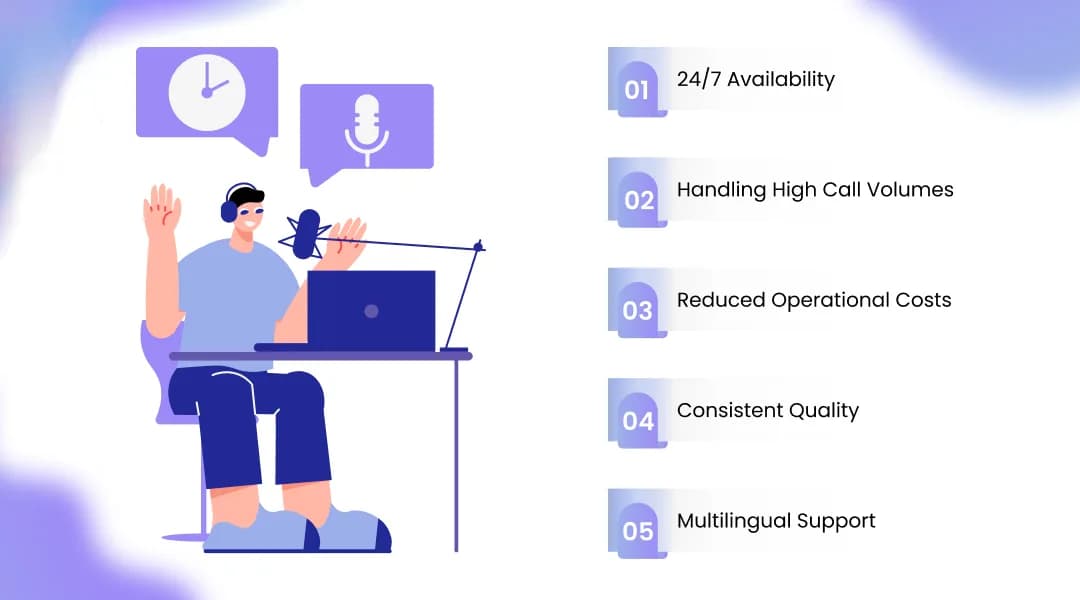
1. 24/7 Availability
Unlike humans, automated voice systems never sleep. Whether it’s midnight or holidays, customers get instant responses.
2. Handling High Call Volumes
During peak times, businesses often drop calls or extend hold times. Intelligent voice automation eliminates these bottlenecks by distributing incoming traffic across virtual assistants without delays.
3. Reduced Operational Costs
Hiring and training call center agents is expensive. Automation reduces overhead and reallocates human talent to higher‑level problem solving.
4. Consistent Quality
Human fatigue and mood swings impact call quality. AI always delivers the same level of service.
5. Multilingual Support
Intelligent systems can speak multiple languages, expanding your customer outreach globally.
Automated AI Voice Call Technology: How It Works
At the heart of every modern communication platform lies Automated AI Voice Call Technology, tools that combine cutting‑edge algorithms with massive voice and speech datasets to drive real conversations.
Here’s how this technology functions:
Voice Capture: The system receives incoming audio from customers.
Transcription: Speech‑to‑text software instantly converts speech.
Interpretation: Natural Language Processing (NLP) identifies user intent.
Decision Logic: Algorithms choose the best response or routing action.
Reply Generation: A text response is transformed back to speech via Text‑to‑Speech engines.
Machine Learning Feedback Loop: Each interaction refines future responses.
Thanks to these components, Automated AI Voice Call Technology feels intuitive, human‑like, and responsive — a far cry from rigid menu‑based phone systems of the past.
How AI‑Driven Customer Call Experience Transforms Support
Customer experience is now the primary differentiator between brands. Frustrating phone systems drive customers away, while personalized conversations create loyalty.
Here are key benefits of an AI‑Driven Customer Call Experience:
Faster Resolution Times: AI assistive systems can handle basic queries instantly — from order status to FAQs — saving time for both customers and support teams.
Personalized Interactions: Machine learning analyzes past interactions and tailors responses based on customer profiles, creating a more meaningful conversation.
Seamless Handoffs: When a human agent is needed, AI transfers context along with the conversation transcript, reducing repetitive explanations.
Better Insights: AI platforms generate real‑time analytics on call trends, customer sentiment, and operational performance.
Proactive Customer Engagement: Instead of waiting for the customer to call, enterprises can automate outbound voice alerts for appointments, reminders, deliveries, or feedback.
Voice AI for Business Call Efficiency: Redefining Productivity
Manual call handling is slow, inconsistent, and resource‑intensive. By contrast, Voice AI for Business Call Efficiency:
Eliminates long hold times
Filters low‑priority calls automatically
Routes complex cases to skilled agents
Responds instantly to repetitive requests
Here’s how that translates into measurable business value:
Benefit | Impact on Business |
Reduced Call Waiting Time | Improved Customer Satisfaction |
Lower Labor Costs | Higher Profit Margins |
Intelligent Call Routing | Faster Resolutions |
Automated Follow‑Ups | Higher Retention |
Real‑Time Data | Better Strategic Decisions |
With these advantages, Voice AI isn’t just a tool — it’s a strategic asset for improving every department from sales to support.
Next‑Gen AI Voice Call Automation in Action
The latest wave of automation goes beyond simple responses. Next‑Gen AI Voice Call Automation integrates deeply with business workflows and customer data, enabling:
Contextual Conversations: AI can recall previous interactions and adapt responses accordingly, creating continuity and reducing customer frustration.
Emotion Recognition: Advanced systems detect customer sentiment and can escalate to human agents when frustration or urgency is detected.
Predictive Assistance: Using historical data, AI predicts caller needs and offers proactive suggestions before a question is asked.
Multichannel Integration: Calls can be connected with SMS, email, chat, or CRM records, creating a unified customer profile across platforms.
These innovations make every interaction smarter, faster, and more aligned with business goals — and dramatically enhance the overall customer journey.
Real‑World Use Cases of AI Call Assistants
Companies across industries are adopting this technology:
E‑Commerce & Retail: Handling order inquiries, tracking deliveries, or answering product questions without human intervention.
Healthcare: Automating appointment scheduling, prescription refills, and patient reminders.
Financial Services: Verifying customer identity, processing payment updates, or reporting lost cards. Telecom & IT Support: Resolving basic technical issues or routing complex problems to specialists.
Hospitality: Managing reservations, cancellations, and guest support efficiently. These real‑world scenarios highlight how automation benefits both customers and businesses by eliminating wait times and enhancing service quality.
Best Practices to Implement AI Call Assistant Technology
To get the most from your investment, follow these key strategies:
Define Clear Objectives: Know what you want — reduced call volume, increased customer satisfaction, or lower costs — and measure performance against those goals.
Integrate With Existing Systems: Connect your AI platform to CRM, help desk, tickeTrain With Quality Data: AI learns from data quality. Ensure your conversation logs, customer records, and intent libraries are clean and well labeled.
Test With Real Users: Deploy gradually, gather feedback, and fine‑tune responses to real customer behavior.
Keep the Human Option: Always allow callers to connect to a human agent — especially for emotional or complex issues.
The Future of Business Communication
The global shift toward intelligent automation isn’t slowing down — it’s accelerating. As AI technologies mature, we can expect:
Smarter contextual understanding
Emotionally aware voice assistants
Seamless AI‑human collaboration
Hyper‑personalized customer communication
Automated compliance and quality monitoring
By adopting AI Call Assistant for Business Communication, companies are not just upgrading their contact centers — they are redefining what it means to connect with customers in a digital world.
Conclusion
The era of rigid phone menus and long waits is over. With Intelligent Voice Automation Solutions, Automated AI Voice Call Technology, and Next‑Gen AI Voice Call Automation, businesses can provide an AI‑Driven Customer Call Experience that is fast, personal, efficient, and cost‑effective.
For companies looking to boost productivity and customer satisfaction, the answer lies in leveraging Voice AI for Business Call Efficiency — a transformative technology designed for modern communication challenges.
As competition increases, the earlier businesses adopt these solutions, the greater their advantage in customer loyalty, operational excellence, and market relevance.