Every unanswered business call represents a conversation that never happened.
For a sales team, it may be a prospect asking about a product. For a clinic, it may be a patient trying to book an appointment. For a real estate company, it may be a buyer ready to schedule a property visit. For a service business, it may be an existing customer looking for immediate help.
The problem is not always a lack of demand. Often, the business simply cannot respond to every call at the moment it arrives.
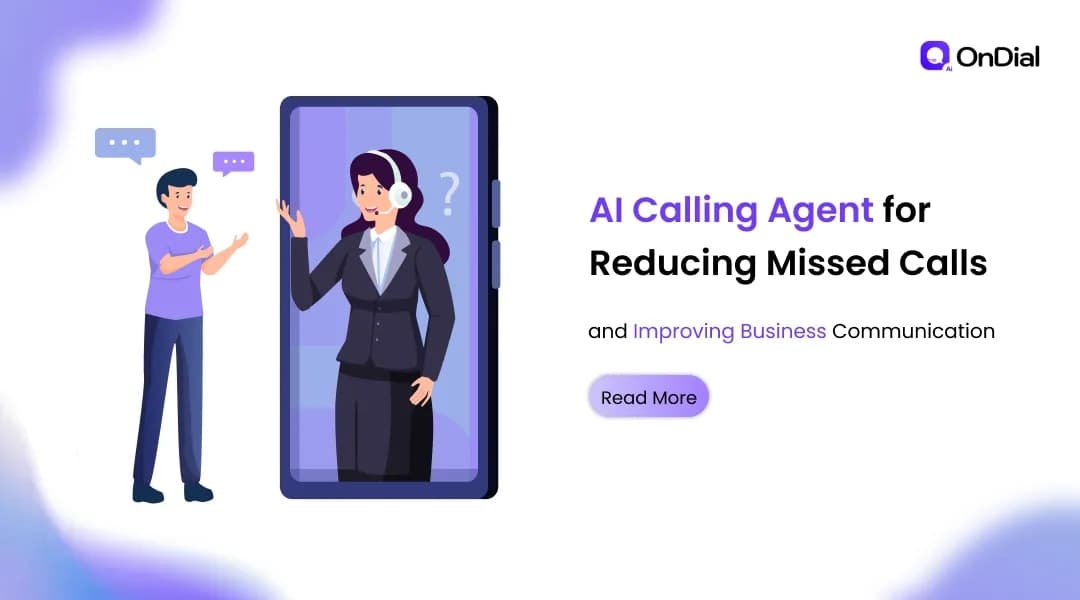
An AI calling agent can help close that gap by answering calls, understanding what callers need, collecting information, completing routine tasks, and transferring conversations to human employees when necessary.
For businesses operating across India and global markets, this also creates an opportunity to provide consistent phone support across different working hours, locations, languages, and call volumes.
What Is an AI Calling Agent?
An AI calling agent is a conversational voice system that can communicate with customers over the phone using artificial intelligence.
Unlike a traditional IVR that forces callers through predefined menus, an AI calling agent allows people to describe what they need using natural language. The system interprets the request, determines the appropriate response or action, and continues the conversation based on the caller's answers.
For example, a customer might say:
"I want to reschedule my appointment for Friday afternoon."
Instead of asking the caller to press several buttons, the AI can identify the request, check the available scheduling workflow, collect the necessary information, and either complete the task or transfer the conversation to a human.
This makes the technology useful for both inbound and outbound communication.
AI Calling Agent vs Traditional IVR
Traditional IVR systems are useful for simple routing, but they generally depend on rigid menu structures.
A caller may hear:
"Press 1 for sales. Press 2 for support. Press 3 for billing."
An AI calling agent can instead interpret a natural request such as:
"I have a problem with my recent order and I want to know when the replacement will arrive."
The difference is important because customers generally think in terms of problems and outcomes, not internal departmental structures.
AI calling agents can therefore make phone interactions more flexible while still preserving controlled business workflows.
Why Businesses Miss Important Calls
Missed calls rarely happen because employees do not care about customers. They happen because phone demand and human availability do not always match.
Several situations create this gap.
Peak Hour Call Volume
A receptionist or sales representative can only actively manage a limited number of conversations at once.
When multiple customers call simultaneously, some callers may encounter a busy line, wait too long, reach voicemail, or abandon the call.
This becomes particularly important during marketing campaigns, seasonal demand, product launches, enrollment periods, property launches, and other events that create sudden increases in call volume.
After Hours and Weekends
Many businesses receive inquiries outside their standard operating hours.
A customer may discover a product in the evening, a patient may need to schedule an appointment after work, or a property buyer may want information over the weekend.
If nobody answers, the customer has to decide whether to wait or contact another business.
For businesses competing in markets where customers can easily compare alternatives online, that delay can be costly.
Employees Are Handling Other Work
Phone communication is often only one responsibility among many.
A sales representative may be speaking with another prospect. A receptionist may be helping a visitor. A support employee may be resolving an existing customer issue.
When the next call arrives, there may simply be nobody available to answer it.
Language and Regional Communication
India adds another layer of complexity because customers may prefer English, Hindi, Gujarati, Tamil, Telugu, Marathi, Bengali, or another regional language.
A phone strategy that works for one customer segment may not work equally well across another.
Multilingual voice AI can help businesses design communication workflows that are more accessible to customers across different regions.
How an AI Calling Agent Reduces Missed Calls
The most obvious benefit of an AI calling agent is availability, but answering the phone is only the beginning.
A well designed system can turn the incoming call into a structured business interaction.
24/7 Call Answering
An AI calling agent can answer incoming calls when human teams are unavailable.
This is useful for after hours, weekends, holidays, overflow periods, and unexpected spikes in demand.
Instead of sending every unavailable caller to voicemail, businesses can use the AI to identify the caller's intent and determine what should happen next.
Some calls may be resolved immediately. Others may require a callback, appointment, escalation, or transfer to a human employee.
Intelligent Call Qualification
Not every caller has the same intent.
One person may want pricing information. Another may want technical support. Another may be ready to purchase.
An AI calling agent can ask relevant questions before deciding what to do with the conversation.
For example, a real estate business could collect property type, preferred location, approximate budget, and preferred visit time before passing a qualified prospect to a sales representative.
Businesses can explore this approach further through OnDial's AI voice agents for real estate solutions.
Automatic Lead Capture
A phone conversation can contain valuable information that is easy to lose when employees rely on manual notes.
An AI calling workflow can capture details such as:
Caller name
Contact information
Reason for calling
Product or service interest
Preferred appointment time
Customer questions
Follow up requirements
Qualification information
The captured information can then be passed into the relevant business system.
This creates a more reliable connection between the phone conversation and the next business action.
Human Handoff When Needed
AI should not be treated as the correct solution for every conversation.
Some calls require empathy, negotiation, technical expertise, or decision making that is better handled by a human employee.
A strong AI calling workflow should therefore recognize when a conversation needs escalation.
The AI can collect relevant context first and then transfer or schedule the conversation so the human employee does not have to start from the beginning.
Improving Business Communication Beyond Answering Calls
Reducing missed calls solves only one part of the problem.
The larger opportunity is creating a more consistent communication process from the first conversation to the final business action.
Consistent Customer Responses
Different employees may answer the same question differently.
This can happen because of training differences, outdated information, workload, or simple human error.
An AI calling agent can follow a controlled knowledge and conversation framework so common questions receive consistent responses.
Businesses can define what the AI should answer directly, what information it should collect, and which situations require human intervention.
Faster Response to Leads
Speed matters particularly when a caller has commercial intent.
Someone who calls to ask about a product, property, course, insurance service, or appointment is already taking an active step.
If that person reaches voicemail, the business has introduced friction at exactly the moment when the customer is ready to engage.
An AI calling agent reduces that initial response delay by making the first interaction available immediately.
Better Customer Context
A human employee who receives a transferred call should ideally know why the caller is being transferred.
Without context, the customer may need to repeat their problem.
With a properly designed workflow, the AI can capture the relevant information first and pass that context into the next stage of the process.
This creates a smoother experience for both customers and employees.
Multilingual Conversations
For Indian businesses, multilingual communication can be particularly valuable.
A customer may understand a company's website in English but feel more comfortable discussing a complex issue in a regional language.
Voice AI can support multilingual conversation flows that allow businesses to serve broader customer groups without requiring every employee to speak every language.
Connecting AI Calling With Business Systems
An AI calling agent becomes significantly more useful when it is connected to the systems employees already use.
A standalone phone bot may answer questions, but an integrated voice workflow can actually contribute to business operations.
For example, the AI can be connected with CRM systems, calendars, support workflows, lead management processes, or other business applications.
OnDial's CRM integration service is designed around this connection between voice conversations and business data.
CRM Updates
When a qualified caller provides information, that information should not remain trapped inside a call recording.
A connected workflow can move relevant information into the CRM so sales or support teams can act on it.
This can reduce manual data entry and make follow up processes easier to manage.
Appointment Scheduling
Appointment based businesses can use voice AI to manage routine scheduling conversations.
The AI can collect the customer's preferred date and time, follow the configured scheduling workflow, confirm the appointment, and handle common rescheduling requests.
This can be useful for healthcare providers, education companies, professional services, real estate teams, and other appointment driven businesses.
Notifications and Follow Up
The initial phone call is often only one stage of the customer journey.
A caller may need a confirmation, reminder, callback, payment notification, or follow up conversation later.
Connecting voice workflows with other systems allows businesses to build a more complete communication process instead of treating every call as an isolated event.
AI Calling Agent Use Cases Across Industries
AI calling agents can support different workflows depending on the business model.
Real Estate
Real estate teams can use AI voice agents to answer property inquiries, qualify prospects, collect preferences, schedule site visits, and follow up with leads.
The system can capture information before a salesperson takes over the conversation.
Healthcare
Healthcare organizations can use voice AI for appointment scheduling, confirmations, reminders, basic administrative questions, and other structured communication workflows.
Sensitive or complex matters can be escalated to appropriate human staff.
Insurance and Financial Services
Insurance and financial businesses often manage repetitive communication around renewals, reminders, lead qualification, customer questions, and follow ups.
Voice AI can help automate structured conversations while allowing complex financial decisions to remain with trained professionals.
E-commerce and Logistics
Customers frequently call about order status, delivery information, returns, replacements, and other routine questions.
An AI calling workflow can handle straightforward requests while directing complicated cases to customer support teams.
Education
Educational organizations can use AI calling agents for course inquiries, admission questions, appointment scheduling, follow ups, reminders, and lead qualification.
This can be especially useful when inquiry volume increases during enrollment periods.
What to Look for When Choosing an AI Calling Agent
Not every voice AI platform will be suitable for every business.
Before selecting a solution, evaluate the complete workflow rather than judging the technology only by how natural the voice sounds.
Natural Conversation
Test how the system handles interruptions, accents, incomplete sentences, unexpected questions, and changes in conversation direction.
A good demonstration should involve realistic conversations rather than only scripted questions.
Workflow Flexibility
The platform should allow the business to define different paths based on caller intent.
A sales inquiry should not follow the same workflow as a support request.
CRM and System Integration
Check whether the platform can connect with the systems your team already depends on.
Integration determines whether the AI is actually part of the business process or simply another disconnected communication tool.
Human Escalation
Ask how the platform handles conversations that the AI cannot resolve.
A reliable system should have clear escalation rules and should preserve useful context during the handoff.
Analytics and Monitoring
Businesses should be able to review conversations and understand what customers are asking.
Useful metrics can include answered calls, call outcomes, transfer rates, appointment bookings, lead qualification, conversation duration, and frequently requested information.
How to Measure the Business Impact
The goal of deploying an AI calling agent should not simply be to increase the number of automated calls.
The better question is whether the system improves meaningful business outcomes.
Start by measuring your current baseline.
Track:
Total inbound calls
Missed calls
Calls outside business hours
Average response time
Qualified leads
Appointments booked
Transfers to human employees
Calls resolved without escalation
Follow up completion
Customer satisfaction
After implementation, compare the same metrics over a consistent period.
This makes it easier to identify where the AI is creating value and where the workflow needs improvement.
Businesses looking for additional context around high volume calling can also review OnDial's AI calling agent guide for high volume customer calls.
AI Should Support People, Not Simply Replace Them
The strongest business communication strategy is rarely about choosing between humans and AI.
Instead, businesses can divide work according to the strengths of each.
AI is well suited to repetitive, structured, high volume conversations that follow predictable workflows.
Human employees remain essential for complex problems, sensitive conversations, negotiation, exceptions, relationship building, and decisions that require deeper judgment.
This combination allows employees to spend more time on conversations where human involvement matters most.
A Practical Way to Start
Businesses do not necessarily need to automate their entire phone operation on day one.
A better starting point is to identify one communication problem with a measurable impact.
For example, begin with after hours calls.
Measure how many calls arrive outside working hours, how many are missed, what those callers typically ask for, and which conversations can be automated safely.
Then create a focused AI workflow for those calls.
Once the process is working reliably, expand into overflow handling, lead qualification, appointment scheduling, customer support, reminders, or outbound follow up.
This approach gives the business a clear baseline and makes it easier to improve the system over time.
For additional context on the financial impact of unanswered calls, see OnDial's analysis of the hidden revenue cost of missed business calls.
Conclusion
Missed calls are more than a phone system problem.
They can represent missed sales opportunities, delayed customer support, incomplete lead capture, slower follow up, and a communication experience that does not match the quality of the rest of the business.
An AI calling agent can help by answering calls when human employees are unavailable, understanding caller intent, collecting information, completing routine tasks, and escalating conversations when human expertise is required.
The most effective implementation is not simply an automated answering system. It is a connected communication workflow that links phone conversations with CRM data, appointments, follow ups, analytics, and human teams.
Businesses that want to explore how AI voice technology can fit into their existing communication processes can learn more about OnDial's AI voice agent platform.