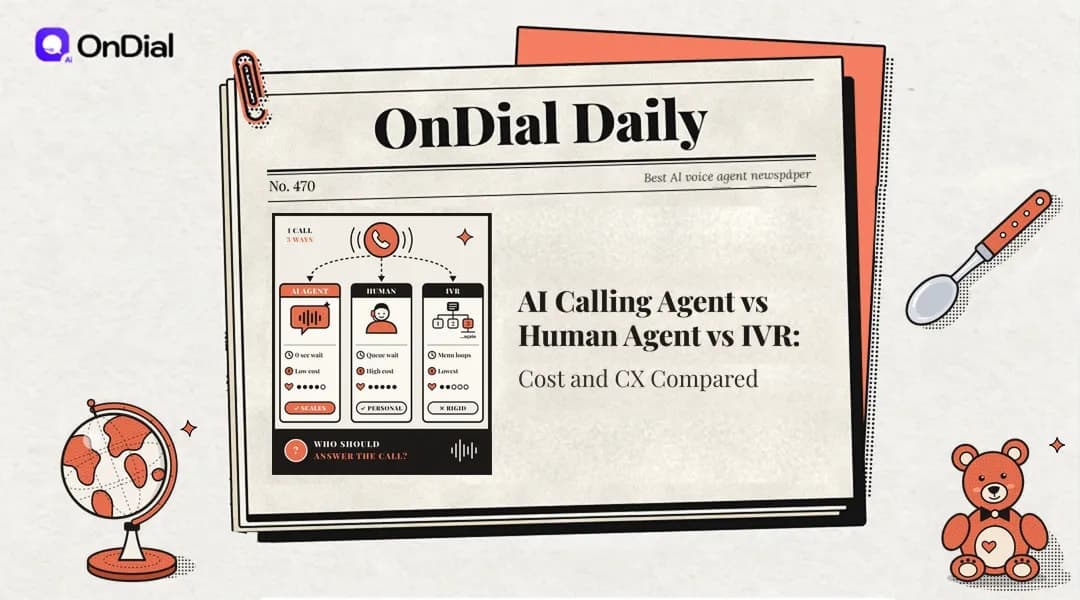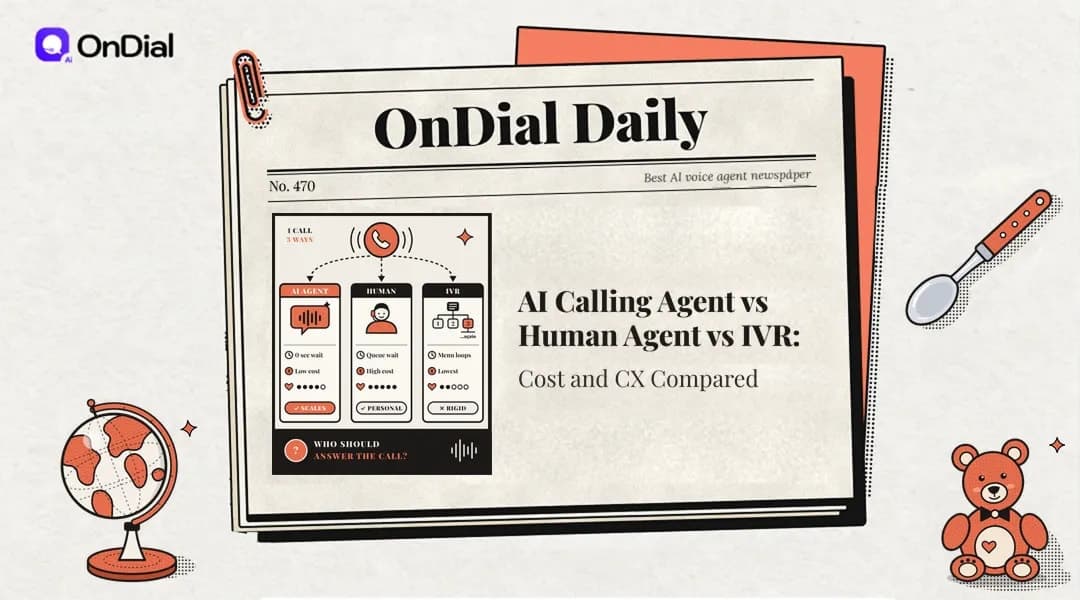
Most phone stacks grew piecemeal, with a keypad menu one year and an overflow vendor the next. If voice AI is new to your team, start with What is an AI call assistant for the basics. The harder question is which calls the best AI calling agent should own, and which it should never touch.
Our answer rests on one number: cost per resolved call, measured separately for each reason people ring you. Price per minute hides the failed attempt, the transfer, and the caller who hangs up at minute four. Price it by call type instead, and the channel debate turns into a routing table.
To keep the numbers concrete, we follow one imagined business from start to finish. Corvane Home Repair is a hypothetical appliance service network with 40 phone agents and about 60,000 calls a month. Every Corvane figure is an illustration, so swap in your own data before deciding anything.
Three Ways to Answer Corvane's Phone, Defined by What the Caller Hears
Call Corvane's number three times and the difference shows up within ten seconds. An IVR plays a menu, a person says hello, and an AI agent asks what you need. After that greeting, each option handles the same problem in a very different way.
The Keypad Menu (IVR)
Picture a Corvane customer whose dishwasher died mid-cycle on a Sunday night. With interactive voice response, she hears options, presses 2 for repairs, and keys in her order number. Most keypad menus can then read a status or route her, but unplanned sentences leave them stuck.
The Trained Person (Human Agent)
Now suppose the same dishwasher owner reaches a person after a short wait. The agent notices this is her third failed repair in two months and offers a senior technician unprompted. That kind of judgment is what you pay for, and labor is also the biggest line on the bill.
The AI Calling Agent That Talks Back
Finally, imagine her describing the dead dishwasher to software that understands plain sentences. The voice agent hears that the dishwasher stopped, finds her booking, and offers Thursday or Friday visits. It sounds natural, yet it follows your team's rules and hands off when those rules run out.
Even the best AI calling agent is still software working from instructions you wrote. Its strengths and blind spots come from that setup as much as from the model inside it. So the rest of this comparison weighs setup as heavily as price.
How an AI Voice Agent Turns Speech Into a Booked Repair Visit
Seven parts work in a tight loop every time Corvane's caller finishes a sentence. Each turn passes through all of them fast enough that she hears no awkward gap. Here is the sequence for Corvane's dishwasher call:
The call lands on Corvane's support number through a SIP trunk and streams live audio.
Speech recognition turns her words into text, including the order number and street name.
A language model works out that she wants a repair visit, then decides what to ask.
Integrations check the booking system, warranty records, and technician calendar in the background.
The agent books the Thursday slot and writes the ticket into the CRM without retyping.
Text-to-speech reads the confirmation back in a voice that fits Corvane's brand.
Guardrails decide when to stop, and a warm transfer passes the caller on with a summary.
In practice, step 2 or step 4 breaks far more often than the model itself. A misheard postcode or a slow scheduling API ruins the call even when the reasoning is sound. When you trial vendors, the best AI calling agent is the one that survives your own recordings.
Call Handling Comparison: Ten Tests Corvane Would Run on Each Option
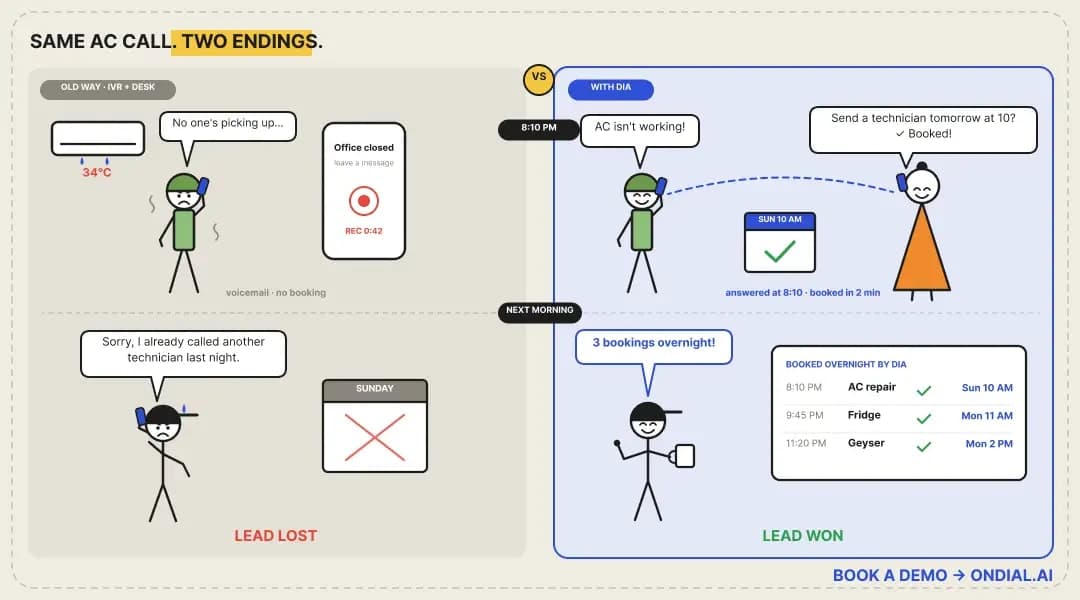
No single channel wins every row for Corvane, which explains why mature stacks usually blend all three. The tests below score each option on things that change a caller's day or your monthly budget. They fall into two groups: running costs and coverage, then conversation quality and risk.
Cost, Speed, and Coverage
These five rows decide what each option costs Corvane to run and when it is available. Price gaps here are real, but customers rarely notice them directly. Read across each row to see the trade:
Running cost and reach | IVR menu | Human agent | AI calling agent |
What drives Corvane's phone bill | Platform and minute fees, low once the repair menu is built | Salaries, training, and supervisors for 40 seats, paid even in quiet hours | Usage fees per minute or per call, plus dispatch system integration work |
The Monday 9 a.m. spike after a holiday weekend | Picks up every line instantly, then parks overflow in a hold queue | Callers wait unless Corvane staffed for that peak weeks earlier | Answers parallel repair calls up to the plan's concurrency limit |
A caller who prefers another language | Needs a separate recorded menu per language, usually only two or three | Limited to whatever languages Corvane's current agents happen to speak | Can switch to the caller's language if the vendor's speech models support it |
A 2 a.m. leak from a washing machine | Stays on all night, but can only route the caller or read data | Needs a costly night shift or an outsourced overflow partner | Stays on all night and can book a morning visit or escalate |
Changing Corvane's warranty policy script | Means re-recording prompts and rebuilding branches of the repair menu | Means retraining all 40 agents and hoping the change sticks | Means editing the knowledge base and testing the change that afternoon |
Conversation Quality and Risk
The next five rows shape how a Corvane caller feels when the call ends. This is the half where the best AI calling agent has to prove itself. Each row also hints at how that option tends to fail:
Quality and risk | IVR menu | Human agent | AI calling agent |
A repair request nobody scripted | Breaks down once the caller's problem sits outside the menu tree | Copes with odd cases, like a fridge installed in a garage, given context | Handles most phrasings, though genuinely new repair problems still trip it up |
A caller on her third failed repair visit | Adds menu friction to a moment that already feels bad | Hears the frustration and can offer a goodwill credit where allowed | Spots some frustration cues, but its apology can sound thin |
What Corvane learns after each call | Keypad digits and menu paths, with little sense of the real problem | Notes that vary with the agent and how hectic the shift was | A full transcript, a tagged call reason, and structured ticket fields |
Consistency across 60,000 monthly calls | Identical on every call, which also makes the menu rigid | Shifts with mood, tenure, and late-afternoon fatigue on the desk | Steady wording, unless someone edits the prompt carelessly |
How each option usually fails Corvane | The caller mashes zero or hangs up halfway through the menu | Long holds in peak season, followed by agent attrition | A confident wrong ETA, or a loop that never offers a person |
The Two Rows That Settle Most Decisions
Two rows decide most real choices: the unscripted request and the upset caller. Everything else is about price and convenience, which matter but rarely end a customer relationship. A well-tuned AI agent narrows the gap on those two rows, though it doesn't fully close it.
Cost Per Resolved Call Beats Price Per Minute
Divide everything a channel costs by the calls it actually finishes, and the cheap keypad menu often loses. An IVR minute costing a couple of cents means little if most callers still end up with a person. The honest formula adds the first attempt, any transfer, and every minute of human time that follows.
Why Labor Dominates the Human Column
If salaries dominate your phone budget the way they would at Corvane, you are typical. Gartner has estimated that agent labor can reach 95% of contact center costs. That share covers a global workforce the firm sized at roughly 17 million agents.
Because labor is so large, small shifts in who handles a call move the budget fast. The same Gartner analysis projected that conversational AI would trim agent labor spending by $80 billion in 2026. For Corvane, the real question is which calls the best AI calling agent should absorb first.
Worked Example: 1,000 Technician ETA Calls at Corvane
Technician arrival checks make up the largest share of Corvane's calls, so they come first. They are short, repetitive, and the answer already sits in the dispatch system. The assumptions below are illustrative, and your loaded labor rate will differ by country:
A person handles an ETA call in five minutes at an assumed loaded cost of $0.80 per minute.
The IVR costs about $0.06 per call and finishes 45% of ETA calls without help.
The AI agent costs about $0.36 per call and finishes 80% of ETA calls on its own.
Transferred AI calls arrive with a summary, so the human leg drops to four minutes.
Next, multiply each path through for a batch of 1,000 calls. Failed attempts still cost money, so every transfer adds a full or partial human call on top. Here is how the three setups compare:
Setup for 1,000 ETA calls | How the total builds up | Total cost | Cost per call |
People answer every ETA call | 1,000 calls at $4.00 each | $4,000 | $4.00 |
IVR first, 550 callers passed to people | $60 in menu fees plus 550 human calls at $4.00 | $2,260 | $2.26 |
AI first, 200 callers passed to people | $360 in AI fees plus 200 shorter human calls at $3.20 | $1,000 | $1.00 |
On this routine lookup, putting AI first cuts cost per call by three quarters against an all-human desk. The best AI calling agent also beats the IVR here, because far fewer callers bounce to a person. For staffing and shrinkage variables, see this AI voice agent vs human call centre agent cost breakdown.
Where the Math Flips: Billing Disputes and the Hidden CX Bill
On a billing dispute, a cheap failed attempt can cost more than a pricey human call. Run Corvane's billing disputes through the same formula, and AI-first still looks cheaper at first. The picture changes once you price the customers who leave after a frustrating loop.
Again, every figure in this second scenario is invented to show the mechanics. The rates match the ETA example, so only the call behavior changes. Here are the assumptions for 1,000 disputes:
A person settles a dispute in nine minutes, or $7.20 at the same loaded rate.
The AI attempt costs about $0.48 but settles only 25% of disputes alone.
Transferred callers repeat their story, so the human leg still runs eight minutes, or $6.40.
Assume 2% of callers who fail with the bot cancel, each worth $300 in future revenue.
Labor alone favors the bot: $480 in AI fees plus 750 human legs at $6.40 comes to $5,280. Those 750 failed attempts also cost 15 lost customers, which adds $4,500 and lifts the total to $9,780. Meanwhile, sending every dispute straight to a person costs $7,200, so AI-first ends up more than a third pricier.
The churn rate is a guess, but even half that rate would still make AI-first the more expensive route. That is the hidden CX bill most per-minute pricing never shows. Even the best AI calling agent loses money on calls where customers feel trapped.
What Customers Say About Reaching a Bot First
Customer research points the same way as Corvane's dispute math. In a Gartner survey of 5,728 customers, 64% said they would rather companies skip AI in service. More than half of that group said they would consider moving to a rival over it.
Newer data adds a useful nuance rather than a reversal. Of 3,566 customers in a Gartner study, 87% said generative AI service must include a path to a person. Half of them also found service easier with generative AI, so callers accept it when leaving is simple.
IVR vs AI When a Caller Says Something the Menu Never Planned For
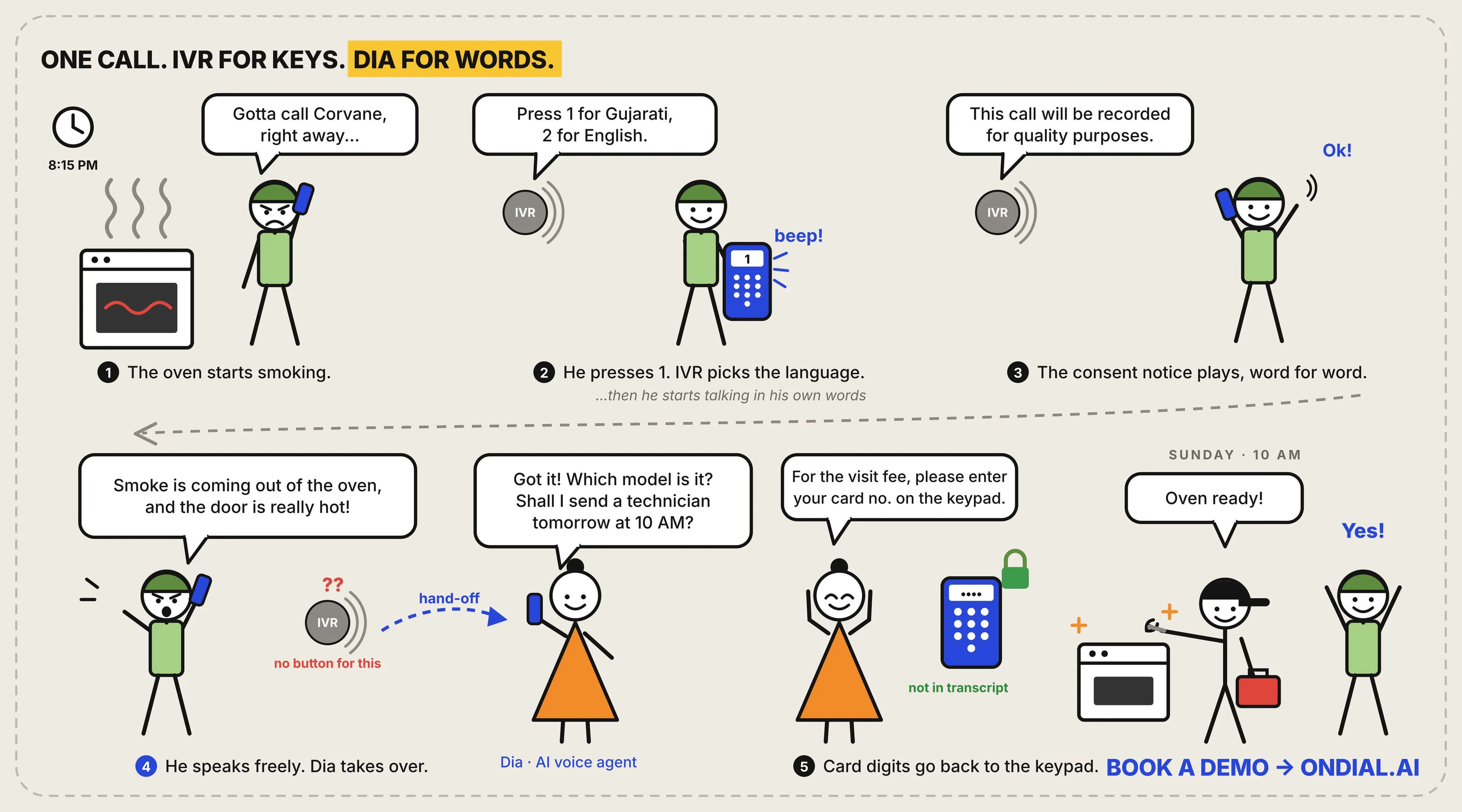
Choose AI once callers describe a broken appliance in their own words, because menus break on free speech. Keep the IVR for tasks that are already a fixed keypad entry. Corvane's callers rarely fit a menu when an oven is smoking, yet they happily key in a PIN.
That said, the IVR still earns its place in a few specific jobs. In these jobs, even the best AI calling agent adds cost without adding much value. All of them reward predictability over flexibility:
Taking card digits through DTMF keypad input can keep them out of speech transcripts and recordings.
A quick language choice at the start costs Corvane almost nothing and routes callers correctly.
Mandatory recorded notices, such as call-recording consent, play word for word with no model rewording.
A two-person repair shop with a simple call mix may never recover AI integration costs.
As a result, many teams don't remove the IVR at all on day one. Instead, they let a voice agent take over the moment a caller speaks rather than pressing a key. If you are weighing that swap, the Voicebot vs traditional IVR comparison walks through the trade-offs in more depth.
AI vs Human Agent on Calls That Need Judgment
Keep people on the calls where Corvane's written rules can't capture the right answer. Corvane's repeat-failure callers are the clearest case, since a third broken visit needs authority and a real apology. An AI agent can still gather the facts first, then pass a summary so the human starts informed.
Some call types should route to a person almost immediately, whatever the AI could attempt. For Corvane, four stand out. In each one, a wrong answer costs far more than a minute of labor:
A caller reporting a gas smell from an oven needs safety instructions and a person at once.
Customers threatening to cancel after a third failed visit expect someone who can approve a goodwill credit.
A bereaved family member closing a late parent's service plan deserves patience no script provides.
Legal threats, regulator complaints, or water-damage claims need a trained human and a documented record.
Only 20% of 321 service leaders in a Gartner survey had cut agent headcount because of AI. Instead, 55% kept staffing steady while call volumes grew. Gartner also expects half of firms planning deep service cuts to drop those plans by 2027.
Taken together, the data says the best AI calling agent works beside people, not instead of them. Gartner still predicts agentic AI will resolve 80% of common service issues on its own by 2029. The phrase that matters there is common issues, which is exactly where Corvane's ETA calls sit.
What AI Calling Agents Still Get Wrong
AI agents fail in fairly predictable places, and a pilot finds them cheaper than live calls do. None of these problems rule the technology out. They simply decide where the guardrails and the warm transfer need to sit:
A street name or an order code like DW-4471 gets misheard on a noisy mobile line.
Quoted callout fees drift out of date when nobody updates the pricing knowledge base.
Some speech models stumble when a caller switches languages mid-sentence or uses heavy slang.
Talk-over happens when the agent cuts in while she is still reading out a model number.
Rules on telling callers they are speaking with AI differ by country, so opening lines may need local versions.
A loosely scoped prompt can let the agent promise a free repair visit nobody approved.
These issues appear even with the best AI calling agent setups, so test for each one directly. Feed the agent your worst recordings, not your cleanest ones, before any caller hears it. A vendor that resists that kind of test is telling you something about live performance.
An AI agent also isn't worth it for every business. At a few dozen calls a week, mostly needing judgment, a skilled receptionist may cost less after setup. The economics favor AI when volume is high and a handful of call types repeat all day.
How to Choose the Best AI Calling Agent for Your Call Mix
Pick the vendor that resolves your top three call types, such as Corvane's ETA checks, on your own recordings. A smooth demo built on a generic script proves very little about Corvane's dishwasher calls or yours. That means choosing the best AI calling agent is really a testing exercise, not a feature comparison.
Questions That Separate Strong Vendors From Polished Demos
Bring these questions to every shortlist call, along with recordings of a dispute and an ETA check. Each one maps to a failure point covered earlier in this comparison. Strong vendors usually answer them with screen shares and sample transcripts:
Can it read from and write to your CRM, dispatch calendar, and ticketing tools mid-call?
Does every transfer include a written summary the human sees before saying hello?
Is pricing per minute, per call, or per resolved outcome, and who decides what resolved means?
Which accents and languages has it handled with callers like the ones in your recordings?
Where do call recordings and transcripts live, and who controls how long they stay?
Can your own team edit the warranty script and guardrails without filing a vendor ticket?
Does reporting show cost per resolved call by intent, rather than total minutes only?
A Routing Rule to Start With
After you find the best AI calling agent, someone still has to decide who answers each call type. The rule below is a starting point to test, not a benchmark drawn from industry data. Adjust its edges as your pilot numbers come in:
Send a call type to AI first when it repeats often, carries little emotion, and contains well.
Keep the IVR for keypad-only steps such as PIN entry, language choice, or mandatory notices.
Route straight to people for gas smells, legal threats, payment disputes, or any caller already upset.
A Four-Week Pilot for One Call Type
Testing one call type keeps the risk small and the results easy to read. Corvane would start with ETA checks because they are frequent and low in emotion. The same sequence works for most teams:
Pull 30 days of call logs, tag each call by reason, and rank reasons by volume.
Choose one frequent, low-emotion reason, such as technician arrival checks.
Route 10% to 20% of those calls to the AI agent and keep the rest as a control group.
Track cost per resolved call, repeat calls within seven days, and post-call CSAT scores.
Expand only when the AI group matches or beats the control group on all three measures.
Payback also depends on what the agent replaces, so model it before the pilot ends. For IVR-fronted queues, the ROI of replacing IVR with a voice agent guide shows the payback math. Bring those figures to finance alongside your pilot results.
Start With One Call Type, Not the Whole Stack
Changing a call stack works best when it starts with one call type and honest measurement. Price that call per resolved outcome, and check that callers stay happy while you test. To see that pilot on your own lines, Book a demo and bring last month's call reasons.