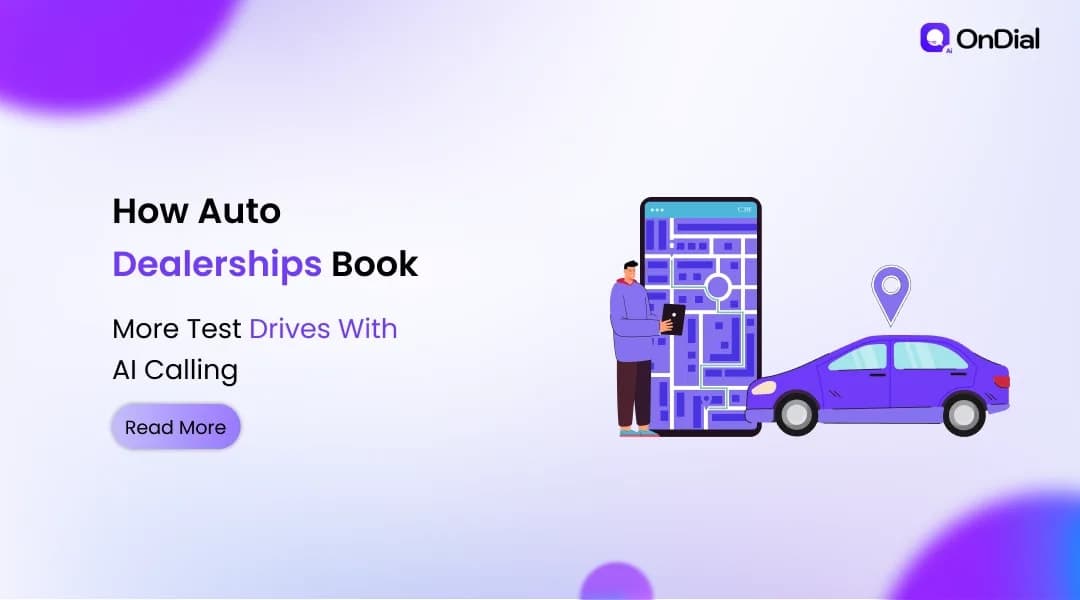
The average car dealership takes more than three hours to respond to a new lead. A 2026 study by Demand Local found that 78% of buyers go with the first business that contacts them. Read those two numbers again. By the time your team calls back, the shopper has often booked a test drive somewhere else.
AI calling for car dealerships closes that gap. It answers every inbound call in seconds, qualifies the shopper, and books the test drive while interest is hot. It works at 2 PM on a Tuesday and at 9 PM on a Sunday. It can speak the caller's own language, without adding a single new hire.
I run voice AI projects at OnDial, and I have watched this shift happen on real dealership phone lines. The pattern is always the same. Speed plus consistency wins the appointment, every time.
Here is what you will learn: why dealerships lose test drives before a rep dials, what AI calling does on the line, how it turns a call into a booked appointment, whether the results hold up, and how to make it work in an Indian market.
Why Dealerships Lose Test Drives Before a Salesperson Even Calls
Most lost test drives never reach a salesperson. The lead arrives, sits in a queue, and goes cold. The problem is rarely your team's effort. The problem is lead response time, and the math is brutal.
The five-minute window that decides who wins the sale
A car shopper who calls or fills a form is usually shopping three dealerships at once. They have tabs open and patience running thin. The first store to respond well almost always controls the conversation.
The data backs this up sharply. Research summarized by industry analysts, drawing on a well-known MIT and Harvard study of millions of leads, shows that responding within five minutes produces roughly nine times higher conversion than waiting past thirty minutes. Yet most automotive leads wait far longer than that.
So ask yourself this. When a buyer calls during a busy Saturday rush, how long before someone actually picks up? If the honest answer is "a few minutes, sometimes never," you are funding your competitor's showroom.
The after-hours and peak-hour black hole
Buyers do not shop on your schedule. They research at night, on weekends, and during their lunch break. Your phones, meanwhile, go to voicemail the moment the showroom closes.
This is the after-hours call handling gap, and it is bigger than most owners think. Indian voice AI provider Haptik reports that 24/7 coverage helped dealerships recover 15 to 20% of bookings that previously fell through after hours. In smaller towns, that share trends even higher.
Peak hours create the same leak from the other direction. When every line is busy and the floor is full, inbound calls hold, abandon, and vanish. A missed call at a dealership is not a minor annoyance. It is a buyer with cash, walking to the next lot.
What AI Calling Actually Does on a Dealership Phone Line
AI calling is a voice agent that holds a natural phone conversation, answers questions, and completes actions like booking a test drive without a human on the line. It is not the old "press 1 for sales" menu. It listens, understands intent, and responds in real time.
A modern voice agent connects to your live inventory, your CRM, and your DMS, whether that is CDK, Reynolds, or Tekion. It reads stock, writes appointments, and logs every detail. The good ones run at sub-200ms latency with barge-in support, so callers can interrupt and the agent reacts like a person would.
Inbound calls: answering inventory questions and booking on the spot
Picture a real call. A shopper rings at 8:45 PM about a specific SUV they saw online. A human team is gone for the day, so the call would normally die in voicemail.
Instead, the AI agent answers instantly. It confirms the exact vehicle is in stock, shares mileage and price, and offers two test drive slots. This is the moment most dealerships drop, and it is exactly where AI calling earns its keep.
Instant pickup: The agent answers every call, so no buyer hears a busy tone or a voicemail beep.
Real-time inventory: It checks live stock and confirms the specific VIN, trim, and price.
Same-call booking: It proposes open slots and writes the test drive scheduling entry straight to the calendar.
Outbound calls: reviving cold and unsold leads
Inbound is only half the story. The bigger revenue often hides in your aged leads, the ones your BDC never had time to chase. AI calling runs outbound campaigns that re-engage these contacts automatically.
The agent calls unsold leads, qualifies their intent, and offers to rebook a visit. It handles the boring, repetitive dialing your team dreads, at scale, without fatigue. This is lead qualification working in the background while your reps stay on the floor.
(A quick reality check: outbound calling is tightly regulated, so consent and call windows matter. More on that in the India section below.)
How AI Calling Turns a Phone Call Into a Booked Test Drive
Booking a test drive should take under two minutes, not three rounds of phone tag. Here is the workflow I see deliver the most appointments, step by step.
Instant response and intelligent qualification
The agent picks up on the first ring and greets the caller in a natural voice. It does not interrogate the buyer with twenty questions. It asks the few that matter.
A dealership-ready agent qualifies fast and politely. It confirms the vehicle or vehicle type, new versus used, and the buyer's rough timeframe. It then captures context like trade-in interest, so the rep knows who is walking in. That context gets packaged into the CRM for a clean human handoff.
Live test drive scheduling into the calendar
Once intent is clear, the agent moves to the close: the booking. CRM and DMS integration is what makes this real rather than a promise. The agent reads live calendar availability and offers concrete slots.
It might say, "I have an opening on that model tomorrow at 2 PM or 4:30 PM. Which works?" It then writes the appointment, sends an SMS and email confirmation, and sets a reminder. For no-shows, it follows up and offers to reschedule.
Here is a quick comparison of how the same after-hours lead plays out across three setups.
Setup | Lead answered? | Test drive booked? | Buyer experience |
Voicemail only | No | No | Frustrated, calls next dealer |
Human BDC (off shift) | No | No | Waits hours for a callback |
AI calling | Yes, in seconds | Yes, on the call | Confirmed and reminded |
Does AI Calling Really Work, or Is It Just Hype?
This is the fair question every skeptical GM asks. So let me be direct about both the wins and the limits.
Yes, AI calling can automatically book test drives, and dealerships report real lifts. A 2026 Demand Local analysis found AI-powered CRM users see a 42% boost in conversion from online lead to test drive. The mechanism is simple: faster, more consistent response captures buyers your team was missing.
The numbers dealerships are reporting
The published results are encouraging and worth weighing honestly. Different vendors and markets report different figures, so treat these as signals, not guarantees.
Demand Local (2026): AI-powered CRM users report a 42% increase in online lead to test drive conversion.
aTeam Soft Solutions (India, 2026): An AI voice agent increased test drive bookings by 40% for a multi-location dealership.
My AI Front Desk (2026): One automotive company reported a 26% increase in test drive bookings after deploying voice AI.
What unites these wins is not the technology alone. It is response speed and follow-up discipline that no tired human team can match across every shift.
Where AI calling still needs a human
Now the honest part. AI calling is not a replacement for your best closer, and any vendor who claims otherwise is overselling. The technology shines at speed, qualification, and scheduling. It is weaker at complex negotiation and emotional, high-stakes conversations.
There is also a setup reality. A voice agent needs a tuning period to match how your top reps actually sell. Skip the careful qualification playbook and CRM integration, and you get activity without conversions. The goal is to support the sales floor, not to remove the people who close deals.
Making AI Calling Work for Indian Dealerships
Most global guides ignore the Indian context entirely, and that gap costs dealers here real money. The buyer behavior, the languages, and the rules are different. Get these right and AI calling becomes a genuine edge.
Multilingual calls and the Hinglish reality
A buyer in a Tier 2 city does not switch to formal English to book a test drive. They call in Hindi, Marathi, Tamil, or a natural Hinglish mix. A voice agent that only handles clean English will lose them in the first ten seconds.
Indian-built voice AI now handles a wide range of regional languages on a single line. As Haptik notes, a rural buyer may call at 8 PM on a Sunday, in Marathi, after the showroom is shut. If your line is dead, that buyer calls a competitor. Language coverage here is not a nice extra. It is the difference between a booked test drive and a lost one.
Compliance: TRAI DLT, the DPDP Act, and consent
Outbound calling in India sits under real regulation, and ignoring it is risky. Any serious deployment must respect these rules from day one.
TRAI DLT and TCCCPR: Commercial calling and messaging must run through registered templates and consent frameworks.
DPDP Act 2023: Customer data collected on calls must be handled with clear consent and proper safeguards.
Call windows and opt-outs: Respect permitted calling hours and honor do-not-disturb preferences automatically.
A compliant voice AI platform builds these guardrails in, rather than bolting them on later. At OnDial, this is the first conversation we have with any dealership group, before a single line goes live.
Conclusion
AI calling for car dealerships wins test drives by doing one thing your team cannot do alone: answering every lead instantly, in any language, around the clock. The three takeaways are simple. Speed captures buyers your competitors lose, consistent follow-up turns cold leads warm, and tight CRM integration books the appointment on the spot.
You do not have to choose between technology and your people. The strongest setups let AI handle the calls and scheduling, so your reps spend their time closing on the floor.
If you are tired of losing after-hours and Saturday-rush buyers to the dealership down the road, that is exactly the gap OnDial builds for. We design human-first voice AI that books test drives in your buyers' languages, fully compliant with Indian rules. Start with one rooftop, measure the booked appointments, and scale from there.