I’ll be brutally honest: follow-up calls are the silent killers of sales pipelines.
Not because they’re unimportant. But because they’re boring, repetitive, and easy to postpone.
I’ve spent years sitting inside sales floors—SaaS teams, real estate hotlines, edtech call centres—you name it. And across all of them, the most consistent bottleneck wasn’t pitch quality. Or product fit. Or even pricing.
It was this: No one follows up on time.
Not SDRs. Not BDRs. Not even the most disciplined Account Executives.
Humans forget. Sales cycles don’t.
That’s where AI follow-up calls started catching my attention. Not as some sci-fi replacement for sales reps, but as a very practical solution for a very human problem: staying consistent.
By 2026, AI follow-up systems aren’t “innovations.” They’re infrastructure. And if your sales team isn’t building on that infrastructure yet—well, you’re already behind.
What Are AI Follow-Up Calls? (Simple Definition + How They Work)
Let me strip the jargon out of it.
AI follow-up calls are automated voice conversations powered by conversational AI that call your leads, remind them, nurture them, qualify them, or re-engage them—without your sales team lifting a finger.
No scripts read like robots. No IVR nightmares. Just a natural-sounding AI voice assistant that handles routine follow-ups your team should be doing but rarely does.
These systems can:
Call a lead immediately after form submission
Remind someone about a demo
Ask qualifying questions
Re-engage cold prospects
Trigger next steps inside your CRM
It’s like having a reliable SDR who never sleeps, never forgets, and never burns out.
And yes, they can sound shockingly human now—companies like OnDial have spent years training AI Voice Assistants that feel conversational, not mechanical.
Why Sales Teams Struggle With Follow-Ups Today
If you’ve worked in sales for more than five minutes, you already know the truth: Most follow-ups don’t happen.
Here’s why.
Manual reminders
Sales reps rely on sticky notes, calendar invites, CRM tasks, and—if they’re old school—their own memory. But between demo calls, pipeline reviews, reporting, and putting out fires, follow-ups get buried.
Missed opportunities
Leads go cold in hours. Not days. Hours. The delay between “someone fills a form” and “someone calls them” is often the difference between a closed deal and a dead number.
Low response rates
Humans are inconsistent. A rep follows up once, twice… then gives up. AI? It doesn’t take things personally. It follows a proven cadence until an answer arrives.
Pattern interrupt #1 → Let me ask you something: When was the last time your team followed up exactly when they were supposed to, every single time?
Exactly.
Benefits of Using AI Follow-Up Calls for Sales Teams
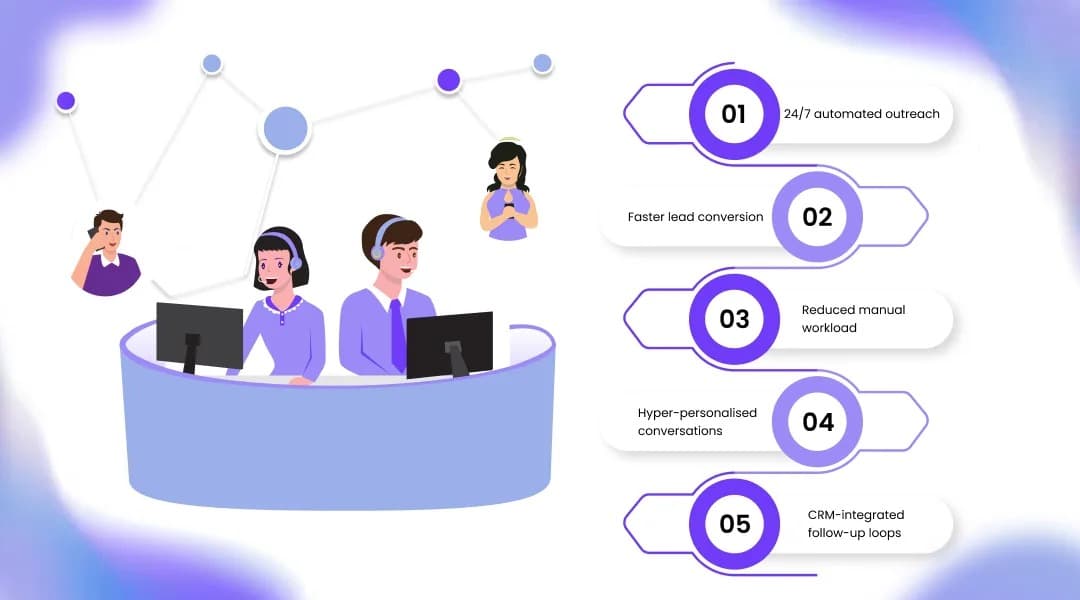
This is where things get interesting. Because AI follow-up calls don’t just “help”—they fundamentally reshape how sales teams operate.
24/7 automated outreach
Imagine a follow-up engine that doesn’t eat, sleep, or ask for weekends off. Leads get calls instantly. Reminders go out on time—always.
Faster lead conversion
Speed wins. Always has. Always will.
Instant AI follow-ups dramatically increase the chance a lead actually picks up, remembers who you are, and moves forward.
Reduced manual workload
Your reps stop wasting time on repetitive touchpoints. The AI handles the routine. Your team handles the relationship.
Hyper-personalised conversations
This isn’t “press 1 for support.” These are contextual, memory-based chats powered by Conversational AI.
“Hey Rohan, I saw you checked pricing yesterday—would you like a call with a product specialist?”
That's miles beyond a traditional reminder.
CRM-integrated follow-up loops
AI reads your CRM, triggers the right action, and writes back:
Notes
Call outcomes
Lead status
Qualification data
Ask any Sales Manager, clean CRM data is a dream. AI follow-ups make it real.
How AI Follow-Up Call Systems Work
I’ve worked with enough AI teams to understand how the plumbing works. Here’s the simplest breakdown you’ll ever read.
Step 1: Lead capture
A form is filled. A WhatsApp reply is received. A call is missed.
The AI gets notified instantly.
Step 2: AI qualification
The system checks:
Who is this lead?
What did they ask for?
What stage are they in?
What’s the right script or flow?
Step 3: Automated calling sequence
The AI calls with a natural voice (OnDial is excellent at this). If the lead doesn’t answer, it retries based on the cadence you set.
Step 4: Smart reminders
It doesn’t just call once. It calls intelligently—optimised timings, best days, best behavioural windows.
Step 5: Analytics & insights
This is where you finally understand your pipeline:
When people answer
Why they don’t answer
Which follow-up stage converts best
How long leads stay warm
Pattern interrupt #2 → A quick confession: The data you get from AI follow-up calls is cleaner than anything a human rep will ever log. Humans forget. AI doesn’t.
Key Features to Look for in an AI Follow-Up Call Tool
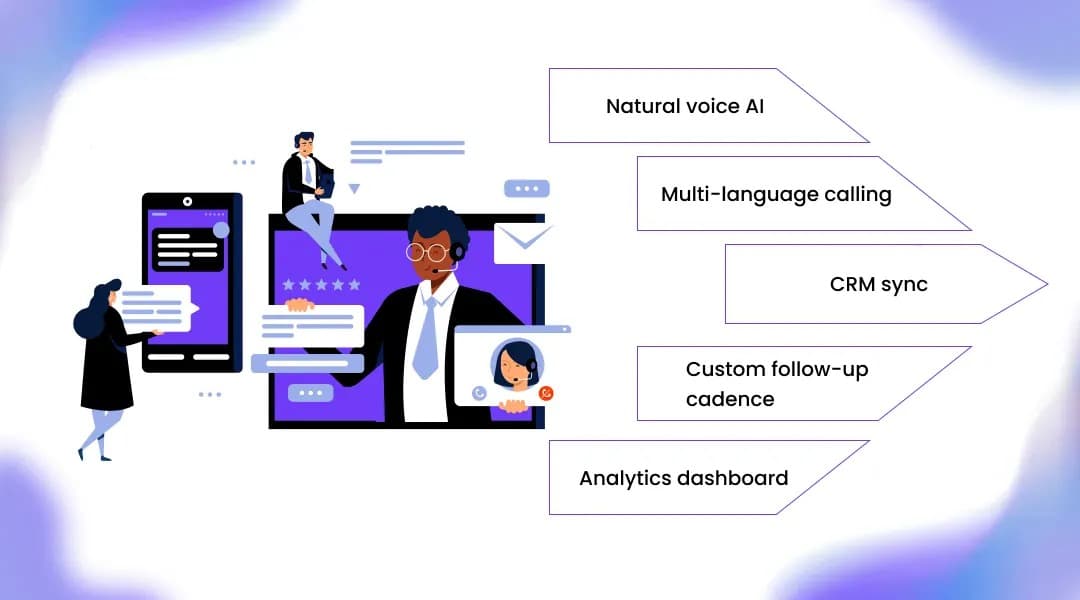
Not all systems are built equal. Some sound robotic. Some lack CRM sync. Some are just glorified auto-dialers pretending to be “AI.”
Here’s what actually matters:
Natural voice AI
If it doesn’t sound human-like, people hang up. Simple.
Multi-language calling
India alone has dozens of linguistic pipelines. If the AI can’t adapt, you lose leads instantly.
CRM sync
Your tool must push and pull data across your existing systems: HubSpot, Zoho, Salesforce—whatever you use.
Custom follow-up cadence
You need control: 1 hour after form fill Next day Next week After 30 days You decide. AI executes.
Analytics dashboard
Not vanity stats. Real insights that improve your pipeline.
Also: if you plan to Hire AI Voice Agents or test AI Phone Calls at scale, make sure the provider offers stability and custom flows. OnDial does.
Real Business Impact: How AI Follow-Up Calls Increase Conversions
Let’s talk results—not fantasies.
Example 1 — SaaS Startup
Before AI: Leads waited 5–10 hours for a callback. Demo attendance: 37%
After AI follow-up calls from a Voice Assistant: Leads received a call in under 2 minutes. Demo attendance jumped to 61%.
Example 2 — Real Estate Agency
Before: Sales reps spent 40% of their day on repetitive reminder calls.
After AI automation: Reps focused only on high-intent buyers. Bookings increased 30% in 90 days.
Example 3 — Education Platform
AI-managed fee reminders recovered 22% more pending payments.
Benchmarks for 2026
Based on market data I’ve personally reviewed across AI-driven campaigns:
3–5x faster contact rate
25–40% higher lead qualification
20–35% improvement in final conversions
60–80% reduction in manual follow-up workload
The numbers speak louder than any sales pitch ever could.
AI Follow-Up Calls vs Traditional Sales Processes
Let’s put it head-to-head.
Efficiency
Traditional: Reps forget. Reps delay. Reps avoid repetitive tasks.
AI: Consistent. Instant. Unlimited calls.
Cost
Traditional: Expensive labour. Limited bandwidth. High burnout.
AI: Predictable cost. Infinite scalability. Plugs into your existing workflow.
And here’s the truth most teams don’t admit: The human touch matters most when the conversation itself matters. Everything else? AI can handle it.
Conclusion
I’ve watched AI evolve from a novelty to a necessity. And AI follow-up calls are one of those rare tools that don’t feel like “extra tech.” They feel like oxygen, you notice the difference the moment it’s missing.
Sales teams thrive on consistency. Customers respond to timing. Pipelines depend on momentum.
AI gives you all three. Without excuses. Without delays. Without burnout.
If you're heading into 2026 with the same follow-up habits you had in 2020… well, you're not just behind. You're invisible.