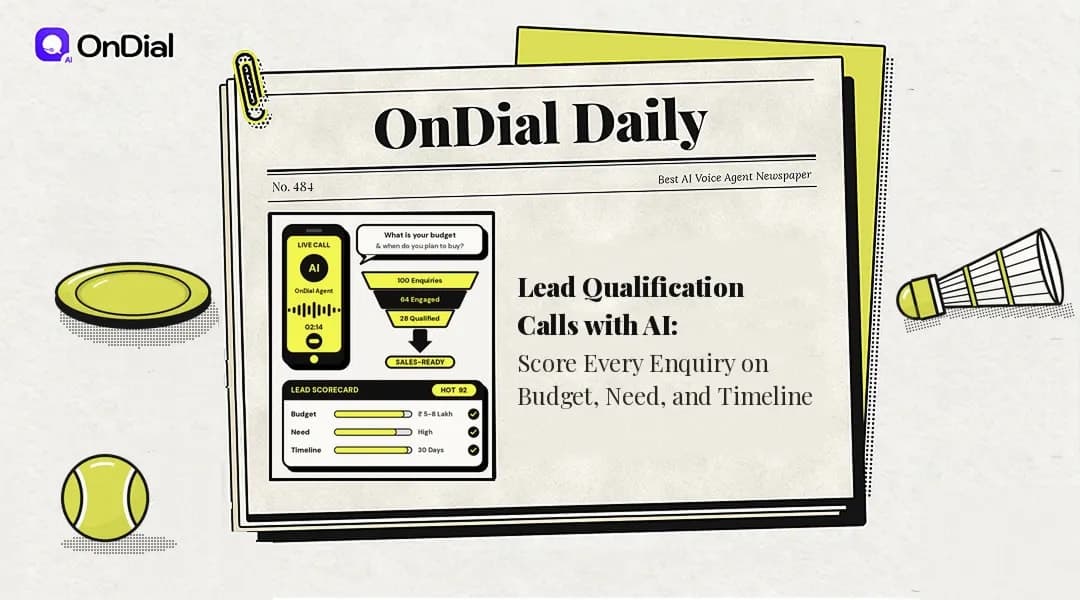
AI lead qualification calls let a voice agent phone every new inquiry within minutes, ask about budget, need and timeline, and write a score straight into your CRM. Your reps stop chasing every form fill and speak only to buyers who are ready. This guide shows how automated lead qualification works, which BANT questions to ask, how lead scoring by voice is calculated, and how to plug it into your stack with an AI voice agent CRM integration.
Quick answer: An AI lead qualification call is an automated call in which a voice agent asks a short set of qualifying questions, captures the answers, scores the lead and hands it to the right person. It answers the three questions every sales rep needs settled before investing time: is there a budget, is there a real need, and is there a timeline.
Who this is for: sales operations heads, marketing leaders and founders who generate plenty of enquiries but watch most of them go cold before anyone has a proper conversation.
What you will learn:
Why most leads never get qualified, and what that costs you
How AI lead qualification calls work from trigger to CRM update
The BANT-style questions an AI can ask naturally, with a sample call
How to score, tag and route leads so hot ones reach a rep in minutes
A seven-step setup plan, compliance basics and answers to common questions
Why Most Leads Never Get Qualified
Most leads go unqualified because qualification depends on a human having the time to call quickly, ask good questions and log the answers. In practice, sales teams run into three limits.
Speed. Leads cool off fast. Widely cited lead response research suggests the odds of reaching and qualifying a lead drop sharply after the first few minutes. A form submitted at 9:40 pm on a Friday often gets its first call on Monday afternoon, if it gets one at all.
Capacity. A rep can hold only a few dozen meaningful conversations a day. When a campaign brings in hundreds of enquiries, the queue grows and the newest leads wait behind the oldest.
Consistency. Ten reps ask ten different sets of questions. One logs detailed notes, another types "called, will revisit". The CRM fills up with a "Contacted" status that says nothing about intent.
The result is a familiar standoff. Marketing reports a healthy number of marketing qualified leads, sales says the leads are poor, and nobody can prove either side because the qualifying data was never captured.
Signs your qualification process is broken
Reps spend their best hours calling people who never had a budget or a need.
Hot enquiries wait in the same queue as curiosity clicks.
Lead status fields are filled in differently by every rep.
Marketing cannot tell which campaigns bring buyers and which bring browsers.
Leads that arrive after hours or on weekends are contacted last, or never.
If two or more of these sound familiar, the gap is not lead volume. It is the missing step between "enquiry received" and "conversation worth a rep's time". That is exactly the step AI lead qualification calls fill.
What Are AI Lead Qualification Calls and How Do They Work?
AI lead qualification calls are conversations where a voice agent contacts a new lead, asks structured but natural-sounding questions, and records the answers as scored data. They replace the first manual screening call, not the sales conversation that follows. Think of the agent as a tireless junior rep who calls instantly, asks the same core questions every time and never forgets to update the record.
The flow has six stages, and each one maps to a setting you control.
Trigger. A new lead arrives from a web form, a Meta or Google ad, a missed inbound call, a WhatsApp enquiry or an uploaded list.
Instant call. The agent dials within seconds or at a time the lead prefers, introduces itself clearly as an AI assistant and states why it is calling.
Conversation. It asks three to six qualifying questions, adapts to the answers and handles simple objections without sounding scripted.
Extraction. Speech is transcribed and the answers are turned into structured fields such as budget range, purchase timeline, decision role and product interest.
Scoring. Your rules turn those fields into a lead score and a label such as hot, warm or nurture.
Routing. The record, transcript and summary sync to the CRM, and hot leads are sent to a rep with a task or a live transfer.
If you already run AI lead follow-up calls, qualification is the natural next layer: the same instant contact, but with a scored outcome instead of a simple reminder. And if your team prospects proactively, the same logic works for outbound lists through AI outbound call agents.
The key difference from a form or a chatbot is the channel. People answer a phone call faster than an email, and they reveal buying signals in tone and detail that a dropdown field never captures. Voice also reaches buyers who will not type, which matters across India where many prospects prefer to speak in Hindi, Tamil, Telugu or another regional language.
BANT Qualification with AI: Questions an Agent Can Ask Naturally
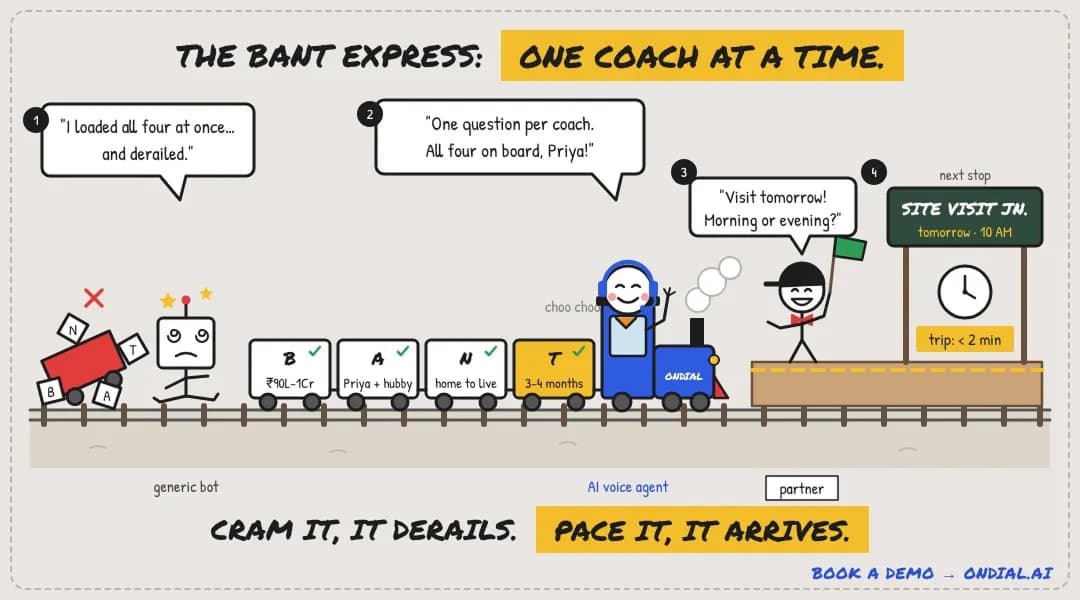
BANT qualification with AI means the agent covers Budget, Authority, Need and Timeline in a relaxed conversation instead of reading a checklist. The goal is to gather signal, not to interrogate. A good agent asks one question at a time, reflects the answer back and moves on.
BANT factor | What you want to learn | A natural way to ask |
Budget | Whether spend is realistic | "Have you set aside a range for this, or are you still comparing options?" |
Authority | Who decides | "Will you be making this decision yourself, or is anyone else involved?" |
Need | The problem and its urgency | "What is not working today that made you reach out?" |
Timeline | When they want to act | "When are you hoping to have this in place?" |
Sample call: how it sounds in practice
Agent: Hi Priya, this is an AI assistant calling from Sunrise Properties. You enquired about 3 BHK apartments an hour ago. Is now a good time for two minutes?
Lead: Sure, go ahead.
Agent: Great. Are you buying to live in the home or as an investment?
Lead: To live in. We are renting at the moment.
Agent: Understood. Have you thought about a budget range?
Lead: Around 90 lakh to a crore.
Agent: Thanks. And will anyone else be involved in the final decision?
Lead: My husband and I together.
Agent: Perfect. When would you like to move in?
Lead: Within three or four months.
Agent: That helps. I will pass this to our senior advisor, who can offer you a site visit tomorrow. Would morning or evening suit you?
In under two minutes the agent captured purpose, budget, decision makers and timeline, and ended with a concrete next step. Nothing in that call needed a rep.
Tips for questions that convert
Keep it short. Four to six questions is the sweet spot. Beyond that, drop-off rises.
Use open questions for need, closed ones for budget and timeline. Open questions reveal pain points, while ranges and time frames are easier to score.
Offer ranges instead of asking for exact figures. People share a bracket more readily than a number.
Add one disqualifier. A single question, such as service area or minimum order size, saves everyone time.
Match the language. Let the lead choose Hindi, English or a regional language at the start of the call.
Always offer a human. If the lead asks for a person, the agent should book a callback or transfer immediately.
BANT is only a starting point. Some teams add fit or competitor questions, such as which tools the prospect uses today. The principle is the same: a handful of questions, asked in a human way, that map directly to fields you can score.
Lead Scoring by Voice: From Answers to a Score in the CRM
Lead scoring by voice turns each spoken answer into points, adds them up and assigns a tier. The model should be simple enough that sales trusts it. Start with one rule per question, then refine after you see which scored leads actually close.
Signal | Example answer | Points |
Budget | Within your price range | 30 |
Budget | Unsure or below range | 5 |
Authority | Decision maker | 20 |
Authority | Influencer, needs approval | 10 |
Need | Clear, specific problem | 25 |
Timeline | Within 30 days | 25 |
Timeline | Three to six months | 10 |
Timeline | Just exploring | 0 |
These weights are only an illustration. A real-estate team may weight timeline highest, while an enterprise software team may care most about authority. What matters is that the same rules apply to every lead, every time.
Turning scores into tiers and actions
Hot (70 to 100): Alert the rep immediately, create a task due within the hour or warm-transfer the call while the lead is still engaged.
Warm (40 to 69): Book a callback or a demo slot and enrol the lead in a short nurture sequence.
Nurture (under 40): Send helpful content, retry in a few weeks and keep the record clean rather than discarding it.
Disqualified: Mark the reason, such as out of service area or wrong product, so marketing can see which campaigns waste budget.
What to write back to the CRM
A useful sync goes beyond a status change. Push these items so your reps never start from zero:
Score, tier and the date and time of the call
Each answer stored in its own field, not buried in notes
A two-line call summary and the full transcript or recording link
Detected language, objections raised and the next step agreed
Source campaign, so reporting links spend to qualified outcomes
With those fields in place, routing rules become straightforward. Hot leads go to the owner of the territory or product line, warm leads join a booking queue, and nurture leads feed a marketing automation list. Because the data is structured, you can also build dashboards that show qualification rate by campaign, by language and by hour of day. You can explore the call-handling controls behind this on the OnDial Features page.
AI vs Manual Lead Qualification: Where Each Wins
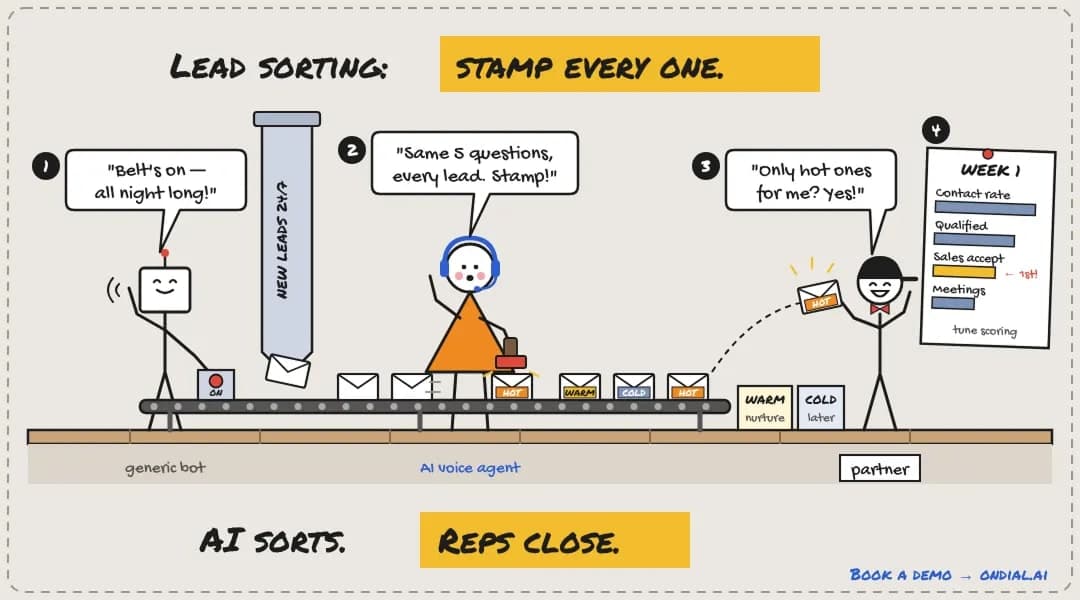
AI wins on speed, coverage and consistency, while humans win on nuance and relationship building. The best setup uses AI for the first screening call and people for everything that follows.
Factor | Manual qualification | AI qualification calls |
Time to first call | Minutes to days, depending on queue | Seconds to minutes, any hour |
Coverage | Limited by headcount and shifts | Every lead, including nights and weekends |
Question consistency | Varies by rep | Same core questions every time |
Data captured | Free-text notes, often incomplete | Structured fields plus transcript |
Cost as volume grows | Rises with each hire | Scales with call minutes |
Complex or emotional conversations | Strong | Hands off to a person |
Benefits you can measure
Faster speed to lead. Contact happens while the enquiry is still fresh in the buyer's mind.
Higher rep productivity. Reps spend their day in conversations with qualified buyers instead of screening.
Cleaner pipeline. Every lead carries a score and the reasons behind it.
Better campaign decisions. Marketing can optimise for qualified leads, not raw form fills.
Better lead experience. Prospects get a quick, polite call in their own language rather than silence.
Where it works best
AI lead qualification calls suit any business with steady enquiry volume and a clear buying path. Typical examples include real estate sites, education and admissions teams, loan and insurance enquiries, home services, B2B software demos, clinics and event registrations. If a human would ask the same five questions on every first call, an agent can ask them too.
Metrics to track from week one
Contact rate: the share of leads who pick up and complete the call.
Qualification rate: the share who finish with a usable score.
Speed to lead: time from enquiry to first conversation.
Sales acceptance rate: how many hot leads your reps agree are genuinely hot.
Lead-to-meeting and meeting-to-deal rates: whether the score predicts revenue.
Cost per qualified lead: total spend divided by leads that reached your hot or warm tiers.
Review the sales acceptance rate first. If reps reject many hot leads, your scoring rules need tuning, not your agent.
How to Set Up AI Lead Qualification Calls in 7 Steps
You can launch a first qualification flow in days if you decide the rules before you configure the agent.
Define a qualified lead. Write down, with sales, what a hot, warm and nurture lead looks like. Use real closed deals as your guide.
Pick your questions. Choose four to six BANT-style questions and one disqualifier. Draft each as a spoken sentence, not a form label.
Choose triggers and timing. Decide which sources start a call (web form, ad lead, missed call, list upload) and the hours when calling is acceptable.
Set languages and voice. Match the languages your leads speak and test accents with real recordings.
Connect your CRM. Map each answer to a field and decide how scores, summaries and tasks are written back.
Define handoffs. Set rules for warm transfer, callback booking and what happens if the lead asks for a person.
Pilot, listen and tune. Run the flow on one campaign, listen to a sample of calls daily and adjust wording and weights before scaling.
Compliance basics for India
Qualification calls handle personal data, so build consent and transparency from the start. Disclose at the start that the caller is an AI assistant, respect do-not-disturb preferences and calling windows, record calls only with a clear notice, and store data in line with the Digital Personal Data Protection Act. Telecom rules for promotional and transactional calling also apply, so read our guide to TRAI DLT rules for AI calling and confirm current requirements with your legal advisor. This section is general information, not legal advice.
Mistakes to avoid
Too many questions. Long calls feel like surveys and lower completion.
Scores nobody trusts. Involve sales when you set weights, or reps will ignore the tiers.
No human exit. A lead who wants a person should reach one quickly.
Calling at the wrong time. Respect local hours and any time the lead requested.
Never listening to calls. Weekly review of transcripts is the cheapest way to improve conversion.
Letting hot leads sit. If a rep does not act within the agreed window, escalate automatically.
Conclusion: Qualify Every Lead While It Is Still Warm
AI lead qualification calls give every enquiry a fast, consistent first conversation and give your reps a scored shortlist instead of a raw list. Define what qualified means, keep the questions short, sync everything to your CRM and tune the scores against real deals.
Want to hear what a scored lead call sounds like with your own questions and languages? Book a demo and see a qualified lead reach your CRM in minutes.