The research on lead response time and sales conversion is conclusive, uncomfortable, and almost universally ignored. A lead that receives an outbound call within five minutes of submitting an inquiry is 21 times more likely to be qualified for a sale than one called after 30 minutes. Once the response window passes one hour, the probability of meaningful engagement drops by more than 80 percent compared to a five-minute response. Despite these findings being documented consistently across industries and geographies, the average business takes between 42 hours and several days to make first contact with a new inbound lead. The gap between what buyers expect and what most businesses actually deliver is not a minor operational friction. It is a compounding revenue leak that penalises every rupee or dollar invested in generating demand.
This pattern appears across every industry that depends on inbound lead generation. A real estate agency receives a property inquiry at 9 pm on a Saturday and adds it to Monday's call list. An insurance brokerage runs a digital advertising campaign, drives prospect traffic to a landing page, and then watches those inquiries accumulate overnight while competitors with faster response processes have already begun conversations with the same prospects. A healthcare clinic misses new patient inquiries over a public holiday weekend and cannot explain on Monday morning why the schedule has gaps that marketing data does not account for.
The solution is not hiring more sales representatives, outsourcing to a call centre, or extending office hours at significant overhead cost. The solution is deploying an AI voice agent for lead qualification that calls every new lead the moment they arrive, conducts a genuine spoken qualification conversation, scores and summarises the lead, and delivers that qualified profile to your sales team before anyone has opened their morning inbox. This blog explains how that capability works, what measurable results businesses can expect, and what a real deployment actually involves.
The Speed-to-Lead Gap That Is Draining Your Sales Pipeline
Why Leads Go Cold Before Your Team Even Calls Back
Lead response time is one of the most consistently studied variables in sales performance, and the findings are uniform across industries, geographies, and deal sizes. Research on over 15,000 leads found that businesses attempting contact within the first hour were nearly seven times more likely to have productive conversations with decision-makers than those waiting longer. The five-minute window, specifically, is where conversion probability peaks sharply. Beyond it, each passing minute reduces the likelihood that the prospect is still engaged, still available, and still in the mindset of evaluating your offering in particular.
The mechanism behind this pattern is straightforward. Modern buyers do not submit one inquiry and wait patiently for a single provider to respond. When someone fills out a web form requesting information, calls a number and reaches a voicemail, or initiates a live chat that goes unanswered, they continue their evaluation. They submit to competing providers. They conduct additional searches. They ask peers for recommendations. By the time your sales representative finds the lead in the CRM and dials, the prospect may have already received a professional first call from a competitor and may be progressing toward a demonstration or pricing conversation with that provider. The window for being first is genuinely narrow, and in most business environments, most leads are contacted well outside of it.
The Revenue Cost of Slow Lead Response
The financial impact of slow lead response is calculable and significant for any business running paid lead generation. Consider a business generating 400 inbound leads monthly at an average acquisition cost of 600 rupees per lead. If the current manual outreach process converts 7 percent of those leads to customers, improving that conversion rate to 13 percent through instant AI voice response represents 24 additional paying customers per month. At an average deal value of 20,000 rupees, that is 480,000 rupees in additional monthly revenue from leads the business already paid to acquire. No additional marketing spend and no new territory are required. The improvement comes entirely from faster, more consistent first contact on existing lead volume.
After-hours inquiries amplify this problem further. Research on inquiry behaviour consistently shows that 35 to 40 percent of consumer-facing business inquiries arrive outside standard office hours, concentrated particularly in the lunch window and the evening period between 8 pm and 11 pm. Leads arriving in these windows often carry higher purchase intent because the prospect is actively researching during personal time rather than filling out forms as a casual distraction during a workday. These are precisely the leads that manual processes are worst at capturing, and precisely the leads that an AI voice agent for lead qualification handles without any change to staffing levels.
Why Traditional Lead Response Models Break Under Real Conditions
Most sales leaders believe their team responds to leads more quickly than the data actually shows. When response time is measured rather than estimated, the gap between perception and reality is typically significant. Common failure patterns include leads routed to shared CRM views where no single person feels direct accountability for follow-up, inquiry queues that grow faster than they are processed during peak campaign periods, manual data entry delays that create a lag between form submission and lead visibility in the sales system, and the complete absence of any response mechanism for the third to nearly half of all inquiries arriving outside working hours.
These problems compound directly as lead volume grows. A business managing 40 leads per month can maintain reasonable manual response times with a small, motivated team. The same business scaling to 400 leads per month faces a structurally different challenge that the same team cannot absorb without hiring. Adding SDR headcount increases cost per lead handled and introduces inconsistency in how qualification criteria are applied, but still does not create 24/7 lead qualification capability. Outsourcing to a third-party call centre reduces per-call cost but removes product familiarity from the first conversation, which is the exact moment when professional expertise creates the strongest impression on a new prospect.
The Qualification Bottleneck Hidden Inside the Response Problem
Response speed is only the first dimension of the problem. Qualification efficiency is the second, and it is equally costly. Even businesses that do call leads promptly face the challenge of sorting high-fit, high-intent prospects from those who are early in research, outside the target customer profile, or submitting multiple inquiries with no intention of proceeding quickly with any provider. Assigning senior sales representatives to manually qualification-call every inbound lead consumes expensive selling time on conversations that, in a significant proportion of cases, will not advance past first contact regardless of how well they are handled.
An automated lead qualification system removes this bottleneck entirely from the human sales workflow. When the first qualification call is handled by an AI voice agent, the sales team's first human touchpoint is with a lead that has already been screened, scored, and summarised. The representative enters that conversation knowing what the prospect said, what criteria they meet, how they responded to qualification questions, and what their expressed timeline and interest level are. That shift in the quality of the handoff transforms the economics of the sales process as significantly as the improvement in response speed.
How AI Voice Agents Solve the Lead Response Problem at the Source
An AI voice agent for lead qualification operates on a fundamentally different model than manual outreach or standard IVR systems. The moment a new lead record arrives from any configured source, whether a web form, a CRM integration, a Facebook or Google lead ad, or an API connection from a marketing automation platform, the AI voice agent initiates an outbound call. There is no available-agent requirement, no office hours constraint, and no queue. The response happens in the same way at 2 pm on a weekday as it does at 11 pm on a Sunday.
The call itself is a genuine spoken conversation, not a prerecorded message. The AI voice agent introduces itself, references the specific action the lead took, and moves through a structured qualification conversation designed by the business. It listens to and interprets natural spoken responses, adapts follow-up questions based on what the lead actually says, and handles common tangential responses without losing the thread of the qualification objective. The quality of this first conversation is what separates modern AI calling for sales leads from the robocall experiences that most people reasonably associate with automated outreach.
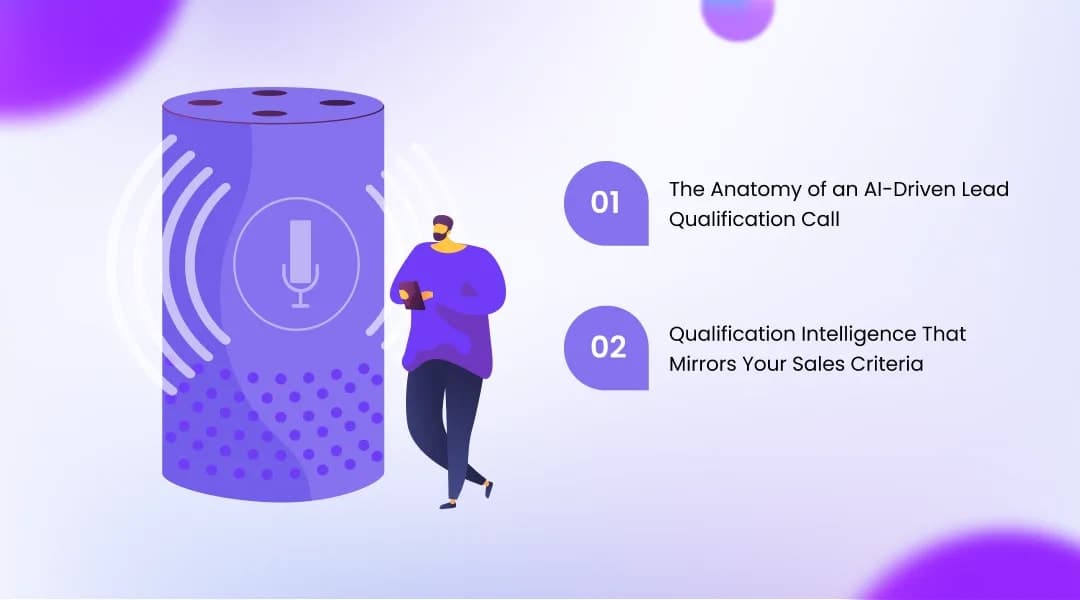
The Anatomy of an AI-Driven Lead Qualification Call
A production-ready AI lead qualification call moves through distinct stages that mirror the structure of a skilled human SDR's first outreach conversation.
The opening establishes context immediately by referencing the lead's recent action and explaining the reason for the call, so the prospect understands from the first sentence that this is a relevant and expected follow-up rather than an unsolicited contact.
The qualification stage asks the specific questions the business defines as determinants of fit, including budget range, decision timeline, use case or problem description, current solution status, and any other criteria the sales team relies on to assess a prospect.
The information-gathering stage captures scheduling preferences, contact details for follow-up, and any specific concerns or questions the lead wants addressed before speaking with a specialist.
The close sets clear expectations for the next step, which in many deployments includes offering direct appointment scheduling so the lead can book a call with a human sales representative before the AI conversation ends.
Every element of this conversation is automatically logged. Call recordings, full transcriptions, sentiment scores, and structured qualification data are written to the CRM in real time, giving the sales team a complete picture of the prospect before they make human contact.
Qualification Intelligence That Mirrors Your Sales Criteria
The qualification logic inside an AI voice agent is not generic or fixed. When a business deploys an automated lead qualification system, the criteria are configured to reflect that specific business's ideal customer profile, disqualification thresholds, and sales process. A real estate developer qualifies on property type interest, budget band, location preference, and purchase timeline. A financial services company qualifies on investment objective, existing portfolio size, and relationship status with the firm. An insurance brokerage qualifies on policy type interest, current coverage provider, and renewal date proximity.
Once the AI voice agent collects these responses, it scores the lead against the defined criteria and routes the lead to the appropriate follow-up pathway. High-scoring, high-intent leads trigger immediate notifications to the sales team with a full conversation summary. Leads that meet criteria but are not yet ready to decide enter a scheduled follow-up sequence. Leads that fail qualification criteria are logged, closed, and excluded from the active sales queue without consuming any human selling time. This sorting happens automatically and consistently on every single call, at any volume, at any hour.
The Measurable Business Impact of AI Lead Response
Businesses that deploy AI calling for sales leads report improvement across three measurable dimensions: first-contact speed, qualification accuracy, and sales team productivity. The most immediate change is in response time. Where average first-contact time was previously measured in hours or days, AI voice agents reduce it to under two minutes from lead submission at any hour and across any lead volume simultaneously. This single change has a direct and documented effect on downstream conversion rates across industries.
Businesses in competitive lead-generation categories such as real estate, insurance, education, and financial services report conversion rate improvements of between 25 and 40 percent when first human contact follows an AI qualification call made within the first five minutes of lead submission, compared to their previous manual process response timelines. These improvements come from the combination of faster first response and the quality advantage of engaging a prospect while they are still actively considering their options rather than hours or days after that decision window has begun to close.
After-Hours Lead Conversion: The Segment Most Businesses Are Missing
After-hours leads represent a disproportionate revenue opportunity that most businesses with manual processes systematically fail to capture. Inquiry volume for consumer-facing services peaks in two daily windows: the midday period between 12 pm and 2 pm, and the evening period between 8 pm and 11 pm. The evening window is particularly high-intent because those prospects are actively researching and evaluating options during personal time, without workplace interruptions and with more cognitive space to engage with a first professional conversation.
A business that deploys 24/7 lead qualification is calling those evening leads while the prospect is still in active research mode and still open to an immediate conversation. A business relying on the next morning's outreach is reaching those same leads after a night's sleep, a morning of work responsibilities, and potentially an already-scheduled call with a competitor who responded the previous evening. Capturing the after-hours lead segment alone, without changing any other element of the sales process, consistently produces some of the highest ROI of any improvement businesses make to their lead conversion operations.
Sales Team Productivity and the Quality of Handoffs
The second measurable benefit is the transformation of how the sales team spends its time. When a human representative receives a lead that has already been called, qualified, scored, and summarised by an AI voice agent, the nature of their first human conversation changes entirely. They know before dialling what the prospect's budget range is, what problem they are trying to solve, how ready they are to make a purchasing decision, and what specific concerns came up during the AI qualification call. That context converts the call from exploratory discovery into a focused, solution-oriented conversation that moves the prospect forward rather than starting at zero.
Sales teams working with AI-qualified leads consistently report higher close rates on the leads they engage, fewer calls wasted on prospects who do not meet the qualification criteria, and more available time for active selling rather than administrative lead sorting. The productivity improvement compounds over the first quarter as the sales team builds confidence in the consistency of leads being handed off and concentrates its energy on the prospect profiles most likely to close.
How OnDial Powers Lead Qualification Across Sales-Driven Businesses
OnDial is an AI voice agent platform that deploys production-grade AI calling for sales leads across businesses in more than 20 industries. Its lead qualification capability is built around the operational requirements that real sales organisations face: zero-delay response from the moment a lead arrives, conversation quality that represents the business professionally on the very first contact, and the data infrastructure to connect AI-generated qualification data to the CRM systems where sales teams actually work.
OnDial's AI voice agents initiate outbound lead response calls with sub-500 millisecond response latency, meaning the moment a lead data record arrives from any configured source, the call begins without a manual trigger or human approval step. The platform manages all outbound call activity without requiring a human in the loop, running continuously 24 hours a day across every day of the year. For businesses operating across Indian markets, OnDial supports 9 Indian languages including Hindi, Tamil, Telugu, Kannada, Malayalam, Bengali, Marathi, Gujarati, and Punjabi, with more than 80 distinct voice variations that allow the AI voice agent to connect with leads using a voice profile that matches their regional and demographic context. For businesses with multilingual customer bases, lead language assignment can be automated based on geography or profile data flowing from the lead source.
The qualification framework inside OnDial is fully configurable through a no-code interface that business teams can manage without engineering resources. Qualification questions, scoring weights, routing logic, and handoff triggers are all defined within the platform. The API integration path connects OnDial to any CRM, marketing automation system, or lead source that supports standard integrations, making it compatible with virtually any existing technology stack. All call activity is handled under GDPR and CCPA-compliant data practices at the platform level, so businesses operating in regulated industries or serving customers with data privacy expectations can deploy with confidence.
OnDial's smart analytics layer surfaces call sentiment data, qualification scores, conversation summaries, and downstream pipeline performance data so sales leaders can measure the direct revenue contribution of the AI qualification layer and continuously refine the qualification criteria based on which lead profiles are converting at the highest rates after the handoff.
Deploying an AI Voice Agent for Lead Qualification: What to Expect
Deploying an automated lead qualification system through OnDial follows a structured sequence that most businesses complete in two to four weeks, not months. Understanding each phase helps set realistic expectations and ensures the deployment is built on a qualification framework that reflects how the business actually sells.
Qualification design is the first phase. The business defines the questions, scoring criteria, disqualification thresholds, and routing logic that the AI voice agent will apply on every call. This process is essentially a documentation exercise: what would a strong SDR assess on a first qualification call, and how would they score the responses. Businesses with a clearly articulated ideal customer profile and established sales criteria complete this phase quickly and with high confidence in the resulting configuration.
Integration setup is the second phase. OnDial connects to the lead source through native CRM connectors, marketing platform integrations, or direct API connections depending on the existing technology stack. Lead data flows automatically from the source to OnDial, triggering the AI outbound call without manual intervention at any point in the process.
Voice and script configuration is the third phase. The conversation flow, voice profile, language settings, and escalation logic are configured and tested in the platform environment before going live. OnDial provides production-ready voice profiles across its supported languages and dialects, so this phase primarily involves refining the conversation script to reflect the brand tone, the specific product context, and any industry-specific language preferences that affect how prospects engage.
Live deployment with performance monitoring is the fourth phase. Most businesses begin with a defined lead segment such as a specific product line, geographic market, or campaign source, measure qualification accuracy and downstream conversion data over the first two to four weeks, and then expand deployment scope based on measured outcomes from the initial period.
Businesses should expect measurable changes within the first 30 days. Response time metrics improve immediately upon deployment. Conversion rate improvements from after-hours lead capture become visible within the first two to four weeks. The sales team productivity benefit builds over the first quarter as qualification data quality improves through iteration and the team develops a reliable picture of which AI-scored lead profiles convert at the highest rates.
Conclusion
Three conclusions emerge clearly from the evidence and analysis in this blog. Slow lead response is not a minor operational inefficiency that a motivated team can solve with better habits. It is the primary mechanism by which businesses systematically convert marketing spend into lost opportunity, and the data on how quickly conversion probability decays after first inquiry submission is unambiguous. Manual lead response processes, regardless of how talented the individuals behind them are, cannot deliver consistent sub-minute first contact across 24 hours and seven days a week without a cost structure that defeats the economics of the model entirely. And the qualification bottleneck sitting behind the response problem compounds the cost further by directing expensive sales talent toward first conversations that should never require a senior representative's time.
AI voice agents for lead qualification address all three of these problems simultaneously. They respond instantly, operate without interruption, apply qualification criteria consistently across every call, and deliver the sales team a richer, more actionable view of each prospect than any manual first-call process can match at scale.
OnDial delivers this capability at production scale for businesses across more than 20 industries, with sub-500 millisecond response latency, support for over 100 languages including 9 Indian languages with more than 80 voice variations, 24/7 lead qualification without human intervention, and deployment options that range from a no-code configuration interface to full API integration with existing CRM and marketing platforms. Businesses that deploy OnDial for lead qualification are not simply improving a single metric. They are restructuring the economics of how marketing investment converts into sales revenue. If your business is generating inbound leads and not converting them at the rate your spend deserves, schedule a demo with OnDial and see exactly how quickly that gap closes.