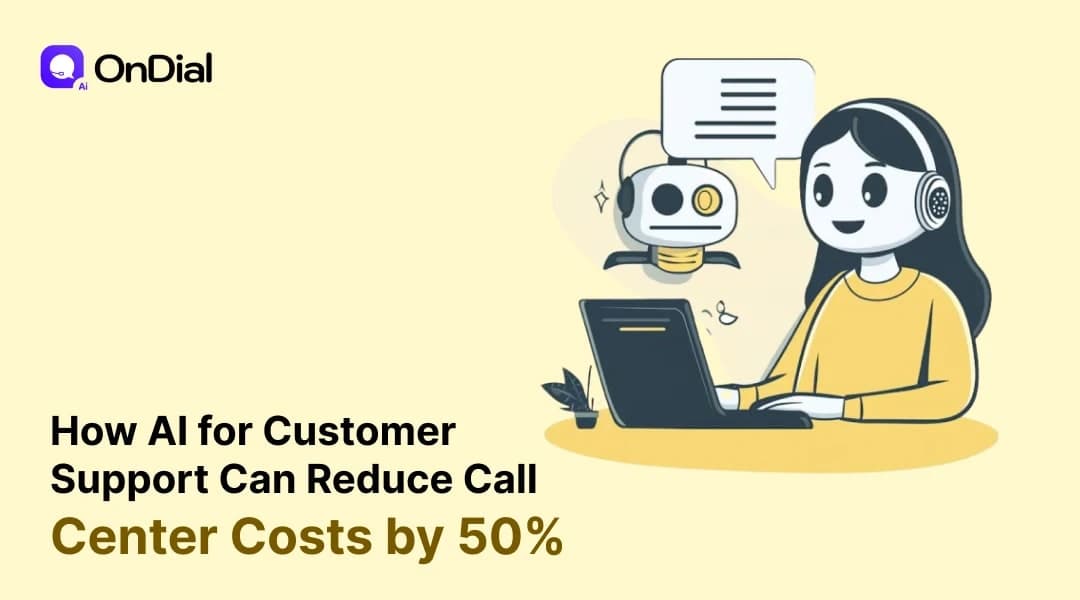
Call center costs rise quickly when every customer interaction requires a human agent. Salaries are only one part of the equation. Businesses also pay for hiring, training, supervision, software, infrastructure, quality assurance, after-hours coverage, and the idle capacity required to handle unpredictable call volumes.
AI for customer support changes that operating model.
Instead of assigning a human agent to every call, businesses can use AI voice agents to handle repetitive conversations, collect information, answer common questions, complete routine actions, and transfer complex cases to human teams.
The goal is not to eliminate human support. The stronger model is to let AI absorb predictable workloads while human agents concentrate on conversations that require judgment, empathy, negotiation, or specialist knowledge.
For businesses with significant inbound or outbound call volumes, this approach can reduce the cost of serving customers while improving response times and extending support availability.
Why Traditional Call Center Support Becomes Expensive
Traditional call centers have a relatively simple cost structure: more calls generally require more people.
When call volume increases, companies often respond by hiring additional agents, adding shifts, expanding office capacity, increasing supervisor coverage, and spending more on training.
That creates a linear relationship between demand and operating costs.
Labor Is Only the Beginning
An agent's salary does not represent the complete cost of customer support.
A more realistic calculation includes:
Salaries and benefits
Recruitment and onboarding
Agent training
Team leaders and supervisors
Quality assurance
Workforce management
Telephony and support software
Office or remote infrastructure
Employee turnover
Overtime and night-shift premiums
This is why businesses should evaluate customer support based on the total cost per resolved interaction rather than salary alone.
Repetitive Calls Consume Valuable Agent Time
Many support conversations do not require complex human reasoning.
Customers may call to ask about an order, confirm an appointment, check a payment status, request basic account information, reschedule a booking, or receive an update on an existing issue.
When human agents spend a large part of their day handling these predictable requests, the company is effectively paying skilled employees to perform tasks that can often be automated.
That is where AI customer support creates its first major opportunity.
How AI Customer Support Reduces Call Center Costs
AI can reduce support costs through several connected mechanisms. The biggest savings usually do not come from one feature. They come from changing how work moves through the support operation.
1. Automating Repetitive Customer Requests
AI voice agents can handle structured conversations without requiring a human to participate in every interaction.
For example, an AI agent can answer questions about:
Order status
Appointment availability
Delivery updates
Business hours
Account information
Basic billing questions
Frequently requested product information
Appointment confirmations
Cancellation and rescheduling requests
When these interactions are automated, human agents have fewer repetitive calls to answer.
The result is not simply fewer calls for the team. It is a better allocation of human capacity.
2. Reducing Average Handle Time
Average handle time, or AHT, is an important operational metric because longer calls consume more agent capacity.
AI can reduce AHT in two ways.
First, it can resolve simple conversations without involving a human. Second, when a call does require escalation, AI can collect relevant information before transferring the caller.
Instead of asking a customer to repeat their problem after reaching an agent, the human representative can receive the caller's intent, conversation history, relevant customer information, and required next action.
This reduces unnecessary repetition and allows the agent to focus on resolution.
3. Providing 24/7 Customer Support
Human support coverage becomes expensive outside normal business hours.
Night shifts, weekends, holidays, and multiple time zones require additional staffing and workforce planning. Businesses may also have to maintain capacity even when after-hours call volumes fluctuate.
AI voice agents can provide continuous coverage without creating a separate human shift for every period of demand.
This is particularly valuable for businesses serving customers across multiple regions.
A customer can receive an immediate response at 2 AM without the company maintaining a full overnight team.
4. Handling Call Spikes Without Immediate Hiring
Customer demand is rarely constant.
E-commerce businesses experience seasonal peaks. Healthcare providers may see appointment surges. Financial companies may experience periods of increased customer inquiries. Travel businesses can face sudden changes in call volume.
Traditional support teams have to plan staffing around these peaks.
AI provides another option. A business can allow AI to absorb a larger share of routine calls during periods of high demand while human agents continue handling exceptions and complex conversations.
This can reduce the need for temporary hiring or excessive overtime.
5. Reducing Post-Call Work
A customer interaction does not end when the caller hangs up.
Human agents may need to write summaries, update CRM records, create tickets, categorize the issue, schedule follow-ups, and document outcomes.
This administrative work can consume significant time.
AI systems can automate parts of the post-call workflow by generating summaries, recording outcomes, updating connected systems, and triggering follow-up actions.
For a high-volume contact center, even a few minutes saved per interaction can create meaningful capacity gains.
AI Should Not Replace Every Human Support Interaction
One of the biggest mistakes businesses make when evaluating AI customer support is assuming that every call should be automated.
That is rarely the best operating model.
Some conversations require empathy, judgment, negotiation, or specialist knowledge. A frustrated customer with a complex complaint may need a human. A sensitive financial discussion may require trained personnel. A complicated technical problem may need an experienced support representative.
The stronger approach is a hybrid model.
What AI Should Handle
AI is well suited to conversations that are:
High volume
Repetitive
Predictable
Rules based
Frequently requested
Easy to validate
Suitable for automated workflows
What Human Agents Should Handle
Human agents should remain available for:
Complex complaints
Escalations
Sensitive conversations
Exceptions
Negotiations
High-value customers
Situations requiring human judgment
The objective is not to remove people from customer support. It is to ensure people spend their time where they create the most value.
A Practical Example of AI Call Center Cost Reduction
Consider a support operation handling thousands of calls each month.
Suppose a significant percentage of those calls involve order updates, appointment changes, FAQs, basic account questions, and other predictable requests.
Instead of sending every call directly to a human queue, the business can introduce an AI voice agent as the first layer.
The workflow could look like this:
Customer calls → AI answers → AI identifies intent → AI resolves routine request → complex request goes to human → interaction is logged automatically.
If AI resolves a meaningful percentage of routine interactions, human agents receive fewer low-value calls.
The business can then use its existing workforce more efficiently instead of immediately increasing headcount as call volume grows.
The exact savings depend on call volume, average handle time, agent cost, automation rate, integration requirements, and the complexity of conversations. There is no universal percentage that every company should expect.
How AI Support Integrates With Existing Call Center Systems
AI customer support does not necessarily require replacing the entire technology stack.
A modern deployment can connect with existing business systems so that the AI agent has access to the information required to resolve customer requests.
For example, a support workflow can connect voice conversations with a CRM, ticketing platform, knowledge base, scheduling system, or order management platform.
This allows the AI agent to do more than provide generic answers.
It can retrieve information, perform permitted actions, and record the result.
Businesses evaluating AI voice automation should therefore prioritize integration capability rather than choosing a platform based only on voice quality.
Why CRM Integration Matters for Cost Reduction
Without system integration, an AI agent may simply answer questions.
With integration, it can become part of the operational workflow.
For example, an AI agent could identify a customer, retrieve an order status, communicate the update, and record the interaction.
The human team does not need to perform every step manually.
This is where automation starts producing operational savings beyond the cost of answering the phone.
AI Customer Support for Indian Businesses
Indian businesses face additional challenges when designing automated voice support.
Customers may switch between English and Hindi during the same conversation. Regional languages can also be important depending on the target market.
An AI support system intended for India therefore needs more than basic translation.
It needs to understand natural conversational patterns, accents, language switching, and the context of the customer's request.
For businesses evaluating AI calling platforms in India, language support should be tested using real customer conversations rather than relying only on a product demonstration.
OnDial's own research on AI calling software for Indian businesses highlights multilingual support, CRM integration, outbound and inbound automation, and India-specific operational requirements as important evaluation criteria.
AI Support Across Different Industries
The economics of AI customer support vary by industry, but the underlying principle remains similar: automate high-volume, predictable interactions while keeping humans available for complex cases.
Healthcare
Healthcare organizations can automate appointment confirmations, scheduling requests, reminders, and routine patient communication.
Human staff can then focus on cases requiring clinical or administrative judgment.
E-commerce
E-commerce companies can automate order status questions, delivery updates, return-related requests, and other common customer inquiries.
This becomes especially useful during seasonal demand spikes.
Banking and Financial Services
Financial businesses can use AI for structured customer interactions such as information requests, reminders, verification workflows, and routing.
Because financial conversations can involve sensitive information, businesses must design appropriate authentication, security, compliance, and escalation processes.
Real Estate
Real estate teams receive large volumes of repetitive calls about property availability, site visits, lead qualification, and follow-ups.
AI can handle initial conversations and pass qualified opportunities to human sales representatives.
Call Centers and BPOs
For BPOs, the opportunity is particularly significant because large volumes of similar interactions are often processed every day.
AI can handle tier-one requests, collect information, route complex cases, conduct surveys, and complete post-call work while human agents manage escalations. OnDial's call center and BPO solution specifically focuses on tier-one call handling, intelligent routing, complaint management, surveys, outbound campaigns, and automated post-call work.
How to Calculate Your Potential AI Support Savings
Before investing in AI customer support, businesses should calculate their current support economics.
Start with five numbers:
1. Monthly Call Volume
Measure total inbound and outbound calls over several months.
Avoid using one unusually busy or quiet month as your baseline.
2. Average Handle Time
Calculate the average amount of agent time required per interaction.
Include after-call work when possible.
3. Fully Loaded Agent Cost
Include salary, benefits, management, training, infrastructure, software, and other operational costs.
4. Percentage of Repetitive Calls
Review call recordings, dispositions, or support categories and estimate how many interactions are predictable enough for automation.
5. Expected Automation Rate
Do not assume AI will handle every eligible call successfully from day one.
Use a conservative initial estimate and increase it as the system is tested and improved.
A simple business case can then compare current support costs with the projected cost of AI handling routine interactions and human agents handling escalations.
What Businesses Should Measure After Deployment
Cost reduction should not be the only success metric.
A poorly designed AI system can lower staffing costs while creating customer frustration.
Track operational and customer metrics together.
Important measures include:
Cost per resolved interaction
Automation rate
First contact resolution
Average handle time
Call abandonment rate
Transfer rate
Customer satisfaction
Escalation rate
Response time
Resolution time
Human agent utilization
The goal is to reduce cost without damaging the customer experience.
Common Mistakes When Implementing AI Customer Support
AI deployment can fail when companies focus only on automation volume.
Automating the Wrong Calls
Start with predictable, high-volume interactions.
Do not begin with the most complicated conversations simply because they represent a large potential saving.
Ignoring Human Escalation
Every production AI support system needs a clear path to a human.
Customers should not become trapped in an automated loop.
Choosing a Platform Without Testing Real Conversations
A scripted demo can make almost any voice AI system look impressive.
Test the system using real accents, interruptions, background noise, language switching, customer objections, and unusual questions.
Measuring Cost Without Measuring Quality
Lower cost is meaningless if customers stop trusting the company.
Customer satisfaction and resolution rates should remain part of the business case.
The Best Cost Reduction Strategy Is Human Plus AI
AI customer support works best when businesses treat automation as a workforce optimization strategy rather than simply a replacement strategy.
AI handles volume.
Human agents handle complexity.
AI provides availability.
Humans provide judgment.
AI manages repetitive workflows.
Humans manage exceptions.
That combination allows businesses to build support operations that are more flexible without automatically increasing headcount every time customer demand rises.
For organizations evaluating an AI voice platform, the [OnDial services platform] provides AI voice automation capabilities designed around inbound and outbound business communication. OnDial services platform
Final Takeaway
AI customer support can reduce call center costs by changing how customer interactions are handled.
Instead of increasing human headcount every time call volume rises, businesses can automate predictable conversations, provide 24/7 coverage, reduce post-call administration, route complex requests intelligently, and give human agents more time for valuable customer interactions.
The biggest opportunity is not replacing the entire support team.
It is building a support operation where every interaction is handled by the lowest-cost resource capable of resolving it effectively.
For businesses ready to evaluate that model, [OnDial] provides AI voice agents for customer support, inbound calling, outbound workflows, and automated customer interactions across industries. OnDial AI voice automation platform