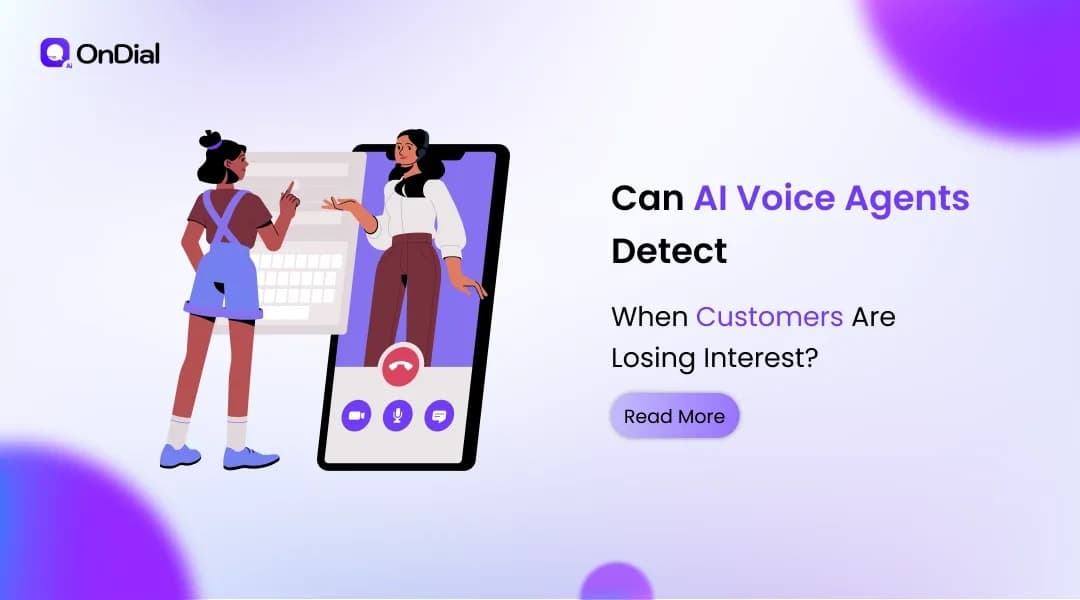
Here is a number that should unsettle anyone running a phone line: 91% of unhappy customers never complain; they simply leave. They stop leaning in, stop asking questions, and quietly move on. So can AI voice agents detect when customers are losing interest before that happens? Yes, to a real and useful degree. Modern AI voice agents track tone, pace, pauses, and word choice in real time to catch the moment interest starts to slip, then adapt the conversation or flag the call before the customer is gone for good.
I get why you might be skeptical. Most vendor demos oversell this, showing a perfect call where the AI "senses frustration" on cue. The reality is more layered and honestly more interesting. In this piece, I will walk through how detection actually works, the specific signals a voice agent reads, how accurate it really is, and the one signal that trips up almost every system. By the end, you will know exactly what to trust and what to question.
How AI Voice Agents Detect When Customers Are Losing Interest
AI voice agents detect fading interest by analyzing how someone speaks, not only what they say. At OnDial, the voice systems we build treat every call as two parallel streams: the words being spoken and the acoustic texture underneath them. That second stream is where waning interest usually shows up first.
Reading the voice, not just the words
A traditional phone menu hears words and nothing else. A capable voice agent layers prosody analysis on top, measuring pitch, pace, volume, and the length of pauses moment by moment. Tone, pitch, pace, volume, and pauses are combined with what the customer says to infer emotion in real time. That combination is what lets the system notice a shift from engaged to indifferent.
The technical backbone here is a fast Speech-to-Text layer feeding a Natural Language Understanding model, running inside a tight latency budget. Speed matters more than people expect. People expect a response in under a second; 200 to 300 milliseconds feels natural, and two seconds feels broken. A laggy agent creates the very disengagement it is trying to detect.
Turning signals into a live sentiment score
Once tone and language are captured, the agent converts them into a rolling sentiment score that updates every few seconds with enterprise AI voice agent services. This is the difference between old speech analytics and modern voice AI. The model updates sentiment scores every few seconds, so the read is live rather than a report you see hours later.
Here is the snippet-ready version. AI voice agents know a customer is losing interest by continuously scoring vocal signals like tone shifts, slower responses, shorter answers, and longer pauses against the emotional baseline set at the start of the call. When the score drops past a threshold, the system acts. That is the whole mechanism in one breath.
The Disengagement Signals a Voice AI Actually Listens For
The strongest disengagement signals are rarely dramatic. They are small, cumulative, and easy for a human agent to miss on call number forty of a long shift. A voice AI never gets tired, so it catches the drift.
Vocal cues that reveal fading interest
Practitioners look for a specific cluster of changes rather than any single tell. A capable AI voice agent monitors vocal cues in real time: volume changes, sentence fragments, rising pitch, and extended silences. When those signals cross a threshold, the system adjusts its own delivery. No single cue is proof, but together they paint a reliable picture.
Here are the signals that matter most on a live call:
Shrinking responses: Full answers collapse into "yeah," "sure," or "uh-huh." The customer is present but no longer investing.
Pace and pitch shifts: A voice tightening or speeding up often signals impatience, while a flattening monotone signals boredom.
Interruptions and talk-overs: Interruptions spike when someone wants the call to end. The agent registers that as a strong negative move.
Filler and hesitation: Rising hesitation or sentence fragments suggest the person is mentally checking out before they say so.
From frustration to indifference
There is a meaningful line between an annoyed customer and a bored one with multilingual customer call automation. Frustration is loud and easy to detect. Indifference is quiet, and it is the harder problem by far. A well-designed agent distinguishes the two because they call for opposite responses.
Frustration usually needs de-escalation and a fast fix. Indifference needs re-engagement, a sharper hook, or a graceful exit. Treating a bored customer like an angry one just accelerates the drift toward the door.
The Signal Most Systems Miss: Silence
Here is the counter-intuitive truth. The most dangerous sign of lost interest is not anger. It is silence. The most dangerous churn signal is not anger; it is silence, and customers who shift from frustrated to indifferent are 3.2x more likely to churn within 30 days than those still actively complaining.
Why silence is the most expensive signal
An angry customer is still engaged. They are giving you information and a chance to recover. A silent one has already half-decided to leave. In projects I have worked on at OnDial, the calls that quietly go flat, no complaint, no drama, are the ones that correlate most tightly with customer churn.
This reframes the whole detection problem. Customers who stop complaining are 3.2x more likely to churn than those still actively frustrated, so silence is the most dangerous signal. A voice agent tuned only to catch shouting will miss the accounts slipping away in a calm, polite tone. Detecting the absence of engagement is a harder engineering task than detecting anger, and it is the frontier that separates a genuinely useful system from a demo.
Building an early-warning layer into your calls
Catching disengagement early is worth real money because the alternative is silent revenue loss. AI-powered feedback analysis provides 30 to 60 days of early warning that usage-based models miss entirely. That window is the entire point of doing this on live calls instead of in a post-mortem dashboard.
A practical early-warning layer does three things during the call:
Baselines the customer in the first few seconds, so drift is measured against that person, not a generic average.
Flags trajectory, not just score, since a customer dropping from 8 to 4 is at higher risk than one consistently at 5.
Triggers an action the moment the trend turns, whether that is a retention offer, a routing change, or a human handoff.
How Accurate Is Voice Sentiment Detection, Really?
Is real-time sentiment detection actually worth it, or is the accuracy overstated with AI voice tools that improve customer satisfaction? Fair question, and the honest answer has two sides. The technology is genuinely good now, and it is also genuinely imperfect.
What the accuracy numbers actually mean
The headline figures are strong. Models combining behavioral data with sentiment analysis reach 85 to 92% accuracy, compared to 70 to 78% for behavioral data alone. Fusing what is said with how it is said adds a measurable lift, with some platforms reporting 23 to 37% higher accuracy by combining text and voice signals.
The business impact tracks with that. Companies using sentiment analysis report 15 to 20% improvements in customer satisfaction scores just by acting on emotional cues that would otherwise go unnoticed. Adoption is following the results, with Forrester research placing voice AI at 19% of inbound contact-center volume, up from 6% in 2024.
Where it still gets things wrong
Now the honest limits, because trust matters more than hype here. Accuracy depends heavily on audio quality, language, accent, and cultural expression, and no serious platform claims perfection. Accuracy depends on the model, call quality, and language; good platforms reliably detect most emotion and intent with human review, and risks include bias, misinterpretation, and over-automation.
Sarcasm, dry humor, and culturally specific tone still fool these systems. A customer saying "that's just great" can read as positive to a model that misses the eye-roll in the voice. That is why we treat sentiment scores at OnDial as a strong signal, not a verdict, and keep a human in the loop for high-stakes moments. Anyone promising flawless emotion reading is selling you the demo, not the deployment.
What Happens the Moment a Voice AI Detects Disengagement
Detection is worthless without a response. A dashboard nobody acts on is worse than no dashboard at all. The value of an adaptive conversation is that the system does something the instant the signal turns.
Adapting the conversation in real time
The first move is for the agent to change its own behavior. When a prospect disengages, the system shifts, and when buying signals emerge, it moves toward next-step scheduling. A drifting customer might get a shorter path, a sharper question, or a direct acknowledgment instead of more script.
Prompt design carries a lot of weight here. Agents should be instructed to acknowledge frustration directly rather than plow ahead with information. The same holds for boredom: cut the monologue, ask what the person actually needs, and stop performing at them.
Knowing when to hand off to a human
The smartest thing a voice agent can do is recognize its own ceiling. A strong AI voice agent does not win difficult conversations by overpowering the objection; it reads the moment, lowers the temperature, resolves what it can, and hands off cleanly what it cannot. A clean handoff beats a stubborn bot every time.
When the system escalates, it should pass the full context so the human is not starting cold. With voice AI, the human agent picks up the call already knowing the customer, the issue, and what has been tried with AI voice agents for call centers. That continuity is often the difference between saving the relationship and losing it at the exact moment interest was fading.
Conclusion
So, can AI voice agents detect when customers are losing interest? Yes, and increasingly well, as long as you stay clear-eyed about the limits. Three things matter most: detection works by reading tone and pacing, not just words; silence is the costliest signal and the hardest to catch; and accuracy is strong but never absolute, so a human stays in the loop. You now know what to trust and what to interrogate in any vendor pitch.
That clarity is the real advantage. If you want a voice agent tuned to catch quiet disengagement, not just shouting, and to act on it before a customer drifts, that is exactly the kind of human-centric system we build at OnDial. Start by mapping the three points in your own calls where interest tends to fade, then let a voice agent watch those moments for you.