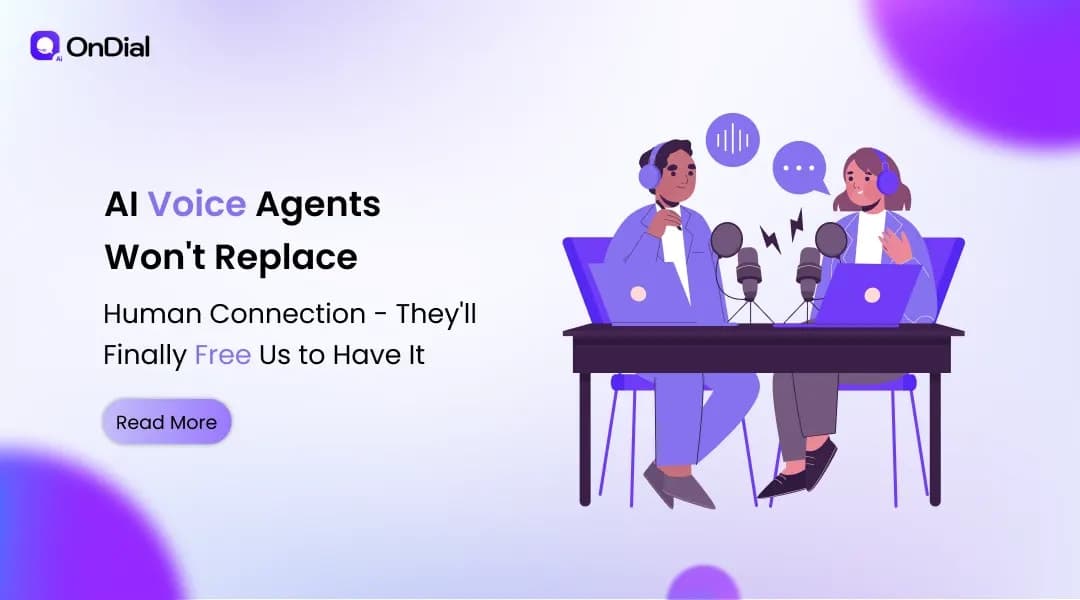
The debate around AI voice agents often starts with the wrong question: will artificial intelligence replace human customer service?
For most businesses, that is not the decision that matters.
The more useful question is where automation can remove repetitive work while giving human employees more time for conversations that require judgment, empathy, context, and trust.
An AI voice agent can answer routine questions, schedule appointments, qualify leads, provide information, handle after hours calls, and route complex conversations to the right employee. A human can then step in when the customer needs flexibility, emotional understanding, or a decision that falls outside predefined workflows.
This creates a practical model for customer experience: AI handles the volume, while people handle the moments that matter most.
What Are AI Voice Agents?
An AI voice agent is a conversational AI system that communicates with customers through phone calls. It uses technologies such as speech recognition, language understanding, conversational logic, and text to speech to listen, interpret, respond, and take defined actions.
Unlike traditional IVR systems, which usually depend on fixed menus, conversational voice agents can understand natural language and respond according to the context of a conversation.
For example, instead of asking a caller to press a number for appointments, an AI voice agent can understand a request such as:
"I need to move my appointment from Thursday to next week."
The system can identify the intent, check available slots through an integrated scheduling system, confirm the preferred time, and update the appointment.
That distinction is important because useful voice automation is not simply about making a phone system sound more natural. It is about allowing the system to complete useful business tasks during the conversation.
Why Human Customer Service Still Matters
Automation can handle a large portion of predictable customer interactions, but not every customer situation is predictable.
Consider a customer dealing with a billing dispute, a patient with a sensitive healthcare concern, or a business client experiencing a serious service problem. These situations can require judgment and emotional awareness that should not be forced into a rigid automated workflow.
Human employees remain particularly valuable when a conversation involves:
Emotional or sensitive situations
Complex problems involving multiple systems
Exceptions to standard policies
Negotiation or conflict resolution
High value customer relationships
Decisions requiring business judgment
Unexpected requests that fall outside the AI's knowledge
The objective should therefore not be to remove humans from customer service.
The objective should be to make sure human employees spend more of their time on the interactions where their skills have the greatest value.
Where AI Voice Agents Can Take Work Off Human Teams
Customer service teams often spend substantial time answering questions that are repetitive and predictable.
Common examples include:
Business hours and location questions
Appointment booking and rescheduling
Order and delivery status
Basic service information
Lead qualification
Customer information collection
Reminder calls
Feedback collection
Frequently asked questions
After hours call handling
These interactions may be important to customers, but they do not necessarily require a human employee every time.
A well configured AI voice agent can manage these conversations consistently while allowing employees to focus on more complicated cases.
For businesses that depend heavily on phone communication, this can also reduce the pressure created by call spikes. Instead of making customers wait while employees finish another conversation, the AI can handle routine calls concurrently and identify which conversations actually require human involvement.
AI Voice Agents Should Not Become a Wall Between Customers and People
One of the biggest mistakes businesses can make is treating automation as a way to prevent customers from reaching employees.
Customers generally understand that businesses need efficient systems. They become frustrated when automation makes it difficult to get help.
The difference comes down to design.
A good AI voice system should make the customer journey easier, not create another barrier.
For example, if a caller explicitly asks to speak with a person, the system should have a clear path for escalation. If the AI cannot confidently resolve a request, it should not continue repeating the same answer. It should identify the limitation and provide an appropriate next step.
This is where a hybrid AI and human model becomes more useful than complete automation.
What a Strong AI Human Handoff Looks Like
A simple call transfer is not always enough.
Imagine that a customer spends several minutes explaining a problem to an AI agent and is then transferred to an employee who knows nothing about the conversation.
The customer now has to repeat everything.
That removes much of the value created by automation.
A better handoff can provide the employee with relevant information gathered during the AI conversation, such as:
Caller identity
Reason for the call
Key information provided by the customer
Actions already completed
Outstanding questions
Conversation summary
Relevant customer history from connected systems
The employee can then begin with context instead of starting the conversation from the beginning.
OnDial's AI voice agent platform features are designed around capabilities such as conversational automation, integrations, analytics, and workflows that can support this broader customer interaction model.
How AI Voice Agents Improve the Work of Human Employees
The value of voice AI should not be measured only by how many calls it handles.
Businesses should also examine what happens to the calls that remain with human employees.
Suppose a support representative previously spent much of the day answering basic questions. After automation, that employee may receive fewer calls but spend more time solving complicated problems.
That can change the quality of the interaction.
The employee has more time to listen. They can investigate the issue rather than rushing through it. They can explain the solution clearly. They can spend more attention on the customer's specific situation.
In this model, AI does not make the human interaction less important.
It makes the human interaction more focused.
A Practical Example: Healthcare Customer Service
Healthcare provides a useful example because routine administrative calls and sensitive conversations often exist side by side.
A healthcare provider may receive calls about:
Appointment scheduling
Appointment cancellation
Clinic hours
Location information
Reminder requests
Insurance related questions
Prescription related requests
Patient concerns
Some of these interactions can follow clearly defined workflows. Others may require a trained member of staff.
An AI voice agent can manage appropriate administrative requests while routing sensitive or complex conversations to the relevant human team.
For healthcare organizations exploring this approach, OnDial's AI voice agents for healthcare and medical providers provides an example of how voice automation can be structured around industry specific workflows.
The important principle is not to automate everything.
It is to separate predictable administrative work from interactions where human involvement is essential.
The Same Model Works Across Other Industries
The hybrid approach can also apply to industries where phone conversations are an important part of the customer journey.
Real Estate
AI can respond to initial property inquiries, collect buyer requirements, qualify leads, and schedule viewings. Human agents can then focus on negotiations, complex property questions, and high intent buyers.
Insurance
Voice AI can handle basic policy questions, collect information, schedule callbacks, and support routine follow ups. Human advisors can handle complicated claims, disputes, and situations requiring professional judgment.
Retail and E-commerce
AI can provide order information, answer common product questions, support returns workflows, and handle delivery related calls. Human representatives can take over unusual complaints or high value customer issues.
Logistics
AI can answer shipment status questions, collect delivery information, and manage routine customer communication. Human teams can handle exceptions, disputes, and operational problems requiring coordination.
Education
AI can answer admission related questions, collect prospective student information, schedule calls, and provide basic program information. Counsellors can then spend more time with students who need detailed guidance.
Across these use cases, the principle remains consistent: automate predictable conversations while protecting access to human expertise.
How to Measure Whether the Model Is Working
Businesses should look beyond call volume when evaluating an AI voice deployment.
Useful metrics include:
Resolution Rate
Measure how many suitable conversations are completed successfully without human intervention.
Human Escalation Rate
A high escalation rate is not automatically a failure. Some businesses may intentionally route complex or high value conversations to people.
The important question is whether escalation happens for the right reasons.
First Contact Resolution
Track whether customers get their issue resolved during the first interaction, particularly for conversations that reach human employees.
Customer Satisfaction
Compare customer satisfaction for routine AI handled interactions and human handled escalations.
Response Time
Measure how quickly customers receive an initial response and how quickly escalated calls reach the right employee.
Employee Workload
Look at whether employees spend less time on repetitive calls and more time on complex customer interactions.
Customer Retention
For businesses with recurring relationships, connect customer communication quality with retention indicators. OnDial's customer churn signals guide explores how customer conversations and behavioral signals can reveal potential retention risks.
These measurements provide a more complete picture than simply counting automated calls.
Common Mistakes When Deploying Voice AI
Technology alone does not create better customer experience. Poor implementation can produce the opposite result.
Automating Too Much
Not every call should be automated.
Start with predictable workflows where the AI can provide clear value and establish explicit boundaries for human escalation.
Hiding the Human Option
Customers should not have to fight the system to reach an employee.
A clear human escalation path helps preserve trust.
Giving the AI Incomplete Information
An AI agent can only provide reliable answers when its knowledge and workflows are properly configured.
Business information, policies, FAQs, customer data, and connected systems should be reviewed before deployment.
Ignoring Conversation Quality
A technically correct response can still create a poor experience if the conversation feels unnatural, confusing, or repetitive.
Voice design should account for pacing, interruptions, clarification, confirmation, and conversational context.
Measuring Only Cost Reduction
Reducing call handling costs may be useful, but it should not become the only objective.
A successful deployment should also improve response times, employee focus, customer resolution, and the quality of human interactions.
How Businesses Can Start With a Hybrid Voice AI Model
Businesses do not need to automate their entire contact operation on day one.
A controlled rollout is usually more practical.
Start by identifying the calls that are:
High volume
Repetitive
Easy to define
Low risk
Supported by reliable business information
These are good candidates for initial automation.
Next, define the calls that should always involve a human. These may include sensitive customer issues, complex complaints, exceptions, high value accounts, or requests requiring professional judgment.
Then connect the AI to the systems it needs to complete tasks. Depending on the workflow, this could include a CRM, calendar, customer database, knowledge base, or other business software.
Finally, review real conversations after launch.
Look for misunderstandings, unnecessary transfers, incomplete answers, and situations where customers repeatedly ask for a human. Those observations should feed back into the conversation design.
For businesses looking for a practical introduction to automated phone interactions, OnDial's AI receptionist guide explains how conversational phone systems can answer calls, complete routine tasks, and transfer conversations when human support is needed.
The Future of Customer Service Is Not AI Versus Humans
The strongest customer service model is unlikely to be entirely human or entirely automated.
AI is particularly useful for availability, repetition, consistency, information retrieval, and high call volumes.
Humans remain essential for empathy, judgment, creativity, relationship building, and complex decision making.
The opportunity is to connect these strengths instead of treating them as competing approaches.
When an AI voice agent answers a routine call immediately, the customer gets faster service.
When that same system recognizes a complex issue and provides a useful handoff, the human employee receives better context.
When the employee is no longer overwhelmed by repetitive conversations, they can give more attention to the customer who genuinely needs them.
That is where AI voice agents can strengthen human connection rather than weaken it.
Conclusion
AI voice agents do not need to replace human customer service to create meaningful business value.
Their most useful role is often much simpler: handle the conversations that can be automated, identify the conversations that cannot, and make the transition between AI and human support as smooth as possible.
For businesses, this creates a practical balance between scale and personal service.
Customers get faster answers for routine requests while retaining access to human support when the situation requires it.
Employees spend less time repeating the same information and more time applying their expertise.
The result is not a customer experience with less human involvement.
It is a customer experience where human involvement is used more intentionally.
Businesses looking to build this type of voice automation can explore OnDial's AI voice agent platform and evaluate where conversational AI can complement their existing customer service operation.