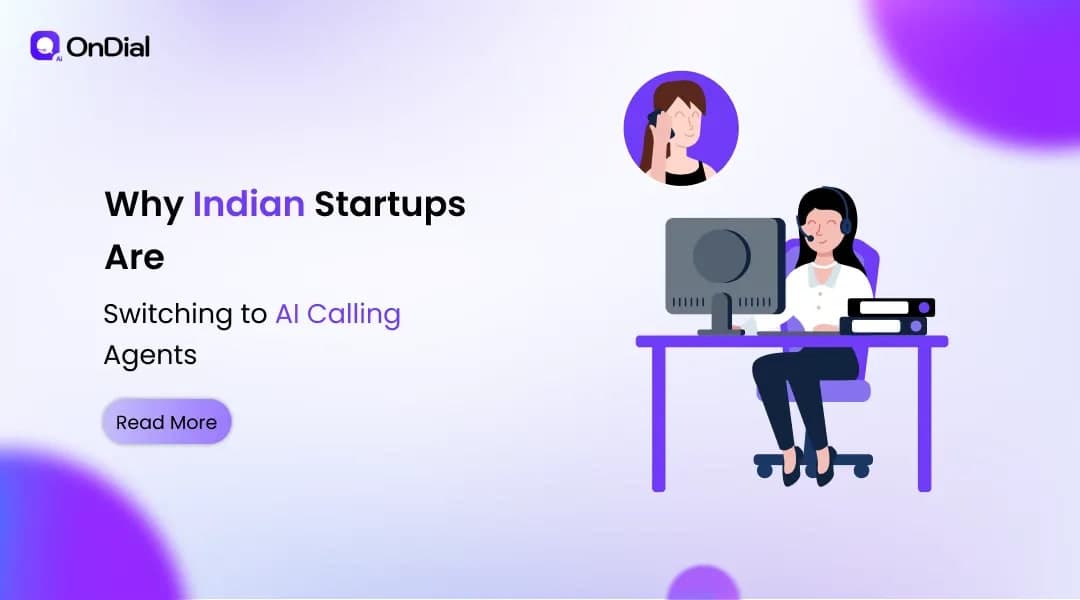
A study by Ozonetel found that call abandonment rates in Indian SME call queues sit between 25% and 40%. Read that again: nearly one in three people calling your business gives up before anyone picks up. That is not a staffing problem. It is a structural one - and no amount of hiring solves it sustainably.
If you are running an Indian startup right now, you already know the feeling. Your telecalling team is stretched. Attrition is brutal. Training a new agent takes weeks, and the moment they are productive, they leave. Meanwhile, your leads are going cold at 11 PM when your team is asleep, and your competitors are not.
AI calling agents for Indian startups are not a distant experiment anymore. They are live, affordable, and increasingly built for the specific reality of Indian business: multiple languages, high call volumes, TRAI compliance requirements, and customers who will hang up on anything that feels like a robot.
In this article, I will walk you through exactly why founders are making this switch, what the technology actually does (and does not do), what it costs relative to traditional telecalling, and what you need to check before deploying. No hype. Just the operational reality.
What Is an AI Calling Agent
AI Calling Agent vs. IVR: The Critical Difference
An AI calling agent is a voice-powered software system that holds real, two-way phone conversations with customers - without a human on the other end of the line.
That definition matters because people confuse AI calling agents with IVR (Interactive Voice Response) systems constantly. IVR tells you to press 1 for billing. An AI calling agent asks you what happened with your last order and actually responds to your answer in context.
The difference is not cosmetic. IVR follows a script. An AI calling agent, built on Natural Language Processing (NLP) and Automatic Speech Recognition (ASR), understands what the caller says - including interruptions, tangents, and Hinglish mid-sentence switches - and responds accordingly. It can qualify leads, book appointments, follow up on payments, and handle FAQs without asking anyone to press a single button.
What an AI Calling Agent Actually Does on a Call
Here is a concrete picture. A user calls your EdTech startup at 11:30 PM. A human agent would have gone home three hours ago. An AI calling agent picks up in under a second, greets the caller by name (pulled from your CRM), answers their question about the course fee, handles their objection about EMI options, and books a callback with a human counsellor for the next morning - all in Hinglish.
That is conversational AI for business calls working as designed. The key capabilities worth knowing are:
Real-time context retention: The agent remembers what was said two sentences ago and does not ask the caller to repeat themselves.
CRM integration: Salesforce, HubSpot, or your proprietary database - the agent logs the interaction immediately.
Human escalation: When the conversation becomes complex or emotionally charged, the agent hands off to a human with full context already transferred.
Concurrent calling: Unlike a human agent who handles one call at a time, an AI calling agent can run thousands of outbound calls simultaneously.
The Real Cost Problem Facing Indian Startups
The Hidden Math of Human Telecallers
Let me be direct about a number most founders avoid calculating. A single call center agent in India costs between Rs 20,000 and Rs 40,000 per month in salary alone. Add training costs of Rs 10,000 to Rs 20,000 per agent, infrastructure overhead, team leads, and quality assurance - and a 10-person telecalling team is quietly consuming Rs 4 to Rs 7 lakhs every month.
That is before you account for attrition. India's BPO sector has some of the highest attrition rates in the world. Every time an agent leaves, you absorb the full cost of rehiring and retraining. Growth becomes genuinely expensive.
AI calling platforms in India, by contrast, typically charge between Rs 0.50 and Rs 2.50 per minute of conversation. That same 10-person team's monthly call volume, automated, often comes in at a fraction of the cost. I have seen startups in projects I have worked on bring their per-interaction cost down by more than 60% within the first quarter of deployment.
The Revenue You Are Losing Right Now
Here is something most cost-reduction conversations miss: the revenue side.
Research by CRISIL (cited in Rootle's SME study) estimated that lost leads due to delayed follow-up account for 18 to 22% revenue leakage for small businesses in sectors like recruitment, retail, and services. Your sales team is not just expensive - it has gaps. Lunch breaks. Weekends. Evenings. Every gap is a window where a warm lead cools down and converts somewhere else.
An AI calling agent does not have gaps. It follows up at 6 AM, at 9 PM, and on Sunday. That consistency alone - independent of any other benefit - is why Indian startup founders are looking at this technology differently in 2026.
How AI Calling Agents Work: The Technology Behind the Voice
NLP, ASR, and Why Response Speed Matters
Here is something a practitioner knows that vendor marketing materials often bury: response latency is everything in voice AI.
A conversation feels human when the response comes within 300 milliseconds. Modern voice AI platforms built for India - including systems like Bolna AI - target sub-300ms latency, which sits below the threshold of human perception. Anything above 800 milliseconds starts to feel mechanical, and callers disengage.
The technology stack that makes this work has three layers. ASR (Automatic Speech Recognition) converts spoken audio to text in real time. NLP (Natural Language Processing) interprets meaning, intent, and context from that text. TTS (Text-to-Speech) converts the agent's response back to natural voice output. When all three layers are optimized for Indian accents, dialects, and code-switching, the result is a conversation that the caller may not immediately identify as automated.
CRM Integration and What Happens After the Call
The value of an AI calling agent does not end when the call ends.
A well-deployed system logs the full call transcript, tags the interaction with intent labels (interested, callback requested, objection raised, qualified), and pushes the record directly to your CRM. Your sales team wakes up to a prioritized list of qualified leads instead of a stack of callback notes to manually sort.
This is where conversational AI for business calls stops being a cost play and becomes a revenue infrastructure decision. The data compound over time. You start understanding which call scripts convert, which objections appear most often, and which follow-up timing generates the highest pickup rate.
The India-Specific Advantage: Multilingual AI Voice That Actually Works
Why Hindi and Hinglish Support Changes Everything
Global voice AI platforms were not built for India. They were built in English, adapted for a handful of European languages, and then retrofitted for Hindi as an afterthought. The result is agents that handle grammatically correct Hindi but stumble on the way most Indians actually speak - which is a fluid, context-dependent blend of Hindi, English, and regional vocabulary in the same sentence.
India has 22 Scheduled Languages. Most Indian consumers in tier-2 and tier-3 markets do not primarily communicate in English. For years, this linguistic diversity was a barrier to scaling voice communication for Indian startups. A multilingual AI voice agent India-built and trained on code-switching data resolves this in a way that hiring multilingual human agents simply cannot match at scale.
Top Indian-built voice platforms now support Hindi, Tamil, Telugu, Marathi, Kannada, Bengali, Gujarati, and others in production. Not as test features. In actual customer deployments.
Reaching Tier-2 and Tier-3 Cities at Scale
Think about what this actually means for growth. A fintech startup expanding lending into tier-3 cities cannot rely on English-language communication to convert those customers. A real estate startup in Tamil Nadu cannot reach rural buyers through a Hindi-only agent.
Real estate companies using Tamil-language voice AI, according to data cited in Vomyra's research, reported a 76% increase in inquiries from rural areas. The language barrier that restricted Indian startups to metro markets is no longer a structural constraint when your calling agent speaks the same language your customer thinks in.
Five Reasons Indian Startups Are Making the Switch
Here is the pattern I consistently see across early and growth-stage startups that make this transition:
1. They cannot scale headcount linearly
Every new sales or support hire takes 4 to 8 weeks to become productive. AI deployment takes days.
2. The attrition math has become untenable
Building institutional knowledge in a telecalling team, only to watch it walk out the door repeatedly, has a genuine cost that founders have finally started quantifying.
3. They need 24/7 coverage without 24/7 payroll
Lead generation and customer support do not respect business hours. An AI calling agent does not either.
4. Investors are asking about unit economics
A startup operating with AI-managed calling workflows signals capital efficiency in a way that a 30-person call floor does not.
5. The technology finally sounds human enough
This is the honest one. Six years ago, the voice quality and language understanding was not good enough for real Indian customer conversations. Today, for structured use cases like lead qualification, appointment booking, and payment reminders, it is.
What to Check Before You Deploy: TRAI Compliance and DPDP Act Basics
TRAI Rules You Cannot Ignore
AI calling is legal in India. But it is regulated, and the rules are real. The Telecom Regulatory Authority of India (TRAI) governs commercial voice communication, including automated calls. Key compliance requirements include DLT (Distributed Ledger Technology) registration, Do-Not-Call (DNC) list scrubbing, consent-based outbound calling, and proper sender ID registration.
A TRAI violation can cost Rs 5 lakhs per incident. For a cash-constrained startup, that is not a theoretical risk - it is an operational one. Any AI voice platform you consider must handle DNC compliance and TRAI DLT registration as part of its standard offering, not as an add-on.
DPDP Act 2023 and Voice Data
Voice interactions capture personally identifiable information - names, phone numbers, expressed intent, financial details in some cases. India's Digital Personal Data Protection Act 2023 (DPDP Act) requires explicit, purpose-limited, revocable consent for processing personal data.
What does this mean practically? Your AI calling platform must capture consent records, respect data retention limits, and be capable of executing purge requests. Before you sign with any vendor, ask specifically how they handle DPDP compliance - consent logging, storage location (India-resident data storage matters here), and deletion protocols. A vendor who cannot answer these questions crisply is not ready for production.
Is Switching to AI Calling Agents Right for Your Startup?
Not every startup should deploy AI calling agents tomorrow. Here is the honest version of that answer.
AI calling agents work best when the use case is structured and repeatable: lead qualification calls that follow a defined flow, appointment reminders, payment follow-ups, satisfaction surveys, onboarding check-ins. They are not the right tool for high-empathy, high-complexity conversations that require genuine human judgment - a customer raising a complaint about a significant financial error, for example.
If your calling volume is low (under 200 calls a month), the operational advantage may not justify the setup investment right now. If your use case is primarily about handling emotionally complex escalations, human agents remain the right choice for that specific layer.
But if you are running any kind of outbound lead qualification, high-volume follow-up, or first-level support at scale - and you are frustrated by attrition, cost, or the simple impossibility of covering every hour - AI calling agents are worth a serious evaluation, not a casual glance.
Conclusion
AI calling agents for Indian startups are not replacing human connection. They are replacing the parts of calling that were already impersonal - the missed calls at 10 PM, the repetitive qualification questions, the follow-ups that never happened because the team ran out of hours. Those gaps were not adding value. They were losing revenue.
The switch Indian startups are making is not about choosing automation over people. It is about deploying each resource where it actually creates impact. Voice AI handles volume, consistency, and coverage. Your human team handles judgment, empathy, and relationships.
Three things worth taking away: the cost math has shifted decisively in favor of AI calling for structured workflows; India's linguistic diversity is now an advantage with multilingual voice AI, not a barrier; and TRAI and DPDP compliance are non-negotiable, so your vendor selection matters as much as the technology.