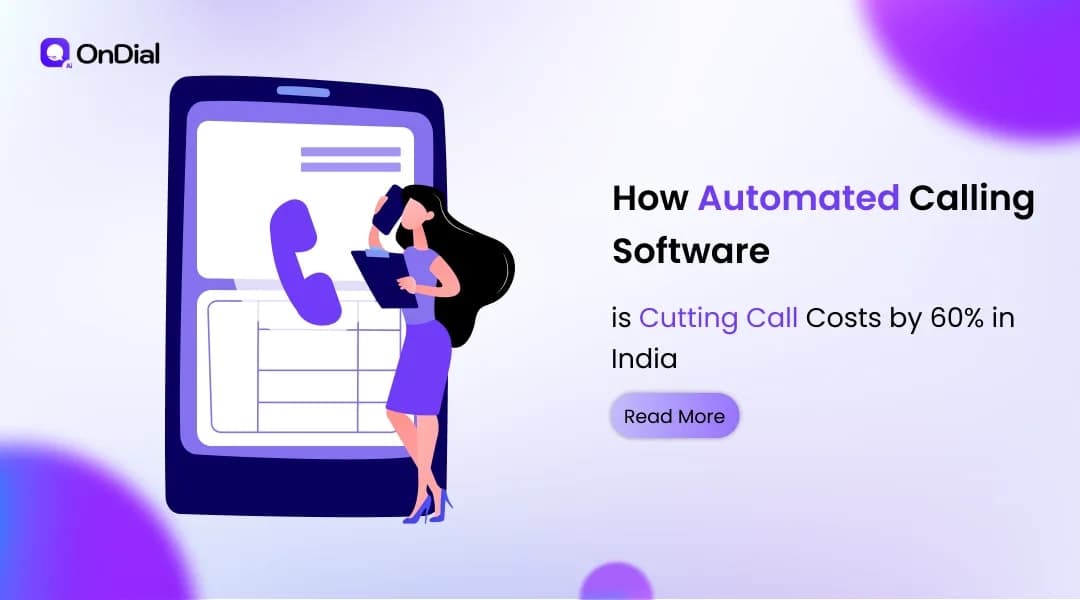
A typical 50-agent call center in India can run up operational costs of around ₹19 lakhs a month once you factor in salaries, infrastructure, and overheads. Deploy an AI-powered automated calling system to handle 80% of routine calls, and that figure can drop to approximately ₹6 lakhs - a saving of over ₹1.5 crores a year. (Source: Dialnexa)
That number stops most business owners cold. Not because it sounds too good, but because they've spent years assuming it wasn't achievable for an Indian operation - with Hindi accents, regional language switches, TRAI compliance requirements, and customers in Tier 2 cities who've never heard a bot before.
I've seen this doubt up close. At OnDial, we work with businesses across India who came to us frustrated: their call costs were rising, their connect rates were embarrassingly low, and their agents were spending 70% of their day listening to the phone ring. Automated calling software in India has moved well beyond the robotic "Press 1 for Hindi" era. Today, it understands Hinglish, integrates with your CRM, and handles the full complexity of a real customer conversation.
This article breaks down exactly where that 60% cost reduction comes from, which features actually drive the savings, and what you need to know about compliance before you flip the switch.
What Automated Calling Software Actually Does
Automated calling software is a cloud-based platform that initiates, manages, and analyzes large volumes of inbound and outbound phone calls with minimal human input. It handles everything from dialing through conversation to CRM logging - without an agent touching a single screen.
That definition matters, because "automated calling" covers a wide spectrum. A basic auto-dialer is not the same thing as an AI voice agent. And confusing the two is one of the most expensive mistakes Indian businesses make when evaluating this technology.
What Makes It Different from a Basic IVR
An IVR (Interactive Voice Response) system routes callers through fixed menus. "Press 1 for billing. Press 2 for support." It is useful for deflecting simple queries, but it cannot hold a conversation. The moment a caller deviates from the expected path - which is most of the time - the experience breaks down.
Modern AI voice agents are built on Natural Language Processing (NLP) and large language models. They understand open-ended speech, detect intent, respond in context, and adapt mid-conversation. A customer in Pune asking a billing question in Marathi-tinged Hindi gets a coherent, contextual response - not a rigid menu that forces them to repeat themselves three times.
The practical difference is enormous. IVR deflects calls. AI voice agents resolve them.
How AI Voice Agents Process a Real Conversation
When a customer calls, the AI voice agent captures the speech in real time, converts it to text using STT (speech-to-text) technology, analyzes intent using NLP, generates a response using an LLM, and delivers it back as natural-sounding speech - typically within 200-400 milliseconds. That sub-second latency is what makes the conversation feel human rather than robotic.
The best platforms built for India support multilingual conversations across Hindi, Hinglish, Tamil, Telugu, Kannada, Bengali, Marathi, and Gujarati - with code-switching handled mid-sentence. This is not a small technical detail. It is the difference between an AI agent that actually works for your customer base and one that alienates them on the first call.
How the 60% Cost Reduction Actually Happens
Here is the question nobody in a sales demo actually answers properly: where, specifically, does the 60% come from?
It is not magic. It is three distinct cost structures being simultaneously addressed by the same platform.
Where the Money Is Actually Being Lost
Ask any call center operations manager where money disappears, and they will describe the same three levers. First, agent idle time: industry data shows that with manual dialing, human agents can waste up to 70% of their working day on unproductive outreach - busy tones, no-answers, wrong numbers, and voicemail. They are being paid while a phone rings in an empty room.
Second, staffing costs: salaries, provident fund contributions, shift allowances, attrition-driven training cycles, and the infrastructure to house agents. A human agent costs roughly ₹15 per minute when you factor salary and infrastructure together. An AI voice agent operating on a VoIP/SIP-based platform costs ₹0.50-2 per minute. (Source: The Tech Journal)
Third, inconsistency: human agents have good days and bad days. Scripts drift. Quality slips during peak hours. Every inconsistency creates rework, escalations, and churn that costs money downstream.
The Three Cost Levers Automation Pulls
Predictive dialing eliminates idle dial time. Instead of one agent dialing one number and waiting, a predictive dialer runs multiple lines simultaneously, connecting the agent (or AI agent) only when a live person picks up. Connect rates that hover around 47% with manual dialing can jump to 91% with predictive automation - meaning your team spends its time in actual conversations, not listening to hold music.
AI-handled volume means routine, repetitive calls (payment reminders, appointment confirmations, lead qualification, order updates) never touch a human agent. The AI handles the full interaction. Human agents are reserved for complex, high-value, or sensitive conversations only. This hybrid model is the structural reason 60% savings are achievable. You are not replacing your team; you are redirecting them.
CRM and workflow automation eliminate post-call admin. Every call is automatically logged, transcribed, tagged, and synced to your CRM. No manual notes. No data entry delays. No dropped follow-ups. The hidden time cost of manual call documentation is significant, and it is simply removed.
Key Features That Drive Cost Savings
Not every platform is built equally. I've personally seen implementations where businesses bought the cheapest dialer available, skipped CRM integration, and wondered why their costs barely moved. The features below are what actually move the needle.
Predictive Dialing and Connect Rate Optimization
A predictive dialer is not simply an auto-dialer. It uses algorithms to predict agent availability and customer answer rates, dialing multiple numbers simultaneously to maximize the probability that a live agent or AI voice agent is available the moment a call connects. For high-volume outbound campaigns in BFSI, e-commerce, or real estate, this is the single feature with the fastest ROI.
Look for platforms that offer progressive dialing (one call at a time, better for complex sales) alongside predictive dialing (multiple simultaneous lines, better for volume campaigns) so you can match the dialing mode to the use case.
CRM Integration and Call Analytics
What happens after a call is as important as the call itself. Tight integration with CRMs like Salesforce, Zoho, HubSpot, or LeadSquared means every outcome, recording, and transcript is captured without agent input. Real-time dashboards give operations managers visibility into call outcomes, agent performance, and conversion trends.
Call analytics also enable something most businesses underestimate: script optimization. When you can analyze thousands of calls, you can identify exactly which opening lines, objection responses, and conversation flows produce the best results - and train both AI agents and human agents accordingly. This continuous improvement loop compounds over time.
Real-World ROI: What Indian Businesses Are Seeing
By 2028, more than 50% of customer interactions in India will likely be handled by AI-enabled systems, with industry analysts projecting aggregate cost reductions of over $400 million annually across the sector. (Source: Ken Research) But the numbers that actually matter to a business owner are in rupees, not market forecasts.
(Here is something worth sitting with for a moment: the businesses seeing the highest ROI are not the ones with the most advanced tech stacks. They are the ones who started with the smallest, most defined pilot.)
A real estate developer who automated their inbound lead qualification process saw a 300% increase in qualified leads alongside 24/7 availability - without increasing headcount. An e-commerce brand handling 50,000 monthly calls reported annual savings of ₹75 lakhs after switching to AI calling automation. (Source: The Tech Journal)
What do these examples have in common? They did not try to automate everything at once. They started at 30-50% of call volume, measured outcomes, refined the AI agent's scripts and escalation logic, then expanded. The businesses that attempt 100% automation on day one almost always have a difficult experience. Start narrow. Prove the numbers. Scale.
TRAI, DLT, and DPDP: Staying Compliant in India
Should I be worried about legal compliance before I launch an automated calling campaign? Yes. Absolutely. This is one area where cutting corners creates a very expensive problem.
Three regulatory frameworks touch every automated voice campaign in India.
TRAI DLT registration (Distributed Ledger Technology) governs commercial voice communications. Outbound calling campaigns require proper DLT registration before launch. Businesses that go live without it face call drops, operator-level blocks, and TRAI notices. DLT onboarding should happen in your first week of implementation - not as an afterthought.
DPDP Act 2023 (Digital Personal Data Protection Act) requires explicit, purpose-limited, revocable consent for processing personal data. Every automated call that captures customer information is a data processing event. Your platform must handle consent records, data retention policies, and erasure requests at scale. Consent logging is non-negotiable, not optional.
RBI Fair Practices Code applies specifically to BFSI organizations using automated calling for collections or loan communications. AI agents must identify themselves clearly, refrain from harassment language, and maintain complete call recordings for audit purposes.
The good news: platforms built specifically for the Indian market - including OnDial's conversational AI platform - have these compliance requirements built into the architecture, not bolted on. When evaluating any vendor, ask them specifically: "How do you handle DPDP consent capture and erasure requests?" If they hesitate, keep looking.
Is Automated Calling Software Actually Worth It for Indian Businesses?
Here is the honest answer: yes, with one condition. It is worth it when you treat it as a communication system that needs configuration, not a product you plug in and walk away from.
The businesses that see the 60% cost reduction are the ones that invest the first two weeks in proper setup: clean contact lists, well-defined call scripts, configured escalation paths to human agents, and TRAI compliance done correctly. The businesses that don't see results are the ones that skipped one of those steps.
For Indian MSMEs specifically, the economics are particularly compelling right now. A full-time telecaller costs roughly ₹20,000-35,000 per month in salary alone, plus training, attrition risk, and management overhead. An AI voice agent platform capable of handling the same volume costs a fraction of that - and it operates 24 hours a day, handles Diwali traffic spikes without extra cost, and never has a bad morning.
The technology has matured. Latency is under one second. Multilingual support is production-grade. The question is no longer "does this work in India?" It is "how quickly can I get a pilot running?"
Conclusion
Automated calling software in India is not a future investment. It is a present-day cost decision. The 60% reduction in call handling costs comes from three specific places - idle dialing time, AI-handled volume at a fraction of human agent costs, and the elimination of manual post-call admin. Understanding those levers is what separates businesses that see the savings from those that don't.
The compliance framework in India is real, manageable, and not a reason to delay. Get TRAI DLT done in week one. Build consent logging into your platform from day one. Start with 30-50% of your call volume, measure outcomes, and scale from there.
If you are managing a contact center, a sales team, or any customer-facing operation in India and your call costs are climbing, the question is not whether to automate. It is where to start.
At OnDial, we build tailored AI voice solutions designed specifically for Indian businesses - not generic global platforms retrofitted for Hindi. We start every engagement by understanding your communication challenges before recommending anything. If you want to see what a 60% cost reduction looks like mapped to your specific call volume and use case, start a conversation with our team at OnDial.