Patient no-shows cost the U.S. healthcare system an estimated $150 billion every year, and individual physicians lose an average of $200 per unused appointment slot. For a mid-sized clinic managing 80 to 120 appointments daily, even a 15% no-show rate translates to 12 to 18 wasted slots per day, amounting to hundreds of thousands of dollars in lost revenue annually. These are not abstract numbers. They represent real clinical hours that go unfilled, staff that remain idle, and patients elsewhere on waitlists who could have been seen.
The traditional approach to managing no-shows relies on a combination of manual reminder calls, SMS messages, and the hope that patients will remember their appointments. Front desk staff spend hours each day dialling patients, leaving voicemails, and attempting callbacks, often with inconsistent results. Studies consistently show that manual reminder calls reach fewer than 60% of patients, and even when patients are reached, the interaction rarely includes an opportunity to reschedule on the spot. The result is a leaky system where missed appointments slip through the cracks and revenue walks out the door.
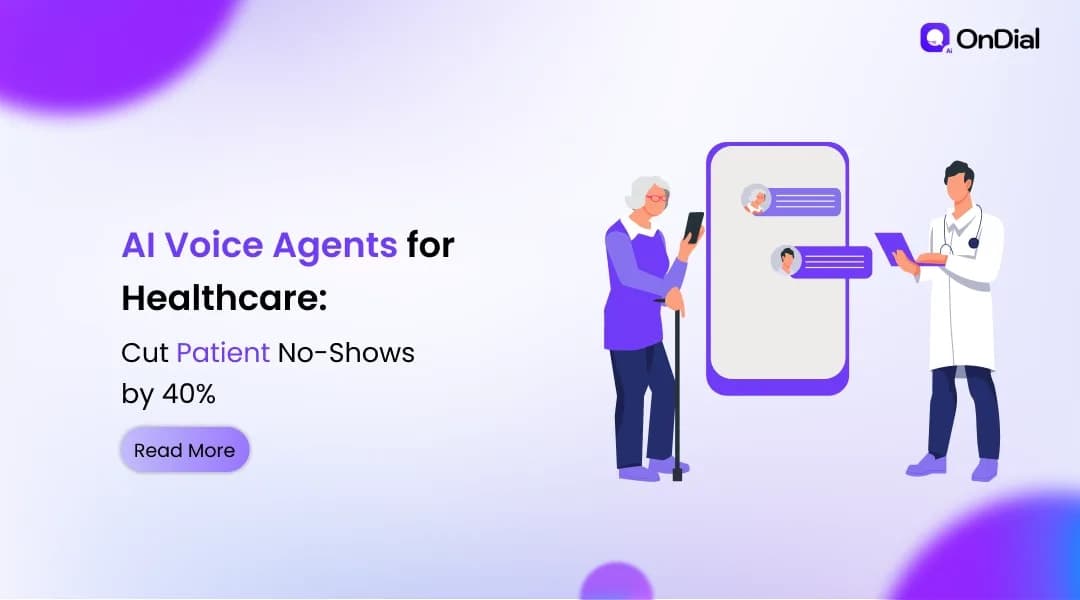
AI voice agents are changing this equation in a measurable way. Healthcare providers deploying intelligent, automated voice agents for appointment reminders and patient outreach are reporting no-show reductions of 25% to 40%, with some specialty clinics seeing even greater improvements. These are not robocalls reading a script. Modern AI voice agents conduct natural, two-way conversations with patients, confirm or reschedule appointments in real time, and operate around the clock in multiple languages. This blog will break down exactly how AI voice agents solve the no-show problem in healthcare, what measurable results providers are seeing, and what implementation looks like for clinics, hospitals, and multi-location practices.
Why Traditional Reminder Systems Fail to Solve Healthcare No-Shows
To understand why AI voice agents represent such a significant improvement, it helps to examine why existing reminder systems consistently underperform. Most healthcare providers rely on one or more of the following methods: manual phone calls from front desk staff, automated SMS or text reminders, email reminders, and patient portal notifications. Each of these has structural limitations that prevent them from meaningfully reducing no-show rates.
The Problem with Manual Reminder Calls
Manual reminder calls are the most labour-intensive and least scalable approach. A front desk coordinator can realistically make 15 to 20 effective reminder calls per hour, assuming each call takes about three minutes including dialling, waiting, speaking, and documenting the outcome. For a clinic with 100 daily appointments, this means dedicating five to seven staff hours purely to reminder calls. That is nearly a full employee's workday consumed by a task that still only reaches a fraction of scheduled patients.
The timing of manual calls creates another problem. Staff typically make calls during business hours, which is precisely when many patients are at work or commuting. Voicemails go unreturned, and the entire cycle is reactive rather than proactive. Manual calling campaigns typically achieve confirmation rates of 40% to 55%, leaving nearly half of all patients unconfirmed before their appointments.
The Limitations of SMS and Email Reminders
Text and email reminders are more scalable than manual calls, but they suffer from a fundamental limitation: they are one-directional or, at best, limited in their interactive capability. A patient who receives a text reminder saying "Reply 1 to confirm, 2 to cancel" has no easy path to rescheduling. Cancellation without rescheduling is actually a worse outcome than a no-show in some respects, because it still leaves the slot empty while removing the possibility that the patient might have shown up.
SMS open rates are strong, typically above 90%, but response rates for healthcare appointment reminders hover between 30% and 50%. Email reminders perform even worse, with healthcare email open rates averaging 20% to 25%. Neither channel supports the kind of dynamic, conversational interaction needed to understand why a patient might not make it and to offer an alternative time that works for them. The missing ingredient in both cases is real-time, two-way conversation at scale.
How AI Voice Agents Solve the No-Show Problem Systematically
AI voice agents address the core limitations of every traditional reminder method by combining the personal, conversational quality of a human phone call with the scalability, consistency, and availability of an automated system. Here is how the process works in practice when a healthcare provider deploys an AI voice agent for patient no-show reduction.
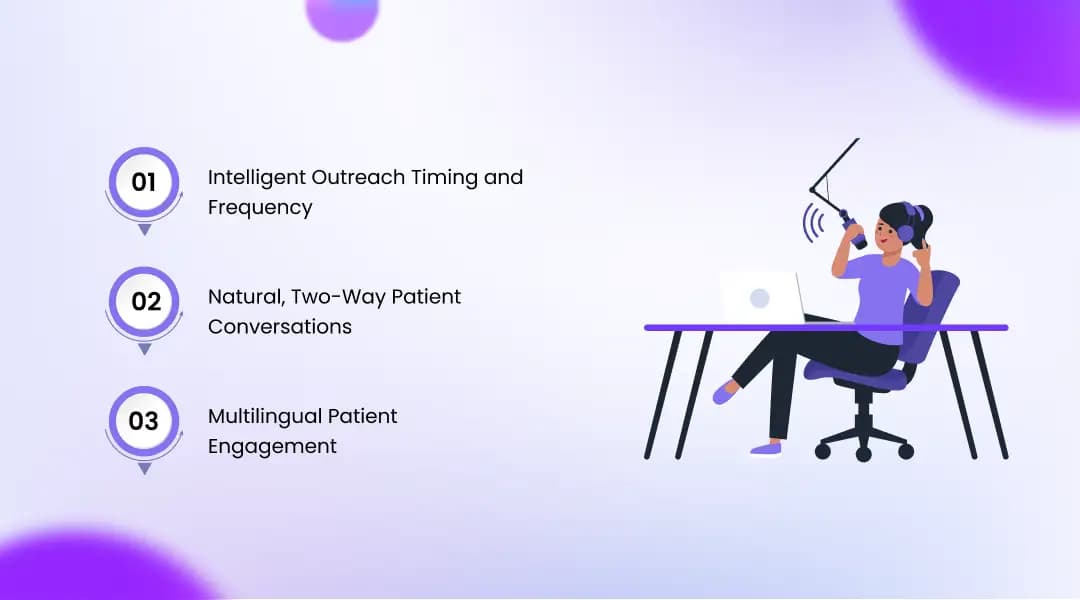
Intelligent Outreach Timing and Frequency
An AI voice agent does not just call patients once and hope for the best. The system is configured to make contact attempts at optimal times based on patient history, time zones, and answer rate patterns. A typical outreach sequence for a healthcare appointment might include an initial confirmation call 72 hours before the appointment, a follow-up call 24 hours before if the patient has not confirmed, and a same-day reminder call on the morning of the appointment. Each of these calls is placed automatically, and the system adjusts its timing to maximise the likelihood of reaching the patient.
Platforms like OnDial enable healthcare providers to configure these outreach sequences with granular control, setting the number of attempts, the intervals between them, and the specific times of day when calls should be placed. Because the AI operates 24/7 without fatigue or scheduling constraints, it can place calls during early morning or evening hours when patients are more likely to be available, something that is impractical for human staff bound by office hours.
Natural, Two-Way Patient Conversations
The most significant advantage of AI voice agents over SMS, email, or traditional robocalls is their ability to conduct genuine two-way conversations. When an AI voice agent calls a patient to confirm an appointment, it does not simply read a script and hang up. It listens to the patient's response, understands intent, and acts accordingly. If a patient says they cannot make it, the agent immediately offers alternative times. If a patient asks a question about preparation instructions or clinic location, the agent can provide that information. If a patient needs to speak with a human staff member, the agent can transfer the call seamlessly.
This conversational capability transforms the reminder call from a passive notification into an active engagement that resolves issues on the spot. A patient who would have silently no-showed because they forgot they had a conflict is instead rescheduled into another slot during the same call. A patient who was uncertain about fasting requirements gets their question answered and feels more confident about showing up. The AI voice agent handles all of this with sub-500 millisecond response latency, meaning the conversation feels natural and fluid rather than stilted and robotic.
Multilingual Patient Engagement
Healthcare providers in diverse communities face an additional challenge: communicating effectively with patients who speak different languages. A clinic serving a multilingual population cannot realistically staff front desk personnel who speak every language their patients speak. This communication gap directly contributes to no-shows, as patients who do not fully understand a reminder message are less likely to confirm or reschedule.
OnDial addresses this challenge with support for over 100 languages, including 9 Indian languages with more than 80 Indian voice variations. For healthcare providers in India and in diaspora communities globally, this means the AI voice agent can converse with patients in Hindi, Tamil, Telugu, Bengali, Marathi, Gujarati, Kannada, Malayalam, or Punjabi, using natural-sounding voices that patients recognise and trust. This multilingual capability is not a novelty. It is a direct driver of higher confirmation rates among patient populations that traditional English-only reminder systems fail to reach.
The Quantified Business Impact of AI Voice Agents on Healthcare No-Shows
Healthcare providers evaluating AI voice agents need concrete numbers to justify the investment. The data from real-world deployments is compelling across multiple dimensions.
Revenue Recovery
A healthcare practice with 100 daily appointments and a 20% no-show rate loses 20 appointment slots per day. At an average revenue of $150 to $250 per appointment, that represents $3,000 to $5,000 in daily lost revenue, or $780,000 to $1.3 million annually for a practice operating five days a week. Reducing the no-show rate by 40% recovers 8 of those 20 daily slots, translating to $1,200 to $2,000 in recovered revenue per day. Over a year, that amounts to $312,000 to $520,000 in revenue that was previously walking out the door.
These numbers scale linearly for larger practices. A hospital network managing 1,000 daily appointments across multiple locations can recover millions of dollars annually by deploying AI voice agents for appointment confirmation and rescheduling. The return on investment typically exceeds 10x within the first six months of deployment, making this one of the highest-ROI technology investments available to healthcare operations leaders.
Staff Time Reallocation
When an AI voice agent handles appointment confirmation calls, front desk staff are freed to focus on tasks that genuinely require human attention: greeting patients, handling complex insurance questions, managing intake paperwork, and providing the kind of personal attention that improves patient satisfaction scores. For a clinic that was previously dedicating 30 to 40 staff hours per week to reminder calls, AI voice agent deployment effectively recovers a full-time employee's worth of productive capacity without adding headcount.
Patient Satisfaction and Retention
Patients who receive timely, professional reminder calls in their preferred language report higher satisfaction with their healthcare provider. The consistency of AI-driven outreach means that every patient receives the same quality of communication, regardless of how busy the clinic is on any given day. Patients are not left wondering whether they have an appointment because the staff was too overwhelmed to call. The AI never forgets a patient, never skips a call because it ran out of time, and never sounds rushed or distracted.
How OnDial Works for Healthcare Appointment Management
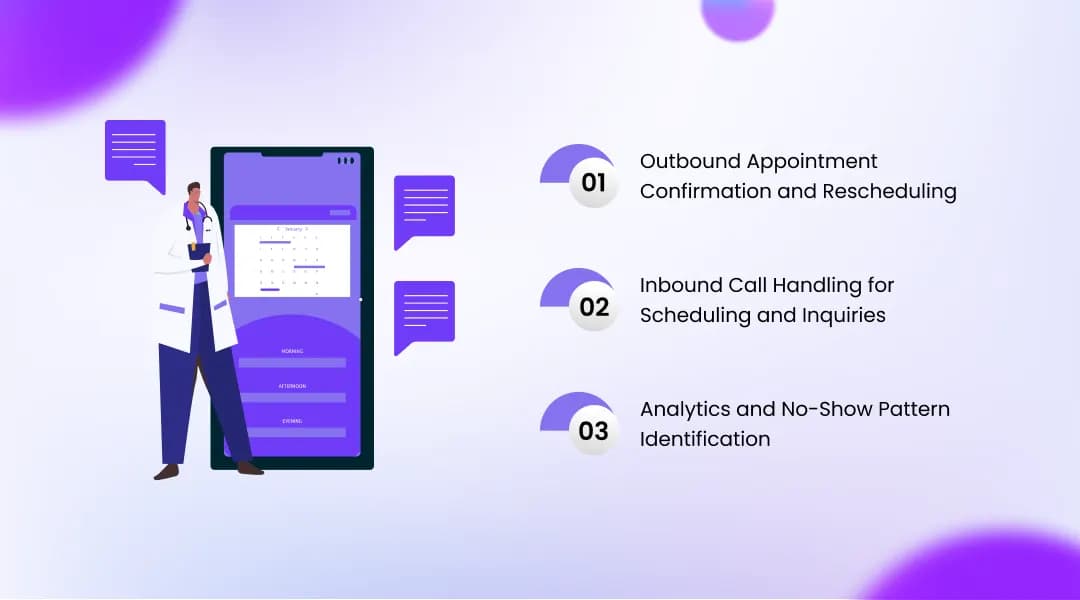
OnDial deploys production-grade AI voice agents specifically configured for healthcare workflows. The platform handles both inbound and outbound calling scenarios that directly impact no-show rates and overall patient engagement. Understanding the practical implementation helps healthcare leaders evaluate whether this approach fits their operational reality.
Outbound Appointment Confirmation and Rescheduling
OnDial's outbound AI voice agents call patients according to configured schedules, confirm appointments through natural conversation, and offer rescheduling options when patients indicate they cannot attend. The agent accesses the provider's scheduling system in real time, so it can offer actual available time slots during the call rather than telling the patient to call back during office hours. When a patient reschedules, the system automatically updates the calendar and can trigger a new confirmation sequence for the rescheduled appointment.
The agent handles common patient responses without human intervention:
Confirming attendance and adding the appointment to the patient's phone calendar.
Rescheduling to a different date or time with live availability lookup.
Cancelling and offering to rebook at a later date.
Answering questions about appointment preparation, clinic location, or required documents.
Transferring to a human staff member for complex medical questions or insurance issues.
Inbound Call Handling for Scheduling and Inquiries
No-show reduction is not only about outbound reminders. Many no-shows result from patients who tried to call the clinic to reschedule but could not get through. When phone lines are busy, patients often give up and simply do not show up for their appointment. OnDial's inbound AI voice agents answer every call instantly, 24 hours a day, 7 days a week, ensuring that no patient call goes unanswered. Whether a patient calls at 2 PM on a Tuesday or 11 PM on a Sunday, the AI agent can check availability, reschedule appointments, answer routine questions, and collect information for callbacks when human follow-up is needed.
Analytics and No-Show Pattern Identification
OnDial's smart analytics and call sentiment tracking capabilities give healthcare administrators visibility into no-show patterns that manual processes cannot provide. The platform tracks which patients are chronic no-showers, which appointment types have the highest no-show rates, which days and times are most affected, and how confirmation call outcomes correlate with actual attendance. This data enables proactive interventions, such as double-booking slots with historically high no-show rates or prioritising personal follow-up for patients flagged as high-risk for missing appointments.
Implementation: What Healthcare Providers Should Expect
Deploying an AI voice agent for healthcare no-show reduction is not a multi-year IT project. Modern platforms are designed for rapid deployment with minimal disruption to existing workflows. Here is what the implementation process typically looks like.
Integration with Existing Systems
The AI voice agent needs to connect with the practice's scheduling system to access appointment data, check availability, and update records when patients confirm or reschedule. OnDial supports both API integration for practices with custom EHR or scheduling systems and no-code deployment options for practices using standard platforms. The integration typically requires configuration rather than custom development, and most practices are operational within days rather than months.
Compliance and Patient Data Security
Healthcare providers are rightly cautious about any technology that handles patient information. AI voice agents for healthcare must comply with applicable data protection regulations, and the handling of patient data must meet the standards that healthcare organisations are held to. OnDial maintains GDPR and CCPA compliant data handling practices, providing healthcare administrators with the assurance that patient information is managed securely throughout the calling process. Practices should verify that any AI voice agent vendor they evaluate can demonstrate clear data handling policies, encryption standards, and compliance certifications.
Training and Customisation Period
While AI voice agents do not require the weeks of training that a new human employee does, there is a configuration period during which the agent's scripts, conversation flows, and scheduling logic are tailored to the specific practice. This includes setting up the appropriate voice and language options, defining the outreach schedule, configuring the escalation rules for when calls should be transferred to human staff, and testing the integration with the scheduling system. Most healthcare practices complete this configuration within one to two weeks and see measurable no-show reduction within the first 30 days of deployment.
Beyond Reminders: AI Voice Agents Across the Patient Journey
While no-show reduction is the most immediately quantifiable application, AI voice agents deliver value across the entire patient journey in healthcare settings. Providers who start with appointment reminders often expand their use of AI calling to other patient communication workflows.
Post-Visit Follow-Up and Care Coordination
AI voice agents can conduct post-visit follow-up calls to check on patient recovery, remind patients about prescribed medications or follow-up tests, and collect feedback about their care experience. These calls improve patient outcomes by catching potential complications early and improve provider reputation through consistent follow-up that patients notice and appreciate.
Waitlist Management and Slot Filling
When a patient cancels or reschedules, the freed-up slot can be automatically offered to patients on the waitlist. The AI voice agent calls waitlisted patients in priority order, offers them the newly available slot, and books the first patient who accepts. This automated waitlist management ensures that cancellations do not result in empty slots, further maximising appointment utilisation and revenue.
Conclusion
The no-show problem in healthcare is not an unsolvable challenge. It is a communication and engagement gap that AI voice agents are uniquely positioned to close. The three most important takeaways from this analysis are clear. First, traditional reminder methods, whether manual calls, texts, or emails, structurally fail to reach and engage enough patients to meaningfully reduce no-show rates. Second, AI voice agents solve this by combining the conversational quality of a human call with the scalability, consistency, and 24/7 availability that only automation can deliver. Third, the financial impact is substantial and measurable, with practices recovering hundreds of thousands of dollars in annual revenue while simultaneously freeing staff to focus on higher-value patient interactions.
OnDial delivers exactly this combination of capabilities for healthcare providers: production-grade AI voice agents with sub-500 millisecond response latency, support for over 100 languages including 9 Indian languages, 24/7 call handling, real-time scheduling integration, and compliant data handling. Whether you operate a single-location clinic or a multi-facility hospital network, the platform deploys quickly and delivers measurable no-show reduction within the first month. If your practice is losing revenue to patient no-shows, schedule a demo with OnDial today and see how an AI voice agent performs with your real appointment data.