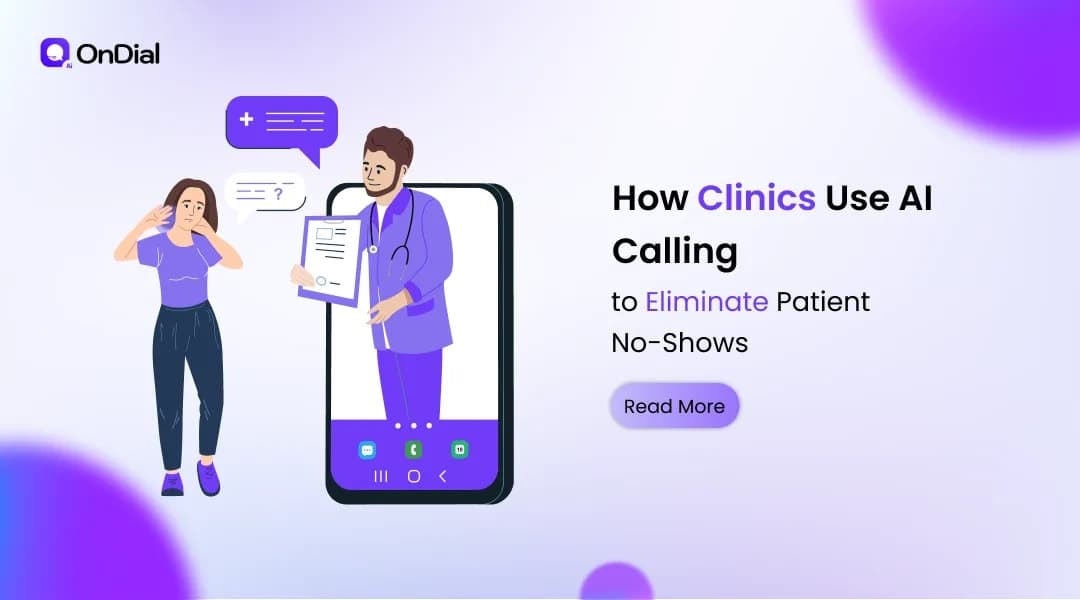
Patient no-shows create a problem that goes beyond an empty appointment slot. A missed visit can disrupt a provider's schedule, leave staff with unused capacity, delay care, and prevent another patient from taking the available time.
Most clinics already use some form of appointment reminder. SMS, email, automated notifications, and manual calls can all help patients remember when they are expected. The bigger challenge begins when a patient needs to change the appointment.
A patient may receive a reminder and realize that the scheduled time no longer works. If changing the appointment requires waiting on hold, navigating a portal, or calling the clinic during working hours, the patient may postpone the task and eventually miss the appointment.
AI calling addresses this gap by turning an appointment reminder into a two-way conversation. Instead of simply telling patients about an upcoming visit, an AI voice agent can confirm attendance, respond to routine questions, offer available alternatives, and trigger the next action.
This approach can be especially useful for clinics managing high appointment volumes, multiple providers, recurring follow-ups, or patients who prefer communicating by phone.
Why Clinics Continue to Struggle With Patient No-Shows
No-shows rarely have a single cause. Forgetfulness is one reason, but patients can also miss appointments because of schedule conflicts, transportation problems, uncertainty about appointment details, communication barriers, or difficulty contacting the clinic.
A reminder can address forgetfulness, but it does not necessarily solve these other problems.
Consider a patient who receives a message confirming an appointment for Thursday at 10 AM. The patient remembers the appointment but cannot attend because of a work commitment. A standard reminder has done its job, yet the appointment can still become a no-show.
A conversational calling system can take the interaction further. The patient can explain the conflict, receive available alternatives, and confirm a new appointment without having to restart the scheduling process.
This is an important distinction for clinics. The goal is not simply to remind more patients. The goal is to make it easier for patients to take the correct action before the appointment becomes a missed visit.
What AI Calling Means for Healthcare Scheduling
AI calling in healthcare refers to an AI voice agent that can conduct natural-language phone conversations and perform predefined tasks within a clinic's workflow.
The experience should be different from a traditional robocall or basic IVR menu.
Instead of asking a patient to press a number to confirm, the agent can communicate conversationally. It can identify the reason for the call, confirm relevant appointment information, understand the patient's response, and follow the appropriate workflow.
For example, a typical interaction might look like this:
The AI calls the patient before the scheduled appointment.
It identifies the clinic and explains the purpose of the call.
It confirms the appointment date, time, provider, or location.
The patient confirms, cancels, or requests a different time.
If rescheduling is required, the system checks available options.
The patient selects an appropriate slot.
The scheduling system is updated.
The patient receives confirmation of the new appointment.
The important part is that the patient does not have to complete the process through multiple disconnected channels.
How AI Calling Can Reduce No-Shows
1. Confirm appointments through conversation
A voice call creates an opportunity for patients to respond naturally rather than simply receiving information.
The agent can ask whether the patient plans to attend and identify situations that could prevent attendance. This makes the reminder an active part of the scheduling workflow rather than a passive notification.
For clinics looking at the broader role of conversational automation, AI voice agents for healthcare and medical providers can support appointment confirmations, scheduling, follow-ups, and other routine patient communication.
2. Make rescheduling easier
Rescheduling is one of the most valuable parts of an AI calling workflow.
When patients cannot attend, the system can guide them toward another available appointment instead of leaving them responsible for contacting the clinic later. Depending on the integration, available slots can be retrieved from the scheduling system and presented during the conversation.
This changes the outcome from:
Appointment conflict → missed appointment
to:
Appointment conflict → rescheduled appointment
The distinction matters because the patient still receives care and the clinic retains the opportunity to use its appointment capacity.
3. Handle routine questions before the appointment
Patients may hesitate to attend when they are uncertain about practical details.
They might want to know where the clinic is located, what time they should arrive, what documents they need, or whether specific preparation is required.
An AI voice agent can answer approved routine questions using information supplied by the clinic. Questions that require clinical judgment or human intervention can be transferred to an appropriate staff member.
This creates a more useful reminder experience without positioning AI as a replacement for clinical professionals.
4. Support multilingual patient communication
Language can affect how effectively patients understand appointment information.
This is particularly relevant for healthcare organizations serving multilingual communities in India and other diverse markets. Voice communication in a patient's preferred language can make appointment details easier to understand and can reduce the friction associated with written reminders.
The objective should not be to use the maximum number of languages simply for marketing. Clinics should prioritize the languages their actual patient population uses and ensure that the AI handles those conversations reliably.
5. Follow up on cancelled appointments
A cancellation does not necessarily have to become lost capacity.
When a patient cancels, the workflow can trigger another action. Depending on the clinic's scheduling process, the system can notify staff, initiate approved waitlist outreach, or begin a rebooking workflow.
This makes AI calling useful beyond the initial reminder. It becomes part of a broader appointment recovery process.
AI Calling vs SMS and Manual Reminder Calls
AI calling does not necessarily need to replace SMS or other reminder channels.
A stronger approach can combine communication methods based on the patient's preferences and the clinic's workflow.
SMS is useful for delivering concise appointment details that patients can reference later. Email can provide longer instructions when appropriate. Voice calls become particularly useful when the patient needs to confirm, explain a problem, ask a question, or reschedule.
Manual calls remain valuable for situations that require human judgment or a personal conversation. The opportunity with AI is to reduce the volume of repetitive calls reaching staff in the first place.
The best workflow is therefore not necessarily AI versus humans or voice versus SMS. It is a coordinated system where each channel has a clear purpose.
For a deeper explanation of conversational appointment reminders, see AI appointment reminders for reducing healthcare no-show rates.
What a Clinic Should Integrate Before Launching AI Calling
AI calling becomes much more useful when it connects to the systems already used by the clinic.
Scheduling system integration
The agent should be able to work with current appointment information rather than relying on manually uploaded lists that can quickly become outdated.
For example, if an appointment has already been cancelled by staff, the AI should not call the patient asking them to confirm it.
Similarly, when a patient reschedules, the new appointment information should flow back into the clinic's scheduling workflow.
Clear task boundaries
AI should have clearly defined responsibilities.
Appointment confirmation, basic scheduling questions, rescheduling, cancellation workflows, and approved administrative requests can be suitable use cases.
Clinical diagnosis, emergency situations, complex medical questions, and sensitive conversations should follow escalation rules that involve qualified human staff.
Human handoff
A reliable healthcare AI system needs an exit path.
When the conversation falls outside the agent's permitted scope, the patient should be able to reach a human or have the request routed for follow-up.
This is especially important when a patient describes a medical concern rather than a scheduling issue.
Data protection and governance
Healthcare organizations should evaluate how patient information is collected, transmitted, stored, accessed, and deleted.
Before deployment, teams should review the provider's security controls, contractual terms, applicable healthcare privacy requirements, access controls, audit processes, and data retention policies.
Compliance should be evaluated for the specific deployment and jurisdiction rather than assumed because a platform uses AI.
How Clinics Can Measure Whether AI Calling Works
Reducing no-shows should be the primary objective, but clinics should track several operational metrics to understand the complete impact.
No-show rate
Compare the no-show rate before and after implementation using a consistent measurement period.
Avoid judging the system from a few days of data. Appointment volume, specialty, seasonality, and patient mix can all influence results.
Confirmation rate
Measure how many patients respond to reminder outreach and how many confirm their appointment.
This shows whether the communication itself is reaching patients effectively.
Rescheduling rate
Track how frequently patients request a different appointment and whether those requests are completed successfully.
A high rescheduling rate is not necessarily negative. If patients who would previously have missed appointments are successfully rebooking, the process may be improving access.
Recovered appointment capacity
Measure how many cancelled or released slots are successfully reused.
This helps connect patient communication with actual scheduling efficiency.
Staff time saved
Track the volume of repetitive reminder and scheduling calls previously handled manually.
The goal is not simply to reduce headcount. It is to allow front desk teams to spend more time on patients who genuinely require human assistance.
For clinics that want to automate the booking and rescheduling workflow itself, OnDial's appointment scheduling service is designed around automated appointment conversations and scheduling workflows.
A Practical AI Calling Workflow for Clinics
A clinic does not need to automate every patient interaction at once.
A focused implementation can start with one appointment type, one department, or one location.
A practical workflow could look like this:
Step 1: Identify the problem
Measure the current no-show rate and identify which appointment types create the most scheduling friction.
Step 2: Define the AI's responsibilities
Decide exactly what the agent can confirm, answer, schedule, cancel, or escalate.
Step 3: Connect scheduling data
Give the system the appropriate access to appointment availability and ensure changes are synchronized correctly.
Step 4: Build the conversation
Create clear call flows for confirmation, rescheduling, cancellation, unanswered calls, and human escalation.
Step 5: Launch a controlled pilot
Start with a limited patient or appointment group rather than changing the entire scheduling operation immediately.
Step 6: Compare results
Measure no-shows, confirmations, completed reschedules, recovered slots, escalation volume, and staff workload.
Step 7: Expand carefully
Once the workflow performs consistently, expand it to additional providers, specialties, locations, or appointment types.
This approach gives healthcare teams a way to validate the operational value before committing to a larger rollout.
Where AI Calling Fits in the Patient Journey
The strongest use of AI calling is not limited to one reminder before an appointment.
The same communication infrastructure can support several administrative touchpoints throughout the patient journey.
Before an appointment, the system can confirm attendance and provide approved instructions.
After an appointment, it can conduct routine follow-up communication and collect feedback.
For recurring care, it can support scheduled outreach and help patients maintain contact with the provider.
For inbound calls, it can answer routine questions, help with scheduling, and route conversations that require human assistance.
This makes AI calling less about a single automation task and more about creating a consistent communication layer around the clinic's existing operations.
When AI Calling Is Not the Right Solution
AI calling is not automatically the answer to every no-show problem.
If a clinic has inaccurate scheduling data, unclear cancellation policies, poor patient records, or ineffective appointment availability, adding AI may simply automate an existing problem.
Similarly, patients should always have an appropriate way to reach a human when their situation requires it.
The technology works best when the underlying workflow is clear. AI can make that workflow faster and more consistent, but it cannot compensate for poorly defined processes.
Clinics should also evaluate whether patients actually prefer phone communication. The best patient communication strategy should reflect the audience, appointment type, urgency, accessibility requirements, and existing communication preferences.
Final Takeaway
AI calling can help clinics move beyond the limitations of one-way appointment reminders.
The biggest opportunity is not simply making more calls. It is giving patients a direct path from reminder to action.
A patient can confirm an appointment, explain a scheduling conflict, request a new time, receive approved information, or reach a human when needed. That reduces the friction that can turn a manageable appointment change into a missed visit.
For healthcare organizations, the most practical starting point is a focused pilot with measurable goals. Track no-show rates, confirmations, rescheduling outcomes, recovered appointment capacity, and staff workload before expanding the workflow.
When implemented with appropriate integrations, clear boundaries, human escalation, and healthcare data safeguards, AI calling can become a useful operational layer for clinics serving patients in India and across global markets.
OnDial provides AI voice automation for appointment scheduling, patient communication, inbound calls, reminders, and other business workflows.