Every quarter, insurance operations teams across the world run the same report and arrive at the same uncomfortable conclusion. A significant portion of lapsed policies belonged to customers who had no intention of leaving. They did not switch to a competitor. They did not cancel out of dissatisfaction. They simply never picked up the phone, never returned the voicemail, and never responded to the single reminder that was sent fourteen days before the policy expired. The revenue walked out the door not because the product failed, but because the communication did.
The scale of this problem is staggering. Industry data consistently shows that between 20% and 30% of insurance policy lapses are preventable, driven not by customer churn intent but by communication failure. For a mid-size insurer managing 50,000 active policies, that represents thousands of policies lost annually to what amounts to a timing and follow-up problem. Each lapsed policy carries not just the immediate premium loss but the lifetime value of a customer relationship, the cost of re-acquisition if the customer does return, and the regulatory reporting implications of rising lapse ratios.
The insurance industry has known about this problem for decades. What has changed is that AI voice agents for insurance policy renewal now offer a fundamentally different approach to solving it. Rather than relying on a single call from an overworked retention team or a generic SMS sent at an arbitrary date, AI voice agents deploy intelligent multi-touch calling sequences that adapt based on customer behaviour, time of day, language preference, and response history. This blog examines why traditional renewal calling strategies consistently underperform, what specific behavioural patterns drive non-renewal, and how automated policy renewal reminders using AI voice technology recover policies that would otherwise lapse.
The Real Reason Renewal Calls Fail Is Not What Most Insurers Think
Most insurance companies attribute policy lapse to price sensitivity or competitive switching. Internal reports focus on market conditions, competitor pricing, and customer satisfaction scores. These factors matter, but they obscure the largest single driver of preventable lapse: the customer never engaged with the renewal communication at all. The call was made, but it was made once, at the wrong time, to a customer who screens unknown numbers, and no meaningful follow-up occurred.
The typical renewal workflow at most insurance companies follows a rigid pattern. Approximately 30 days before policy expiry, the system generates a renewal notice, usually by email or physical mail. Around 14 days before expiry, an agent or automated system places a single outbound call. If the customer does not answer, a voicemail is left or the call is simply logged as "attempted." In some cases, an SMS follows. If none of these touchpoints generate a response, the policy lapses, and the customer enters a "winback" pipeline that costs three to five times more than retention would have.
Why a Single Call Is Structurally Insufficient
The problem with the single call model is not effort or intent. It is probability. Research into outbound calling effectiveness consistently shows that the probability of reaching a customer on the first attempt is between 15% and 25%, depending on the time of day, day of week, and whether the number displays caller ID. This means that for every 100 renewal calls placed, 75 or more do not result in a live conversation. The majority of these are not rejections. They are simply missed calls from customers who were busy, asleep, at work, or unwilling to answer an unrecognised number.
A single attempt gives insurers roughly a one in five chance of having the renewal conversation. When the stakes are a full year of premium revenue and the lifetime value of the customer relationship, those odds are unacceptable. Yet most insurers continue to operate this way because the alternative, making multiple well-timed calls per customer across thousands of policies, requires a level of staffing and coordination that manual teams simply cannot deliver.
The Behavioural Patterns Behind Non-Renewal
Understanding why customers do not respond to renewal calls requires looking at behaviour, not just logistics. Customers who lapse preventably tend to fall into identifiable behavioural categories. The first category is the screener, a customer who does not answer calls from unknown numbers and deletes voicemails from numbers they do not recognise. The second is the procrastinator, a customer who intends to renew but needs multiple prompts spread across days or weeks before they take action. The third is the confused customer, someone who received a renewal notice but does not understand the terms, the new premium, or the process for renewing, and whose confusion turns into inaction.
Each of these behavioural types requires a different communication strategy. The screener needs calls from a recognised or local number, at varied times, with a clear voicemail that identifies the purpose immediately. The procrastinator needs a sequence of escalating urgency spread across multiple touchpoints. The confused customer needs a call that is conversational rather than transactional, one that answers questions and walks them through the renewal. A single outbound call at a fixed time cannot address any of these needs effectively.
How AI Voice Agents Transform the Renewal Calling Workflow
Insurance renewal call automation through AI voice agents replaces the single attempt model with an intelligent, adaptive, multi-touch calling strategy that operates at scale without proportional increases in staffing cost. The difference is not simply that AI makes more calls. The difference is that AI makes smarter calls, timed better, personalised to the customer, and structured as a sequence rather than a single event.
When a policy enters the renewal window, an AI voice agent system initiates a pre-configured calling sequence. The first call might occur 45 days before expiry, framed as an informational call rather than a hard renewal push. If the customer answers, the AI agent confirms their details, explains the renewal terms in plain language, and offers to process the renewal immediately or schedule a callback. If the customer does not answer, the system logs the attempt, adjusts the next call timing based on historical pickup patterns for that customer segment, and tries again at a different time of day or day of week.
Multi-Touch Sequences That Match Customer Behaviour
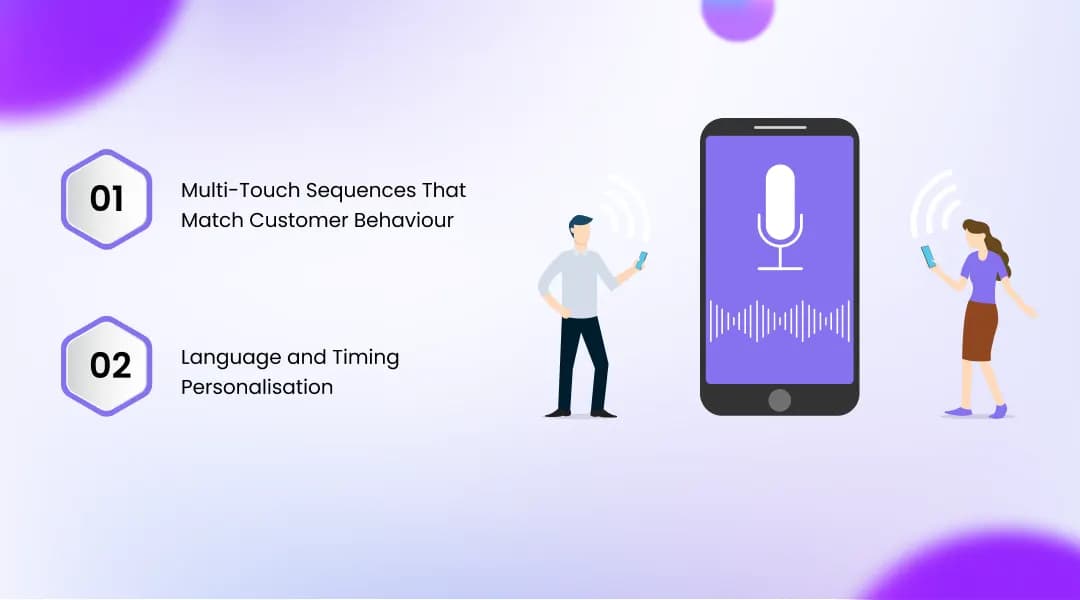
The power of AI calling for insurance companies lies in the ability to run multi-touch sequences that would be logistically impossible for human teams. A typical AI renewal sequence might include five to seven contact attempts spread across three to four weeks, each with a slightly different script, a different time slot, and escalating urgency as the expiry date approaches. Early calls are informational and low pressure. Mid-sequence calls reference the approaching deadline. Final calls communicate urgency and offer to connect the customer with a human agent if they have questions.
OnDial's AI voice agent platform supports this kind of sequenced calling natively, allowing insurance operations teams to design renewal workflows that include conditional branching. If a customer answers on the second call and says they need to discuss pricing, the system can flag the policy for a human callback from the retention team while continuing automated sequences for the remaining non-responsive customers. If a customer answers and confirms they want to renew, the AI agent can walk them through the process in real time, collect verbal confirmations, and update the CRM accordingly.
Language and Timing Personalisation
One of the most overlooked factors in renewal call effectiveness is language. In multilingual markets, particularly in India, the Middle East, and parts of Europe, customers who receive calls in a language that is not their primary spoken language are significantly less likely to engage. They may understand the language but feel less comfortable conducting a financial transaction in it. They may not fully grasp the renewal terms. Or they may simply disengage because the call feels impersonal.
OnDial addresses this directly with support for over 100 languages, including 9 Indian languages with more than 80 Indian voice variations. For an Indian insurance company managing policies across Maharashtra, Tamil Nadu, Gujarat, and West Bengal, this means renewal calls to a customer in Pune are conducted in Marathi, calls to Chennai in Tamil, and calls to Kolkata in Bengali. This is not a cosmetic improvement. It directly affects whether the customer stays on the line, understands the renewal terms, and completes the renewal. The combination of language personalisation and intelligent timing, where calls are placed at hours when the customer is statistically most likely to answer, creates a renewal contact rate that is fundamentally higher than the traditional single call approach.
The Economics of AI Renewal Calling Versus Manual Teams
The financial case for automated policy renewal reminders is compelling when examined at the per-policy and per-call level. Consider a mid-size insurance company with 80,000 policies renewing annually. Under the manual model, a renewal team of 15 agents can each handle approximately 40 to 50 outbound calls per day, with meaningful conversations on roughly 10 to 12 of those calls. Across a month, this team reaches a fraction of the renewing portfolio, and the calls they make are single-attempt contacts with no systematic follow-up.
Under an AI voice agent model, the same insurer deploys automated renewal sequences across the entire renewing portfolio. Every policy holder entering the renewal window receives a structured multi-touch calling sequence. The AI system handles thousands of simultaneous calls, operates 24 hours a day and 7 days a week, and requires no additional headcount regardless of whether the renewal volume in a given month is 5,000 or 15,000 policies. The per-call cost drops dramatically compared to human agent calls, and the contact rate increases because the system makes multiple attempts at optimised times rather than a single attempt during business hours.
Reducing Lapse Rates by Addressing the Follow-Up Gap
The direct impact of this approach on lapse rates is measurable. Insurers who move from single-touch to multi-touch renewal calling typically see a reduction in preventable lapse rates of 25% to 40%. This is not because the AI agent is more persuasive than a human. It is because the AI agent makes five to seven contact attempts where the human team made one. The customer who missed the Tuesday afternoon call gets called again on Thursday morning, and again on Saturday at noon, and again the following Wednesday evening. The probability of making contact across five attempts is dramatically higher than across one.
For an insurer losing 6,000 policies per year to preventable lapse, recovering even a quarter of those through improved renewal contact rates represents millions in retained annual premium. OnDial's analytics dashboard tracks renewal sequence performance in real time, showing which call in the sequence generated the conversion, which time slots produce the highest answer rates, and which customer segments require more or fewer touches. This data does not just improve the current renewal cycle. It continuously refines the approach for subsequent cycles.
What Happens During an AI Renewal Call
A common concern among insurance operations leaders considering AI calling is whether the customer experience will feel impersonal or robotic. This concern is valid for older IVR systems and basic robo-diallers, but modern AI voice agents operate at a fundamentally different level of conversational capability. An AI renewal call powered by a platform like OnDial sounds natural, responds in real time with sub-500 millisecond latency, and handles the conversational flow of a renewal discussion with genuine flexibility.
A typical AI renewal call begins with the agent identifying itself, naming the insurance company, and stating the purpose of the call. The agent confirms the customer's identity using security questions or date of birth verification. It then explains the renewal terms, including any changes to the premium, coverage adjustments, or new options available. If the customer has questions, the AI agent answers from a knowledge base that includes FAQs, policy terms, and common objections. If the customer wants to renew immediately, the agent walks them through verbal confirmation and payment options. If the customer needs time, the agent schedules a follow-up call for a date and time the customer specifies.
Handling Objections and Escalations
The AI agent does not simply read a script. It recognises objection patterns and responds appropriately. When a customer says the premium is too high, the agent can explain value, reference coverage benefits, or offer to connect the customer with a human retention specialist who has authority to discuss pricing. When a customer says they want to cancel entirely, the agent captures the reason, offers relevant alternatives if applicable, and logs the interaction for the retention team. The call sentiment analysis built into platforms like OnDial tracks the emotional tone of these conversations, flagging calls where customers expressed frustration or dissatisfaction for priority human follow-up.
This approach ensures that the AI handles the volume while humans handle the complexity. The retention team is no longer spending 70% of their time dialling numbers and leaving voicemails. They are spending their time on the 15% to 20% of customers who need a real conversation about pricing, coverage, or claims concerns. Every other customer, the ones who just need to be reminded, walked through the process, and given an easy path to renewal, is handled entirely by the AI.
Building the Renewal Workflow from Scratch
For insurance companies considering AI voice agents for the first time, the implementation path for renewal calling is one of the most straightforward and highest-ROI starting points. The workflow has clear inputs (policy renewal dates and customer contact details), clear outputs (renewed or escalated or lapsed), and clear success metrics (contact rate, renewal conversion rate, and lapse rate reduction). This makes it an ideal candidate for a first AI voice deployment.
Designing the Sequence
The first step is designing the calling sequence. This involves deciding how many contact attempts to make per policy, across what timeframe, and with what escalation logic. A common starting configuration is six attempts across 30 days, starting with an informational call at day minus 45, a renewal offer call at day minus 30, a reminder call at day minus 21, an urgency call at day minus 14, a final reminder at day minus 7, and a last-chance call at day minus 2. Each call in the sequence has a distinct script, a distinct tone, and distinct conditional branching based on the customer's response or non-response.
OnDial's platform supports no-code workflow design, meaning that insurance operations teams can build, test, and modify these sequences without engineering support. The workflow builder allows teams to set calling windows (avoiding late night or early morning calls), define language preferences per customer segment, and configure what happens at each decision point in the call. For companies that prefer API integration, OnDial also supports full API deployment, connecting the AI calling system directly to the policy management platform so that renewal sequences trigger automatically when a policy enters the renewal window.
Measuring and Optimising Performance
Once the workflow is live, the critical next step is measurement. The metrics that matter for renewal calling are contact rate (percentage of customers who answered at least one call in the sequence), conversation rate (percentage of contacted customers who engaged in a meaningful renewal discussion), renewal conversion rate (percentage of conversations that resulted in a confirmed renewal), and escalation rate (percentage of calls that required human follow-up). OnDial's smart analytics dashboard tracks all of these in real time and provides historical trend data that allows operations teams to see exactly which parts of the sequence are working and which need adjustment.
Call sentiment tracking adds another layer of insight. By analysing the emotional tone and language patterns across thousands of renewal calls, the system identifies systemic issues. If a significant percentage of customers express confusion about a particular policy change, that insight feeds back into product and communications strategy. If customers in a specific region consistently respond better to calls in the evening versus the morning, the system automatically adjusts the timing for that segment. This continuous optimisation loop is something that manual renewal teams simply cannot replicate at scale.
Compliance and Data Security in AI Renewal Calling
Insurance is a regulated industry, and any communication with policyholders must comply with data protection regulations, call recording requirements, and consent management rules. This is a non-negotiable consideration when deploying AI voice agents, and it is an area where many early-stage AI calling platforms fall short.
OnDial is built with GDPR and CCPA compliance as a foundational requirement, not an afterthought. Call recordings are stored securely with appropriate encryption and retention policies. Customer consent for automated calling is captured and managed within the workflow, ensuring that every call made by the AI agent complies with the relevant regulatory framework. For insurers operating across multiple jurisdictions, the platform supports jurisdiction-specific consent rules, ensuring that a renewal call to a customer in the EU follows GDPR requirements while a call to a customer in California follows CCPA requirements.
This compliance infrastructure is critical for insurance companies because regulatory penalties for improper automated calling can be severe, and customer trust is the foundation of the insurance relationship. An AI calling system that handles compliance poorly does not just create legal risk. It damages the customer relationship it is supposed to protect. Building renewal automation on a platform that handles compliance natively eliminates this risk and allows the operations team to focus on renewal outcomes rather than regulatory anxiety.
Conclusion
The insurance industry's policy lapse problem is not primarily a product problem or a pricing problem. It is a communication problem. Customers lapse because they are not contacted at the right time, in the right language, with the right frequency, and with the right level of conversational support to make renewing easy. The single-call renewal model that most insurers still rely on gives them roughly a one-in-five chance of reaching each customer, and the policies that slip through become expensive winback campaigns or permanent losses.
AI voice agents solve this by replacing the single attempt with an intelligent, adaptive, multi-touch calling sequence that reaches customers where and when they are most likely to engage. The technology handles the volume, the timing, the language personalisation, and the compliance requirements, while human retention specialists focus their expertise on the customers who need real conversations about coverage and pricing. The result is measurably lower lapse rates, higher renewal revenue, and a better customer experience.
OnDial delivers exactly this capability, purpose-built for insurance operations teams that need to reduce lapse rates without scaling headcount. With sub-500 millisecond response latency, support for over 100 languages, no-code workflow design, and real-time analytics that continuously optimise renewal sequences, OnDial gives insurers the infrastructure to make every renewal contact count. If your organisation is losing policies to communication gaps rather than customer intent, schedule a demo with OnDial to see how automated renewal calling works in practice and what it can recover for your business.