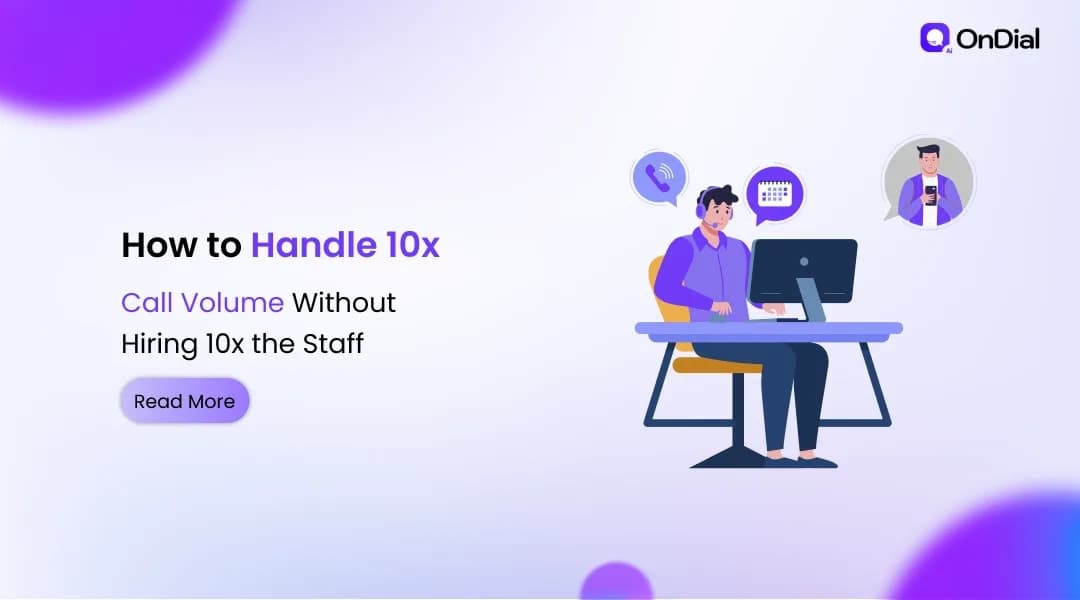
When call volume rises, hiring more people seems like the obvious answer.
A marketing campaign can generate hundreds of new enquiries in a few hours. A seasonal promotion can overload customer support. A product launch can create a sudden wave of order questions. In India, demand can also rise sharply around festivals, admissions, renewals, travel periods, and financial cycles.
The problem is that human capacity does not increase as quickly as customer demand.
Recruitment takes time. New employees need training. Managers need to supervise them. And when the spike disappears, the business may be left carrying a larger fixed workforce than it actually needs.
A more scalable approach is to redesign how calls are handled.
Instead of sending every caller directly to a human agent, businesses can combine AI voice agents, intelligent routing, self service, proactive communication, analytics, and human escalation. The objective is not to remove people from customer conversations. It is to make sure people spend their time on conversations where human judgment creates the most value.
Why High Call Volume Becomes a Business Problem
High call volume is not automatically bad.
More calls can mean more customers, stronger demand, more leads, or increased usage of an existing service. The problem starts when the communication infrastructure cannot absorb that demand.
A typical high volume operation begins to show the same symptoms:
Longer waiting times
Missed calls
Abandoned calls
Repeated customer calls
Agents spending most of their time answering routine questions
Slower lead follow up
Inconsistent responses
Increasing employee fatigue
More transfers between departments
Poor visibility into why customers are calling
These problems can reinforce one another.
A customer who cannot get through may call again. Another customer may abandon the queue and try a competitor. An overloaded employee may rush a conversation, creating another follow up call.
The result is that call volume grows faster than the original demand because the system itself is creating additional interactions.
Why Hiring More Agents Does Not Always Solve the Problem
Hiring is useful when a business genuinely needs more human expertise. It becomes inefficient when recruitment is being used as the default response to every temporary or repetitive volume increase.
Consider a business that receives a major increase in calls for three months.
Hiring additional agents requires recruitment, interviews, onboarding, training, scheduling, management, quality monitoring, and eventually workforce adjustments when demand returns to normal.
There is also a capacity problem.
If 500 customers call at the same time, adding a few employees does not instantly create 500 additional conversations. The business still has to manage queues, availability, breaks, shifts, transfers, and training.
This is why scalable call operations need a technology layer between demand and human capacity.
The Scalable Call Architecture
A modern call operation can be structured into four layers.
Layer 1: Automated first response
AI voice agents answer calls immediately and identify why the customer is calling.
They can handle repetitive tasks such as appointment scheduling, order status questions, FAQs, lead qualification, confirmations, reminders, and basic information requests.
The important principle is to automate based on call intent rather than trying to automate every possible conversation.
Layer 2: Intelligent routing
If a conversation requires a human, the system should determine who should receive it.
A billing issue should not reach a sales representative. A high value sales lead should not wait behind a basic status enquiry. A sensitive complaint may require a specialised support agent.
AI can identify intent before transferring the conversation, reducing unnecessary transfers and helping the human agent start with useful context.
Layer 3: Human expertise
Human agents remain responsible for conversations that require judgment, negotiation, empathy, approval, or specialised knowledge.
This changes the role of the human team.
Instead of spending most of the day repeating basic information, agents can focus on exceptions, complex cases, high value opportunities, and relationship driven interactions.
Layer 4: Analytics and optimisation
Every interaction creates operational information.
Businesses can analyse why customers call, which requests are resolved automatically, which situations cause escalation, when demand peaks, and where customers experience friction.
This information should then influence the next version of the call workflow.
7 Practical Ways to Scale Call Volume Without Hiring
1. Automate repetitive inbound calls
Start with the conversations that are predictable and repetitive.
Examples include:
Appointment booking and rescheduling
Order and delivery status
Business hours and location questions
Lead qualification
Customer confirmations
Basic account enquiries
Frequently asked questions
Callback requests
Survey collection
These are often better starting points than trying to automate complex complaints or high risk decisions immediately.
OnDial's AI voice agents can answer inbound and outbound calls, understand customer intent, access connected business information, complete workflows, and escalate conversations when human involvement is needed.
The goal is simple: let automation absorb repeatable demand while the human team handles exceptions.
2. Use AI to qualify calls before human involvement
Not every caller has the same value or urgency.
A sales team may receive hundreds of enquiries, but only a portion may meet its qualification criteria. A support team may receive thousands of calls, but many may involve simple questions that do not require specialist attention.
An AI voice agent can collect the information needed to classify the interaction.
For example, a real estate business could identify the customer's preferred location, property type, budget range, and purchase timeline before transferring a qualified prospect to a sales representative.
The representative receives a more useful conversation instead of starting with basic discovery questions.
3. Introduce intelligent human handoffs
Automation should not become a dead end.
A strong AI calling workflow needs a clear escalation path. When the conversation exceeds the AI's scope, the system should transfer the caller to a human with relevant context.
That context can include the caller's intent, answers already provided, conversation summary, and other information available from connected systems.
This prevents the frustrating experience where a customer explains the same problem twice.
For high volume operations, this distinction matters. The objective is not maximum automation. The objective is maximum useful resolution.
4. Reduce predictable call demand before the phone rings
Some calls can be prevented through proactive communication.
Suppose a business knows that customers frequently call after placing an order because they want delivery updates. Instead of waiting for those calls, the business can send status notifications automatically.
The same approach can work for appointment reminders, payment reminders, service updates, booking confirmations, and follow ups.
Call deflection is therefore not simply about pushing customers away from the phone. It is about answering predictable questions before they become phone interactions.
Businesses evaluating this approach can also review AI call center software features as part of their broader call infrastructure planning.
5. Prepare for peak periods before they happen
The worst time to design a surge strategy is during the surge.
Review historical call data and identify predictable patterns.
Look for:
Days with unusually high volume
Peak hours
Seasonal demand
Marketing campaign spikes
Product launch periods
Payment or renewal cycles
Geographic demand patterns
Common questions during previous peaks
Then create predefined workflows for those periods.
For an Indian business, this could mean preparing different call flows for festival campaigns, admission periods, insurance renewals, loan campaigns, travel seasons, or major promotional events.
A voice AI layer can provide additional capacity without requiring the company to build a completely new team for every temporary increase.
How India Based Businesses Can Benefit
India presents an interesting challenge for high volume voice operations.
Customers may speak English, Hindi, Hinglish, or regional languages. They may also switch languages during the same conversation.
A scalable voice system therefore needs to account for more than call quantity. It needs to account for language, accents, customer context, and regional communication preferences.
OnDial supports multilingual AI voice interactions and describes capabilities including regional accents, language switching, and multilingual conversations.
This can be particularly useful for businesses serving customers across multiple Indian states while maintaining a consistent service process.
The same architecture can also support global operations where customers call across different time zones and languages.
For a broader view of how voice AI can affect customer experience in India, businesses can also explore AI voice agents for improving customer experience in India.
How to Decide What to Automate First
Do not begin by asking, "How many calls can AI handle?"
Start with better questions.
Which calls happen most often?
Look at the largest categories in your call data.
If thousands of customers ask the same few questions every month, those conversations are strong candidates for automation.
Which calls follow predictable workflows?
A conversation is easier to automate when the business process is clearly defined.
Appointment booking is a good example. The AI needs to understand the request, check availability, confirm the slot, and record the outcome.
Which calls require human judgment?
Create a clear boundary.
Sensitive complaints, complex negotiations, unusual cases, regulated decisions, and situations requiring authority should have a defined human escalation path.
Which calls create the most business value?
Volume alone should not determine automation priority.
A low volume conversation may be more valuable than thousands of routine enquiries. Lead qualification is one example where the objective is not simply reducing workload but improving how quickly valuable opportunities reach the sales team.
Measure Capacity, Not Just Automation
A successful AI voice deployment should be measured using operational outcomes.
Useful metrics include:
Call answer rate
How many incoming calls are answered successfully?
Abandonment rate
How many callers leave before reaching a resolution?
AI resolution rate
How many conversations are completed without human intervention?
Escalation rate
How often does the AI need to transfer a conversation?
A rising escalation rate may indicate that the workflow needs improvement, not necessarily that AI is unsuitable.
Average handling time
Measure whether automation is reducing unnecessary conversation time without rushing customers.
First contact resolution
The best outcome is not simply a short call. It is solving the customer's problem without requiring another interaction.
Agent utilisation
Track whether human agents are spending more time on high value or complex conversations after automation is introduced.
Customer satisfaction
Capacity improvements only matter if the customer experience remains strong.
What a Scalable AI Voice Workflow Looks Like
A practical workflow can look like this:
A customer calls the business.
The AI voice agent answers immediately.
The system identifies the caller's intent.
The AI checks the required business information.
A routine request is completed automatically.
The outcome is recorded in the relevant system.
A confirmation is sent when necessary.
A complex request is transferred to a human.
The human receives the conversation context.
The interaction becomes data for future optimisation.
This architecture allows businesses to increase communication capacity without making every additional call dependent on another employee.
OnDial positions its AI voice platform around this combination of conversation, business system integration, workflow execution, analytics, and human handoff.
When AI Voice Agents Are Not the Right First Step
AI should not be deployed simply because call volume is high.
If the business has poorly documented processes, inconsistent policies, inaccurate customer data, or no clear escalation rules, automation can reproduce those problems at a larger scale.
Before implementation, document the most common call types and define what the AI can answer, what actions it can take, what information it can access, and when it must transfer the caller.
The technology should follow a well designed process, not replace the need for one.
A Practical 30 Day Plan
Businesses can approach call volume scaling incrementally.
Week 1: Audit the calls
Categorise recent calls by intent, volume, duration, outcome, and escalation requirement.
Week 2: Select the first use cases
Choose a small group of high volume, repetitive conversations with clear workflows.
Week 3: Build and test
Create the AI conversation flows, connect the required systems, define escalation rules, and test unusual customer responses.
Week 4: Launch and measure
Start with a controlled deployment. Monitor resolution, escalation, customer feedback, and human agent workload.
Then expand into additional use cases based on actual call data.
This approach is safer and more measurable than attempting to automate an entire contact center at once.
The Real Goal Is Scalable Customer Communication
Scaling call volume without hiring is not about eliminating the human element.
It is about separating repetitive work from work that genuinely requires people.
AI voice agents can provide the first response, collect information, answer routine questions, complete defined workflows, and route complex conversations. Human agents can then concentrate on decisions, relationships, exceptions, and situations where empathy or expertise matters.
That creates a more flexible operating model.
The next time call volume rises, the answer does not have to be another recruitment cycle. The business can increase automated capacity, refine routing, improve self service, and use the data from previous conversations to prepare for the next demand spike.
For businesses looking to build that infrastructure, OnDial AI Voice Agents provides a platform for automating inbound and outbound conversations while connecting voice interactions with business workflows.
The broader objective is straightforward: answer more customers, resolve more requests, protect service quality, and give human teams more time for work that actually needs them.
If you want to see how this approach fits into a broader AI voice strategy, OnDial offers AI voice automation for businesses handling customer conversations across industries and regions.