Most business calls start with someone wanting something, and the first question is who dials. An outbound AI voice agent places that call for you, and an inbound agent answers when the customer rings. Sales teams run AI outbound call agents for follow-ups, while support teams use inbound agents to clear queues.
The two look like mirror images, but they fail in different ways. Inbound breaks when a caller hits a dead end. Outbound breaks when a call goes out without consent or lands at the wrong moment.
So the cleanest way to choose is to follow the intent and track how fast it decays. Live intent belongs to inbound. Stored intent, such as a form fill or a renewal date, belongs to outbound.
Follow the Intent: A Two-Minute Test for Picking a Call Direction
Automate the direction where customer intent leaks fastest today. If people call and cannot get through, intent is dying on your phone line. If leads fill forms and wait hours for a call, it is dying in your CRM instead.
Think of each inquiry as having a half-life. A caller on hold has minutes of patience left. A web lead may cool within the hour, while a renewal reminder can usually wait a few days.
Run this check against last month’s data before any vendor demo:
Count calls that rang out, reached voicemail, or dropped on hold, and group them by hour.
Measure the median gap between a form submission and the first dial attempt on that lead.
List scheduled events, like appointments, EMI dates, or renewals, that currently get no reminder call.
Estimate which leak touches more revenue per week, because that figure picks your first deployment.
The longer, costlier list sets your starting direction. If the CRM list wins, an outbound AI voice agent is the natural first build. Most teams eventually run both, yet starting with one keeps the first rollout easy to measure.
What Changes When an Outbound AI Voice Agent Dials Instead of Answers
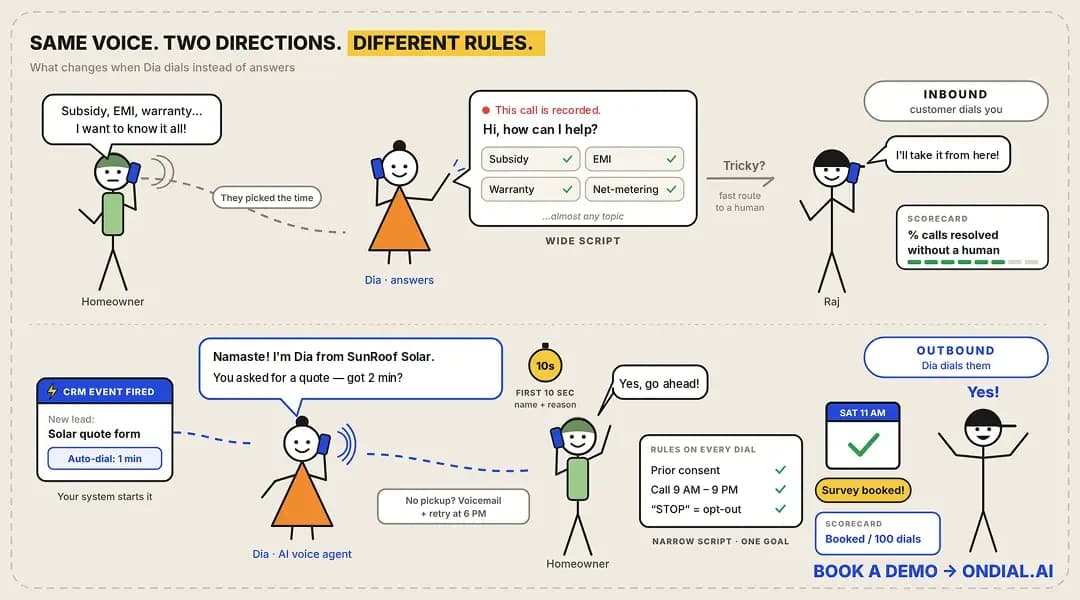
The speech engine stays the same, but nearly everything around it flips. The trigger, the script, the legal duties, and the scorecard all change once your system places the call.
An inbound agent meets a person who already chose to talk. So it needs broad knowledge and a quick route to a human. Outbound starts colder, because the person did not plan this moment.
That first outbound sentence carries most of the weight. It must name the business, state the reason, and earn the next ten seconds. Otherwise, the person hangs up before the useful part begins.
Here is how inbound vs outbound voice AI differs on the points that shape budgets and risk:
Scoping question | Inbound agent | Outbound agent |
Who starts the conversation | The customer, at a moment they picked | Your system, after a CRM or calendar event fires |
What the person expects first | Help with a problem they can already describe | A clear name and reason before anything else |
How wide the script must be | Wide enough for almost any topic a caller raises | Narrow, built around one outcome per campaign |
Where billed minutes go | Mostly conversations the customer asked for | Conversations plus voicemails, retries, and screening |
Main legal exposure | Recording notices and handling of personal data | Prior consent, calling windows, and opt-out handling |
Number that proves it works | Share of calls resolved without a human | Booked outcomes per hundred dials attempted |
How a Voice AI Agent Handles a Call, Step by Step
Each call runs through the same five-stage loop in both directions. Outbound simply adds checks before the dial and after the pickup.
The core pipeline works in this order:
Telephony connects the call through a carrier number, a SIP trunk, or your cloud phone system.
Streaming speech recognition converts the caller’s audio into text while they are still speaking.
A language model reads that text alongside your instructions, knowledge base, and the customer’s CRM record.
Tool calls take actions mid-conversation, such as booking a slot, updating a lead, or texting a link.
Text-to-speech replies in the chosen voice, then the transcript and outcome flow back into the CRM.
Inbound adds routing logic at the front, so the agent can replace a press-one menu and transfer by intent. By contrast, an outbound AI voice agent needs four extra layers:
A consent check that confirms valid permission before the dialer releases a number.
A pacing rule that caps attempts per contact and respects local calling hours.
Answering machine detection that decides quickly whether to leave a message or hang up.
A retry schedule that spaces attempts instead of redialing the same person every hour.
Latency matters on both sides. Even a one or two second pause after someone stops talking can make the agent feel scripted.
Inbound Use Cases Where Live Intent Pays Off
Inbound automation pays off wherever callers reach you at moments your staff cannot cover. Close to half of business calls do not reach a human today. Across more than 70 million calls in 10 industries, Invoca’s July 2026 benchmarks found people answered just 56%.
These inbound jobs usually deliver value first, because the conversation follows a predictable shape:
After-hours coverage for clinics, dealerships, and property firms whose callers ring outside office time.
Appointment booking and rescheduling against a live calendar, with an SMS confirmation going out mid-call.
Order, delivery, or claim status lookups pulled from your system using the caller’s phone number.
Intent-based routing that retires the old keypad menu and transfers callers with a short summary attached.
Overflow handling during campaign launches, when a sudden surge would otherwise sit in a queue.
Keep refunds, complaints, and emotional calls on a human path from day one. Good inbound call AI knows when to stop talking and hand over. The guide Automate inbound calls with an AI agent walks through the setup steps.
Outbound Agent Use Cases Built Around Intent That Expires

An outbound AI voice agent works best when the person expects your call and it has one job. Speed explains most of its value. A 2011 Harvard Business Review audit of 2,241 US firms found an average first reply of 42 hours.
That average only counted firms that replied within 30 days. Per the same article, first-hour outreach made qualification nearly seven times likelier than trying an hour later.
Strong outbound jobs share a trigger, a single goal, and a person who opted in:
New web leads called within seconds of a form submission, then qualified and booked onto a calendar.
Appointment confirmations a day ahead, with an option to move the slot during the same call.
EMI, premium, or subscription reminders that text a payment link, so nobody reads card numbers aloud.
Callbacks to missed inbound calls, placed while the caller still remembers why they rang.
Short feedback surveys after a delivery or service visit, kept free of sales offers.
Revenue teams usually start with the first item, since each hour of delay drains qualified pipeline. Our breakdown of AI sales calling agents for outbound outreach goes deeper on that sales workflow. Cold lists are a different story, though, and outbound calling automation cannot rescue a weak lead source.
The Handoff Loop Between Inbound and Outbound Agents
The two directions feed each other, so design the handoff before launching either one. A missed inbound call becomes a callback task for the outbound AI voice agent. In turn, an outbound voicemail creates an inbound return call.
Trouble starts when the two sides share no memory. Picture a hypothetical insurance broker in Kochi running a renewal campaign through an outbound AI voice agent.
The agent leaves a voicemail about a policy lapsing on Friday. That evening the customer calls back, and the inbound agent greets them like a stranger. Now the customer repeats everything, and the renewal starts to feel like spam.
Three design choices prevent that broken experience:
Write each call outcome, voicemails included, to one shared CRM record that both agents read first.
Tag outbound campaigns so the inbound agent recognizes a returning caller and opens the matching script.
Trigger an automatic callback within minutes whenever an inbound call drops, rings out, or hits voicemail.
This loop is where running both directions on one platform pays back. Two disconnected tools often struggle to share context while a call is live.
Why the Outbound Agent Carries More Compliance Weight
Rules on unsolicited calls attach mostly to the party placing the call. So inbound answering stays lighter, although recordings and transcripts still count as personal data. Treat what follows as a summary, not legal advice.
India: Number Series, A2P Declarations, and Consent Records
TRAI’s February 2025 amendment to its commercial communication rules created two lanes. Promotional calls use the 140 series, while service and transactional calls use the 1600 series.
Then, on September 18, 2026, TRAI added a third amendment covering application-to-person calls. Its definition explicitly includes artificial voice technology. That wording appears to cover an outbound AI voice agent dialing on its own.
For a campaign aimed at Indian numbers, the practical checklist now looks like this:
Pre-declare A2P calling and its numbers to your telecom provider; undeclared calls count as unsolicited commercial communication.
Budget for a termination charge of up to 5 paise per minute on A2P calls outside designated series.
Treat a customer’s own inquiry as a seven-day window, and store that inquiry in verifiable form.
Register older consents on your telecom provider’s digital platform, because only verifiable, registered legacy consent counts.
Caller ID apps also may not blanket-tag calls from the designated series as spam. Separately, the DPDP Rules notified in November 2025 bring core notice and consent duties into force in May 2027. Our explainer on TRAI DLT rules for AI calling goes deeper on how registration applies to AI campaigns.
United States: Consent Before the First Dial
In February 2024, the FCC ruled that AI-generated voices count as artificial voices under the TCPA. As a result, an outbound AI voice agent calling mobile numbers needs the person’s prior express consent.
Telemarketing calls need stronger, written consent. Artificial-voice calls must also name the calling business in their opening. However, calls a customer places to you do not trigger these consent rules.
Cost per Outcome: A Worksheet for Scoping AI Calling
Compare the two directions by cost per finished outcome, not by the per-minute rate alone. Outbound minutes also pay for voicemails, unanswered rings, and retries. Take an illustrative rate of ₹6 per minute, chosen here only to make the math concrete.
Here is a hypothetical campaign of 1,000 AI outbound calls to opted-in loan inquiries:
About 350 dials reach a person, and each conversation averages 2.5 minutes, for 875 minutes.
The other 650 attempts hit voicemail or ring out, using roughly 0.4 minutes each, or 260 minutes.
Total usage lands at 1,135 minutes, which costs ₹6,810 at the illustrative rate.
If 20% of conversations book a meeting, that yields 70 bookings at about ₹97 each.
A naive per-call view of an outbound AI voice agent suggests ₹15 per conversation. Yet the true cost per booking is more than six times higher.
Inbound math runs differently. A thousand calls at three minutes each cost ₹18,000. If the agent fully resolves 550 of them, each resolution costs about ₹33.
Do not compare ₹97 with ₹33 directly, because a booking and a resolution carry different value. Instead, compare each figure with what that outcome costs your team today.
Check Shared Line Capacity Before Mixing Directions
Inbound and outbound often draw on the same pool of concurrent channels. Suppose inbound peaks at 40 simultaneous calls and your plan allows 50. A 30-line outbound batch at noon would then leave 20 callers unable to connect.
So schedule outbound batches in your inbound troughs, or reserve a fixed number of channels for each side. A week of call logs usually reveals where those troughs sit.
Which AI Voice Agent Should Your Team Launch First?
Start inbound if calls are leaking, and start outbound if stored leads are aging. These signals point to an inbound start:
Calls ring out, reach voicemail, or abandon on hold several times a day.
Front-desk staff spend most shifts on bookings and the same handful of questions.
Ad spend drives phone calls that arrive after closing time with nobody to answer.
An outbound AI voice agent deserves the first slot when the leak sits in your CRM:
New leads wait more than an hour for a first call on normal business days.
No-shows or missed EMIs cost more each month than the calls you fail to answer.
Each contact on the target list carries documented consent that names your business.
One caution applies here. An outbound AI voice agent is a poor first build if your leads come from bought lists. Fix lead sourcing first, because software does not make unconsented calls lawful.
Scorecards That Keep Each Direction Honest
Give each direction its own scorecard, so strong inbound numbers cannot hide a weak campaign. Track these measures from the first week:
Inbound resolution rate, read alongside repeat calls within 48 hours to catch false wins.
Inbound transfer reasons, sorted so planned handoffs stay separate from knowledge gaps.
Outbound human connect rate, counted without voicemail so the figure stays honest.
Outbound outcomes per conversation and opt-out requests, reviewed weekly during the first month.
Where an AI Voice Agent Still Falls Short
Current agents handle structured, repeatable calls well and struggle where judgment, emotion, or messy audio dominate. Plan around these limits before production finds them for you:
Emotional or high-stakes calls, like bereavement claims or disputed charges, still need a trained person.
Noisy lines, strong accents, and rapid language switching can lower recognition accuracy in many implementations.
An outbound AI voice agent calling from unfamiliar numbers often goes unanswered, so caller ID reputation matters.
Agents know only what your knowledge base and integrations supply, so stale data produces confident errors.
Some customers refuse to speak with software and hang up as soon as the disclosure plays.
None of this rules AI out. It does mean each flow needs a clean exit to a human, plus weekly transcript reviews.
Start Where the Leak Is Loudest
Both directions attack the same problem from opposite ends: intent that slips away before anyone acts. Choose the side where that slippage costs more this quarter, then connect both agents to one shared record.
For teams losing callers, the phone line is the obvious first fix. If that matches your data, start with OnDial’s AI inbound calling. Add outbound once that first scorecard holds steady for a month.