A support lead has two quotes: one for an AI call assistant, one for an autonomous voice agent. Both vendors call their product an agent, and both demos sound polished. If those labels still blur together, this explainer on What is an AI phone agent covers the basics first.
The real decision is about authority, and it shifts from one call type to the next. For example, a password reset can safely run on its own. A billing dispute, however, usually needs a person to approve the outcome.
That is why buying one tier for every call rarely works. Instead, match the level of autonomy to what a mistake would cost on each kind of call.
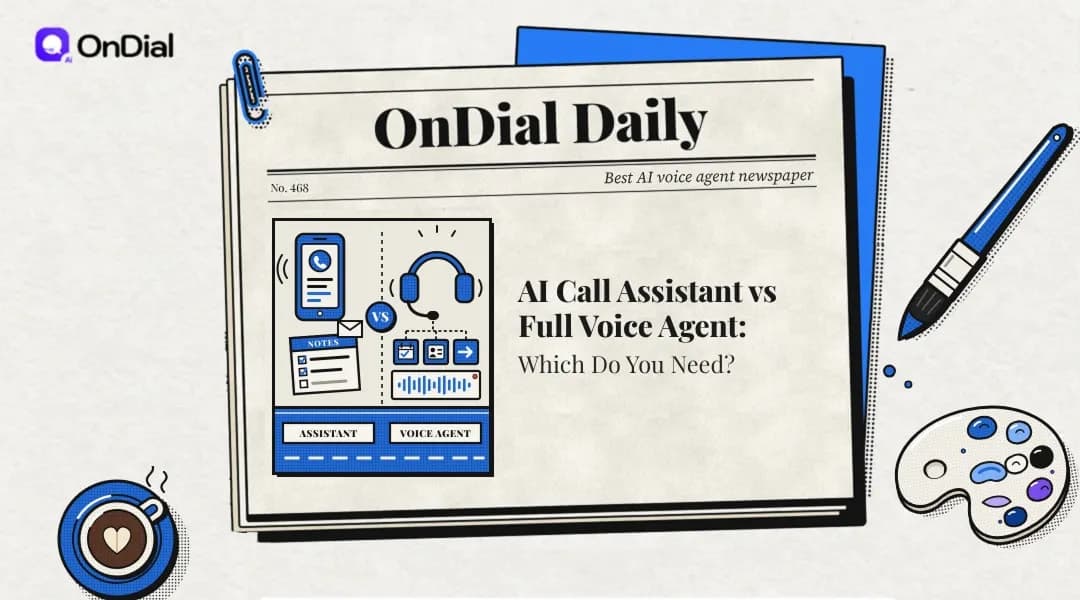
AI Call Assistant or Voice Agent: Who Owns the Outcome?
An AI call assistant handles the talking, while a person or a fixed rule owns the result. A full voice agent owns both, from the first hello to the updated record.
Both tools understand speech and reply in natural language. They split once the caller asks for something in your systems to change.
What an AI call assistant handles on a live call
Think of the assistant as a sharp front desk that never makes binding promises. It answers known questions, gathers details, and then passes a tidy summary to your team.
Typical jobs at this level include the following:
Answering repeat questions about hours, pricing tiers, delivery zones, or documents a caller should bring.
Collecting the caller’s name, account reference, and reason for calling before any human picks up.
Sending the call to the right queue with a short written recap attached to the ticket.
Whispering suggested replies, policy snippets, or next steps to a human rep mid-conversation.
What changes when a voice agent takes full ownership
A voice agent goes one step further and acts. It reads and writes to your booking tool, CRM, or order system during the call.
So a caller moving an appointment hears the new slot, confirms it, and gets a text before hanging up. Nobody on your team touches that call unless something unusual happens.
That extra reach also carries extra risk. An agent that books the wrong slot creates real cleanup work. By contrast, an assistant that misroutes a call only costs the caller a short wait.
Voice AI Levels: A Five-Rung Autonomy Ladder
Five rungs cover nearly every phone setup on the market, and each rung adds one new permission. Seeing them this way makes vendor claims far easier to compare.
Level 0, human only. A person answers and decides, with software limited to recording or a basic IVR.
Level 1, listen and suggest. AI transcribes live and prompts the rep, who still speaks and decides.
Level 2, answer and route. AI talks to callers directly, resolves simple questions, and hands everything else to people.
Level 3, act within guardrails. AI completes reversible tasks, such as bookings or address changes, after the caller confirms.
Level 4, own the outcome. AI runs whole workflows, including outbound campaigns, and escalates only the exceptions you flag.
Levels 1 and 2 are assisted, human-in-the-loop calling, which is where an AI call assistant lives. Levels 3 and 4 are autonomous calling, the territory of a full voice agent. In practice, most teams run two or three levels at once, one per call type.
How Each Setup Works From Ring to Record
Both setups share the same front half of the pipeline. They part ways at the point where the system either reports back or takes action.
A typical call moves through these stages in order:
Telephony connects the call through your existing number, a SIP trunk, or a forwarded line.
Speech recognition turns audio into text while the caller talks, streaming words in near real time.
A language model reads intent and judges whether it understands the request well enough to continue.
Retrieval pulls approved facts from your knowledge base, price sheet, or policy documents to ground each reply.
The action layer calls your systems through APIs to book, update, or cancel records on the caller’s behalf.
Text-to-speech voices the reply quickly enough that the caller does not sit through an awkward silence.
Logging and handoff close the loop with a transcript, a summary, and a warm transfer when needed.
Every stage adds delay, and callers feel it. A PNAS study of ten languages found that people avoid both overlapping talk and long pauses between turns. Average gaps across those languages differed by less than 250 milliseconds, so even small lags stand out.
Step five is the whole difference in practice. Without it, the system is an AI call assistant. With it, plus permission to use it, you have an agent.
Call Assistant vs Voice Agent at a Glance
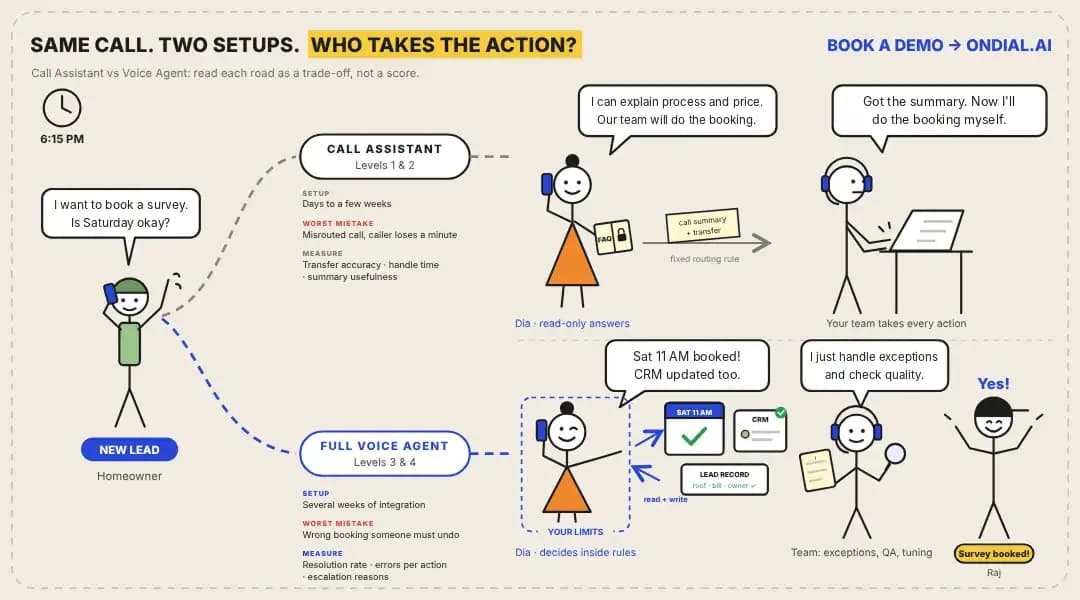
The table below compares both tiers on the points buyers most often misjudge. Read each row as a trade-off rather than a score.
What you are comparing | Assisted setup (Levels 1 and 2) | Full voice agent (Levels 3 and 4) |
Who makes the final call | A team member or a fixed routing rule decides what happens next | The agent decides inside limits you configure for each task |
Access to your systems | Read-only access to FAQs and policy documents is usually enough | Read and write access to booking, CRM, or order tools during calls |
Typical setup effort | Days to a few weeks, mostly scripting and loading approved knowledge | Several weeks of integration work, testing, and edge-case mapping |
Worst realistic mistake | A misrouted call or a vague answer that wastes a caller’s minute | A wrong booking, refund, or record change that someone must undo |
Staffing after launch | Your team still completes every request that needs an action taken | People shift toward exceptions, quality reviews, and tuning the rules |
What to measure | Transfer accuracy, handle time, and how useful reps find the summaries | Resolution rate, errors per action, and the reasons behind escalations |
Assisted vs Autonomous Calling: The Three-Question Test
Run every call type through three questions before you choose a level. If any answer comes back risky, drop that call type one rung lower.
Can a wrong action be undone cheaply? Rebooking a haircut is easy, but reversing a processed refund rarely is.
Can the AI reach the truth? If the answer sits in an unreadable system, autonomy only produces confident guesses.
Does the caller need judgment or comfort? Grief, anger, and disputes call for a person, however simple the task.
A yes, yes, no pattern points to Level 3 or 4. On the other hand, a no on the first question caps that call at Level 2.
Worked example: one week of calls at a home-services firm
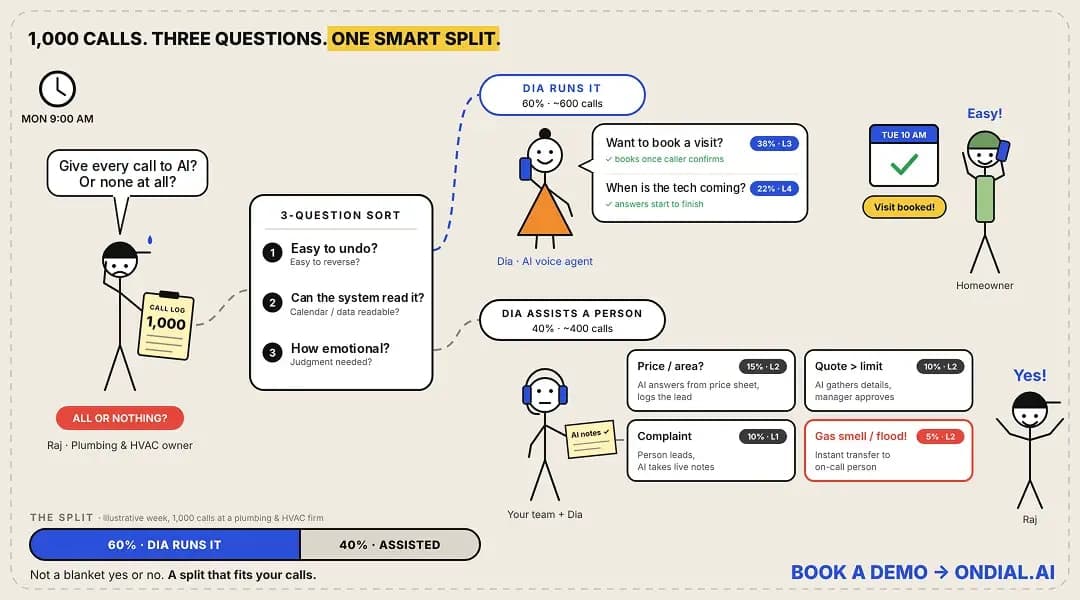
Imagine a plumbing and HVAC company that logs 1,000 inbound calls in a typical week. These numbers are illustrative only, but the sorting method works with any call log.
Call type | Share of weekly calls | Three-question result | Suggested level |
Booking or moving a service visit | 38 percent, roughly 380 calls | Easy to reverse, calendar is readable, little emotion | Level 3, agent books after the caller confirms |
Arrival time and technician status | 22 percent, roughly 220 calls | Read-only lookup with nothing to undo | Level 4, agent answers from start to finish |
Pricing and service-area questions | 15 percent, roughly 150 calls | Answers live in a maintained price sheet | Level 2, assistant answers and logs the lead |
Quote approvals above a set amount | 10 percent, roughly 100 calls | Money is committed and hard to claw back | Level 2, assistant gathers details for a manager |
Complaints about a finished job | 10 percent, roughly 100 calls | Emotion runs high and judgment matters | Level 1, a person leads with live AI notes |
Gas smells, floods, and other emergencies | 5 percent, roughly 50 calls | Safety risk with zero tolerance for delay | Level 2, instant transfer to an on-call person |
As a result, about 60 percent of calls can run autonomously while the rest stay assisted. That split is far more useful than a blanket yes or no on full autonomy.
When an AI Call Assistant Is the Smarter Buy
This tier fits best when your answers are stable but your actions are sensitive. It also fits when your systems are not ready for an AI to write into them.
Consider an assistant first if several of these sound familiar:
Your team misses calls at peak hours, yet most requests still need a human decision.
Your CRM or booking tool lacks a usable API, or its data often runs out of date.
You work in a regulated field where staff must approve refunds, claims, or account changes.
New hires take months to learn your policies and would benefit from live prompts.
That last point has strong evidence behind it. Economists Brynjolfsson, Li, and Raymond tracked 5,179 support agents in an NBER working paper. Each agent got an AI tool that suggested replies, which they could freely ignore.
Issues resolved per hour rose 14 percent on average, and 34 percent for newer staff. However, the most experienced agents saw minimal gains, so the payoff depends on your team mix.
The assisted model also has a ceiling. Because every action still waits for a person, your headcount keeps growing with call volume.
Support teams usually hit this ceiling first. This guide to an AI call assistant (automating support) shows what that setup covers day to day.
When a Full Voice Agent Earns Its Extra Setup
Go autonomous when the same request arrives hundreds of times and the fix lives in software. In that situation, each human touch adds cost without adding judgment.
A full agent tends to pay off when these conditions hold:
A large share of calls end in a booking, reschedule, status lookup, or simple record update.
Your core systems expose APIs that can read and write data without anyone stepping in.
After-hours callers want a task finished tonight instead of a promised callback tomorrow morning.
Outbound work such as reminders, renewals, or payment nudges follows a repeatable flow.
Analysts expect this tier to grow quickly. Gartner forecasts that agentic AI will settle 80 percent of common customer service issues without human help by 2029. It also projects operating costs dropping by about 30 percent as a result.
The word common carries real weight in that forecast. Unusual, emotional, or high-stakes calls sit outside it, so even mature agent setups keep a human path open.
What Neither Option Can Do Well Yet
Both tiers share real blind spots, and buyers should plan around them from the start. These gaps vary by provider, but most current systems show some version of each.
Watch for these limits during any pilot:
Heavy background noise, weak mobile signal, or strong accents still cause misheard names and numbers.
Knowledge goes stale fast, so last month’s price list produces wrong answers delivered with confidence.
When a connected API times out, an agent may stall or repeat itself unless fallbacks exist.
Sarcasm, bundled requests, and callers who change course mid-sentence often confuse intent detection.
Decisions with legal weight, such as credit approvals or medical advice, belong with qualified people.
Even a simple AI call assistant inherits most of these weak spots. Caller trust is the other limit to plan for.
A Gartner survey of 5,728 customers found that 64 percent would prefer companies skip AI in service. Their top worry was losing an easy route to a real person.
So make the exit obvious at every level. Any caller should reach a human within one or two requests.
Spotting Agent Washing Before You Sign
Some products sold as agents are assistants wearing a new label. Gartner calls this agent washing. It estimates that only about 130 of the thousands of vendors claiming agentic AI are genuine.
The same firm expects over 40 percent of agentic AI projects to face cancellation by the end of 2027. It points to rising costs, unclear value, and weak risk controls as the main causes.
Bring these questions to every demo to separate the two tiers:
Can the system write to our calendar or CRM mid-call, and can we watch it happen?
What exactly happens to the caller when an API request fails halfway through a booking?
Can we set a different autonomy level for each intent instead of one global switch?
Which actions require caller confirmation, and can our own team edit that list?
How do transcripts, summaries, and error logs reach our team after each call ends?
A product that only talks, routes, and summarizes is an AI call assistant, whatever the brochure says. Clear answers to the questions above usually narrow the field fast. For a wider shortlist, see this review of the Best AI voice agent platform choices.
From Call Assistant to Voice Agent Without a Big-Bang Launch
The safest path climbs the ladder one call type at a time. Each step then earns the next with evidence from real calls.
A practical sequence looks like this:
Start at Level 1 or 2 on your busiest call type, and collect a few weeks of transcripts.
Review where the AI answered correctly and where people had to step in.
Grant write access for one reversible action, such as rescheduling, with caller confirmation required.
Track errors per action, and expand only while the rate stays below a limit you set.
Add outbound or after-hours workflows once inbound results hold steady for several weeks.
Most of the effort sits in steps one and two, where you learn your own call patterns. This walkthrough on How to implement an AI call assistant covers the setup details.
Choosing Your Starting Rung
Picking a level gets easier once you sort calls by risk instead of by vendor tier. An AI call assistant is often the right first rung. Proven call types can then graduate to full autonomy.
Map your call log against the three-question test first. Then compare the OnDial Features with your results before booking a demo.