I’ve spent almost 15 years watching customer support teams run on caffeine, scripts, and sheer willpower. And I’ve watched the same teams crumble when ticket volumes spike, agents burn out, and customers lose patience after hearing the same IVR menu for the 50th time that day.
If you’re reading this, you probably feel that pain. Or worse - you’re responsible for fixing it.
Let me be blunt: Most customer support systems aren’t “broken.” They’re overloaded.
Humans weren’t built to answer the same 17 questions all day. AI-powered voice automation was. Not the gimmicky kind. Not the robotic IVR systems we all love to hate. I’m talking about conversational AI that actually listens, responds, understands, and resolves.
And yes, it resolves fast.
Before you roll your eyes (I can practically hear it), stick with me. I spent years as a developer ripping apart models that claimed to “transform CX.” Most were dressed-up scripts. But voice AI has matured into something genuinely helpful - when built right.
OnDial (if you haven’t met them yet) is one of the few teams that treats voice automation as a human experience problem, not a tech demo. And that’s exactly why this conversation matters.
Let’s pull back the curtain.
What Is AI-Powered Voice Automation?
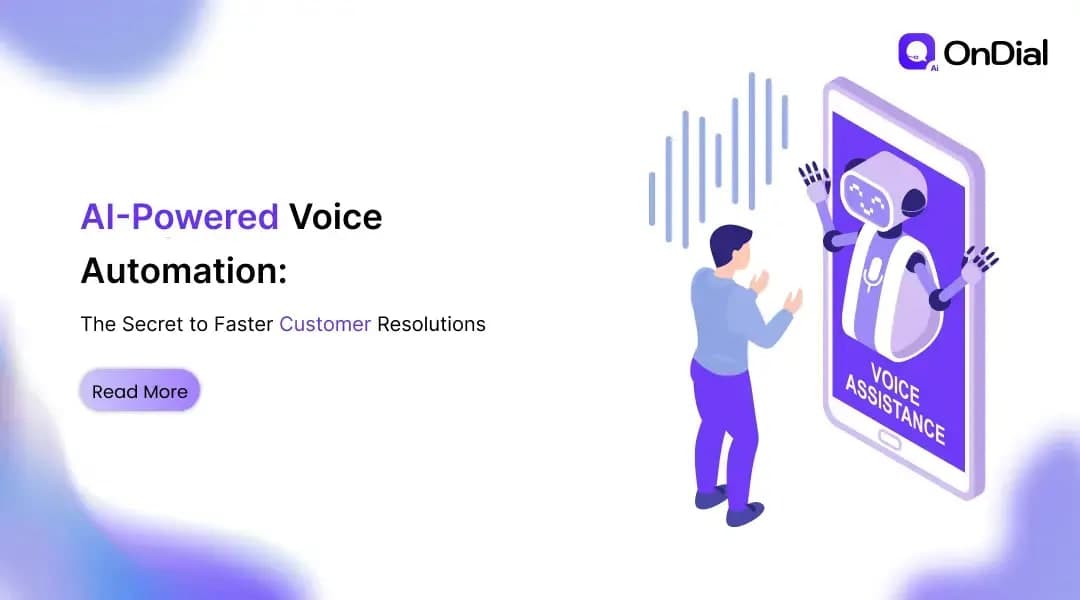
AI-powered voice automation refers to intelligent systems that listen, understand, and respond to customer queries using natural, human-like conversation, without needing a human agent.
Think of it as a voice assistant built specifically for support workflows.
How Does It Work?
I’ll keep this jargon-friendly:
ASR (Automatic Speech Recognition) turns speech into text.
NLP (Natural Language Processing) interprets the words.
NLU (Natural Language Understanding) figures out what the customer means.
TTS (Text-to-Speech) responds with a natural-sounding voice.
Done well, it feels like speaking to a trained agent—just one who never gets tired.
Voice Bot vs IVR
Let’s settle this:
IVR: “Press 1 for billing.” Voice Bot: “Sure, I can help with billing. What exactly do you need?”
One is a maze. The other is a conversation.
Why Businesses Are Switching to AI Voice Bots
Three reasons keep coming up in almost every boardroom I walk into:
1. Cost Reduction
Hiring more agents to handle repetitive queries is like fixing a leaky pipe with more buckets.
2. 24/7 Always-On Availability
Customers don’t wait for business hours. Neither should support.
3. Scalability Without Stress
Your incoming calls can triple overnight. AI doesn’t flinch.
I’ve seen call centres go from a 40-minute wait time to under 2 minutes simply by shifting common tasks to voice automation.
(Yes, I know that sounds dramatic. But operational math rarely lies.)
7 Ways AI-Powered Voice Automation Speeds Up Customer Resolutions
This is where things get interesting—and measurable.
1. Faster Call Routing
Instead of customers guessing which option fits, the AI listens and routes instantly based on intent.
2. Automated FAQs
Password resets, order status, hours of operation, your agents shouldn't be answering these in 2026.
3. Handles Repetitive Queries Without Fatigue
AI doesn’t get annoyed. It doesn’t lose enthusiasm. It doesn’t ask for a break.
4. Reduces Agent Workload
The AI filters low-complexity conversations, letting agents focus on the 20% of queries that actually require brains.
Quick aside (pattern interrupt #1): Ever seen an agent face when a customer asks the same question for the fifth time that hour? Exactly.
5. Personalized Responses
Because AI can pull customer data in real time, it knows the account, the history, the last order, even the last complaint.
That’s personalisation that doesn’t feel creepy.
6. Real-Time Data Access
AI can fetch data from CRMs, ERPs, and internal systems faster than a human can open the right tab.
7. Improved Accuracy
No misheard numbers. No typed errors. Just consistent execution.
Accuracy leads to speed, and speed leads to satisfaction.
AI Voice Automation vs Traditional Support Systems
Let’s run a quick comparison. No fluff.
Speed
Humans think fast, but systems delay them. AI removes the delay.
Cost
Traditional systems = linear cost. Voice automation = cost plateaus even when volume spikes.
Accuracy
Humans vary. AI stays consistent.
CX Quality
This surprises people: AI often delivers a calmer, more polite tone - especially for frustrated callers.
A voice bot doesn’t take anything personally. That alone prevents escalations.
Industries Benefiting Most from Voice Automation
I’ve deployed or studied deployments across multiple verticals. Here’s where voice automation shines.
1. E-Commerce
Order tracking, returns, cancellations, delivery status—AI handles 80% of these instantly.
2. Healthcare
Appointment scheduling, reminders, prescription refill requests—handled securely and swiftly.
3. Banking & Finance
Balance checks, card issues, EMI queries, fraud reporting.
4. Telecom
Recharge, plan info, network complaints - high-volume queries perfect for automation.
5. Travel & Hospitality
Flight updates, ticket changes, hotel queries - especially during peak season chaos.
How to Implement AI Voice Bots in Your Business
This is where most articles get vague. Let’s not.
Technical Requirements
A voice AI platform (OnDial is a strong example).
Telephony integration (SIP, VoIP, etc.).
Access to customer databases or CRMs.
APIs for real-time information retrieval.
Integrations
CRM (Salesforce, HubSpot, Zoho)
Ticketing systems (Freshdesk, Zendesk)
Payment systems
Product or order databases
Authentication systems
Customization Tips
Build intents around actual call transcripts. Avoid robotic scripts—use conversational phrasing.
Add fallback responses that feel human.
Test voices with real customers before scaling.
Best Practices
Start with high-volume queries.
Measure early KPIs: AHT, FCR, CSAT.
Keep humans available for escalations.
Update intents monthly based on new patterns.
If you ignore anything, ignore nothing here. This is where success or failure gets decided.
Future of Voice Automation & AI in CX
Let me give you the version I share with companies preparing for the next 3 years.
Predictive AI
Bots won’t just react, they’ll anticipate. “Your order seems delayed, would you like an update?”
Multilingual Voice Bots
Not robotic translations, actual localisation. With accents that fit the region.
Emotion-Based Voice Analysis
Detecting frustration, confusion, urgency— and adjusting tone or escalating instantly.
This isn’t sci-fi. Teams like OnDial are already experimenting with this in the field.
Conclusion
If you’ve read this far, you’re not just “curious about AI.” You’re evaluating a real solution to a real operational challenge.
AI-powered voice automation isn’t a buzzword. And it’s not here to “replace agents.” It’s here to reduce the nonsense work that keeps agents from doing what humans do best: solve nuanced problems with empathy.
I've seen support teams go from drowning to breathing again. I’ve seen customers stop raging. I’ve seen CX leaders finally get ahead instead of constantly playing catch-up.
And yes, voice automation made that possible.
If you’re building toward faster resolutions, more consistent support, and happier customers, this isn’t just an option. It’s the next logical step.