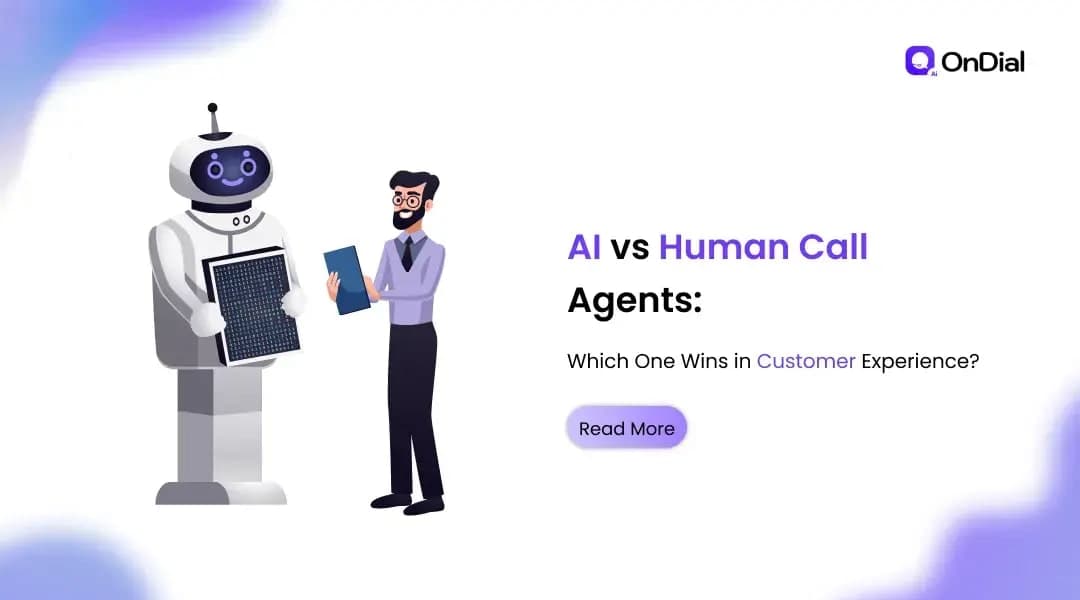
Customer experience does not improve simply because a business adds AI or hires more call agents. It improves when customers can reach the right level of support quickly, receive accurate answers, and get meaningful help when the situation becomes complex.
That is why the debate around AI vs human call agents needs a better question.
Instead of asking which one is better, businesses should ask which type of interaction each one handles best.
AI voice agents are well suited to repetitive, structured, high volume conversations. Human agents remain essential when a customer needs judgment, emotional understanding, negotiation, or a solution that falls outside a defined workflow.
The strongest customer service strategy combines both.
What Is an AI Call Agent?
An AI call agent is a conversational AI system that can receive or make phone calls, understand spoken requests, respond naturally, and complete predefined business actions.
Unlike a traditional IVR, an AI voice agent can interpret conversational language instead of forcing customers through fixed menu options.
A typical interaction can involve several stages:
Speech recognition converts the caller's speech into usable information.
The AI identifies intent and relevant context.
The system retrieves information from connected business systems.
The voice agent responds to the customer.
The system performs an action such as booking an appointment, updating a record, qualifying a lead, or routing the call.
The conversation is escalated to a human when the request requires human judgment.
This makes AI voice agents useful for customer support, lead qualification, appointment management, reminders, surveys, order-related questions, and other structured conversations.
What Human Call Agents Do Better
Human agents remain critical because customer service is not only about information retrieval.
People can interpret ambiguity, understand emotional context, negotiate unusual situations, and make decisions when there is no predefined workflow.
Consider a customer who received an incorrect invoice and has already contacted support twice. The customer may be frustrated, unwilling to repeat the issue, and asking for an exception.
A human agent can investigate the situation, acknowledge the frustration, coordinate with another department, and decide how to resolve the issue.
That combination of judgment and empathy is difficult to standardize.
Human agents are especially valuable for:
Complex complaints
Sensitive healthcare conversations
Insurance disputes
Financial hardship situations
High value B2B relationships
Negotiations
Escalations
Unusual or previously unseen problems
The goal should not be to remove humans from customer service. The goal should be to reserve human attention for conversations where it creates the most value.
AI vs Human Call Agents: Key Differences
The right comparison depends on what a business expects from its customer service operation.
Availability
AI voice agents can operate continuously without shifts, breaks, or holidays. This makes them useful for after-hours calls and businesses serving customers across multiple time zones.
Human teams require staffing schedules and additional coverage when demand increases outside normal operating hours.
Advantage: AI for continuous availability.
Response Speed
An AI voice agent can begin a conversation immediately when a call reaches the system. It can also retrieve structured information without placing the customer on hold while an employee searches through multiple systems.
Human response time depends on workload, tools, training, and the complexity of the request.
Advantage: AI for fast first response.
Empathy and Emotional Understanding
Human agents can respond to emotional signals that may not be fully represented in customer data.
A caller may technically ask a simple question while communicating frustration, fear, urgency, or disappointment through their tone and context.
AI can detect conversational signals and follow escalation rules, but sensitive situations often benefit from human involvement.
Advantage: Humans for emotional and sensitive interactions.
Handling Repetitive Questions
Questions such as business hours, order status, appointment availability, basic service information, and routine follow-ups are highly structured.
These conversations are strong candidates for AI because the required information and actions can be defined clearly.
Human agents can handle the same requests, but repetitive work consumes time that could otherwise be spent on complex cases.
Advantage: AI for repetitive interactions.
Scalability
When call volume increases suddenly, adding human capacity requires recruitment, scheduling, training, and supervision.
AI voice infrastructure can support additional conversations without requiring a new employee for every increase in demand, subject to the platform's capacity and configuration.
This is particularly useful during campaigns, seasonal peaks, appointment drives, and large outbound calling programs.
Advantage: AI for high volume operations.
Complex Problem Solving
AI performs best when the business process is known and the required information is available.
Human agents have an important advantage when the problem requires investigation across teams, exceptions to standard policy, negotiation, or discretionary decisions.
Advantage: Humans for complex cases.
Consistency
AI follows configured conversation rules consistently. It can collect the same information, follow the same qualification process, and deliver approved information across calls.
Human performance can vary because of workload, experience, training, and individual communication styles.
However, consistency is only useful when the underlying workflow and information are correct.
Advantage: AI for standardized processes.
Personalization
AI can personalize conversations using customer information, previous interactions, CRM records, preferences, and business rules.
Human agents can personalize beyond stored information by responding naturally to unexpected details and social context.
The difference is important: AI can deliver data driven personalization at scale, while humans can provide contextual personalization.
Advantage: Depends on the interaction.
Which Customer Experience Metrics Matter?
Choosing between AI and human agents should not be based only on cost or call volume.
Businesses should measure whether the customer actually receives a better experience.
First Response Time
How quickly does the customer reach a capable first responder?
A shorter response time can reduce abandonment and frustration, particularly for inbound enquiries.
First Call Resolution
How often is the customer's issue resolved during the first interaction?
AI can perform well when the issue follows a defined process. Human agents can be stronger when resolution requires investigation or coordination.
Customer Satisfaction
CSAT helps businesses understand how customers perceive individual interactions.
A faster conversation is not automatically a better conversation. Satisfaction should be measured alongside resolution quality.
Escalation Rate
For AI deployments, escalation rate is an important quality signal.
A high escalation rate may indicate that the workflow is too narrow. An extremely low escalation rate may also be concerning if the AI is attempting to handle conversations that should reach a human.
Abandonment Rate
If customers disconnect before reaching a useful response, the contact process is creating friction.
Businesses should track abandonment before and after introducing automation.
Average Handle Time
A lower handle time can indicate greater efficiency, but it should never be treated as the only success metric.
Reducing a call from five minutes to two minutes is not an improvement if the customer needs to call again.
Where AI Voice Agents Deliver the Most Value
AI voice agents are strongest when the business process is repetitive, predictable, and measurable.
Customer Support
AI can handle common questions, provide information, collect initial details, and route customers according to intent.
This can reduce pressure on human support teams while keeping routine callers moving.
For businesses focused on improving service quality through voice automation, AI voice agents for customer experience can support faster and more consistent customer interactions.
Appointment Scheduling
Healthcare providers, service businesses, educational organizations, and other appointment based businesses receive many calls involving availability, confirmations, cancellations, and rescheduling.
These workflows can often be structured clearly enough for AI to manage the initial interaction.
Lead Qualification
Sales teams frequently spend time asking the same qualifying questions before a prospect reaches a sales representative.
An AI voice agent can collect basic information, identify intent, and pass qualified prospects to a human representative.
Missed Call Handling
A missed inbound call can represent a lost enquiry.
AI can respond to calls outside normal operating hours or help manage periods when human agents are already occupied.
Surveys and Feedback
Businesses that need structured feedback from large customer groups can automate outbound conversations while keeping the questions consistent.
Human teams can then focus on analyzing feedback and responding to important issues.
Where Human Agents Should Remain Involved
Automation should have clear boundaries.
Sensitive Conversations
Healthcare, insurance, financial hardship, complaints, and other sensitive interactions can require empathy and careful judgment.
An AI system can gather initial information, but the business should define when the customer needs a human.
Escalated Complaints
When a customer has already attempted to resolve an issue multiple times, transferring them through another automated workflow can increase frustration.
A well designed system should recognize escalation signals and route the customer appropriately.
High Value Sales
AI can qualify prospects and schedule meetings, but high value negotiations often require a human representative who can understand business context and make decisions.
Exceptions
A workflow may cover the majority of normal cases while leaving unusual cases outside its boundaries.
Those exceptions should have a clear escalation path instead of forcing the AI to improvise.
The Hybrid AI and Human Model
For many businesses, the strongest approach is not AI or humans.
It is AI first, human when needed.
The model can work like this:
The customer calls the business.
AI identifies the purpose of the call.
The AI handles a routine request when the workflow is suitable.
Customer information and conversation context are captured.
The system identifies situations that require escalation.
A human agent receives the conversation with relevant context.
The human resolves the complex issue without making the customer repeat everything.
This changes the role of human agents.
Instead of spending most of their day answering repetitive questions, they can focus on conversations that require judgment and relationship building.
The result is not simply automation. It is better allocation of human attention.
For a deeper perspective on this model, AI voice agents and human connection explains why automation can support stronger human interactions rather than simply removing them.
How to Decide What AI Should Handle
Before automating a call workflow, classify conversations based on complexity.
Step 1: Identify Repetitive Calls
Review call recordings, transcripts, dispositions, or support categories.
Look for questions that appear frequently and follow predictable patterns.
Step 2: Map the Required Action
Ask what the customer actually needs after asking the question.
Does the system need to provide information, update a CRM record, book an appointment, send a notification, or transfer the caller?
Step 3: Define the Boundaries
Document what the AI can answer and what it cannot.
This is one of the most important parts of deployment because a clear escalation policy protects both customer experience and brand reputation.
Step 4: Connect Business Systems
An AI voice agent becomes more useful when it can work with the systems employees already use.
CRM data, calendars, order information, customer records, and workflow tools can provide the context needed for useful conversations.
Step 5: Measure Outcomes
Do not evaluate the deployment only by the number of calls handled.
Track resolution rate, escalation rate, customer satisfaction, abandonment, response time, repeat contacts, and business outcomes.
AI vs Human Call Agents: Which Should Your Business Choose?
There is no universal winner.
AI is usually the better fit when the priority is availability, speed, repetitive call handling, structured qualification, multilingual support, or high volume conversations.
Human agents are usually the better fit when the interaction requires empathy, negotiation, complex problem solving, discretion, or relationship management.
A hybrid model becomes the strongest option when a business needs both operational scale and human judgment.
The key is to assign each type of work to the system that handles it best.
What to Look for in an AI Voice Agent Platform
Businesses evaluating AI voice technology should look beyond voice quality.
Important capabilities include:
Natural conversational interaction
Reliable speech recognition
Business workflow integration
CRM connectivity
Appointment scheduling
Lead qualification
Call analytics
Multilingual support
Human escalation
Conversation monitoring
Configurable business rules
Security and access controls
Clear performance reporting
The platform should also make it possible to improve workflows based on real conversation outcomes.
For businesses evaluating a broader AI voice agent platform, the focus should be on how effectively the technology connects conversations with actual business actions.
Final Verdict: AI vs Human Call Agents
AI and human call agents solve different customer experience problems.
AI is strongest at speed, availability, consistency, repetitive interactions, and scalable call handling.
Humans remain stronger at empathy, judgment, complex problem solving, negotiation, and relationship building.
The most effective customer service strategy is therefore not about replacing one with the other.
It is about designing the customer journey so that routine interactions are handled efficiently and meaningful human attention is available when it matters.
That is where voice AI creates its greatest value.
The goal is not to make every customer talk to AI.
The goal is to make every customer interaction more useful, more responsive, and easier to resolve.