Roughly 40% of appointment bookings now happen outside standard business hours, according to Gartner's consumer behavior research. Businesses automate appointment booking with AI by deploying a system that answers every call, message, and web request the moment it arrives, checks the live calendar, confirms the slot, and logs it to a CRM without a human involved. It runs around the clock, handles several conversations at once, and never leaves a caller on hold.
Here is the part that stings. McKinsey's customer journey research found that 73% of prospects who try to book after hours and hit a closed system never return. If your business lives on booked appointments, you are rarely losing people because your service is weak. You are losing them because nobody picked up at 8 PM on a Tuesday.
I have spent years building voice AI at OnDial, and I will be straight with you throughout this guide. This technology is genuinely useful, but it is not magic. Below is what actually works, what does not, and exactly how to set it up.
Why Appointment Booking Breaks Down Without Automation
Manual scheduling fails quietly, which is what makes it dangerous. Nobody sends you an invoice for the bookings you never captured. The revenue simply never arrives, and most owners never trace the loss back to a missed call or an unanswered form.
The Hidden Cost of Missed and After-Hours Calls
Your customers do not book on your schedule. They book on theirs, which means evenings, weekends, and lunch breaks. When 40% of booking demand lands outside office hours and your phone rolls to voicemail, that demand does not wait politely for morning.
The compounding damage comes from what happens next. Research summarized across service industries shows that a large share of callers who reach voicemail simply dial the next business on the list with ai voice agent for healthcare. First response wins the booking, and a system that never sleeps is the only reliable way to be first. In projects we have run at OnDial, the single biggest recovered revenue line is almost always after-hours calls that used to vanish.
Why Manual Scheduling Quietly Loses Revenue
Think about the last time your team booked a single appointment by hand. A form comes in at 9 PM, an admin sees it the next morning, checks two or three calendars, emails a few time options, waits for a reply, and proposes new times when none fit. What should take thirty seconds stretches across three days and seven emails.
That back-and-forth carries real costs that stack up fast:
Lead decay: the longer a prospect waits, the colder they get, and the more likely they book elsewhere.
Staff drain: front-desk time spent on "what's open Tuesday?" is time not spent on customers who are already in the room.
Double bookings and errors: manual calendar juggling is where the embarrassing mistakes happen, and every mistake dents trust.
Multiply those small leaks across a month, and the number gets uncomfortable. This is not a scheduling problem. It is a revenue problem wearing a scheduling costume.
What Is AI Appointment Booking, and How Does It Work?
AI appointment scheduling uses artificial intelligence to book, confirm, and manage appointments through natural conversation across voice, text, or web, without a person coordinating each step. That is the whole idea in one sentence, and it is worth sitting with, because the shift from menus to conversation is the real change.
AI appointment booking is software that understands what a customer wants, checks your real availability, and confirms the slot in the same interaction. No phone tree. No "press 1 for scheduling." Just a request and a booking.
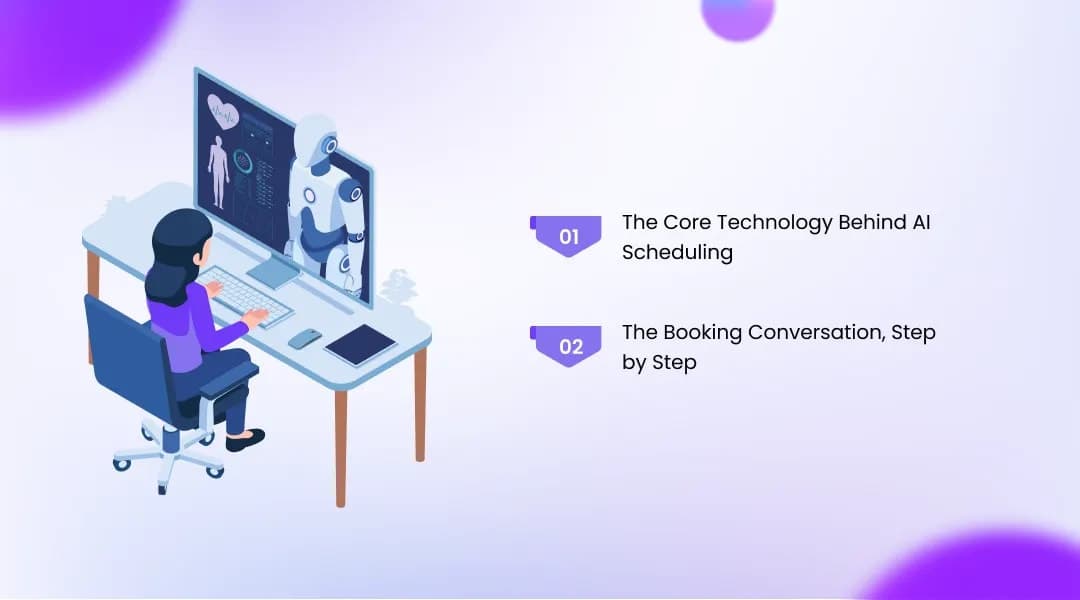
The Core Technology Behind AI Scheduling
Under the surface, a few technologies do the heavy lifting together. Understanding them helps you evaluate platforms honestly instead of trusting marketing claims.
Natural language processing (NLP): this is what lets the system understand "I need a cleaning sometime next Tuesday afternoon" instead of forcing rigid form fields on the customer.
Calendar integration: direct, real-time sync with Google Calendar, Outlook, Calendly, or your practice-management software prevents double-booking and keeps availability accurate to the minute.
Voice recognition and speech synthesis: for phone bookings, the agent listens, interprets intent, and responds in a natural voice rather than a robotic menu.
CRM logging: every confirmed booking, along with the caller's details, drops into your CRM automatically, so client history stays current without manual entry.
Accuracy has climbed sharply as these systems matured. Industry reporting now places intent-understanding accuracy for standard booking requests in the mid-to-high nineties, with built-in safeguards like confirmation messages and buffer times to catch the rest.
The Booking Conversation, Step by Step
A well-built booking flow follows a predictable arc, whether it happens by voice or chat with never miss another client call with voice AI. The customer reaches out, the agent greets them and asks what service they need, then confirms the duration and any prerequisites. Next, it offers genuinely open slots pulled from your live calendar; the customer picks one, and the agent captures contact details.
Finally, the appointment is booked, a confirmation goes out by SMS or email, and the record lands in your CRM. The entire loop closes inside one interaction, which is exactly why an AI agent can complete a booking before the caller hangs up. That speed is not a convenience. It is the difference between a captured booking and a lost one.
How Can Businesses Automate Appointment Booking with AI?
Here is the direct answer. To automate appointment booking with AI, connect a booking agent to your live calendar, define your services and availability rules, choose your channels (voice, SMS, chat, or web), write the conversation logic, including when to escalate to a human, then test with real calls before going live. Most businesses complete this in one to two hours.
The steps are not complicated, but the details decide whether the system feels helpful or frustrating. Rushing the setup is the most common reason a deployment underperforms.
Mapping Your Services, Rules, and Calendars
Start with the boring groundwork, because it is where quality is won or lost. Enter each bookable service with accurate names, durations, pricing, and prerequisites, so the agent never offers a thirty-minute slot for a service that needs an hour. Then connect the calendar the agent will write into and confirm the sync runs in real time.
Your availability rules matter just as much as your calendar. Set working hours, buffer times between appointments, booking windows, and cancellation policies so the agent only offers slots that are genuinely workable with AI voice agents for business calls. Get this layer right, and the agent enforces your policies automatically, which quietly removes a whole category of scheduling headaches.
Choosing Your Channels: Voice, SMS, and Chat
Not every business needs every channel, and pretending otherwise wastes money. Choose based on how your customers actually reach out today.
AI voice agent: the strongest fit for businesses that live on inbound phone calls, since a voice agent answers on the first ring, has a real conversation, and books during the call. This is the channel we focus on at OnDial, because the phone remains where high-intent bookings are won or lost.
SMS and chat are valuable for younger audiences and for missed-call recovery, where an automatic text turns an unanswered call into a booked slot.
Web widget: useful as a self-serve option for customers who prefer to check availability themselves.
A quick question for you: when a customer calls your business right now and you cannot pick up, what happens to that call? If the honest answer is "voicemail, and usually nothing," voice is where you start.
Does AI Appointment Booking Actually Reduce No-Shows?
Yes, and the effect is measurable rather than theoretical. No-shows are one of the most expensive problems in appointment-driven businesses, and automated reminders plus easy rescheduling attack the problem at its root.
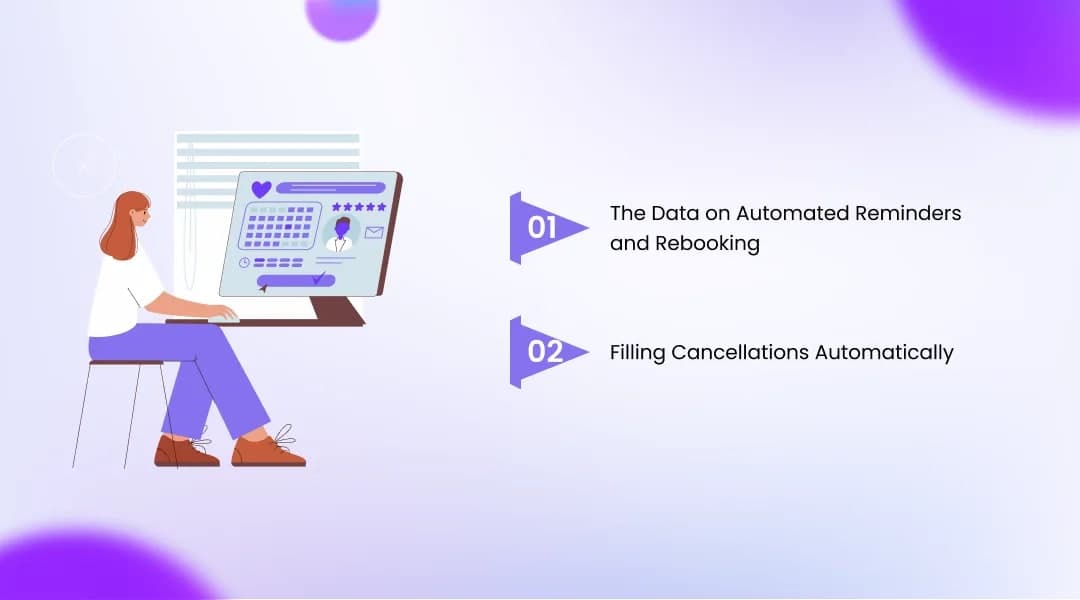
The Data on Automated Reminders and Rebooking
The numbers here are hard to ignore. Prosper AI's research puts the cost of each missed appointment at roughly $150 to $200 in lost revenue, and the American Dental Association's Health Policy Institute has pegged annual no-show losses for an average dental practice near six figures. Those are not rounding errors. They are a direct hit to collections.
Automation moves the needle in a specific way. CallSetter AI reports an average 34% reduction in no-shows when AI handles booking, reminders, and rescheduling end-to-end, and multiple studies place SMS reminder effectiveness in the range of a 38% or greater drop in missed appointments. The reason is simple and human: most no-shows are not bad faith. People forget, life gets busy, or they want to reschedule but do not want to call during business hours and sit on hold. Remove that friction, and attendance climbs.
Filling Cancellations Automatically
Cancellations are the other half of the no-show equation, and this is where automation quietly shines. When a slot opens up, most teams scramble, calling down a waitlist and leaving voicemails while the clock runs out. By the time someone confirms, the slot is often gone.
An AI system flips that scramble into an instant match. The moment a cancellation lands, it identifies waitlisted customers who fit the open slot and sends simultaneous offers, giving the slot to whoever confirms first with OnDial AI voice agent services. One voice AI deployment documented by Synthflow, with the healthcare provider Medbelle, reported a 60% boost in scheduling efficiency and 2.5 times more booked appointments after automating scheduling and follow-ups. That is a full calendar working for you instead of against you.
What AI Should Handle, and What It Shouldn't
Now the part most guides skip. AI is not a full replacement for your front desk, and any vendor who tells you otherwise is selling harder than they are thinking. The goal is not to remove humans. It is to remove the repetitive work so humans can do what only humans do well.
Automate the Routine, Escalate the Exceptions
The most reliable design principle I know is also the simplest: automate the routine, escalate the exceptions. Studies suggest AI handles roughly 80 to 90% of routine bookings cleanly, which is exactly where you want it, and the remaining slice is where a human belongs.
Let AI handle: standard bookings, reschedules, cancellations, confirmations, and answering "what times are open?" for the hundredth time this week.
Route to a human: complex multi-appointment coordination, insurance edge cases, upset callers, and your top clients who expect a familiar voice.
The trick is context. A well-configured agent detects complexity, sentiment, or VIP status and transfers the conversation to a person with the full history attached, so the customer never has to repeat themselves. Done right, the handoff feels like an upgrade, not a dead end.
The Limitations Worth Knowing Before You Start
I promised honesty, so here it is. Voice AI still stumbles on heavy accents, poor phone connections, and genuinely unusual requests, and a badly written script will make even good technology sound stiff. These are real constraints, not deal-breakers, and knowing them upfront saves you from disappointment.
Compliance deserves a mention too. If you operate in healthcare or handle sensitive data, confirm your platform meets the standards that apply to you, such as HIPAA for patient information and SOC 2 Type II for security practices with OnDial. Ask vendors direct questions, read the documentation, and test the agent against your trickiest real calls before you trust it with customers. The businesses that win with this technology are the ones that respect its edges rather than pretend they do not exist.
Conclusion
When you automate appointment booking with AI, three things matter most, and getting them right is the whole game. Capture every after-hours request so no lead slips away, cut no-shows with automated reminders and effortless rescheduling, and set clear rules for when the AI hands a caller to a human. Nail those, and your calendar starts filling itself while your team focuses on the work only people can do.
You now know what to automate, what to keep human, and how to begin. That clarity was the hard part, and you have it.
At OnDial, we build voice AI that books appointments through natural phone conversations, tuned to your services, your policies, and your escalation rules. If missed calls are quietly costing you bookings, a voice-first agent is the fastest place to start, and we would rather show you honestly where it fits than oversell what it cannot do.