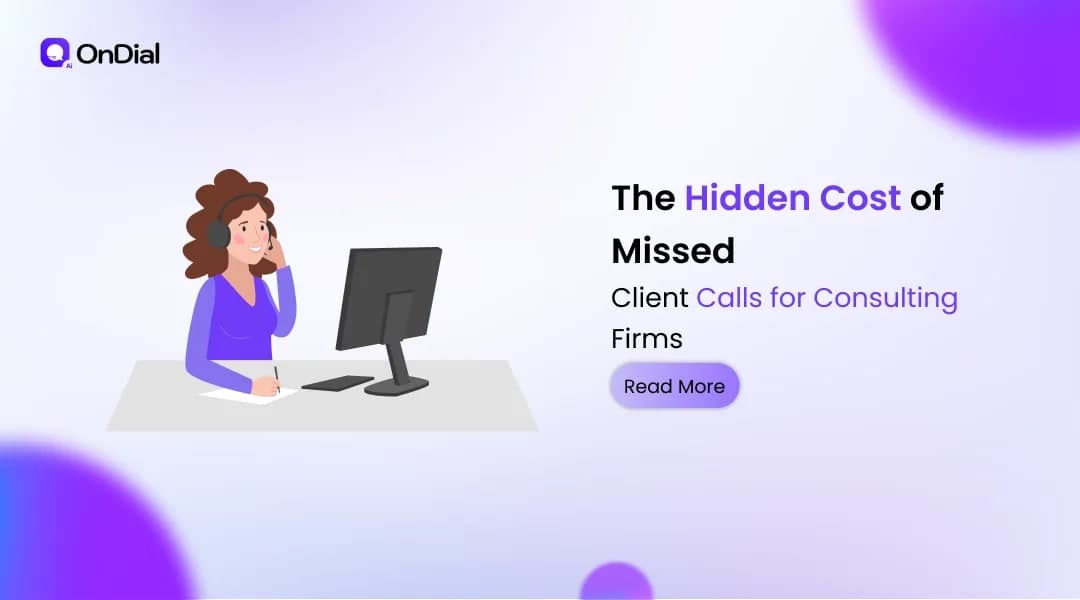
Firms that respond to a new inquiry within five minutes are roughly 100 times more likely to make contact and 21 times more likely to qualify that lead than firms that wait thirty minutes, a finding from Dr James Oldroyd's Lead Response Management study conducted with MIT and InsideSales. Sit with that number for a second. The hidden cost of missed client calls for consulting firms is not the single conversation that got away; it is the compounding distance between the moment a buyer decided to hire someone and the moment you finally called back. If you have ever finished a client session, glanced at your phone, and seen an unknown area code with no voicemail attached, you already know the specific feeling I am describing.
That low-grade dread is usually accurate. Something expensive did just happen, and you will never find out exactly how expensive, which is precisely what makes this problem so easy to keep ignoring.
In this article, I will break down what a missed call genuinely costs a consulting practice, why consulting firms miss calls for reasons that do not apply to other industries, where the client intake process actually fails, and what the honest options are for closing the gap.
What a Missed Client Call Actually Costs a Consulting Firm
A missed client call is any inbound call from a prospect or client that reaches voicemail, rings out, or is answered too late to hold the caller's attention. That definition matters because most firms only count the first category.
The Number Most Firms Never Calculate
How much does a missed client call cost a consulting firm? Multiply your monthly missed calls by your close rate on inbound inquiries, then by your average engagement value. A firm missing eight inbound calls a month, closing 25 per cent, with a 15,000-dollar average engagement, is losing roughly 30,000 dollars per month in unrealised pipeline before you count referrals or renewals.
That formula is deliberately conservative. Published research puts the general figure far higher: missed calls are estimated to cost law firms 109 billion dollars annually industry-wide, with a single missed client representing 5,000 dollars or more in fees a scale of exposure that tracks closely with what advisory practices face. Consulting engagements typically carry higher values than a single legal matter, which means the per-call exposure for an advisory firm is usually worse, not better.
There is also the acquisition cost you already paid. Every unanswered call that came from your content, your LinkedIn presence, or a paid campaign represents marketing spend that produced a ring and nothing else. Research from the Hinge Research Institute shows that high-growth professional services firms now generate a significant share of new opportunities from digital visibility and thought leadership rather than referrals alone, which means more of your inbound comes from strangers who have no relationship reason to try you twice.
Why Consulting Losses Compound Differently
Consulting revenue is rarely transactional. A single new client typically produces an initial engagement, a follow-on scope, a retainer, and two or three introductions over the following years. Losing the first call does not remove one deal from your pipeline; it removes a branch.
Retention economics make this sharper. The average professional services firm retains 84 per cent of its clients year over year, and a 5 per cent improvement in retention can lift profitability by 25 to 95 percent according to Bain and Company research. A client you never acquired cannot be retained, so every missed intake call quietly reduces the base that your entire growth model compounds against- the exact math we break down in how much revenue you're losing from missed calls.
Here is the part that stings. The firms best positioned to win those calls are usually the ones most likely to miss them, because their partners are the busiest.
Why Consulting Firms Miss More Calls Than They Realise
Most articles on this topic assume the phone goes unanswered because nobody is at the desk. In consulting, the opposite is true. The phone goes unanswered because your best people are working.
The Billable Hour Conflict
Picture a partner thirty-five minutes into a paid strategy session. The phone vibrates face-down on the table. Picking it up signals to a paying client that someone else in the world is more important than the person sitting across from them, and no senior consultant sends that signal.
So the call is missed on purpose, by a professional making a correct decision. This is the structural conflict at the centre of the problem: answering damages the relationship you have, and missing damages the pipeline you need. Utilisation targets make it worse, since consulting firms typically aim for utilisation rates in the 75 to 80 per cent range, meaning three-quarters of your revenue-generating hours are hours nobody can pick up a phone.
After-Hours Call Coverage and the Time Zone Problem
The second gap is temporal. Buyers research at night, on weekends, and between their own meetings, and a corporate buyer with a board deadline does not wait for your office hours. After-hours call coverage is not a luxury tier for consulting firms; it is where a meaningful share of serious inquiries land.
Cross-border work multiplies this. A firm in Ahmedabad serving clients in London and New York has a live business day that no single staffed reception window can cover, the same pattern we examine in how missed after-hours calls hurt customer value. In the deployments I have worked on at OnDial, the after-hours window is consistently where clients discover they were losing inquiries they never knew existed, because an unanswered call at 9 pm leaves no trace at all.
Third, there is the invisible category: calls that ring during another call. A two-person firm on a single line is unreachable for as long as either person is talking.
The Lead Response Time Problem Nobody Solves
Lead response time is the elapsed period between an inbound inquiry arriving and a human from your firm making live contact. It is the single most studied and least acted-on metric in professional services.
What the Five-Minute Rule Really Says
Average B2B lead response time is roughly 47 hours, while only about 7 per cent of companies respond within five minutes. That gap exists despite two decades of consistent research showing that response speed is the strongest single predictor of whether an inbound inquiry converts. The rule is not that fast is better. The rule is that slow is close to worthless.
The supporting data is unusually consistent. A Harvard Business Review analysis of 15,000 leads and 100,000 call attempts found the odds of qualifying a lead drop by 400 per cent when response time slips from five minutes to ten, and only 7 per cent of B2B companies consistently respond to leads within five minutes. Meanwhile, the average B2B lead response time sits at 42 hours and only 27 per cent of leads ever get contacted at all, according to Salesforce data.
I want to be honest about the provenance here. Much of this is vendor-platform data rather than randomised controlled research, though nearly two decades of subsequent studies have reproduced the same directional finding. Treat the multipliers as strong signal, not gospel.
Why Voicemail Stopped Working
Do you still leave voicemails for businesses you have never spoken to? Almost nobody does. Between 80 and 85 per cent of callers who reach voicemail hang up without leaving a message, and fewer than 3 per cent of callers sent to voicemail during a sales interaction will leave one.
That single behavioural shift dismantles the safety net most firms still rely on. Your voicemail greeting is not a message capture system; it is a disconnection notice with a polite voice. National audit data on professional firms found that 78 per cent of legal clients hire the first firm that answers their call or inquiry, and consulting buyers working through a shortlist behave much the same way.
Where the Client Intake Process Quietly Breaks
The client intake process is the sequence that carries an inbound inquiry from first contact to a scheduled, qualified conversation. Most consulting firms have a strong second half and no first half at all.
The Gap Between Ringing and Recorded
Firms invest heavily in what happens after a lead is in the CRM. Sequences in HubSpot or Zoho fire correctly, proposals go out on time, follow-up cadences are documented. None of that machinery activates for a call that never became a record.
This is why intake gaps stay invisible on dashboards. Your reporting can only measure inquiries that entered the system, so a firm losing 30 per cent of its inbound calls will show a healthy-looking funnel built on a denominator that is quietly wrong. You cannot see the leak because the leak happens upstream of your instrumentation.
Existing Clients Pay a Price Too
New business is the obvious casualty, but not the only one. An existing client calling about a scope question, an urgent board request, or an invoice dispute experiences an unanswered call as evidence about how the relationship is going.
Responsiveness is one of the few service attributes clients can evaluate without expertise. They cannot easily judge the quality of your market model, but they can judge whether you picked up. Over a twelve-month retainer, a pattern of unreturned calls does more quiet damage to renewal probability than a single mediocre deliverable ever will.
What Actually Closes the Gap
There is no option here without trade-offs, and I would rather set them out plainly than sell you a single answer.
The Options and Their Real Trade-Offs
Hire a receptionist. Reliable during business hours and genuinely good at reading tone. Expensive at full cost, unavailable nights and weekends, and unavailable during their own lunch break.
Use a human answering service. Broader hours at lower cost, but generic operators rarely qualify a consulting inquiry well, and a poorly briefed message-taker can lose a serious buyer inside sixty seconds.
Route to a mobile. Free and instant, but it reintroduces the exact billable-hour conflict the firm was trying to escape.
Deploy an AI voice agent: it answers every call within seconds at any hour, qualifies against your criteria, and books directly into a calendar the exact set of AI voice agent features covered on our features page. Requires proper configuration and clear escalation rules to be worth anything.
The market has moved decisively toward the last option. AI receptionist adoption is now growing fastest among small and mid-sized professional services firms including accounting, consulting, and insurance, and in most deployments these systems complement rather than replace human staff by absorbing traffic that would otherwise reach voicemail.
How an AI Voice Agent Fits a Consulting Firm
An AI voice agent for consulting firms is a conversational system that answers inbound calls, asks qualification questions, and routes or books based on the answers. The useful version is not a phone tree with better audio. It is a first responder that holds a real conversation and hands off with full context.
For a consulting practice specifically, three configuration decisions matter more than the vendor choice. First, the qualification script should reflect how you actually screen work, including budget range, timeline, and decision authority. Second, escalation must be immediate for named existing clients, because a retainer client should never be triaged. Third, every call needs a written summary pushed into your CRM within seconds, so the partner calling back at 6 pm already knows what the conversation was about.
At OnDial, we build voice systems for exactly this kind of use, and the honest limitation is worth stating. An AI agent handles first contact and qualification well; it does not sell a 200,000-dollar transformation engagement, and Gartner predicts that half of organisations will abandon plans to reduce customer service headcount by 2027, since AI tends to augment rather than replace. The goal is that a human partner speaks to every serious buyer, just never as the fifth firm to call back.
Conclusion
Missed client calls are not a discipline problem at consulting firms, and treating them as one is why they persist for years. They are a structural gap between delivery work and business development; they are measurable with a formula you can run this afternoon, and they are fixable without asking anyone to interrupt a client session. The three things worth remembering: speed of first response predicts conversion more strongly than almost anything else, voicemail no longer functions as a safety net, and your CRM cannot show you a leak that happens before the record exists.
You now have the number, the cause, and the options. That is enough to make a decision rather than carry a suspicion.
If you want to see what your own intake gap looks like before committing to anything, map one week of inbound calls against your calendar and count how many landed during billable hours. Bring that number to the OnDial team, and we will show you exactly how a voice agent would have handled each one.