Let me guess.
You’ve heard about AI voice agents. Maybe someone pitched it. Maybe you saw a demo. Maybe you thought…
“Sounds cool. But will this actually work in Hindi?”
Fair question.
Because Hindi isn’t just a language. It’s emotion, tone, regional variation, context. It’s messy. Beautifully messy.
And most early AI systems? They butchered it.
But things have changed. Dramatically.
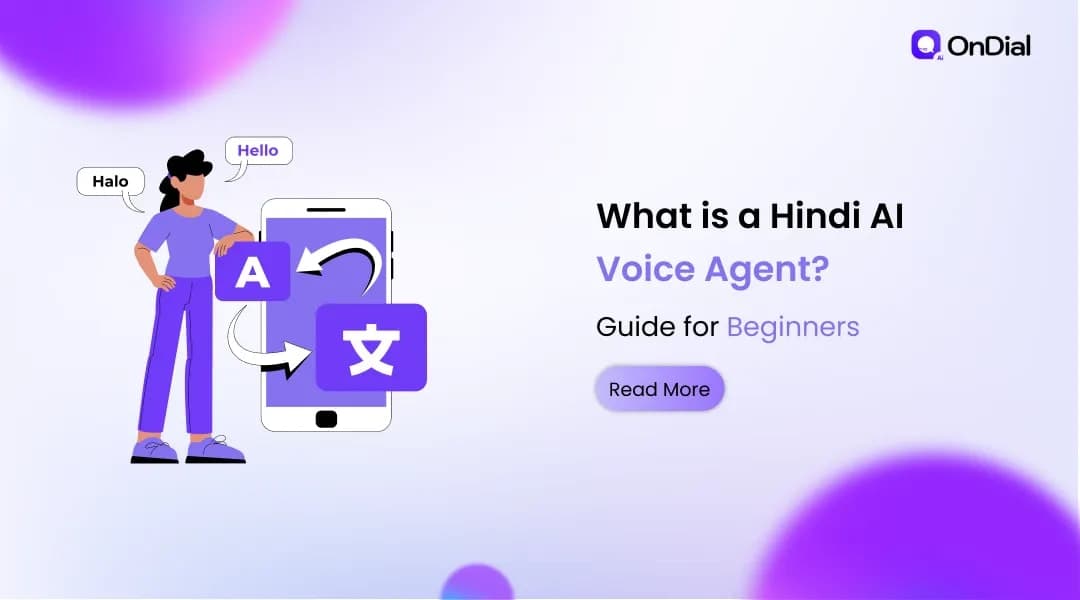
What is a Hindi AI Voice Agent?
A Hindi AI Voice Agent is a software system that can understand, process, and respond to human speech in Hindi just like a human conversation.
But here’s the part most people miss.
It’s not just “voice playback.”
It’s:
Listening (speech recognition)
Understanding (language processing)
Thinking (decision logic)
Responding (speech generation)
All happening in real time.
Think of it as a virtual employee. One who never sleeps, with an AI Calling Agent Handling High Volume Customer Calls. Never forgets. And doesn’t lose patience on the 500th call.
Still sounds abstract?
Let’s simplify.
It’s basically a human-like voice assistant that can:
Answer customer calls
Handle queries
Book appointments
Follow up on leads. All in Hindi.
How Does a Hindi AI Voice Agent Work?
Behind the scenes, it’s a stack of technologies working together.
Here’s the flow:
Speech Recognition (ASR) converts spoken Hindi into text. AI Voice Agents Improve Customer Experience in Travel.
Natural Language Processing (NLP) understands what the user actually means (not just what they say).
Decision Engine figures out the best response based on context.
Text-to-Speech (TTS) converts the response back into natural Hindi voice.
Now pause for a second.
Have you ever yelled “agent se baat karni hai” into an IVR system… and it still didn’t understand?
Exactly.
That’s the gap modern AI voice systems are closing.
Key Features of Hindi Voice AI Systems
Not all systems are equal. Not even close.
The good ones? They do this well:
Natural Hindi Conversations Not robotic. Not awkward. Fluid.
Multi-Dialect Understanding Hindi from Delhi ≠ Hindi from Bihar ≠ Hindi from Gujarat.
Context Awareness Remembers what the user said earlier in the conversation.
Interrupt Handling Users can cut in mid-sentence. Just like real life.
24/7 Availability No shifts. No downtime.
CRM & API Integration Connects with your existing tools.
Call Analytics Every conversation becomes data.
And yes… this is where modern AI Voice Agents start to outperform traditional systems.
Benefits of Using Hindi AI Voice Agents
Let me be blunt.
If your customers speak Hindi… and your system doesn’t… you’re already losing business.
Here’s what changes when you fix that:
1. Better Customer Experience
People prefer speaking in their native language. Always.
2. Massive Cost Reduction
Call centers are expensive. Hiring, training, attrition it adds up.
3. Scalability Without Hiring Chaos
10 calls or 10,000 calls. Same system.
4. Faster Response Times
No hold music. No queues.
5. Higher Conversion Rates
Leads don’t wait. AI responds instantly.
And if you’re exploring the Best AI Voice Agents for Call Centers, this is exactly the layer where ROI becomes obvious.
Real-World Use Cases in India
This isn’t theoretical. I’ve seen these deployed.
1. E-commerce
Order confirmations
Delivery updates
COD verification
2. Healthcare
Appointment booking
Patient reminders
Follow-ups
3. Banking & Finance
Loan eligibility checks
EMI reminders
KYC calls
4. EdTech
Student onboarding
Course reminders
Fee collection follow-ups
5. Real Estate
Lead qualification
Site visit scheduling
Quick question.
How many of these tasks actually need a human?
Exactly.
Hindi AI Voice Agent vs Traditional Call Centers
Let’s compare honestly.
Factor | Traditional Call Center | Hindi AI Voice Agent |
Cost | High | Lower over time |
Availability | Limited | 24/7 |
Scalability | Slow | Instant |
Consistency | Varies | Stable |
Language Handling | Depends on agent | Built-in |
But here’s the nuance.
AI doesn’t replace humans completely.
It removes repetitive work so humans can focus on complex conversations.
That’s the real shift.
Who Should Use Hindi AI Voice Agents?
Not everyone needs this. Let’s be practical.
You should seriously consider it if:
You handle high call volumes
Your audience is Hindi-speaking
You struggle with support costs
You miss leads due to delayed responses
If you’re just starting out with 10 calls a day?
Wait.
If you’re drowning in calls?
Now we’re talking.
How to Choose the Right Hindi Voice AI Platform
This is where most businesses mess up.
They choose based on demos. Not reality.
Here’s what I tell every founder:
1. Test Real Conversations
Not scripted demos. Real user queries.
2. Check Hindi Accuracy
Ask tricky questions. Use slang. Break it.
3. Integration Capability
Can it connect with your CRM?
4. Customization Level
Your business ≠ generic workflows.
5. Support & Partnership
This matters more than tech.
Companies like OnDial focus heavily on this “human-centric” approach because implementation is where most systems fail.
Challenges & Limitations
Let’s not pretend this is perfect.
It’s not.
Accent Variations Still Matter
Complex Queries Can Confuse AI
Initial Setup Takes Effort
Poor Training = Poor Results
And here’s the uncomfortable truth:
Bad implementation will make AI look worse than humans.
Every time.
Future of Hindi AI Voice Technology
Now this part excites me.
We’re moving toward:
Emotion-aware conversations
Real-time translation
Hyper-personalized voice interactions
Regional language expansion beyond Hindi
Imagine this.
A system that not only understands what you say… but how you feel when you say it.
That’s where this is heading.
Getting Started: How to Implement a Hindi AI Voice Agent
Don’t overcomplicate it.
Start simple.
Identify one use case (e.g., lead qualification)
Map conversation flow
Choose a reliable platform
Test with real users
Improve continuously
That’s it.
Not 20 steps. Not a six-month project.
Start small. Scale smart.
Conclusion
Here’s my honest take.
Hindi AI voice agents aren’t “the future.”
They’re already here.
The only question is whether you implement them well… or badly.
Because the difference between a frustrating bot and a brilliant assistant?
Execution.
And if you’re exploring the Best AI Voice Agents, don’t chase features.
Chase outcomes.