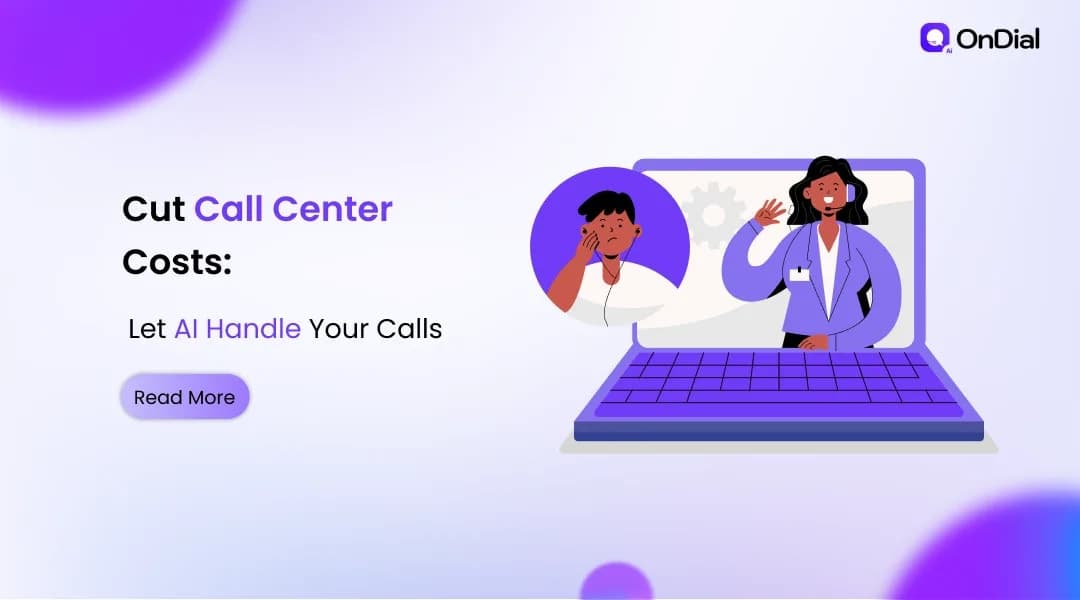
Gartner projects that conversational AI will reduce contact center labor costs by $80 billion in 2026. That number stopped me in my tracks the first time I read it. If you're running a contact center or managing customer support operations, you've probably felt the squeeze: budgets shrinking, call volumes climbing, and the constant pressure to deliver better experiences with fewer resources. You're not imagining it. The economics of traditional call handling are broken.
AI call center cost reduction is no longer a theoretical exercise or a pilot program buried in some innovation lab. It's the primary lever that forward-thinking businesses are pulling right now to reclaim 50-85% of their operational spend. In this guide, I'll walk you through exactly how AI voice agents handle calls, where the biggest savings hide, which calls to automate first, and the mistakes that derail most deployments. By the end, you'll have a clear framework to evaluate whether AI call handling is right for your operation and how to get started without disrupting what's already working.
Why Traditional Call Centers Are Bleeding Money
The fundamental problem isn't that call centers are inefficient. It's that the cost model was designed for a world with fewer options.
The Labor Cost Trap
Labor accounts for 60-70% of total contact center expenses, according to industry benchmarks. The average call center employee in the U.S. earns roughly $40,000 per year, and once you factor in benefits, training, management overhead, and turnover costs, that figure can double. Agent turnover in the industry runs between 30-45% annually. Every time someone leaves, it costs between $18,500 and $74,000 to replace them.
Here's what makes this especially painful: a significant portion of the calls your team handles every day are repetitive. Password resets. Order status checks. Appointment confirmations. Balance inquiries. In my experience working with businesses across industries at OnDial, 40-60% of inbound call volume falls into this category.
That means your most expensive resource (trained human agents) is spending most of its time on tasks that don't require human judgment.
Hidden Expenses Most Teams Ignore
The per-call cost everyone quotes, typically between $2.70 and $12 depending on complexity and geography, only tells part of the story. What about the calls that get misrouted? IVR systems misdirect roughly 15% of calls, and each misrouted call burns approximately 65-100 seconds of additional agent time. For a center handling a million calls per year, that wasted time adds up to a staggering expense.
Then there's the after-hours problem. Providing 24/7 coverage with human teams means paying 1.5-2x premiums for night and weekend shifts. And quality assurance? Most teams can only audit 2-5% of calls manually. The rest is a blind spot.
An AI call center cost reduction strategy doesn't just address the obvious expenses. It eliminates the invisible ones.
How AI Voice Agents Actually Reduce Call Center Costs
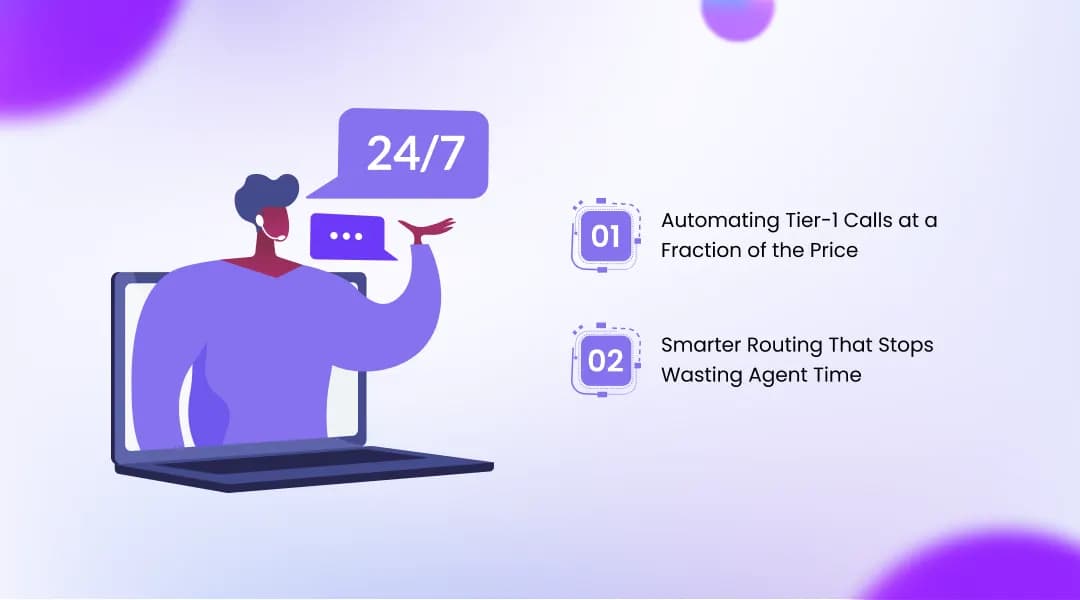
Let me be specific here, because the term "AI" gets thrown around loosely. An AI voice agent is a conversational system that uses speech recognition, natural language processing, and large language models to hold real phone conversations. It understands intent, retrieves customer data from your CRM, and resolves issues, or hands off to a human agent with full context when needed.
Automating Tier-1 Calls at a Fraction of the Price
Voice AI handles routine interactions for approximately $0.40-$1.50 per call. Compare that to $7-$12 for a human agent handling the same query. That's a 90-95% cost reduction per interaction on the calls that don't need human involvement.
I've personally seen this play out in deployments at OnDial. A mid-sized healthcare company we worked with was spending over $8 per call on appointment scheduling. After deploying an AI voice agent trained on their specific workflows, that cost dropped to under $1.20 per interaction, with patient satisfaction scores actually improving because wait times disappeared.
(Here's the part that surprises most people: customers often prefer the AI interaction for simple tasks because it's instant. No hold music. No menu trees. No repeating their account number three times.)
Smarter Routing That Stops Wasting Agent Time
Even for calls that do require a human agent, AI dramatically changes the cost equation. Traditional skill-based routing tries to match callers with the right agent based on menu selections. AI eliminates the need for routing entirely in over 80% of cases by resolving the call itself. When escalation is necessary, the AI transfers full conversation context so the agent doesn't waste time re-gathering information.
This alone can cut average handle time by 35%, according to ICMI data. Fewer minutes per call means your existing team handles more volume without additional hires.
What Types of Calls Should AI Handle First?

Not every call is a good candidate for automation on day one. The businesses that see the fastest return start with the right call types.
High-Volume, Low-Complexity Calls
Start by pulling your last 30 days of ticket data. Identify the top 10-15 most common inquiry types. In most operations, you'll find that a handful of categories, such as order tracking, appointment scheduling, account balance checks, FAQ responses, and password resets, make up 40-60% of total volume.
These are your starting targets. They follow predictable patterns, require data lookups rather than judgment, and resolve quickly. Should you automate calls that involve emotional complexity, negotiations, or complaints? No. Not yet, and maybe not ever. That's where human empathy still matters most.
After-Hours and Overflow Support
Here's a question worth asking: how many calls are you missing entirely?
Contractors and home service businesses miss 60-80% of incoming calls, according to industry research. Each missed call represents $200-$2,000 in potential revenue. AI voice agents don't sleep, don't take breaks, and scale instantly during demand spikes. Deploying them for after-hours and overflow coverage is often the single fastest path to ROI because it captures revenue you were previously losing with zero incremental labor cost.
At OnDial, we often recommend this as the entry point for businesses that are cautious about AI. It's low risk because it handles calls that currently go unanswered, and the results are immediately measurable.
Real Numbers: The ROI of AI in Call Centers
Let's move past vague promises. The economics here are concrete and auditable.
Cost Per Call Comparison
A traditional inbound call costs an average of $7.16 per interaction. McKinsey reports that AI can resolve inbound calls for under $1 per resolution. That's an 80-92% cost reduction per resolved interaction.
For a center handling 10,000 monthly contacts with a 45% AI deflection rate, the math works out to roughly $45,000 in monthly savings before any other operational changes are made. Scale that to 50,000 or 100,000 contacts, and you're looking at savings that fundamentally reshape your P&L.
One stat that I find particularly compelling: for every $1 invested in AI for customer service, businesses see an average return of $3.50. Some implementations report 148-200% ROI within the first year.
Where the Savings Compound
The initial cost reduction is just the beginning. Over time, AI generates compounding savings across multiple lines.
Reduced training costs are significant because AI doesn't need a six-week onboarding program every time you scale. Lower turnover impact matters because when agents handle fewer soul-crushing repetitive calls, burnout drops. Zendesk data shows a 40% reduction in agent burnout when AI handles routine tasks. Quality assurance automation means you can monitor 100% of interactions instead of a small sample, catching compliance issues and coaching opportunities that would otherwise slip through.
The businesses that treat AI call center cost reduction as a one-time savings event miss the bigger picture. The real value is structural. Your cost per resolution drops, your team focuses on high-value interactions, and your service quality improves simultaneously.
Common Mistakes When Deploying AI for Call Handling
I wouldn't be doing my job if I only told you what works. In the projects I've worked on at OnDial, I've seen plenty of deployments stall or underperform. The pattern is almost always the same.
Automating Too Much, Too Fast
The most common failure mode is deploying AI on complex calls before proving it on simple ones. If your AI voice agent struggles with a straightforward appointment booking, it will absolutely fail on a billing dispute. Start narrow. Prove containment rates above 55-70% on two or three high-volume intent types. Then expand.
Gartner's own research warns that the cost of generative AI per problem resolution could exceed $3 by 2030 for complex use cases. AI is remarkably cost-effective for the right call types and remarkably expensive for the wrong ones. The distinction matters.
Ignoring the Human Handoff
AI that can't gracefully transfer to a human agent when it reaches its limits creates worse experiences than no AI at all. The handoff has to include full conversation context, customer history, and a summary of what was already attempted. Cold transfers, where the customer has to repeat everything, negate most of the goodwill the AI built.
I believe in being transparent about this: AI voice technology is powerful, but it is not a universal replacement for human agents. The best deployments I've seen treat AI as the first responder and human agents as the specialists. That model works. "AI for everything" does not.
Conclusion
AI call center cost reduction isn't coming. It's here, and the gap between businesses that adopt it and those that don't is widening every quarter. The three takeaways that matter most: first, start with high-volume, low-complexity calls where the ROI is immediate and measurable. Second, treat AI as your first responder, not your entire team, because the hybrid model wins. Third, measure cost per resolution, not just cost per call, to capture the full value of what changes.
You have the information. The question now is whether you'll use it. At OnDial, we build AI voice solutions tailored to exactly this challenge: helping businesses scale smarter, reduce costs, and connect better with their customers through conversational AI that actually works on the phone. If you want to see what your specific savings would look like, reach out at OnDial and let's map it out together.
AI voice agents are intelligent systems that handle phone-based customer interactions using speech recognition and natural language processing, reducing call center costs by 50-85% while maintaining or improving service quality for routine inquiries.