I’ll tell you a secret most AI companies won’t say out loud: half the “AI for business” content you see online is written for algorithms, not humans.
I know because I’ve been on both sides, the ex-developer who once rolled his eyes at AI claims, and now the strategist who has watched voice AI turn chaotic support centers into smooth machines.
And I’ve spent enough time inside teams like OnDial, where conversational AI and Voice Assistants don’t exist as buzzwords but as actual systems that pick up Customer Calls, speak naturally, route queries, qualify leads, and make people’s days slightly less frustrating.
So let’s strip away the jargon and get honest about one thing:
AI isn’t here to replace your team. It’s here to stop your team from drowning.
If you’ve ever dealt with angry customers, missed follow-ups, abandoned leads, or a support team held together by caffeine and duct tape - stick with me.
This is for you.
What Is AI in Customer Service and Sales?
AI in this context refers to software systems that can:
Understand human queries
Respond, recommend, or route actions
Learn from data
Improve over time
Reduce repetitive tasks
This includes:
AI chatbots, Voice Assistants, AI Phone Calls, predictive models, sentiment analysis, automated workflows, and conversational AI platforms like the ones OnDial builds for businesses.
Here’s the simplest way I explain it to founders:
AI is the colleague who handles the repetitive stuff without complaining, freeing your real team to focus on moments that actually matter.
Why AI Matters for Modern Businesses
I’ve worked with hundreds of teams, and the pattern is universal: Your customers will not wait.
They won’t wait for replies. They won’t wait for resolutions. They won’t wait for your team to “check internally.”
If you can’t respond with speed and accuracy, you lose them.
AI doesn’t fix your business. It fixes the bottlenecks stopping your business from moving.
And yes, you feel the difference instantly.
How AI Improves Customer Service
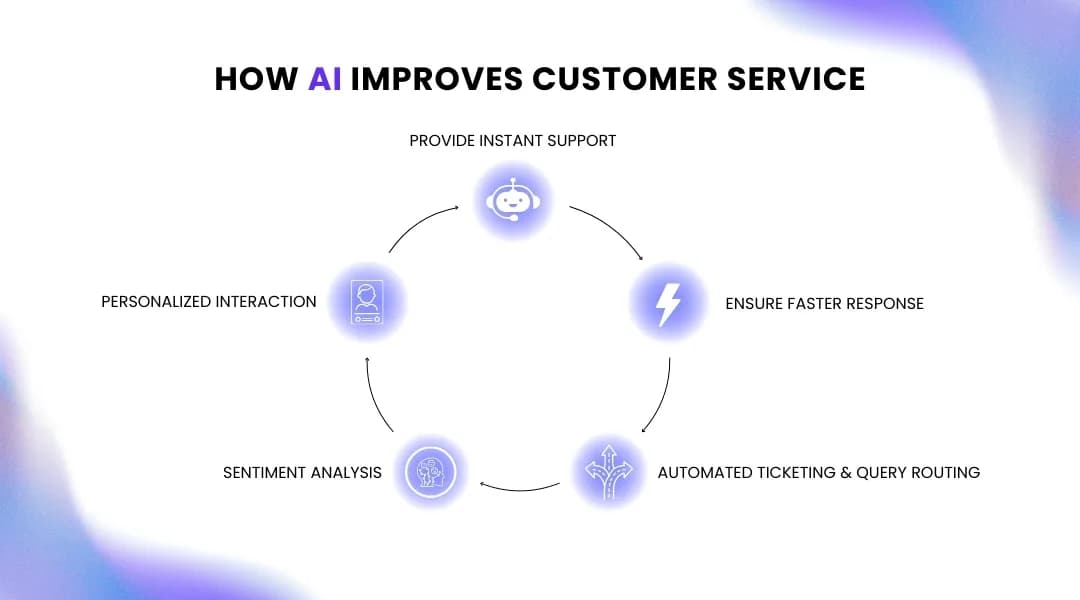
1. Instant 24/7 Support with AI Chatbots
Let’s be honest: no human wants to reply to “Where’s my order?” at 3AM.
AI chatbots can handle:
Order updates
Billing queries
FAQs
Refund status
Appointment booking
Policy-based questions
Here’s the beauty: AI never gets tired, never sounds irritated, and never forgets a detail.
OnDial’s conversational AI systems go a step further — they analyse context, speak naturally, and bridge the gap between “robotic bot” and “human-like agent.”
2. Faster Response Times
In customer service, speed isn’t a luxury — it’s oxygen.
AI drastically reduces:
First Response Time
Average Handling Time
Ticket backlogs
A Voice Assistant can answer and triage Customer Calls instantly instead of letting them ring endlessly in a queue.
(If you’ve ever run a support team during a sale season, you know exactly how life-saving this is.)
3. Automated Ticketing & Query Routing
This is where AI stops being “cool tech” and becomes operational firepower.
AI can:
Auto-classify tickets
Route queries to the right department
Prioritise high-risk or high-value customers
Identify issues that require human empathy
I’ve seen companies reduce routing errors by 60–80% simply by introducing smart AI call flow systems.
The old IVR systems? Yeah. Let’s just say customers won’t miss them.
4. Sentiment Analysis for Better Customer Understanding
Here’s a question for you — Would you treat a frustrated customer the same way you treat a calm one? Of course not.
AI sentiment analysis can detect:
Anger
Confusion
Satisfaction
Urgency
OnDial’s Voice AI even flags emotional cues during calls, giving managers real-time visibility.
This isn't about replacing human intuition. It’s about supporting it with data.
5. Consistent and Personalised Customer Interactions
Humans — wonderful as we are — get inconsistent. Bad days. Long shifts. Forgotten details.
AI doesn’t.
It remembers:
Customer preferences
Past issues
Purchase history
Behaviour patterns
So the experience stays consistent, even when your human team changes shifts or staff turns over.
How AI Enhances Sales Performance
Now let’s talk about the revenue side, where the stakes are even higher.
1. AI-Powered Lead Scoring
Sales teams spend too much time chasing the wrong leads.
AI can score leads based on:
Behaviour
Engagement level
Purchase intent
Historical data
Conversion patterns
This means your reps stop guessing. They focus on the customers who actually want to buy.
2. Smart Sales Forecasting
Forecasting used to be gut instinct + spreadsheets. Now it’s pattern recognition powered by machine learning.
AI helps sales teams understand:
What’s likely to close
When revenue peaks
Which segments convert better
What messaging works on whom
This isn’t magic. It’s maths at scale.
3. Personalised Product Recommendations
Great sales happen when the right offer hits the right person at the right time.
AI makes that easier by analysing:
Behavioural data
Browsing history
Purchase timelines
Customer lifecycle stage
4. AI-Driven Upselling & Cross-Selling
AI knows when a customer is ready for more. Often before a human rep does.
Voice AI can gently recommend upgrades during Customer Calls without sounding pushy.
5. Automating Follow-Ups & Outreach
Let me ask you something blunt:
How many deals have you lost simply because no one followed up?
AI fixes this by:
Scheduling outreach
Sending reminders
Triggering calls
Personalising messages
Tracking engagement
OnDial’s AI Voice Agents even make outbound calls automatically - reminders, renewals, qualification, feedback - all handled without overwhelming your team.
Real-World Examples of AI Transforming Support & Sales
Scenario 1: A D2C brand drowning in support tickets
AI reduced ticket load by 40% and improved response time from 4 hours to under 3 minutes.
Scenario 2: A SaaS team missing follow-ups
After adding AI-driven reminders and Voice Assistants, renewal rate improved by 18%.
Scenario 3: A call center struggling with staffing
AI Voice Agents took over 60% of repetitive inbound queries, freeing human agents for complex issues.
Scenario 4: A retail company using AI sentiment analysis
Customer satisfaction rose because managers finally knew which conversations needed escalation.
None of this is theory. I’ve watched it happen — repeatedly — inside businesses working with platforms like OnDial.
Benefits of Integrating AI into Your Business Workflow
Lower operational cost
Shorter resolution times
Higher sales conversions
Happier customers
Less pressure on human teams
24/7 availability
Better analytics and visibility
More predictable revenue
Higher agent productivity
Stronger customer loyalty
And the hidden gem: Your team actually enjoys their jobs more when the brain-numbing tasks disappear.
Which Businesses Can Benefit the Most?
From my experience, these sectors hit ROI faster:
Ecommerce & D2C
SaaS companies
Healthcare providers
Real estate firms
Insurance & finance
Hospitality
Logistics
EdTech
Call centers
Utility providers
If your business handles high volumes of Customer Calls, messages, or sales conversations — AI is not optional anymore. It’s the baseline.
Top AI Tools for Customer Service and Sales Teams
Conversational AI like OnDial for voice interactions
AI chatbots (WhatsApp, Web, In-app)
AI-powered CRM
Sentiment analysis platforms
AI email automation
Predictive sales analytics
Speech-to-text and call analytics tools
AI-driven monitoring dashboards
Conclusion
I’ve lived long enough in this industry to tell you this with complete conviction:
AI won’t replace people, but companies using AI will outperform those who don’t.
Not because AI is magical. But because AI makes humans better.
The best customer experiences and the most reliable sales systems — happen when machines handle the repetitive work and humans handle the meaningful work.
If you ever want to explore voice automation, conversational AI, or the Role of AI Call Agents, teams like OnDial specialise in building solutions that feel human, not robotic.
Because at the end of the day, the goal isn’t “more AI.” The goal is better communication.