Only 28% of telecom customers say they are very satisfied with their provider, according to aggregated industry data compiled by Worldmetrics. That is a stunning number for an industry that spends billions on service. So when people ask me how AI improves telecom customer experience, my honest answer is that AI is not a magic fix. It is a way to close the gap between what customers expect and what most carriers actually deliver, but only when it is built with care.
Here is the short version. AI improves telecom customer experience by answering routine questions instantly, catching problems before the customer notices them, and freeing human agents to handle the messy, emotional cases that actually need a person. Done well means shorter waits, fewer repeated explanations, and support that feels like it remembers you.
I have spent years building voice AI at OnDial, and I have seen both sides: the deployments that delight customers and the ones that make them furious. This guide walks through what genuinely works, backed by current data, and it is honest about where AI still falls short.
Why Telecom Customer Experience Is Quietly Broken

Telecom has the highest AI adoption of any industry, with roughly 95% of telecom companies using AI in some form, per Lorikeet's research. And yet customers are still miserable. That contradiction is the whole story.
The Churn Problem Nobody Wants to Name
Customer churn is the quiet emergency behind every telecom CX conversation. Global telecom churn reached 17.2% in 2023, up from the year before, according to Worldmetrics data. When you sell a product that looks almost identical to your competitor's, the experience around it becomes the only thing worth switching for.
The numbers get sharper when you look at what moves them. Proactive support conversations have been shown to cut churn by around 40%, while a single unresolved network outage can spike churn by 22% within a month with AI voice agents for call centers. In other words, the difference between keeping and losing a customer often comes down to one interaction handled badly.
What Customers Are Actually Angry About
Spend an hour reading real complaints, and a pattern jumps out. It is never "the AI answered too fast." It is always the same handful of failures, described in the customer's own words.
The pain points repeat across every forum and thread:
Deflection instead of resolution. One Verizon customer answered "yes" so many times to a bot asking "Would you like a live agent?" that the account got flagged as possible fraud. The bot could not connect them, so it treated persistence as suspicious.
Bots that misunderstand basic requests. A Telus customer wanted to subscribe to a channel to watch a TV show. The bot tried to sell them a smartwatch, then switched to French. That story went viral because everyone recognized it.
Being forced to repeat yourself. Customers describe explaining the same problem to a bot, then to one agent, then to another, with nothing carried over.
Notice something? None of these are complaints about AI existing. There are complaints about AI being implemented badly. That distinction is everything.
How AI Improves Telecom Customer Experience (The Honest Version)
Let me answer the core question directly, because this is the paragraph an AI search engine is most likely to quote.
AI improves telecom customer experience by resolving routine requests instantly, personalizing support using account history, and shifting from reactive to proactive service. The best systems handle high-volume simple tasks and hand complex, emotional issues to human agents. That handoff is the hinge the whole experience turns on.
Instant Answers to the Boring but Urgent Stuff
Most telecom support volume is not complex. It is billing questions, plan changes, SIM activation, data-limit checks, and connectivity troubleshooting. Natural language processing (NLP) lets a customer ask these in plain speech instead of navigating a phone tree, and get an answer in seconds.
The efficiency gains here are real and measured. McKinsey's contact centre analysis found that AI agents achieved roughly a 50% reduction in cost per call while improving customer satisfaction at the same time. That last part matters, because cutting costs while making customers happier is rare. Separately, CallSphere reported that 99% of telecom companies deploying conversational AI saw measurable productivity gains, with an average 32% drop in cost per interaction.
From Reactive to Proactive Support
Here is a counterintuitive idea: the best customer service call is the one that never happens. Proactive customer support flips the model. Instead of waiting for a frustrated customer to call about a data overage, the system notices the pattern and reaches out first with a plan option or a heads-up.
In projects I have worked on, this is where AI earns its keep. An AI agent watching usage and network signals can alert a customer to an approaching data limit, flag a local outage before they call in confused, or nudge someone toward a better-fit plan. Predictive analytics turns support from a cost center that mops up problems into something that quietly prevents them. Customers rarely say "thank you for the proactive alert," but they do stay.
Conversational AI and Voice: Where the Real Shift Is Happening
For years, telecom self-service meant the IVR menu, that press-one-for-billing maze everyone hates. Conversational AI in telecom is what finally kills it. And within conversational AI, voice is where the biggest change is landing.
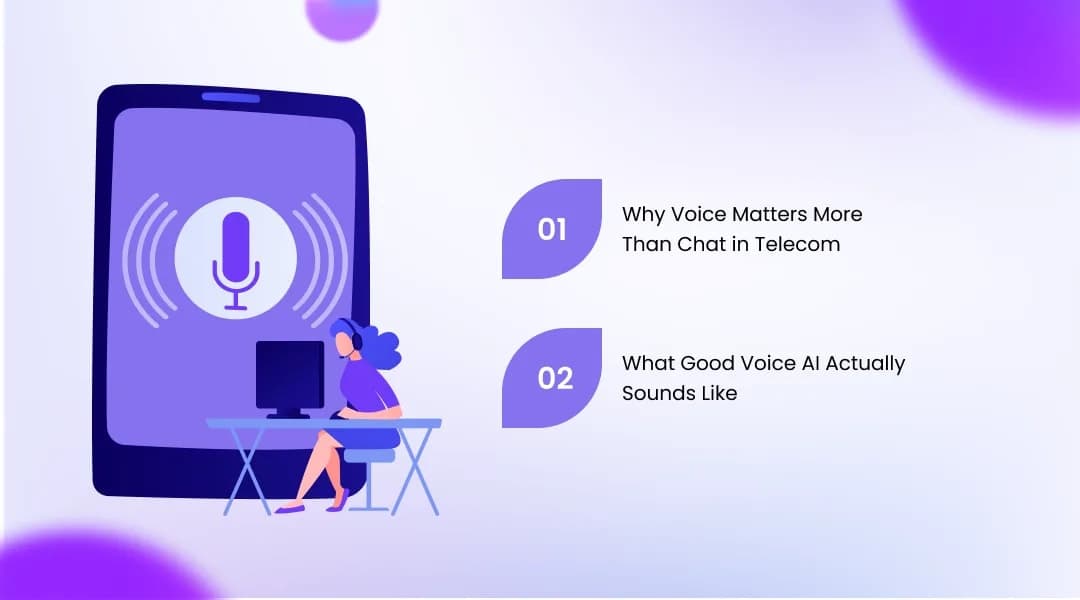
Why Voice Matters More Than Chat in Telecom
Telecom is a phone-first relationship. When your service goes down, you do not open a chat window; you call. That is why AI voice agents are reshaping this space faster than text bots ever did.
The expectation shift is measurable. Around 74% of consumers now expect round-the-clock service because of AI, per Zendesk's CX Trends 2026 report. Voice AI meets that at a fraction of the cost: AI voice minutes start near $0.08 per minute against a roughly $7.16 average cost for a human-handled inbound call, based on ElevenLabs and ContactBabel figures. The math is not close.
What Good Voice AI Actually Sounds Like
A good voice agent does not sound like a robot reading a script from a decade ago, with AI Voice Agent VS Human Call Centre Agent. It understands intent, holds a real two-way conversation, pulls context from your CRM and billing systems, and takes action instead of just talking.
This is the core of what we build at OnDial. A well-designed voice agent should recognize when a customer is frustrated through sentiment analysis, adjust its tone, and escalate to a human the moment the situation calls for it. The goal was never to sound human for its own sake. It was to resolve the issue on the first contact, which is the metric, first contact resolution (FCR), that customers feel most.
Have you ever stayed with a provider purely because leaving felt like too much hassle? That inertia is fragile. One genuinely helpful voice interaction can rebuild loyalty that a dozen bad ones eroded.
Does AI Actually Reduce Telecom Churn?
Short answer: yes, when it is tied to resolution rather than deflection. Reducing telecom churn is the outcome most operators actually care about, and the link between good AI support and retention is well documented.
The Retention Math
Churn is expensive because acquiring a new customer costs far more than keeping one. AI Call Center Agents Reduce Costs and Improve Customer. So even small retention gains carry outsized value. When AI cuts wait times, resolves issues on first contact, and personalizes offers, the friction that pushes people toward a competitor starts to disappear.
The supporting data is consistent. Carriers using sentiment analysis across their support transcripts have reported 15 to 20% churn reduction and a 25% improvement in Net Promoter Score, according to Subex. Those are not marginal numbers. They are the difference between a shrinking base and a growing one.
Sentiment Analysis and Catching Problems Early
Agentic AI systems can now read the emotional temperature of thousands of conversations at once. That surfaces patterns a manual review would never catch: a billing bug generating quiet anger, a region where outages are spiking complaints, a script that keeps failing customers.
I will be blunt about the limitation here. Sentiment analysis tells you where the fire is, not how to put it out. It is a detection layer, and it only helps if the organization behind it acts on what it finds. AI can hand you the insight at scale, but the fix still needs human judgment and follow-through.
The Part Most Vendors Skip: Where AI Still Fails
Most articles on this topic stop at the good news. I think that is a mistake, because trust comes from honesty, and customers can smell a sales pitch. So here is the uncomfortable part.
The Deflection Trap
The single biggest failure in telecom AI is designing bots to deflect rather than resolve. When a system is optimized to keep customers away from human agents to save money, it quietly optimizes for bad outcomes. Nearly 1 in 5 consumers who used AI for customer support saw no benefit at all, according to the Qualtrics XM Institute 2026 Consumer Experience Trends report.
That is the SNL-skit territory: the bot that loops, refuses to connect a human, and calls persistence fraud. It is not an AI problem. It is an incentive problem baked in at the design stage.
Keeping Humans in the Loop
Customers want AI, and they also want a way out of it. Around 73% of customers say they would take their business elsewhere if a company offered only AI with no human option, per Avaya's research. Even when an issue could be fully resolved by AI, a large share of people still prefer a person for the hard stuff.
The winning model is not AI versus humans. It is a human-in-the-loop design where AI handles the high-volume routine work and hands off the emotional, high-stakes cases cleanly, with full context so the customer never repeats themselves. At OnDial, an easy, obvious path to a human is not a fallback we tolerate. It is a feature we design in on purpose. The providers that respect this balance are the ones that will keep customers through the next decade, especially as Gartner projects that by 2028 around 70% of customer interactions will begin with conversational AI.
Conclusion
AI telecom customer experience works when it is built to resolve, not to deflect. The three things that matter most: use AI to answer routine requests instantly, shift from reactive to proactive support so problems get caught early, and always keep a clean, easy path to a human for the cases that need one. Get that balance right, and the payoff shows up as lower churn, higher satisfaction, and support that customers actually trust.
You do not have to guess your way there. If you are weighing how voice AI could fit your support stack without falling into the deflection trap that burns customers, that is exactly the problem we work on at OnDial. We build human-centric voice AI for telecom, and we would rather show you honestly where it helps and where it does not than sell you a bot that flags your customers as fraud for wanting a person.