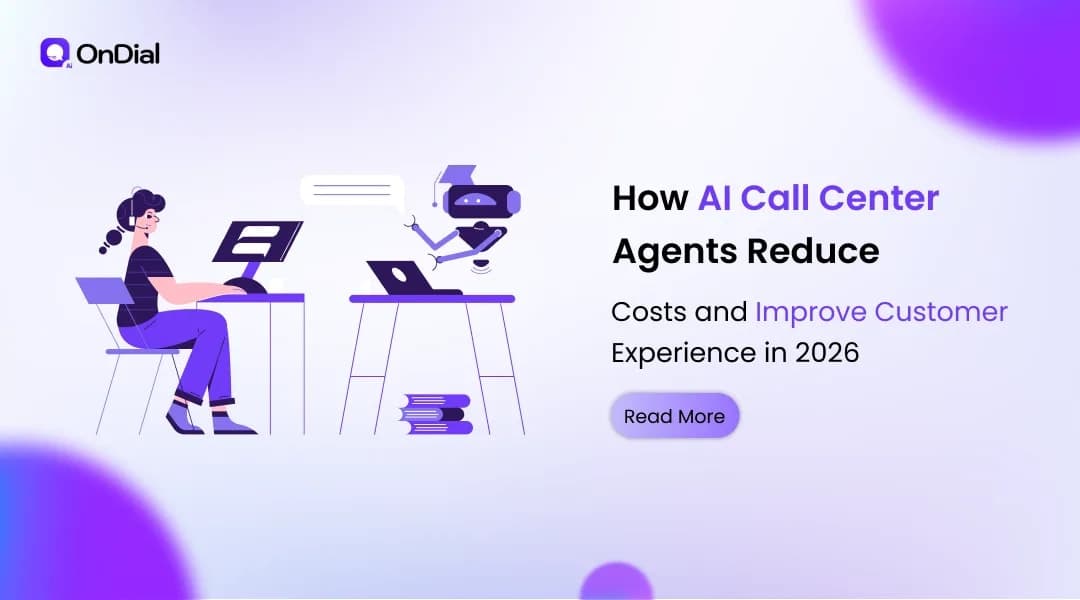
Gartner projects that conversational AI deployments within contact centers will reduce agent labor costs by $80 billion in 2026. That figure has been quoted in nearly every boardroom AI conversation for two years, and it is finally meeting reality. I have sat across the table from operations heads who have heard every vendor pitch on the planet, and the question I get most often is not whether AI works. It is whether the savings actually show up on the P&L without trashing the customer experience.
This is a fair question. Most CX leaders I speak with are not anti-AI. They are anti-disappointment. They have watched chatbot rollouts make customers angrier and metrics murkier. So let me cut through the noise. This guide explains exactly how AI call center agents reduce costs, where the customer experience gains come from, what the 2026 economics look like (including for Indian businesses paying in rupees), and the deployment path that does not blow up your CSAT scores.
Why 2026 Is the Year the Math Finally Works
The vendor demos have always been impressive. The unit economics, until very recently, were not. That has changed.
The 2026 cost curve
In 2025, premium AI voice stacks in India ran ₹8 to ₹12 per minute. That was often more expensive than a junior BPO telecaller once you accounted for volume below 500 calls a day. Today, that range is ₹2 to ₹6 per minute, which beats even a Tier 3 BPO telecaller's fully-loaded cost of ₹4 to ₹5 per minute. The flip happened quietly, but the implication is loud. AI call center agents are now cheaper than the cheapest human option in the cheapest labor market on earth.
The global picture matches. Voice AI costs about $0.40 per call compared to $7 to $12 for a human agent, a 90 to 95% cost reduction. Contact centers that automate the right call types see 65 to 90 percent reductions in operational cost per resolution, depending on geography and complexity.
The adoption curve has caught up
88% of contact centers report using some form of AI, but only 25% have fully integrated automation into daily operations. The gap between using and integrating is where most of the disappointment lives. Pilots become permanent. Permanent pilots do not save money.
The organizations capturing the projected savings have done something specific. They moved past the "is it ready" question into "where does it belong in our call mix" and "how do we measure outcomes that actually matter." That shift is what 2026 is really about.
What AI Call Center Agents Actually Do
An AI call center agent is an artificial intelligence system that handles voice conversations end to end using speech recognition, natural language understanding, large language models, and text-to-speech. It is not an IVR with a friendly voice. It is not a chatbot ported to phone. It is a system that listens, decides, acts, and escalates.
The technical stack in plain language
Five components run in real time during every call. Automatic Speech Recognition (ASR) converts the caller's audio to text. Natural Language Understanding (NLU) interprets intent. A large language model decides what to do next. Backend integrations execute the action, such as pulling an order, processing a refund, or rescheduling a delivery. Text-to-speech (TTS) returns a natural-sounding response, often with sub-500 millisecond latency for the kind of conversational rhythm callers expect.
This pipeline is what separates 2026 voice AI from 2022 voice bots. The latency, the multi-turn memory, and the ability to handle interruption are now production-grade.
What it is not
A common confusion: AI call center agents are not the same as agent assist tools, IVRs, or text chatbots. IVR routes. Agent assist helps a human agent during a call. Chatbots handle text. AI call center agents handle the full spoken interaction autonomously, only escalating when the situation requires human judgment. Mixing these definitions is how vendors oversell and buyers feel cheated.
How AI Call Center Agents Reduce Costs (The Mechanics)
This is the section every CFO wants. Here is how the savings show up, item by item.
AI call center agents reduce costs through six concrete mechanisms: lower cost per interaction, elimination of after-call work, 24/7 availability without overtime, instant scaling without recruitment cycles, reduced attrition costs on remaining human teams, and a structural shift from cost-per-call to cost-per-resolution. The combined effect is typically a 30 to 90 percent reduction in operational cost on the call types automated.
The per-interaction math
McKinsey research finds the average inbound call costs $7.16, which is 18% more than email and 42% more than chat. AI voice agents eliminate this cost of disparity by resolving interactions end-to-end, often for under $1 per resolution. This is the foundation of every cost case.
A few worked examples make this concrete:
10,000 calls per month, 4.5-minute average handle time. Outsourced agents cost $22,500 to $78,750 monthly depending on geography. The same volume through AI voice agents costs $3,150 to $6,750 monthly at $0.07 to $0.15 per minute. That is roughly $190,000 to $864,000 in annual savings before counting setup, training, and turnover costs.
India BPO with 50 outbound agents at ₹5 per minute fully-loaded. Replacing 60 percent of outbound dialing with AI at ₹4 per minute cuts ₹2 to ₹3 lakh from the monthly P&L while increasing concurrent calling capacity.
A US support team paying $29 to $42 per agent hour. Diverting routine queries (order status, account balance, password resets) to AI at sub-$0.50 per call reclaims 40 to 60 percent of agent capacity for higher-value interactions.
Where the hidden savings live
Per-minute cost is the headline. The real wins sit beneath it.
After-call work consumes a stunning share of agent time. 54% of calls require ACW, making it one of the most consistent drains on agent productivity. AI summarization and automatic CRM logging cut wrap time from minutes to seconds.
Attrition is the other invisible tax. AI absorbing the repetitive, high-volume tasks that burn agents out and drive 30-45% annual turnover across the industry reduces the recruit-train-lose cycle that costs $10,000 to $20,000 per replaced agent.
Then there is the staffing math. Call volume swings; staffing does not. AI voice agents scale instantly. They handle 10 concurrent calls or 10,000 with no recruiting cycle, no training period, and no overtime. The perpetual over-or-understaffing problem stops being a problem.
How AI Call Center Agents Improve Customer Experience
This is the section every CX leader actually cares about. Cost savings that wreck CSAT are not savings. They are deferred churn.
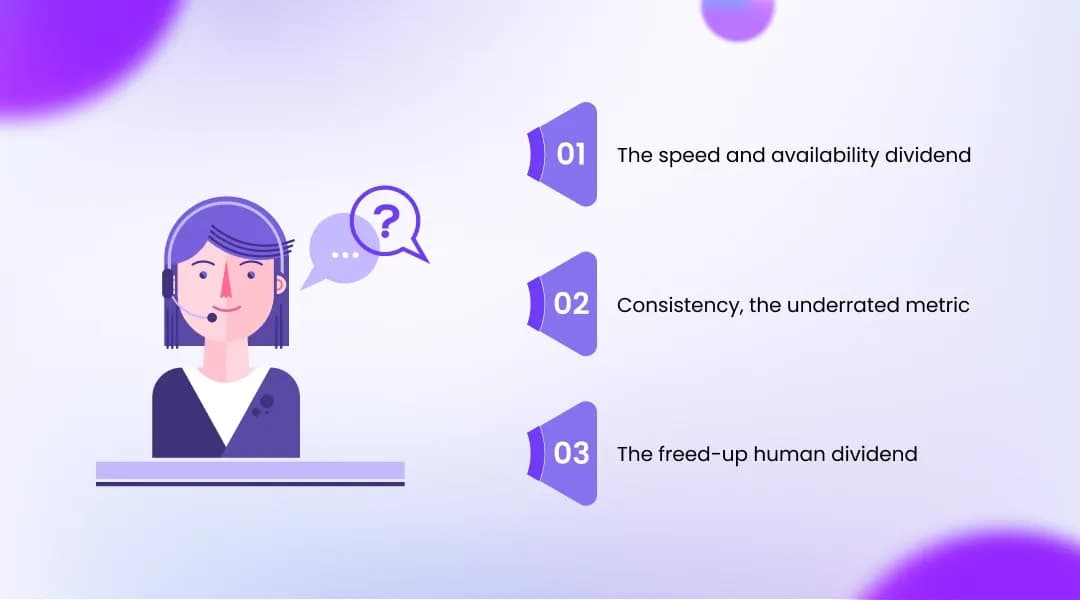
The speed and availability dividend
Customers do not want to be impressed by your AI. They want their problem solved without holding for 12 minutes. AI call center agents answer instantly. Always. 24/7. In any time zone. Zero queue time alone moves CSAT meaningfully on routine call categories.
The data supports this. Salesforce reports that 89% of service professionals say conversational AI increases self-service resolution rates, while 88% say it accelerates resolution times. Faster does not always mean better. Faster and accurate does.
Consistency, the underrated metric
Human agents have good days and bad days. They learn at different paces. They escalate inconsistently. An AI agent does not. Every caller gets the same compliance disclosures, the same script discipline, the same accurate information. For regulated industries (BFSI, insurance, healthcare), this consistency is not nice to have. It is a compliance asset.
The freed-up human dividend
This is the point most articles miss. The biggest CX improvement is not what the AI does. It is what the AI lets your human agents do.
When AI handles the 60 to 70 percent of calls that follow structured patterns, your best agents stop burning their day on password resets and start focusing on the complaints, retention saves, and complex troubleshooting where empathy and judgment actually matter. Human agents are not replaced - they are repositioned. Instead of handling repetitive queries, they focus on complex cases, exceptions, and high-value interactions. Agent satisfaction rises. Attrition falls. Customer outcomes on the calls that matter most improve.
That is the hybrid model working as designed.
The India Economics Most Articles Skip
Almost every guide on this topic is written for US contact centers, with US pricing, US labor assumptions, and zero acknowledgment of how Indian businesses actually operate. If you are running a contact center in India or serving Indian customers, the math and the constraints are different.
Pricing and labor reality
A 50-agent India BPO running voice support costs roughly ₹50 lakh to ₹1 crore monthly fully loaded. AI voice infrastructure for the same call volume now runs ₹15 to ₹40 lakh, with capacity to handle 3 to 5x the concurrent load. The savings are real, but the bigger unlock is that small and mid-size Indian businesses (clinics, EdTech players, NBFCs, D2C brands) that could never afford a 24/7 contact center can now operate one.
Hinglish, code-switching, and the language problem
Most Indian customer conversations are not pure Hindi or pure English. A real call sounds like "Haan, woh delivery aaj hi chahiye, Saturday ko toh main out of station hoon." Models trained on clean Hindi or American English fail on this. AI voice platforms that handle Hinglish code-switching reliably are still a minority of the market. This is one of the most important vendor questions a buyer can ask. OnDial, an India-based AI voice technology platform, builds for exactly this code-switching reality across 20+ industries, with sub-500ms latency tuned for Indian telecom networks.
Regulatory compliance is not optional
Two frameworks shape every Indian outbound calling deployment. The TRAI DLT (Distributed Ledger Technology) regime requires registered headers, content templates, and consent records for promotional and transactional voice traffic. The DPDP Act 2023 sets data protection obligations on how customer voice data is collected, stored, and processed. A vendor that cannot speak fluently to both is not ready for the Indian enterprise market.
Where AI Agents Belong (And Where They Do Not)
Honest scoping is what separates successful deployments from cautionary tales.
Strong fits
High-volume, structured inbound calls such as order status, account balance, delivery rescheduling, branch hours, plan information, and FAQ handling.
Outbound at scale including EMI reminders, payment collections, lead qualification, appointment confirmations, KYC verification, and customer surveys.
24/7 coverage requirements where human staffing makes the unit economics unworkable.
Multilingual support where hiring native speakers across regional languages is operationally hard.
Weaker fits
Emotionally charged complaints where empathy and creative resolution drive outcomes.
Complex multi-system troubleshooting that requires real-time judgment.
High-stakes retention conversations where a policy bend or relationship signal saves the account.
Regulatory edge cases that need human accountability.
The pattern is clear. AI takes the rule-bound 80 percent. Humans take the judgment-bound 20 percent. Get the routing right and both halves outperform either alone.
A Realistic 90-Day Deployment Path
Most failed AI rollouts share a single root cause. The team tried to automate too much, too fast, across too many call types. Here is a sequence that consistently works.
Days 1 to 30: Pick one use case
Choose one high-volume, low-complexity call type. Order status, EMI reminders, and appointment confirmations are the typical winners. Define success in three numbers: containment rate (calls fully resolved by AI), CSAT on those calls, and cost per resolution. Resist the temptation to scope more.
Days 31 to 60: Pilot with a fallback ramp
Route 20 percent of the chosen call type to AI. Keep the human queue ready for instant fallback. Measure obsessively. Listen to call recordings. Tune the conversation design. According to Verint data, 66% of businesses took more than six months to see ROI from AI implementations, but the first 60 days tell you whether you are on the right trajectory.
Days 61 to 90: Scale to 60 to 80 percent
If containment is above 60 percent and CSAT holds, scale aggressively on that one use case. Then, and only then, plan the next use case. Stacking AI rollouts in parallel is how teams break things.
Closing Thoughts
AI call center agents are no longer an experiment. In the 2026 economics work, the technology is production-grade, and the playbook for deployment is well understood. The leaders capturing the savings are not the ones with the most AI features. They are the ones who scoped narrowly, measured honestly, and built the human-AI boundary with care.
You do not need to automate everything to win. Pick one high-volume call type. Measure containment, CSAT, and cost per resolution. Scale what works. Hold the line on what does not.
If you are evaluating AI call center agents for an Indian business and want a deployment partner that handles Hinglish code-switching, TRAI DLT registration, and DPDP Act compliance without you having to learn the regulatory stack, OnDial builds AI voice technology purpose-designed for the Indian market across 20+ industries. The conversation worth having is which single use case in your current call mix would deliver the cleanest ROI in 90 days. Start there.