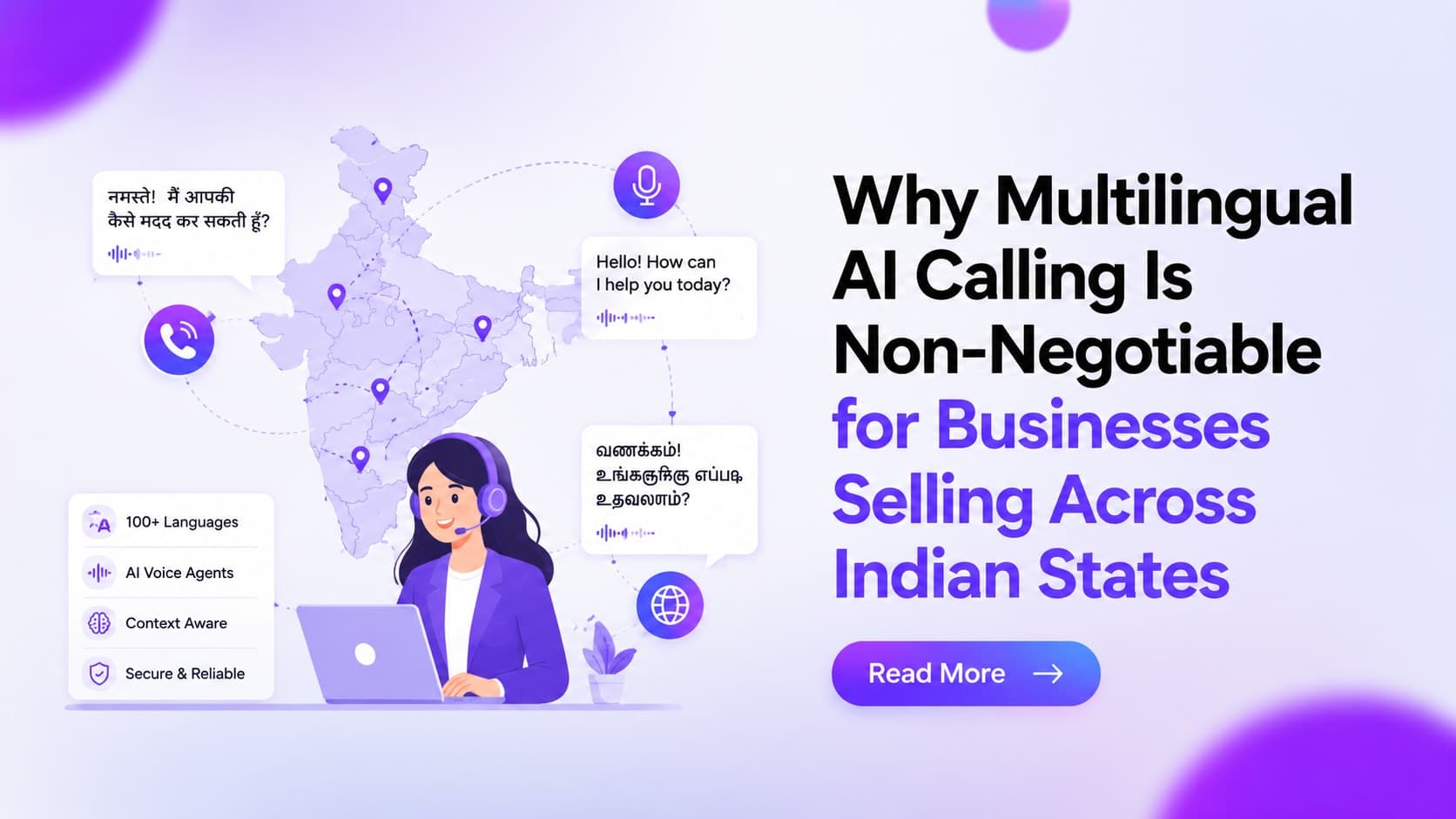
India is not one market. It has 28 states, 8 union territories, 22 officially recognized languages, and over 19,500 dialects layered across a population of 1.4 billion people. A business headquartered in Bengaluru trying to sell to farmers in Rajasthan, retailers in Tamil Nadu, or SME owners in West Bengal is not just crossing state borders. It is crossing linguistic, cultural, and psychological barriers that a single-language sales team simply cannot bridge.
This is where most businesses quietly lose revenue without ever realizing the exact cause. Leads go cold. Follow-up calls get rejected. Customers disengage mid-conversation. Conversion rates in Tier 2 and Tier 3 markets stay stubbornly low. The instinct is to hire more local sales agents or open regional offices. Both approaches are expensive, slow to scale, and operationally fragile.
AI Calling is the modern answer to this problem, but not just any AI calling solution. Businesses operating across Indian states need multilingual AI calling systems that understand regional language nuances, local dialects, cultural communication styles, and state-specific buying contexts. Anything less is just noise in the customer's ear.
This article explains exactly why multilingual AI calling has moved from a competitive advantage to an operational requirement for any serious business with pan-India ambitions, and how to implement it in a way that actually converts.
The Scale of the Challenge: India's Linguistic Landscape by the Numbers
To understand why this problem demands a technological solution rather than a hiring solution, the numbers have to come first.
Hindi is spoken as a first language by roughly 44 percent of the population, which means the majority of India's population communicates primarily in languages other than Hindi. Bengali, Telugu, Marathi, Tamil, Gujarati, Kannada, Malayalam, Odia, Punjabi, and dozens of other languages collectively represent the working vocabulary of hundreds of millions of potential customers.
When a business runs a single-language outbound calling campaign in Hindi or English, it is effectively locking itself out of vast regional markets. Studies across customer experience research consistently show that customers are significantly more likely to engage, trust, and convert when spoken to in their native language. In the B2C context, this effect is even more pronounced. In the B2B context for SMEs and regional buyers, it is absolute.
The cost of ignoring this is measurable. Consider an outbound campaign generating 10,000 calls per month in Hindi-only mode targeting customers across Maharashtra, Tamil Nadu, Andhra Pradesh, and West Bengal. If 60 percent of contacts speak a language other than Hindi as their primary preference, the campaign is functionally delivering value on only 40 percent of its spend. That is not a minor inefficiency. That is a structural revenue leak.
Regional language AI voice agents powered by modern AI calling infrastructure change this calculus entirely.
Why Generic AI Calling Falls Apart Across Indian States
Not all AI calling is created equal. Many businesses deploy basic automated calling systems and mistake them for intelligent voice AI. The difference becomes obvious the moment those systems encounter India's linguistic reality.
The Problem with Single-Language Deployments
A standard automated calling system or a basic conversational AI trained only on English or Hindi will fail in multiple ways when deployed for cross-state outreach in India. It will misinterpret code-switched speech, where a customer naturally blends Hindi with Telugu or Tamil with English mid-sentence. It will mispronounce names, town names, and product terms that are state-specific, immediately signaling to the customer that the caller is not a trusted local voice. It will fail to pick up on cultural hesitation cues that vary significantly between, for example, a Gujarati business owner and a Punjabi one.
These failures are not cosmetic. They are conversion killers.
The Dialect Problem Goes Deeper Than Language
Even within a single language like Tamil, the spoken dialect in Chennai differs substantially from the dialect in Coimbatore, which differs again from rural Tirunelveli. A voice AI system trained on standard literary Tamil will sound robotic and distant to a Madurai merchant. The same problem exists in Marathi, Kannada, Bengali, and virtually every major Indian language.
Businesses running AI Calling campaigns without dialect sensitivity built in are essentially broadcasting in a foreign accent to their own customers, and wondering why the conversion rates are underwhelming.
The Trust Gap in Regional Markets
India's regional markets, particularly Tier 2 and Tier 3 cities and rural belts, operate on relationship-based buying behavior. Trust is built through familiarity, local references, and communication in the buyer's comfort language. A cold call in an unfamiliar accent or language triggers immediate skepticism. A call in the customer's regional language, calibrated to local communication norms, triggers the opposite: openness, curiosity, and engagement.
This is precisely why multilingual AI calling is not optional for businesses with cross-state revenue targets.
What Multilingual AI Calling Actually Does Differently
Multilingual AI calling is not about running parallel campaigns in multiple languages. That would simply multiply the operational complexity. It is about deploying a single intelligent system that detects, adapts, responds, and converts across language contexts dynamically and automatically.
Language Detection at the Point of Contact
Modern multilingual AI calling systems are built to identify the customer's preferred language from the first few seconds of a call. This is done through a combination of the customer's response language, regional phone number identification, and profile data from CRM integrations. Once the system identifies the language preference, it shifts seamlessly into that mode without the customer needing to press a button, navigate a menu, or wait for a transfer.
This zero-friction experience is what separates genuine AI calling infrastructure from basic IVR systems dressed up with AI labels.
Dynamic Script Adaptation Across Languages
The content of a sales conversation does not translate directly across Indian languages. A sales narrative that works in Hindi requires structural reordering to land well in Tamil. The level of directness appropriate in Punjabi business culture is different from the more formal approach that works in West Bengal. Effective regional language AI voice agents are built with culturally calibrated scripts, not just translated ones with OnDial.
This is a critical distinction. Translation produces words. Cultural calibration produces outcomes.
Real-Time Contextual Responses
Unlike static IVR trees, intelligent AI Calling systems engage in real conversations. They handle objections, answer product questions, respond to pricing queries, and escalate complex issues to human agents, all in the customer's preferred language. The system does not loop endlessly or redirect customers to English menus when the conversation gets complex. It stays in the regional language throughout.
Regional Language AI Voice Agents: How They Work in Practice
Understanding the mechanics of regional language AI voice agents removes the abstraction and helps businesses make smarter deployment decisions.
The Technology Stack Behind Multilingual Voice AI
A production-grade multilingual AI calling system for India typically runs on several interconnected layers. The automatic speech recognition layer converts spoken audio into text across supported languages. The natural language understanding layer interprets intent, sentiment, and context from that text. The dialogue management layer determines the appropriate response based on the conversation state, business rules, and customer profile. The text-to-speech layer converts the response back into natural-sounding regional language speech. All of this happens in near real-time, creating a conversation that feels natural rather than mechanical.
The quality of each layer varies significantly across vendors, which is why businesses need to evaluate multilingual AI calling systems on actual language performance metrics rather than marketing claims.
Supported Languages and Coverage Expectations
A robust regional language AI calling platform for India should support, at minimum, Hindi, Tamil, Telugu, Kannada, Malayalam, Marathi, Gujarati, Bengali, Punjabi, and Odia. Systems with broader dialect coverage, including rural dialect variants, provide significantly better performance in Tier 2 and Tier 3 markets where the linguistic gap between standard and spoken versions of a language is widest.
Businesses planning state-specific campaigns should map their target geographies against the language and dialect coverage of the AI calling system before deployment. Coverage gaps in priority markets are not a minor technical issue. They directly translate to revenue loss.
Integration with Lead Data for Personalized Calling
The best regional language AI voice agents do not operate in isolation. Learn more in AI Voice Agents Handle Hindi English Code Switching. They pull lead data from CRM systems to personalize outbound calls. A call to a textile merchant in Surat should reference relevant product categories, previous interactions, and location-specific offers, all delivered in Gujarati. This level of personalization at scale is what makes AI calling genuinely competitive with human agents in regional markets, often outperforming them on consistency and availability.
AI Calling System for Multilingual Lead Conversion: A Stage-by-Stage Breakdown
Lead conversion across Indian states requires a structured funnel that accounts for language preferences at every stage. The AI calling system must be architected to support this without creating operational silos for each language.
Stage 1: Initial Outreach and Language Identification
The first call in a multilingual AI calling campaign performs two functions simultaneously: it introduces the business and its offer, and it identifies the customer's language preference. Systems that handle this gracefully, without making the language identification feel like a bureaucratic checkpoint, set a far better tone for the relationship. The best implementations begin with a short neutral greeting that works across language contexts and then branch based on the customer's response.
Stage 2: Qualification in the Customer's Language
Once the language is established, the AI calling system moves into qualification. This stage asks questions designed to assess the lead's fit, readiness, and interest level. In a multilingual context, qualification questions must be culturally adapted. The way you ask about budget in Tamil Nadu is different from the way you ask in Haryana. The AI system needs to reflect this not just linguistically but in tone, pacing, and the order of questions.
Stage 3: Product Presentation and Objection Handling
This is where the depth of the AI calling system's training becomes visible. A system trained on regional language sales conversations will handle objections far more effectively than one trained only on English data with translated overlays. Common objections, such as price sensitivity, distrust of new vendors, and preference for local suppliers, vary in how they are expressed across states and must be addressed with culturally relevant responses.
Stage 4: Follow-Up Sequencing Across the Funnel
Multilingual AI Calling does not end at the first call. A properly designed system runs follow-up sequences in the same language as the initial contact, building a consistent brand voice across every touchpoint. This consistency, particularly in regional languages, dramatically improves lead nurturing effectiveness because customers are not suddenly switching to English email follow-ups after a Tamil phone conversation. Learn more in AI Voice Agents Hindi English Code Switching Indian.
Voice AI for Cross-State Customer Support: Operational Architecture
The application of multilingual AI calling extends beyond sales. Customer support across Indian states presents an equally complex multilingual challenge, and voice AI is increasingly the scalable answer.
Inbound Support in Regional Languages
A customer in Vijayawada calling support for a product purchased from a Bengaluru-based company expects to be helped in Telugu. A customer in Bhopal expects Hindi. Currently, most companies route both customers to the same English or Hindi support queue, creating immediate friction for a significant portion of their user base.
Voice AI for cross-state customer support eliminates this problem by detecting the customer's language from the first spoken words and routing the conversation to the appropriate language model. The customer experiences seamless support in their preferred language without any manual routing or waiting.
Automated Resolution for Common Regional Queries
A large percentage of inbound support queries across any business are repetitive: order status, return policy, billing questions, delivery timelines. A multilingual AI calling system can resolve these queries in the customer's regional language without human agent involvement. This dramatically reduces support costs while improving resolution speed for customers who might otherwise be waiting in a multilingual queue.
Escalation Protocols Across Language Contexts
When a query genuinely requires human intervention, the AI calling system must transfer the conversation to a human agent with full context, including the customer's language preference, conversation history, and issue classification. This prevents the customer from having to repeat themselves in a different language to a new agent, which is one of the most common and damaging friction points in cross-state customer support operations.
Entity-Based Multilingual AI Sales Automation: The Intelligence Layer
Beyond language, the most advanced multilingual AI calling systems incorporate entity-based intelligence that makes every conversation more contextually relevant and commercially effective.
What Entity-Based AI Means in Practice
Entity-based multilingual AI sales automation refers to the system's ability to recognize and act on specific data points within a conversation, such as the customer's business type, state location, product interest, budget signals, and buying timeline, and to use those entities to guide the conversation intelligently. This is not keyword matching. It is semantic understanding that works across languages.
A system that understands entity signals in Tamil as well as it does in Hindi allows a business to run genuinely intelligent sales conversations at scale across state boundaries, without needing separate teams for each language market.
CRM-Integrated Entity Recognition
When the AI calling system is integrated with a business's CRM, entity recognition becomes even more powerful. The system can pull existing data about the customer, recognize new entities mentioned in the conversation, and update the CRM record in real-time. A sales manager in Delhi can review the outcome of a Tamil-language call in Coimbatore with full structured data, without needing to understand Tamil, because the entity layer has already extracted and organized the relevant information.
Lead Scoring in a Multilingual Context
Traditional lead scoring models are built on English-language data and miss signals that appear in regional language conversations. A proper entity-based multilingual AI sales automation system scores leads based on signals extracted across languages, ensuring that a high-intent Telugu-speaking prospect in Hyderabad is not underscored simply because the system was not designed to interpret Telugu buying signals accurately.
ROI of Multilingual AI Calling: What the Numbers Actually Look Like
Every technology investment needs to justify itself in business terms. Multilingual AI calling presents a compelling financial case when modeled properly.
Cost Per Lead Reduction Across States
A traditional cross-state sales operation requires regional agents who speak the local language, earn local salaries, and need local management infrastructure. Scaling from 5 states to 10 states means roughly doubling that cost structure. Multilingual AI calling adds new state coverage at a fraction of the incremental cost, because the system handles language variation without additional headcount.
Businesses that have made this transition report reductions in cost per qualified lead ranging from 40 to 65 percent when comparing AI calling operations to equivalent human agent operations across the same multilingual markets.
Conversion Rate Improvement in Regional Markets
The conversion rate improvement from language-matched calling is one of the strongest ROI levers in this analysis. When leads are contacted in their preferred regional language, engagement rates improve substantially. Industry observations from businesses deploying regional language AI Calling in India show engagement rate improvements of 30 to 55 percent compared to Hindi or English-only campaigns in non-Hindi-speaking markets.
Even at the conservative end of that range, the revenue impact on a business generating significant pipeline from regional markets is substantial.
Speed-to-Scale Economics
A human agent operation expanding into a new language market needs to recruit, train, and ramp regional agents, a process that typically takes 3 to 6 months before a new language market is operational at full capacity. A multilingual AI calling system can be extended to a new language in a fraction of that time, with no recruitment costs, no training overhead, and immediate deployment capability.
For businesses in growth mode with aggressive geographic expansion targets, this speed advantage is not just financially significant. It is strategically decisive.
Implementation Framework: Rolling Out Multilingual AI Calling Across States
A structured rollout reduces risk, accelerates time-to-value, and builds the internal competence needed to optimize the system over time.
Phase 1: Language Coverage Audit and Priority Market Mapping
Before deployment, map your existing and target customer base by state and language. Identify the top 5 to 7 languages that cover 80 percent or more of your market opportunity. This creates a prioritized language roadmap for the AI calling system, ensuring you focus development and configuration effort where the commercial impact is greatest.
Phase 2: Script Development and Cultural Calibration
Work with native language experts and regional sales professionals to develop scripts in each priority language. Do not simply translate your existing Hindi or English scripts. Restructure the narrative for each language context, incorporating local idioms, culturally appropriate approaches to objection handling, and region-specific product positioning.
Phase 3: CRM Integration and Data Mapping
Connect the multilingual AI calling system to your CRM. Map data fields for language preference capture, regional entity recognition, and call outcome logging. Ensure the data flowing from regional language calls is structured and accessible to your central sales and analytics teams.
Phase 4: Pilot Campaigns by State
Launch pilot campaigns in 2 to 3 priority states before full rollout. Use these pilots to validate language performance, test script effectiveness, measure conversion rates, and identify gaps in dialect coverage or cultural calibration. Pilot data provides the evidence base for optimizing the system before it runs at full scale.
Phase 5: Full Rollout and Continuous Optimization
After pilot validation, scale the AI Calling operation to all priority states simultaneously. Establish a continuous optimization process that reviews language performance metrics weekly, updates scripts based on objection patterns, and adds dialect refinements as field data accumulates.
Common Mistakes Businesses Make When Deploying AI Calling in India
Awareness of these mistakes allows businesses to avoid costly course corrections after deployment.
Treating Translation as Localization
The most pervasive mistake is translating a single master script into regional languages and assuming the job is done. Translated content without cultural adaptation consistently underperforms native-calibrated content. Customers hear the difference immediately, even if they cannot articulate why.
Ignoring Tier 2 and Tier 3 Dialect Variation
Many businesses configure their multilingual AI calling system for standard versions of regional languages and then wonder why performance is weak in smaller cities and towns. Tier 2 and Tier 3 markets often use dialect variations that differ substantially from the standard language the system was trained on. Dialect coverage must be part of the configuration specification, not an afterthought.
Failing to Integrate Language Data with CRM
If the AI calling system is running multilingual campaigns but language preference and regional entity data are not flowing into the CRM, the business is losing a significant portion of the system's long-term value. Every call is an opportunity to enrich the customer profile and improve future targeting. Without CRM integration, that data disappears.
Setting and Forgetting the System
AI calling systems require ongoing optimization. Language models improve with data. Scripts evolve based on objection patterns. Cultural references shift. A business that deploys the system and does not actively maintain and optimize it will see performance decay over time.
Underestimating the Importance of Voice Quality
A syntactically correct regional language response delivered in a robotic, unnatural voice will alienate customers. Voice quality in regional language AI is a critical conversion variable. Businesses must evaluate voice naturalness in each target language as a primary selection criterion when choosing an AI Calling platform.
Future of AI Calling in India's Multilingual Sales Environment
The trajectory of multilingual AI calling in India is moving in one direction: toward greater language coverage, deeper dialect sophistication, and tighter integration with the full commercial stack.
Hyper-Local Dialect AI at Scale
Within the next few years, AI calling systems will routinely support hyper-local dialect variations within individual states. A system calling customers in rural Vidarbha will sound different from one calling customers in Pune, both within Maharashtra, because the dialect data and training sets will have become granular enough to support that distinction. For businesses competing in agricultural, rural retail, and regional SME markets, this level of localization will be decisive.
Multimodal Regional Language Engagement
Voice AI will increasingly be combined with regional language text messaging and WhatsApp follow-ups to create fully multilingual engagement sequences. A Tamil-language voice call will trigger a Tamil-language WhatsApp message with the relevant product information, creating a seamless multi-channel experience in the customer's preferred language.
AI-Driven Regional Market Intelligence
As multilingual AI calling systems accumulate conversation data across states and languages, they will generate increasingly sophisticated regional market intelligence. Businesses will be able to identify state-specific buying patterns, seasonal demand signals, objection trends by region, and language-specific conversion optimization opportunities, all from the call data the AI system generates.
Zero-Click Optimized AI Calling for India
Search and discovery are evolving rapidly. Zero-click optimized AI calling for India refers to the convergence of voice search, regional language AI, and instant calling infrastructure, where a customer's spoken query about a product directly triggers an intelligent AI call to the most relevant business, in the customer's language, without any intermediate steps. This represents the logical end state of the multilingual AI calling evolution, and the businesses positioned to capture it will have invested in the infrastructure long before competitors recognize the opportunity.
Conclusion
India's linguistic diversity is not a market complexity to be managed around. It is a commercial opportunity to be captured with the right technology. Businesses that continue running pan-India sales and support operations in a single language are not just leaving revenue on the table. They are handing that revenue to competitors who have invested in multilingual AI calling infrastructure.
The technology exists today to run intelligent, culturally calibrated, regionally personalized sales and support conversations at scale across every Indian state and major language market. The ROI is measurable and significant. The implementation roadmap is clear and achievable. The competitive advantage for early movers is substantial.
Multilingual AI calling is not a future capability to evaluate later. For any business with serious cross-state revenue ambitions in India, it is an operational requirement right now.