Gartner predicts conversational AI will reduce contact center labor costs by $80 billion globally. That number is striking. But here is what it doesn't tell you: most call centers are still paying $7 to $12 for every single inbound call handled by a live agent, and a large portion of those calls don't need a human at all.
The pressure is real. You're being asked to do more with less, cut headcount without tanking customer satisfaction, and somehow modernize a system that was built for a different era of customer service. If you've been burned by a previous AI pilot that delivered modest results and a big invoice, I understand the skepticism.
This guide is built to change that. You'll learn exactly how to reduce call center costs with AI, which specific tools move the needle fastest, and how to build a model where AI and humans each do what they're actually best at. No vague promises. No hand-waving about "automation." Just a concrete playbook drawn from what's working right now across real deployments.
How Much Can AI Actually Reduce Call Center Costs?
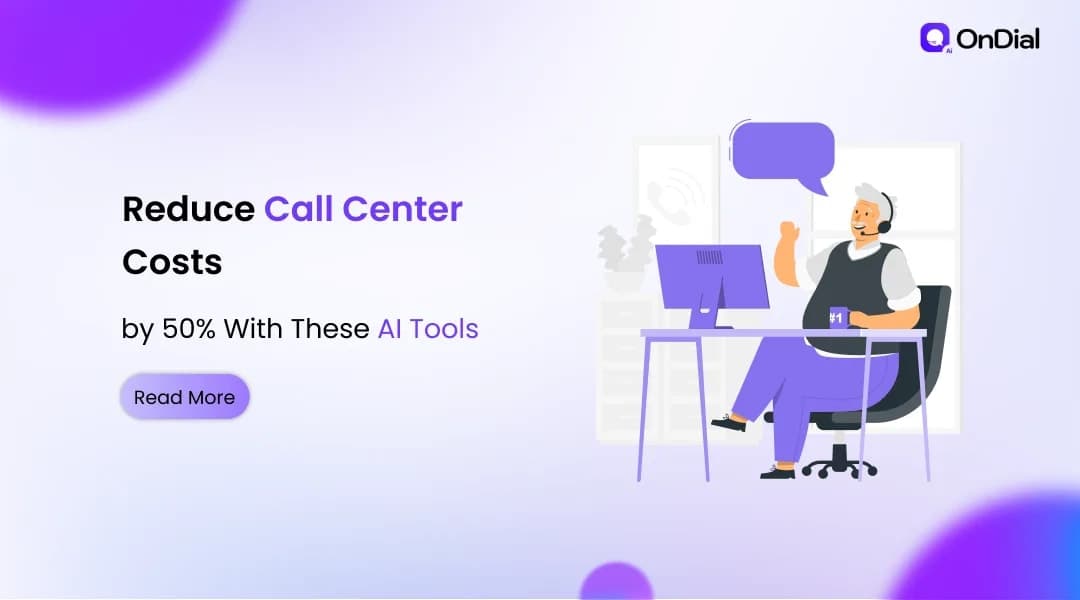
Here's a direct answer for anyone who wants it without the preamble: AI tools can reduce call center operating costs by 30% to 85%, depending on your call mix, implementation quality, and how deeply you integrate automation.
According to data from CX Today, voice AI costs roughly $0.40 per call compared to $7 to $12 for a human agent. That's a 90 to 95% reduction per interaction. At scale, even a 40% call deflection rate translates to tens of thousands of dollars in monthly savings before you've changed a single process.
McKinsey estimates that AI-enabled self-service can reduce incident volume by 40 to 50%, with cost-to-serve dropping more than 20% while maintaining or improving satisfaction scores. The Swisscom case is instructive: after rebuilding their customer service AI using conversational technology, they cut operational costs by 50% while simultaneously improving their Net Promoter Score.
The math is not abstract. It compounds fast. A team of four agents handling 50 calls per day, with 40% of those calls being routine inquiries, is spending roughly 80 agent-contacts daily on conversations AI could resolve in seconds. At $10 per call, that's $800 per day, $16,000 per month, before a single complex case is touched.
AI Voice Agents: The Highest-ROI Tool in Your Stack
What AI Voice Agents Actually Do
An AI voice agent is a conversational AI system that can handle inbound and outbound phone calls using natural language understanding (NLU), not the old rigid IVR menu. When a customer calls and says "I need to update my billing address," a well-built AI voice agent understands the intent, verifies the customer, executes the update, and closes the call, without routing to a single human.
That distinction matters more than it sounds. Traditional IVR systems could only understand if a customer pressed "2 for billing." Modern conversational AI understands what the customer actually said, in their own words, including accents, hesitations, and rephrasing.
What AI voice agents handle well: order tracking, appointment scheduling, account updates, payment processing, password resets, FAQ resolution, and outbound follow-up calls. What they should not handle: complex complaints, emotionally charged escalations, nuanced negotiations, or situations where empathy and judgment are the product.
I've seen teams make the mistake of over-automating and routing complaints about a billing error to a voicebot that can only read a balance. The customer hangs up angrier than when they called. Getting the handoff architecture right is as important as the AI itself.
Real-World Cost Impact: The Numbers That Matter
Voice AI resolving calls end-to-end at under $1 per resolution versus the industry average of $7.16 per inbound call is not a vendor claim. McKinsey's data supports it, and Gartner reports that AI-powered chatbots have reduced average handle time by 25 to 30% across high-volume call centers. Meanwhile, Klarna's AI assistant did the equivalent work of 853 full-time agents as of Q3 2025, saving the company $60 million.
These are not outliers. They are increasingly the benchmark for what well-implemented AI voice technology delivers.
Call Deflection Tools That Stop Expensive Calls Before They Start
The highest-ROI move is not optimizing the call. It's stopping it from happening in the first place.
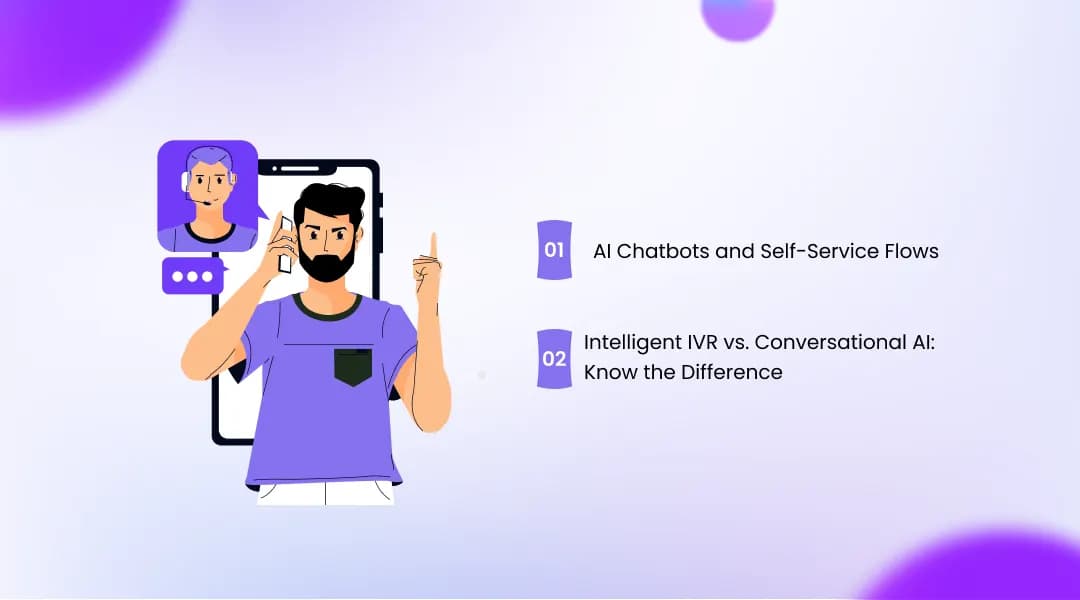
AI Chatbots and Self-Service Flows
AI chatbots are automated conversational tools that resolve customer queries through text or voice without human agent involvement. The goal is deflection: resolving issues before they become phone calls.
Over 67% of customers already prefer resolving simple issues on their own rather than speaking with an agent, according to research cited by Contentsquare and Loris. More than 50% prefer chatbots specifically because they answer basic questions faster. That's your audience. They want to self-serve. The question is whether you've built the flows that let them.
Practical starting point: pull your top 15 call drivers from last month's ticket data. Build AI flows for each one. In most operations, that covers 30 to 50% of inbound phone volume within 60 days.
Password resets and account unlocks - fully automatable
Order status and tracking - fully automatable
Billing inquiries and balance checks - automatable with CRM integration
Appointment scheduling - automatable with calendar API
FAQ and policy questions - automatable with knowledge base connection
Each deflected call is a call your agents never have to take.
Intelligent IVR vs. Conversational AI: Know the Difference
Traditional IVR costs you money twice: once in the misdirected call's handle time, and again in the re-queue wait that erodes customer satisfaction. Conversational AI replaces the menu-driven experience with something that actually understands what the caller wants. If a customer says "I want to speak to someone about my account," a good conversational AI system understands context, intent, and can either resolve it or route intelligently, not just move the caller down a decision tree.
This is not a subtle difference. It's the difference between customers who call back repeatedly and customers who get resolved on the first attempt.
AI Copilot Tools That Make Every Agent More Efficient
Here's something most articles on this topic miss entirely.
You don't have to replace agents to dramatically reduce your cost per call. You can make each agent significantly faster, which cuts cost per interaction without cutting headcount. That's often the smarter first move, especially for teams where customer relationships are the product.
Real-Time Agent Assistance
AI agent copilots are tools that listen to live calls and surface relevant answers, scripts, and knowledge base articles to the agent in real time. Instead of the agent spending 45 seconds on hold while searching for a policy, the AI retrieves it instantly.
Freshworks benchmark data shows that organizations integrating AI copilot tools see a 38% improvement in resolution time. That's not agents being rushed. That's dead time eliminated. After-call work reduction alone typically frees 15 to 20% of agent capacity per shift, which effectively gives you more throughput without adding a single seat.
Automated After-Call Work
After-call work (ACW) is one of the most expensive hidden costs in any call center. An agent finishes a call, then spends 3 to 5 minutes updating the CRM, logging notes, tagging the call type, and sending follow-up communications. Multiply that across 50 calls per day per agent, and you're paying for hours of work that AI can do in seconds.
AI tools that auto-generate call summaries, populate CRM fields, and trigger follow-up actions eliminate ACW almost entirely. Agents move to the next call faster. Supervisors get cleaner data. The whole system tightens.
Speech Analytics: The Tool Most Teams Overlook
What Speech Analytics Actually Costs You Without It
Most quality assurance teams manually review less than 5% of calls. Which means 95% of what's happening in your call center, every repeated complaint, every misrouted call, every compliance risk, is invisible to you.
Speech analytics is AI-powered software that transcribes, analyzes, and extracts insights from 100% of customer interactions in real time. It flags compliance issues, identifies call trends, surfaces root causes of repeat contacts, and evaluates agent performance at a scale no QA team could match manually.
Here's why this matters for cost: if 12% of your inbound calls this month were about a confusing change to your billing statement, that's not a call center problem. That's a product communication problem. Fix it upstream, and those 12% of calls stop coming. Every call center I've seen implement speech analytics finds at least two or three call drivers they had no visibility on.
How to Use AI Insights to Fix Root Causes
The Contentsquare 2026 Digital Experience Benchmark found that when customer sentiment is negative during a service interaction, resolution rate is only 28%. When it's positive, resolution rate jumps to 67%. Speech analytics identifies those sentiment patterns in real time, giving supervisors the data to intervene, coach, and redesign scripts before costs spiral.
The practical workflow: review your speech analytics dashboard weekly. Identify your top three repeat-contact drivers. Build one deflection or resolution path for each. Measure the call volume impact over 30 days. This is how sustainable cost reduction actually works - not a single automation deployment, but a compounding cycle of insight and improvement.
Building a Human-AI Hybrid Model That Actually Works
What AI Should Handle
The cleanest framing I've found for this is: AI should handle anything that is repeatable, rule-based, and resolvable without empathy. That includes the vast majority of Tier 1 inquiries. At OnDial, when we build voice AI solutions for clients, we always start with a call audit to identify which specific call types can be fully automated, which benefit from AI assistance, and which must stay human. Skipping that audit is where most AI deployments go sideways.
AI handles best: FAQs, status updates, scheduling, payment processing, outbound reminders, call routing, and post-call follow-up.
What Humans Must Keep
Research consistently shows that 89% of customers want a human option always available, even when they're comfortable using AI for simple queries. The winning model is not full automation. It's smart automation with seamless human escalation.
Human agents are irreplaceable for: complex problem-solving, emotional de-escalation, retention conversations, nuanced technical support, and situations where a customer's trust in the brand is genuinely at stake. These are also the interactions where a skilled agent produces the most measurable business value. Limiting humans to high-value escalations reduces attrition (agents doing meaningful work stay longer) and reduces training costs for routine tasks.
Gartner reports agent attrition averaging 30 to 45% annually. That churn costs between $18,500 and $74,000 per replaced agent. A hybrid model that removes dull, repetitive tasks from agents' days directly attacks that attrition number.
Is Replacing Agents With AI Really Worth It?
Short answer: it depends on what you're optimizing for.
Full replacement of human agents is not the right goal for most call centers. Not because the technology can't handle it, but because the business case for a hybrid model is actually stronger. You retain flexibility, maintain customer trust, and preserve institutional knowledge.
What is worth doing: automating 40 to 60% of your inbound volume with AI voice agents, equipping remaining agents with copilot tools, deploying speech analytics for QA and root cause analysis, and using AI for all post-call work. That combination consistently delivers 40 to 60% cost reduction in real deployments, without the customer experience risk of full automation.
Conclusion
Reducing call center costs with AI is not a technology decision. It is an operational architecture decision. The tools exist and the ROI is proven: AI voice agents, call deflection automation, agent copilots, and speech analytics each target a different cost driver, and together they consistently deliver 40 to 60% operational savings in real deployments.
The three most important takeaways from everything above: start with your call data before buying any tool, build a hybrid model rather than chasing full automation, and treat speech analytics as the feedback engine that makes everything else smarter over time.
You don't have to overhaul your call center overnight. Start with one call type. Automate it properly. Measure the cost impact. Let the results build the internal case for the next layer.
At OnDial, we specialize in building exactly this kind of tailored, human-centric voice AI architecture for businesses that want real cost savings without sacrificing the customer relationships they've worked hard to build. If you're ready to see what a properly scoped AI voice deployment could save your operation specifically, talk to us at ondial.ai. We'll start with your numbers, not ours.