India's BPO services market was valued at USD 49.87 billion in 2024 and is projected to surpass USD 139.35 billion by 2033, according to Astute Analytica. That number is impressive. But behind it sits a harder truth that most business owners I speak with already know: scaling customer support in India is expensive, chaotic, and fragile.
You hire agents. They leave within thirteen months - the average industry tenure. You train replacements. Call queues pile up on Monday mornings and festival seasons. And somewhere in that pile, a frustrated customer in Lucknow is hanging up because the IVR menu doesn't understand his Hindi-English mix.
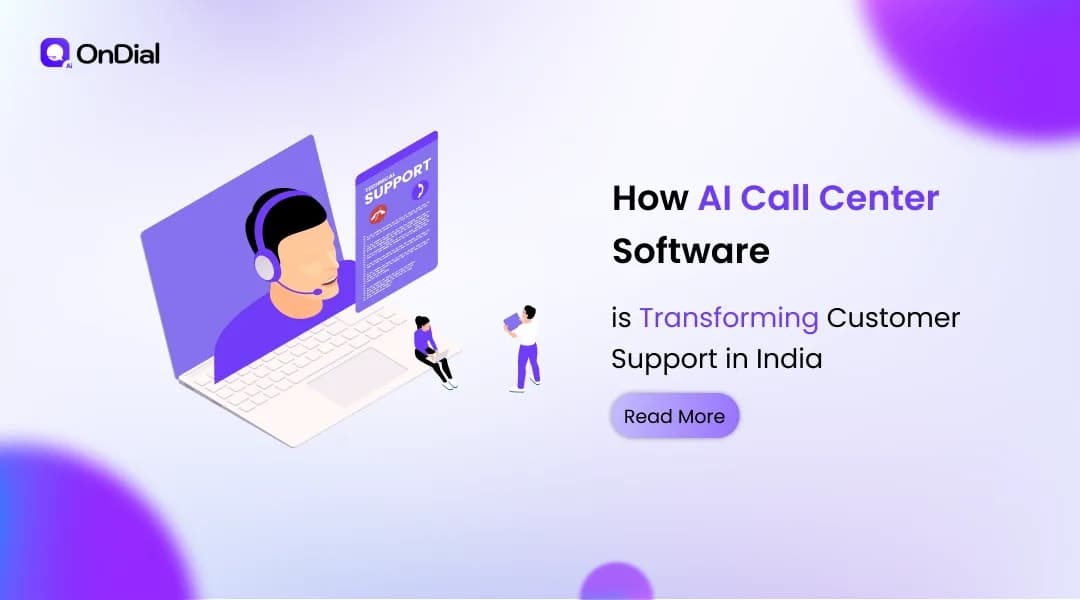
AI call center software India solutions are directly addressing this gap - not by replacing people, but by absorbing the high-volume, predictable interactions that consume most of a support team's day.
This guide covers exactly how that works, what compliance requirements apply in India, where the technology genuinely earns its cost, and where human agents still own the conversation. By the end, you will know whether AI call center software makes sense for your business - and what to look for if it does.
What Is AI Call Center Software?
AI call center software is a platform that uses voice AI, natural language processing, and machine learning to handle customer calls, route inquiries, analyze sentiment, and assist human agents - automatically and at scale, without requiring a person on the line for every interaction.
It is not a fancier IVR. It is not a chatbot with a phone number. A modern AI call center system can take an inbound call in Hinglish, pull a customer's order history from your CRM, resolve the issue, and log the interaction - all before a human agent would have finished the greeting.
The global call center AI market was valued at USD 1.99 billion in 2024 and is projected to reach USD 7.08 billion by 2030, growing at a CAGR of 23.8%, according to Grand View Research. Asia-Pacific, led in large part by India's dense BPO ecosystem, is expected to register the highest growth rate across all regions.
How AI Voice Agents Work in India's Multilingual Market
Here is where most global AI platforms fall short - and where India-built solutions earn their place.
Understanding Code-Switching and Regional Languages
India is not one language market. It is 22 scheduled languages, hundreds of dialects, and a daily communication reality where a single caller will switch between Hindi, English, and their regional language mid-sentence. This pattern is called code-switching, and it breaks most voice AI systems that were built for Western markets and then localised as an afterthought.
At OnDial, I've seen this firsthand: a well-funded international platform deployed in a Tier-2 city contact center struggled to maintain basic comprehension when callers spoke Hinglish. The dropout rate was higher than it had been with the traditional IVR it replaced. The fix wasn't more training data - it was a system built for Indian speech patterns from the ground up.
Top Indian conversational AI platforms in 2026 support Hindi, English, Hinglish, Tamil, Telugu, Kannada, Malayalam, Marathi, Bengali, Gujarati, and more - with genuine code-switching capability. That means the system doesn't just recognise a language; it stays coherent when a caller moves between two of them in the same sentence.
Automatic Speech Recognition (ASR) in India-first platforms is specifically trained on regional accent variation. A buyer in Ludhiana hears Punjabi. A customer in Hyderabad gets Telugu. The model routes and responds accordingly.
Voice-First Is Not a Feature - It Is the Strategy
This is counter-intuitive to most people who come from a chat-centric mindset. Globally, digital support means web chat, email, WhatsApp. In India, hundreds of millions of customers - particularly in Tier-2 and Tier-3 cities, BFSI, rural insurance, and micro-lending - still prefer to talk.
They don't type support queries. They call.
So the strategic question for an Indian business is not "should we add AI?" It is "should our AI be voice-first?" For most industries here - telecom, BFSI, healthcare, e-commerce logistics - the answer is yes. Any AI call center solution that doesn't place voice intelligence at its core will solve only a fraction of the problem.
(And this is exactly why OnDial's focus on conversational AI and voice AI platforms is not a niche play - it is an understanding of where India's customer communication actually happens.)
Key Benefits of AI Call Center Software for Indian Businesses
24/7 Availability Without Burning Out Your Team
A human support team runs in shifts. Call volumes don't. Festival sales, payment deadlines, and product launches don't check your roster before generating 3x the usual inbound traffic.
AI voice agents don't need shifts. They handle calls at 2am and 2pm with equal quality, routing complex cases to human agents and resolving routine ones independently. In projects I've worked on with e-commerce and fintech clients, deploying an AI voice agent for order status and FAQ queries reduced the load on human agents by 60% to 70% during peak windows - without adding headcount.
The math matters here too. According to industry data shared by AI calling providers in India, a 50-agent call center typically costs between Rs. 15-20 lakhs per month in salaries alone - not including infrastructure or management overhead. AI-augmented operations running equivalent call volumes have reported monthly operational costs 70-75% lower for the automated portion of interactions.
Cost Reduction That Actually Adds Up
There is a common fear I hear from operations managers: "What if we invest in AI and it doesn't handle our call types well?" It is a fair concern. The answer is to start narrow.
Pick one high-volume, low-complexity workflow - order tracking, appointment reminders, loan repayment nudges, password resets. Deploy AI on that workflow only. Measure first-contact resolution, customer satisfaction scores, and handle time. Expand from there.
Businesses that try to automate their entire call center on day one almost always underperform. Those who start with one workflow and iterate see both better results and faster team buy-in.
By 2028, more than 50% of customer interactions in India are expected to be handled by AI-enabled systems, helping companies reduce operational costs by over USD 400 million annually, according to Ken Research.
Real-Time Analytics and 100% Call Quality Coverage
Ask a call center manager how many calls their quality team reviews manually. The answer is usually somewhere between 5% and 10%. The rest go unreviewed.
AI call center platforms change that entirely. Every call gets logged, transcribed, tagged by intent, and scored for quality and sentiment. That is 100% coverage - not a sample. For industries under regulatory oversight (BFSI, insurance, healthcare), this is not just an efficiency gain. It is a compliance necessity.
Sentiment analysis tools flag calls where a customer's tone shifts negative mid-conversation, allowing supervisors to intervene or review those interactions first. Agent assist features feed real-time prompts to human agents during live calls - policy details, compliance disclosures, suggested responses - reducing errors and shortening average handle time.
Do you know what's happening on the 90% of calls your QA team never reviews? AI does.
AI Call Centers and Compliance: What TRAI and DPDPA Actually Require
This section matters more than most vendors will tell you. Compliance is not a checkbox you hand to your legal team. It is an operational architecture decision.
TRAI Is the Floor, Not the Ceiling
The Telecom Regulatory Authority of India (TRAI) regulates commercial voice communication - which number series you can use, when you can call, and how consent must be obtained and recorded. In 2026, TRAI updated its framework to require mandatory AI disclosure (callers must be informed when they are speaking with an AI system), verified consent through its Distributed Ledger Technology (DLT) platform, and the use of dedicated number series (140 for promotional, 160 for service calls) for AI-initiated outbound communications.
Penalties for violation reach up to Rs. 10 lakh per incident, with repeat violations risking blacklisting from telecom networks entirely.
But TRAI governs the call. It does not govern the data the call generates.
What This Means for BFSI and E-Commerce Businesses
The Digital Personal Data Protection Act (DPDPA) 2023 requires explicit, purpose-limited, revocable consent for processing personal data. Every AI conversation captures data. Your AI call center platform must handle consent records, honor data deletion requests, and maintain audit-ready logs - separately from TRAI compliance.
For BFSI specifically, the RBI's 2026 framework mandates Zero Trust Architecture across all digital infrastructure, including telephony. IRDAI requires insurance sales call recordings to be retained for a minimum of six months. These obligations can conflict with DPDPA's right-to-erasure provisions, and any platform deployed in insurance or lending must manage that tension intelligently.
This is precisely why OnDial's approach emphasizes building tailored, compliance-aware voice AI solutions rather than deploying off-the-shelf global tools. The regulatory map in India is genuinely different - and any vendor who doesn't acknowledge that complexity is either uninformed or hoping you won't notice.
The Human-AI Balance: What AI Should and Should Not Handle
AI will not replace call center jobs in India. That is not a reassurance designed to make people feel better - it is the operational reality. The IBM Institute for Business Value found that 59% of enterprise-scale organizations in India already had AI actively in use, yet employment in India's BPO sector continues to grow. What is changing is the composition of work, not the demand for people.
Where AI Wins Every Time
AI performs best on interactions that are:
High-volume and repetitive: Order status, balance inquiries, appointment confirmations, payment reminders, FAQ resolution
Compliance-sensitive and scripted: Insurance disclosures, regulatory notifications, KYC confirmation calls where exact language must be used consistently
Outbound at scale: EMI nudges, delivery notifications, lead qualification, appointment reminders across thousands of contacts simultaneously
After-hours and overflow: Any call that would otherwise queue or go unanswered
An AI voice agent does not misquote a policy on a difficult call, does not forget a compliance disclosure when tired on a Friday afternoon, and does not have bad days. For regulated industries, that consistency carries real operational weight.
Where Human Agents Remain Irreplaceable
The conversations that require judgment, emotional intelligence, and situational creativity still belong to humans. Complaints that are escalating emotionally. Complex technical troubleshooting that requires iterative back-and-forth. High-value customer retention scenarios. Disputes requiring negotiation.
The smartest deployment model I've seen is not AI versus humans - it is AI handling the first 70-80% of contact volume so human agents can give full attention to the 20-30% that genuinely needs them. The result is faster resolution for routine queries and better-quality conversations for complex ones. Both customers and agents win
How to Evaluate AI Call Center Software for Your Indian Business
Not all platforms are built for India. Many are global products adapted after the fact, with Indian language support bolted on rather than built in. Here is what to evaluate before committing:
Indian language depth: Does the platform support your customers' actual languages - not just Hindi and English, but the regional languages your Tier-2 and Tier-3 callers speak? Ask for a live demo in those languages, not just a features list.
Compliance architecture: Ask specifically about TRAI DLT integration, DPDPA consent management, and how the platform handles data retention versus erasure requests. If the answer is vague, walk away.
CRM integration quality: Bi-directional native sync with your existing CRM (Salesforce, Zoho, LeadSquared, Freshdesk) is the standard. Middleware workarounds like Zapier introduce latency and break points that will surface at the worst possible time.
Voice quality on mobile networks: India's call infrastructure is predominantly mobile, and audio quality varies. Test your shortlisted platform on a 4G connection with real callers, not just in a demo environment.
Escalation logic: What happens when the AI cannot resolve an interaction? The handoff to a human agent must be context-preserving - the agent receives the full transcript and intent summary, not a cold transfer. This is where most platforms fail in real-world deployments.
Pricing transparency: Request a full year-one estimate that includes telephony usage, AI feature tiers, integrations, and storage costs - not just the base seat price. The headline number is rarely the number you will pay.
Conclusion
AI call center software India deployments are no longer pilot projects. They are operational infrastructure. The three things to take from this guide: India's voice-first communication culture makes AI voice agents - not chatbots - the right foundation; compliance in India covers TRAI, DPDPA, and sector regulators simultaneously, and your platform must handle all of them; and the best deployments start narrow, prove value on one workflow, and expand from there.
If you have read this far, you are not wondering whether AI call center software works. You are deciding whether it works for your specific business, your languages, your customers, and your compliance environment.
That is exactly the kind of question OnDial is built to answer. We work with Indian businesses to build voice AI solutions that are tailored to your customer base - not adapted from a global template. If you want to understand what a right-fit deployment looks like for your operation, start a conversation with the OnDial team at ondial.ai.
AI call center software in India is most effective when it is designed for India - multilingual, compliant, and built around how your customers actually communicate. The businesses moving now are building that advantage one workflow at a time.