The Indian Voice AI market is projected to reach USD 957.61 million by 2030 at a 35.7% CAGR, according to NextMSC research. That number isn't just a stat. It's a signal that thousands of Indian sales teams are actively testing, deploying, and arguing over AI voice technology right now.
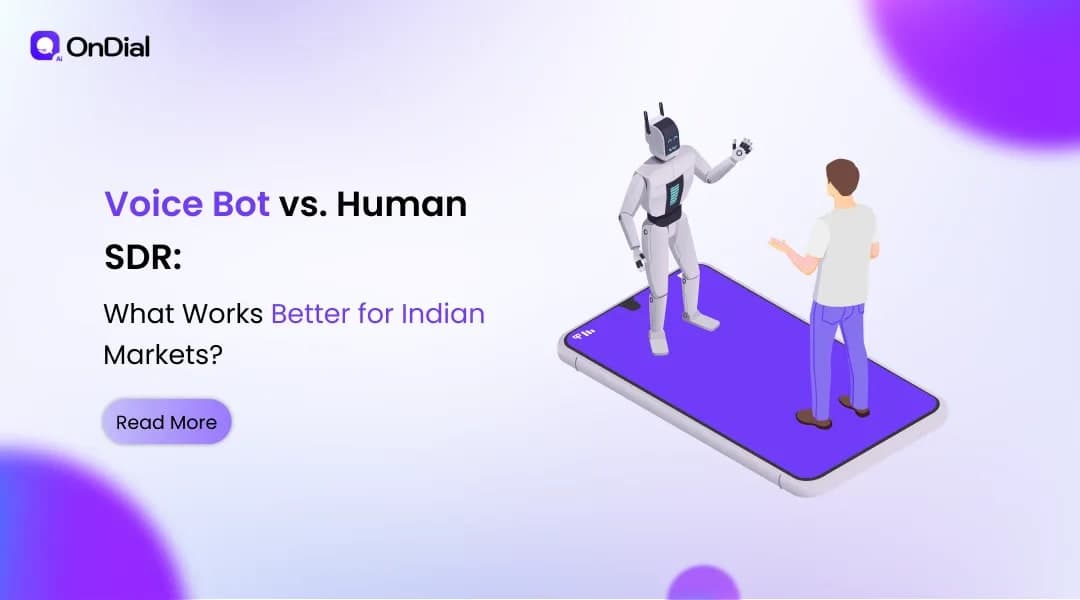
And yet, I've spoken with sales leaders across Bangalore, Mumbai, and Hyderabad who are stuck in the same frustrating loop: they've watched the demos, seen the pricing models, and they still can't answer the one question that actually matters for their business. Not "is AI good?" Not "is voice AI the future?" Their real question, the one nobody in the vendor pitch is answering directly, is this: for Indian customers, in Indian sales contexts, with all the linguistic and cultural complexity that involves, does a voice bot actually work better than a human SDR?
This article is the honest answer to that question. At OnDial, we build voice AI solutions specifically for Indian businesses, so I've seen this question play out in real deployments, not just in theory. Here's what you'll learn: where voice bots genuinely outperform human SDRs in India, where humans still can't be replaced, and how the best Indian sales teams are combining both to build something better than either alone.
What Is a Voice Bot in Sales?
What Makes a Voice Bot Different from Old IVR
A voice bot is an AI-powered conversational assistant that engages prospects and customers through natural spoken language in real time. Unlike traditional IVR systems, which forced callers through rigid "press 1 for billing" menus, a modern sales voice bot uses Automatic Speech Recognition (ASR), Natural Language Processing (NLP), and large language models (LLMs) to understand intent, handle objections, and respond in a human-like voice without a script.
The practical difference is enormous. A legacy IVR fails the moment a prospect says something unexpected. A modern voice bot, trained on real conversational data, can handle "haan, bataiye" as confidently as "yes, please tell me more." That's not a minor upgrade. That's a fundamentally different technology.
Why Indian Markets Need a Different Definition
Here's something global voice AI vendors don't advertise prominently: most platforms are trained on Western English data. And that matters immensely in India, where code-mixing between Hindi and English happens in roughly 78% of customer calls, according to research cited by Qcall.ai. A voice bot that can't handle "Mera order ka status kya hai?" isn't a voice bot for India. It's a liability.
The voice bots that actually work for Indian sales contexts are purpose-built for multilingual support, regional accent variation, and the informal conversational style that Indian buyers naturally use. Platforms like Gnani.ai, Sarvam AI, SquadStack, and Haptik have made this a core engineering priority, not an afterthought.
What a Human SDR Actually Does in Indian B2B Sales
The Relationship Layer That Numbers Can't Capture
Indian B2B sales, particularly at deal values above a certain threshold, runs on trust built through human interaction. A decision-maker at a mid-size manufacturer in Coimbatore or Surat isn't just evaluating your product. They're evaluating you. They want to sense whether the person on the other end of the call understands their business, respects their time, and can be reached when things go sideways.
This is the relationship layer. And no voice bot, however sophisticated, can fully replicate it for high-stakes deals. Human SDRs read hesitation in a voice. They pick up on when a prospect is interested but distracted by something personal. They know when to stop pitching and just listen. I've personally seen enterprise deals in India where the relationship built over three or four genuine conversations with a human SDR was the single deciding factor.
Where Human SDRs Spend Most of Their Time
The honest answer is: not on the high-value activities above. According to Salesforce data, human SDRs spend over two-thirds of their time on non-selling tasks such as prospecting, manual CRM updates, follow-up scheduling, and lead research. That's the uncomfortable truth about how most Indian sales teams operate today.
A typical human SDR in India makes 60 to 80 calls per day. Most of those calls are prospecting touches, first-contact qualification attempts, or follow-ups on leads that went cold. These are exactly the tasks where AI voice bots have a structural advantage, not because bots are "smarter," but because they don't burn out, don't need breaks, and can make 300 or more calls in the same period.
Where Voice Bots Win for Indian Sales Teams
High-Volume Lead Qualification at Scale
This is where the case for voice bots in India becomes genuinely compelling. Consider the math: human support agents cost around $0.70 per minute, while AI voice agents operate between $0.03 and $0.04 per minute, according to Jesty CRM's analysis of industry benchmarks. For high-volume outbound, that's not a marginal cost difference. That's a fundamental rethinking of what scale means for an Indian sales team.
Featured Snippet Block: A voice bot wins for Indian sales teams at the lead qualification stage: it can make 300+ outbound calls per day, works 24/7, handles Hinglish naturally, and costs a fraction of a human SDR for first-touch outreach. It qualifies intent, captures basic objections, and routes warm leads to human reps in real time.
Voice bots built for the Indian market, like those from SquadStack, can switch between English, Hindi, and Hinglish mid-call without losing conversational thread. For businesses reaching prospects across Tier 1, Tier 2, and Tier 3 cities, this isn't just convenient. It's the difference between a call that connects and one that gets dropped in the first 15 seconds.
Multilingual Outreach Across Tier 2 and Tier 3 Cities
Ask yourself this: how many of your human SDRs can conduct a confident qualification call in Tamil, Bengali, and Marathi? Very few. And even the ones who can are typically concentrated in your metro offices, not available for outreach across India's linguistically diverse geography.
Voice bots designed for the Indian market change this equation entirely. Platforms trained on Indian language data, including dialects and regional accent patterns, can conduct natural-sounding qualification calls in multiple Indian languages simultaneously. For businesses targeting manufacturing clusters in Gujarat, agricultural enterprises in Punjab, or retail distributors in Tamil Nadu, multilingual AI voice outreach opens markets that were simply impractical to reach at scale with a human team.
(And yes, I know what you're thinking: "But will a bot really work in a Rajasthani accent?" The honest answer is that the best India-focused platforms are getting remarkably close, though edge cases remain a real consideration worth testing before full deployment.)
Where Human SDRs Still Beat the Bot
Complex Discovery and Objection Handling
Voice bots are excellent at structured qualification. They ask the right questions, capture the right data, and route leads appropriately. But the moment a prospect goes off-script with a complex, nuanced objection, such as a security concern, a competitive comparison, a budget constraint tied to Q3 fiscal pressure, or a political consideration involving multiple internal stakeholders, a voice bot's limitations become visible quickly.
Human SDRs win here because genuine discovery isn't a checklist. It's a conversation that evolves in real time, picking up on tone, subtext, and the things a prospect is almost saying but hasn't committed to yet. The 2026 AI SDR research from Amplemarket confirms this: the highest-performing sales development approach is human-in-the-loop AI, precisely because AI handles the mechanical parts well but handles judgment poorly.
High-Trust, High-Value Deal Scenarios
There's a specific type of Indian B2B buyer who will simply end a call the moment they sense they're talking to an automation system. This is especially true in industries like manufacturing, legal services, healthcare procurement, and government-adjacent enterprises, where the decision-maker has been in business for decades and built a career on reading people.
For these segments, leading with a voice bot isn't just suboptimal. It can actively damage your brand perception. A misjudged first impression in a relationship-driven sales culture like India's can close doors that are very hard to reopen. The right answer here is a human SDR first, with AI supporting the research and follow-up workflows behind the scenes.
The Hybrid AI and Human SDR Model: What Actually Works in India
Building the Right Handoff Architecture
The question isn't "voice bot OR human SDR." The question Indian sales leaders should be asking is: at exactly which point in my pipeline does the handoff from AI to human create the most value?
The answer, based on what I've seen work across Indian B2B deployments, is this: use voice bots for everything from first-touch outreach through to initial qualification and interest confirmation. The moment a prospect indicates genuine interest, raises a specific objection, or asks a question that requires product judgment, that's your handoff trigger. The human SDR takes over with full context, already knowing what the prospect said and how they responded.
This architecture matters because it respects both the efficiency of AI and the irreplaceable judgment of humans. Companies that deploy AI as a wholesale replacement for their SDR team typically revert to hybrid models within months, according to industry data from Amplemarket. The companies that build the handoff architecture intentionally from the start consistently outperform both pure-AI and pure-human approaches.
A well-designed voice bot deployment should also be TRAI compliant, with proper consent mechanisms built into every outbound call flow. This isn't optional in India. It's a regulatory requirement, and it also builds the kind of trust that makes prospects more receptive to the human follow-up that comes next.
Real-World Example: How Indian Companies Are Doing This Now
One of the clearest examples of this hybrid approach working in an Indian context comes from the BFSI sector. Banks and NBFCs use AI voice agents to handle the high-volume first layer of loan inquiry qualification, collecting basic information, verifying income ranges, and confirming interest in proceeding. The human loan officer only enters the conversation once a lead is pre-qualified and the prospect has already expressed intent.
Gnani.ai, for example, has built voice bots that help lenders talk to potential customers, understand their financial needs, gather personal information, and assess basic loan eligibility. This isn't replacing the relationship. It's protecting the relationship, by ensuring the human loan officer only speaks with prospects who are genuinely interested and appropriately qualified.
The same logic applies to SaaS sales, insurance, edtech, and manufacturing supply chains. The form changes. The principle stays the same.
Conclusion
The voice bot vs human SDR debate in India has the wrong frame. The right question isn't which one works better. It's which one works better at each stage of your specific pipeline, with your specific customers, in your specific market context.
Here's what the evidence actually shows: voice bots built for India, trained on multilingual data and integrated properly with your CRM, are genuinely superior for high-volume first-touch qualification. Human SDRs are genuinely superior for complex discovery, relationship-building, and closing the deals that matter most. The hybrid model, AI for scale and humans for judgment, isn't a compromise. It's the architecture of a modern Indian sales team.
At OnDial, this is exactly what we help Indian businesses build: voice AI solutions designed specifically for the complexity of Indian markets, with human-centric handoff architectures that don't just automate calls but actually improve the quality of every human conversation that follows. If you're evaluating how to structure your outbound sales motion, or wondering whether your current SDR setup is leaving qualified leads on the table, let's have that conversation directly.
The answer to "voice bot vs human SDR in India" is both. The question is just getting the sequence right.