Insurance is a phone heavy industry. Policyholders call to ask about coverage, report incidents, check claim status, make payments, renew policies, update information, and resolve service issues.
The challenge is not simply call volume. It is the amount of repetitive work hidden inside those conversations.
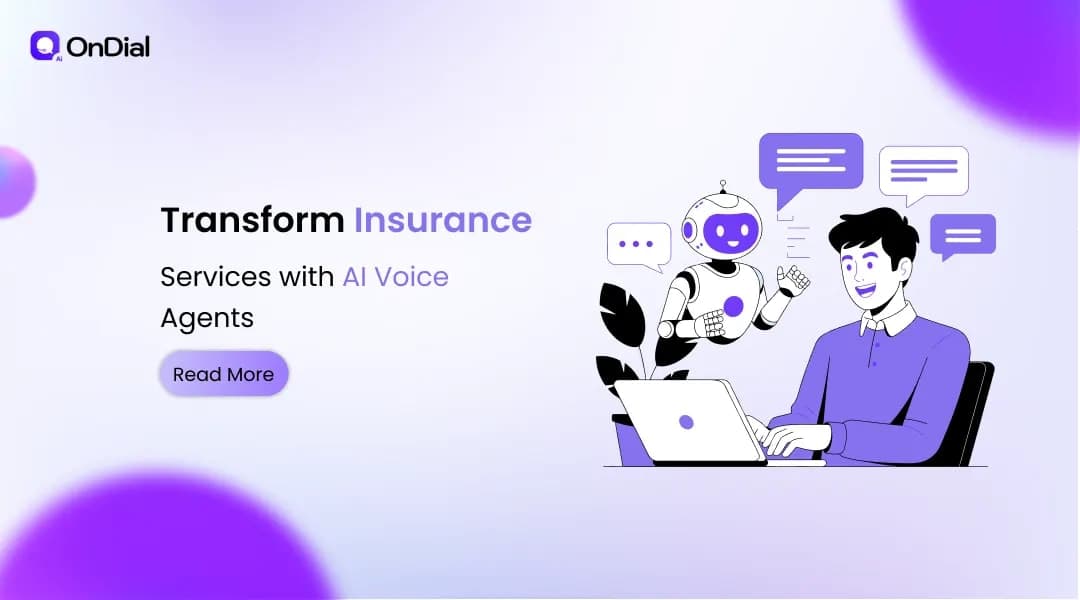
AI voice agents can automate many of these interactions while keeping human employees involved when a case requires judgment, empathy, negotiation, or specialist knowledge. The result is a more flexible model where AI handles routine conversations and people focus on exceptions.
For insurers operating across India and international markets, this approach can also make multilingual customer communication easier to manage.
What Are AI Voice Agents for Insurance?
An AI voice agent for insurance is a conversational system that communicates with policyholders through phone calls, understands spoken requests, retrieves relevant information, and performs predefined actions.
Unlike a traditional IVR, the caller does not have to navigate a rigid menu. They can explain their situation naturally, answer follow up questions, and receive a response based on the workflow configured for that conversation.
For example, a policyholder could call to ask about a claim. The agent can verify the required details, identify the claim, provide an available status update, and transfer the conversation to a human if the request falls outside its approved workflow.
This makes voice automation more useful than simple call routing. The objective is to complete meaningful business tasks during the conversation.
Why Insurance Companies Are Exploring Voice Automation
Insurance operations involve thousands of conversations that follow predictable patterns.
Customers ask similar questions about premiums, deductibles, renewal dates, documents, coverage, claims, and payment deadlines. Human teams can handle these conversations, but scaling that model requires additional staffing, training, supervision, and scheduling.
AI voice agents provide another option.
High Call Volumes Create Operational Pressure
Call volume can increase sharply during renewal periods, severe weather events, claim spikes, product launches, or payment cycles.
A human only has one conversation at a time. An automated voice system can support multiple conversations according to its configured capacity.
This allows insurers to handle predictable demand without designing the entire operation around peak staffing requirements.
Customers Expect Faster Answers
Policyholders increasingly expect immediate access to information.
Waiting for an agent to become available can be frustrating when the request is straightforward. A voice agent can handle routine questions immediately and reserve human attention for conversations that genuinely need it.
Insurance Communication Is Often Repetitive
A large portion of insurance service involves structured information.
That makes it a strong candidate for automation. When a conversation follows a defined workflow, an AI agent can consistently ask the required questions, collect responses, provide approved information, and record the outcome.
Key Insurance Use Cases for AI Voice Agents
The value of AI voice agents becomes clearer when they are connected to specific insurance workflows.
1. Policy Information and Customer Support
Policyholders frequently need information about coverage, premiums, exclusions, deductibles, renewal dates, and required documents.
An AI voice agent can answer approved questions using the insurer's knowledge base or retrieve relevant information from connected systems.
This reduces the number of routine calls reaching customer service representatives.
2. First Notice of Loss and Claims Intake
First Notice of Loss, commonly called FNOL, is one of the most practical areas for insurance voice automation.
The agent can collect information about the incident, confirm required details, ask structured questions, and create or initiate a claim workflow where the integration supports it.
The important point is consistency. Every caller can be guided through the required information instead of relying on different agents to capture the same details in different ways.
For a deeper look at the workflow, insurers can review AI voice agent insurance claims automation.
3. Claim Status Calls
Customers often call simply to find out what is happening with an existing claim.
These conversations do not always require a claims specialist. If the relevant information is available through an approved system integration, an AI voice agent can retrieve the status and communicate the next step.
If the customer asks something outside the automated workflow, the call can be escalated to a human representative.
4. Policy Renewal Calls
Renewals are another strong use case because the process often follows a defined sequence.
An outbound AI voice agent can remind customers that a policy is approaching renewal, confirm relevant details, explain approved information, answer common questions, and identify customers who need human assistance.
The workflow can also record whether the customer answered, requested a callback, showed interest, or declined.
Insurance teams looking specifically at renewal automation can also explore how insurance companies automate policy renewal calls with AI voice agents.
5. Premium Payment Reminders
Missed payments can create avoidable service activity and increase the risk of policy lapse.
AI voice agents can make scheduled reminder calls, explain the purpose of the call, provide approved payment information, and trigger the next step in the workflow.
The exact payment actions should depend on the insurer's systems, authorization requirements, and compliance policies.
6. Lead Qualification
Insurance businesses also need to manage new enquiries.
A voice agent can ask predefined qualification questions, collect information about the customer's needs, identify relevant product interest, and route qualified prospects to a sales representative.
This helps sales teams spend more time on conversations with clear buying intent.
7. Customer Retention and Re engagement
Voice automation is not limited to servicing existing policies.
Insurers can use outbound conversations to follow up with customers, identify dissatisfaction, remind customers about important actions, or reconnect with policyholders who have become inactive.
The objective should be useful communication rather than simply increasing call volume.
How an Insurance AI Voice Agent Works
A production voice workflow usually connects several components.
Step 1: The Customer Calls or Receives an Outbound Call
The conversation begins through an inbound call or a scheduled outbound workflow.
The agent identifies the purpose of the interaction and starts the appropriate conversation flow.
Step 2: Speech Is Converted Into Meaning
The system processes the caller's speech and identifies intent.
A customer saying "I want to know where my claim is" and another saying "Can you tell me what happened with my claim?" may express the same intent even though the wording is different.
Step 3: The Agent Retrieves Relevant Information
For authenticated workflows, the agent can use approved integrations to access relevant customer, policy, or claim information.
This is where integration becomes critical. A voice agent should not invent policy information or rely on outdated static responses when the answer depends on live records.
Step 4: The Agent Takes an Approved Action
Depending on the workflow, the agent may provide information, collect details, create a request, schedule a callback, trigger a notification, or transfer the call.
Every action should be governed by business rules.
Step 5: The Conversation Is Recorded as Structured Data
Call outcomes can be stored alongside transcripts, summaries, dispositions, and other relevant information.
This creates a useful operational record and gives teams better visibility into recurring customer issues.
AI Voice Agents vs Traditional IVR
Traditional IVR still has a role in many contact centers, but its limitations become obvious when customers need to explain something in their own words.
An IVR generally asks customers to select options from a predefined menu.
A conversational voice agent can understand natural speech and continue a multi step conversation.
For insurance, this difference matters because many calls do not fit neatly into one menu option. A customer may begin by asking about a claim and then ask about required documents or the next step.
A conversational system can maintain that context rather than forcing the caller to restart the interaction.
The strongest approach is not necessarily to remove every existing call system. Insurers can use AI for suitable workflows while keeping existing routing and human escalation paths for complex cases.
What Makes an Insurance Voice Agent Reliable?
Automation quality depends on more than the voice itself.
Accurate Knowledge
The agent needs access to approved insurance information, policies, procedures, and frequently asked questions.
Strong System Integration
A voice agent becomes significantly more useful when it can securely interact with CRM, policy administration, claims, scheduling, and communication systems.
Clear Escalation Rules
Not every conversation should be automated.
Complex disputes, sensitive complaints, unusual claims, vulnerable customers, and situations requiring professional judgment may need a human representative.
Conversation Monitoring
Teams should continuously review call outcomes, failed intents, transfers, customer feedback, and common questions.
The objective is not to assume the first workflow is perfect. It is to improve the system based on real interactions.
Multilingual Insurance Support for India and Global Markets
Insurance providers serving India face a particularly important communication challenge.
Customers may prefer English, Hindi, Gujarati, Tamil, Marathi, Telugu, Bengali, or another regional language. International insurers face similar requirements across different countries and language markets.
Voice AI can help centralize these conversations rather than requiring every language to be supported by a separate staffing model.
However, language support should be evaluated beyond simple translation.
The system needs to understand accents, conversational phrasing, local terminology, interruptions, and code switching. Insurance terminology also needs to remain accurate when the conversation moves between languages.
Security and Compliance Considerations
Insurance conversations can involve personal information, policy information, financial details, health information, and claims data.
That makes security a core part of deployment rather than an optional feature.
Before launching an AI voice workflow, insurers should define what information the agent can access, which actions it can perform, how identity is verified, how recordings and transcripts are handled, and when human escalation is mandatory.
Organizations should also evaluate applicable privacy, data protection, consent, recording, and communication requirements for each market in which the system operates.
The AI should work within those controls rather than becoming an independent system with unrestricted access.
How to Implement AI Voice Agents in an Insurance Business
A successful deployment should start with a business workflow, not with technology.
Identify the Best First Use Case
Begin with a high volume process that has clear rules and measurable outcomes.
Policy status enquiries, renewal reminders, claim status requests, premium reminders, and basic information calls can be suitable starting points.
Map the Existing Call Journey
Document what happens before, during, and after each call.
Identify which information is required, which systems are involved, which questions are frequently asked, and where human intervention is currently required.
Define Automation Boundaries
Decide exactly what the AI can do independently.
Also define the conditions that require a transfer to a human.
This prevents automation from becoming a risk instead of an operational improvement.
Connect the Required Systems
The agent may need access to CRM records, policy systems, claims platforms, calendars, payment workflows, or other business tools.
The integration should provide only the information and permissions required for the specific workflow.
Test With Realistic Conversations
Testing should include accents, interruptions, unclear answers, unexpected questions, silence, corrections, language switching, and escalation scenarios.
A workflow that performs well with a scripted demonstration may still fail in real customer conversations.
Measure Business Outcomes
Track metrics such as answer rate, containment rate, transfer rate, completion rate, average handling time, customer satisfaction, abandoned calls, and successful workflow completion.
The right KPI depends on the use case.
The Future of Insurance Customer Communication
AI voice agents are not a replacement for every insurance employee or every customer conversation.
Their strongest role is to remove repetitive work from the communication layer.
Routine enquiries can be automated. Claims intake can become more structured. Renewal outreach can become more consistent. Customers can receive answers outside traditional working hours. Human representatives can focus on cases where judgment and empathy matter most.
For insurers, the strategic opportunity is to connect voice automation with the systems and workflows they already operate rather than treating AI as another isolated channel.
That is the difference between a voice bot that answers questions and an AI voice agent that helps complete business processes.
Conclusion
Insurance companies have many opportunities to automate customer communication, but the best results come from starting with specific workflows.
AI voice agents can support policy enquiries, claims intake, claim status requests, renewals, payment reminders, lead qualification, retention, and other structured conversations.
The technology becomes more valuable when it is connected to business systems, governed by clear rules, monitored continuously, and combined with human escalation.
For insurers in India and global markets, multilingual communication adds another practical advantage.
The goal is not to automate every conversation. The goal is to make every conversation easier to handle, easier to measure, and more useful for both the customer and the insurance team.
For organizations evaluating that approach, OnDial provides an AI voice agent platform designed for inbound and outbound business conversations, workflow automation, integrations, and human handoff.