Here's a number that stopped me mid-scroll the first time I saw it: the global AI customer service market is on track to hit $15.12 billion in 2026, and 88% of contact centers already use some form of AI. That's not a future prediction. That's right now. If you're a business owner staring at your support queue wondering whether an AI call center agent is hype or something you should actually be using, you're not behind. You're asking the question at exactly the right time.
I get why there's hesitation. Nobody wants their customers talking to a robot that sounds like it's reading a script written in 2015. At OnDial, we build voice AI for a living, and the question I hear most often isn't "what can AI do," it's "will this make my customers feel handled or ignored." Fair question. This guide walks through what an AI call center agent actually is, what it can and can't do in 2026, the real costs and numbers behind the shift, and how to roll one out without losing the trust you've spent years building. By the end, you'll know exactly where AI fits in your support stack and where it doesn't.
What Is an AI Call Center Agent, Really?
An AI call center agent is software that answers, understands, and responds to customer phone calls without a human on the line for most of the interaction. Think of it less like a chatbot wearing a phone costume and more like a coworker who never sleeps and remembers every conversation perfectly.
That distinction matters because most people still picture the old "press 1 for billing" system when they hear "automated support." This is not that.
How It Differs From the Old IVR Menu
Old-school IVR systems forced customers down a rigid decision tree. You'd shout "REPRESENTATIVE" into your phone just to escape it. An AI call center agent uses natural language processing and machine learning to understand intent, respond to questions, and route inquiries efficiently, which means the customer just talks. No menus. No guessing which number maps to their problem.
A few things separate it from the old system:
It listens for meaning, not keywords. If someone says "my package never showed up," the AI understands they're asking about order status, not just matching the word "package."
It holds context across the call. It doesn't forget what the customer said two sentences ago.
It gets smarter over time. It learns from every interaction, refining its answers rather than running the exact same fixed script forever.
I've watched this play out on calls we've built for clients. The difference customers notice first isn't the AI's intelligence. It's that they stopped repeating themselves.
The Core Technology Stack Behind It
Underneath the conversation, a few moving parts work together. Natural Language Understanding (NLU) decodes what the customer means, including tone and urgency. Sentiment analysis tracks how the customer feels in real time, flagging frustration before it boils over. CRM integration pulls up account history so the AI, or the human it hands off to, isn't starting from zero.
One definition worth keeping in mind: agentic AI means a system that can independently complete a multi-step task, like resolving a billing dispute end to end, not just answering a single question and stopping there. That's the line between a glorified FAQ bot and an actual AI call center agent.
In projects we've worked on at OnDial, the systems that perform best aren't the ones with the most features. They're the ones where NLU, sentiment detection, and CRM access are wired together tightly enough that the AI never sounds like it's juggling three separate tools mid-sentence.
Will AI Replace Call Center Agents in 2026?
No. AI is not replacing human call center agents wholesale in 2026. AI replaces tasks, not people, and the data backs this up clearly: 95% of customer service leaders plan to retain human agents even as automation expands. What's actually happening is a redistribution of work, not a replacement of workers.
This is probably the single most search-worthy question on this whole topic, and it deserves a straight answer instead of a dodge.
What AI Handles Well Right Now
AI earns its keep on the repetitive, high-volume, low-ambiguity stuff: order status checks, password resets, appointment booking, basic billing questions. These are the calls that clog queues without requiring much judgment.
Here's where it gets genuinely impressive. AI-native platforms now achieve 55-70% first contact resolution at $1-3 per resolution, with handle times under three minutes. That's faster than a lot of human-staffed tier-1 desks.
A few use cases where AI consistently outperforms expectations:
24/7 coverage without overtime pay. The phone gets answered at 2am or during a surge, no scheduling required.
Consistent first-touch resolution on routine intents. FAQs, hours, and basic account questions get handled the same way every time.
Faster routing on complex calls, so by the time a human picks up, they already have the context.
What Still Needs a Human
Here's the part vendors don't always say out loud: AI still struggles with the messy, emotional, ambiguous stuff. AI voice bots may misunderstand sarcasm, emotion, or layered queries, especially when the interaction requires sensitivity, reassurance, or complex negotiation.
I want to be honest about this because overselling AI's capabilities is how trust gets broken with customers. A frustrated customer who's been double-charged doesn't want a perfectly worded script. They want to feel heard, and that's still a fundamentally human skill. The smartest deployments don't try to make AI "more human." They make AI excellent at the 70-80% of calls that don't need one, and they make the handoff to a real person seamless for the rest.
That's the actual future of call center work: not AI versus humans, but AI clearing the runway so humans can focus on the calls that matter most.
The Real Numbers Behind the AI Call Center Shift
If you're the one who has to justify this to a finance team or a skeptical co-founder, you need numbers, not vibes. Here are the ones that actually move decisions.
Cost and Speed Benchmarks
This is the stat that tends to end the debate fastest: voice AI costs roughly $0.40 per call compared to $7 to $12 for a human agent, a 90 to 95% cost reduction. Even accounting for setup and platform fees, that gap is hard to argue with at any meaningful call volume.
Speed tells a similar story. Bank of America's Erica resolves 98% of queries within 44 seconds, and across industries, AI has cut first response times from over 6 hours to less than 4 minutes. Customers don't care about your tech stack. They care about not waiting on hold.
Where the Adoption Gap Actually Is
Here's the part that surprises people: adoption isn't the bottleneck anymore. Integration is. 88% of contact centers report using some form of AI, but only 25% have fully integrated automation into daily operations. That's a massive gap between "we bought the tool" and "the tool is actually doing the work."
Why does this gap exist? A few recurring reasons show up across the research:
Fragmented systems. The average contact center now manages 3.9 different technology platforms, and stitching AI cleanly across that mess is harder than any sales demo makes it look.
Governance hesitation. Teams are cautious about compliance and data handling.
No clear ownership. AI gets piloted by IT, used loosely by ops, and nobody owns making it actually work end to end.
This is honestly the gap OnDial spends most of its time closing with clients. The AI itself usually isn't the hard part anymore. Making it talk cleanly to existing CRM, telephony, and escalation workflows is where most projects actually live or die.
How an AI Voice Agent Changes the Customer Support Experience
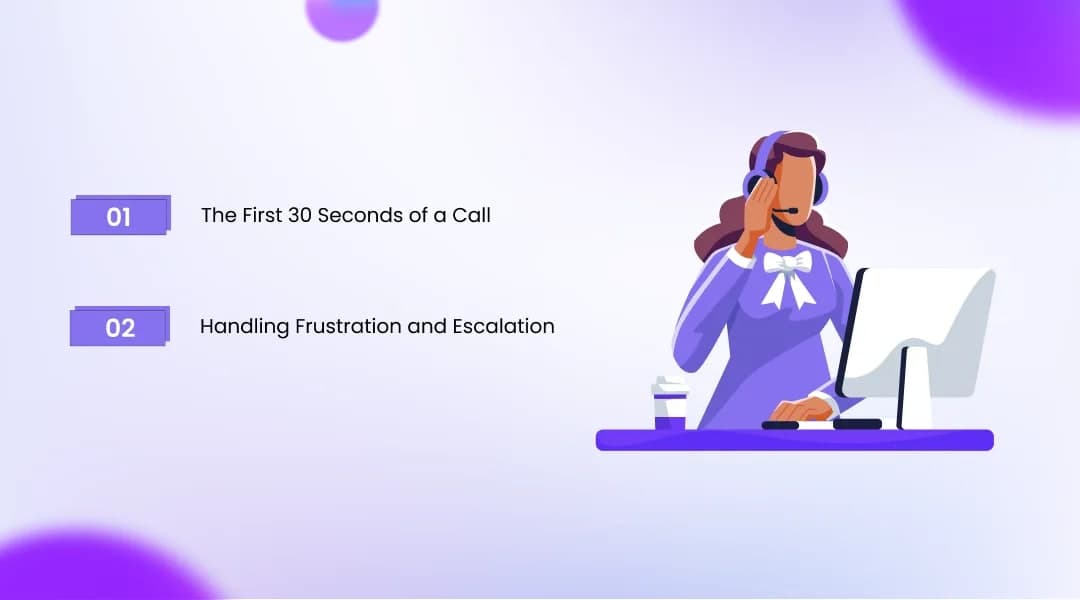
Numbers are convincing on paper. But the experience is what customers actually remember, and that's shaped in small, specific moments.
The First 30 Seconds of a Call
The first half-minute decides whether a customer relaxes or braces for a fight. A good AI voice agent answers instantly, no hold music, and confirms understanding before launching into a script. A bad one talks over the customer, mishears a name, or loops back to a menu the customer already escaped.
I've sat in on calls where the difference was almost embarrassingly small. The AI that says "Got it, let me pull that up" before going quiet for two seconds feels attentive. The AI that just goes silent feels broken.
What separates a smooth first 30 seconds from a frustrating one usually comes down to: instant pickup with no dead air, an immediate confirmation that the system understood the request correctly, and a clear path to a human if the customer asks, without having to ask twice.
Handling Frustration and Escalation
This is where sentiment analysis earns its place in the stack. If frustration is detected, the AI agent can escalate the interaction to a live agent who already has full context, preserving continuity and trust. The key phrase there is "full context." A cold transfer where the customer has to re-explain everything torches goodwill that took the AI thirty seconds to build.
In the work we've done at OnDial, we treat escalation design as seriously as the AI's conversational ability itself. A voice AI that's brilliant at answering FAQs but clumsy at handing off an angry customer hasn't actually solved the problem. It's just moved the bad experience one step later in the call.
Choosing and Implementing an AI Call Center Agent
Once you've decided AI belongs in your support stack, the harder question is picking the right one and not torching the rollout in month one.
What to Evaluate Before You Buy
Most vendor comparisons focus on flashy features. The questions that actually predict success are less exciting.
Does it integrate with your existing CRM and telephony, or does it require ripping out what you already have? Integration friction is where most "successful pilot, failed rollout" stories begin.
Can you test it on real historical calls before it talks to a live customer? A simulation mode that runs your actual call data is worth more than any demo reel.
What happens when it doesn't know the answer? The best systems escalate gracefully with context. The worst ones guess, or repeat themselves in a loop.
Does it handle your specific language and accent mix? This matters for businesses serving diverse, multilingual customer bases, where a model trained mostly on one accent will quietly underperform.
Common Rollout Mistakes
The pattern I see most often isn't a bad AI model. It's a rushed rollout. Teams go straight from zero to "AI handles everything" without a phased transition, and customers notice the whiplash.
A calmer path looks like this: start with one or two narrow, well-defined intents like order status or appointment booking. Measure resolution rate and customer sentiment honestly, including the calls that didn't go well. Expand scope only once the narrow case is genuinely solid, not just technically working.
Should you do this alone or with a partner? It depends on your internal bandwidth more than your budget. Teams with a dedicated ops resource can manage a build-it-yourself platform. Teams without that bandwidth tend to do better working with a partner who's already made the expensive mistakes elsewhere. Either way, the goal is the same: an AI call center agent that earns customer trust instead of just answering the phone faster.
Conclusion
An AI call center agent isn't a replacement for your team in 2026. It's a way to stop making your team handle the same fifteen questions a hundred times a day while customers wait on hold for answers that don't require a human brain at all. The three things worth remembering: AI now resolves routine calls faster and cheaper than ever, the real challenge is integration rather than adoption, and the businesses winning right now are the ones treating escalation and tone as seriously as the technology itself.
If you've read this far, you're past the "is this hype" stage and into the "how do I do this right" stage. That's exactly where OnDial likes to start a conversation: not with a sales pitch, but with an honest look at which of your calls actually need a human, and building a voice AI around the answer to that question.
You don't need to guess at this. A short call with our team can map out exactly where an AI voice agent would help your specific support queue, and where it shouldn't touch a thing.