Historically, most companies reviewed less than 5% of the conversations they had with customers, according to AssemblyAI, which means the other 95% of what buyers actually said simply vanished. That gap is exactly why AI call analytics has moved from a niche contact-center feature to a business-wide priority. AI call analytics is the use of artificial intelligence to transcribe, analyze, and extract structured insights from voice conversations automatically, at scale, so that every call becomes usable data instead of a forgotten audio file.
If you have ever felt that your phone lines hold answers you can never quite reach, you are not imagining it. Thousands of calls carry the real reasons customers churn, buy, or complain, and almost none of it reaches the people making decisions. That frustration is common, and it is fixable.
I run voice AI projects at OnDial, and I have watched teams go from guessing about customer intent to measuring it. In this guide, you will learn what AI call analytics captures, how the technology actually works, where it earns its keep across sales and support, and the honest limitations most vendors skip over.
What Is AI Call Analytics, and Why Every Conversation Counts
Every customer call is a small, unrepeatable research interview. The problem is that traditional call recording only stores the audio, so the intelligence inside stays locked away. It breaks that lock by reading the content of the conversation, not just filing it.
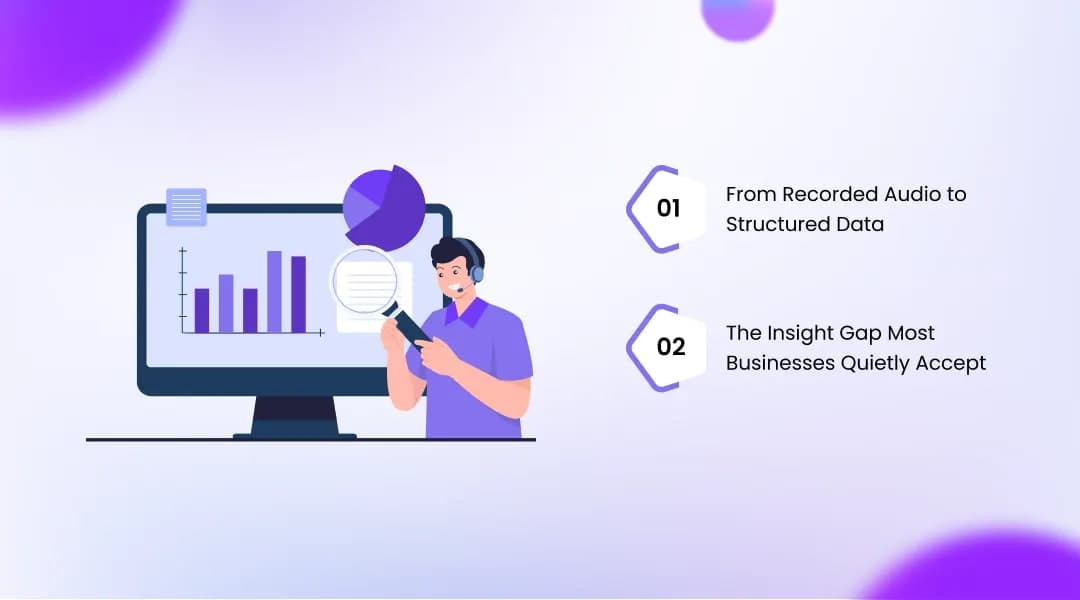
From Recorded Audio to Structured Data
Think about the difference between two questions. "How many calls did we get?" is reporting. "What were those calls about, how did the customer feel, and what should we do next?" is analytics, and only the second one changes decisions.
Conversation intelligence is the broader category of software that turns spoken and written interactions into searchable, measurable business data. It sits inside that category and focuses on the voice channel specifically. It classifies why someone called, measures how they felt, and scores how the interaction went, converting unstructured speech into rows you can filter, chart, and act on.
The scale of this shift is not small. The conversation intelligence software market is projected to reach $32.25 billion in 2026, up from $28.54 billion the year before, growing at roughly 13% annually, according to The Business Research Company, and it is on track for $52.03 billion by 2030. That is not hype money. That is businesses paying to stop losing what their customers tell them with voice AI for sales.
The Insight Gap Most Businesses Quietly Accept
Here is the counter-intuitive part: the companies with the most call data often understand their customers the least. When review is manual, a supervisor listens to a handful of calls, forms an impression, and calls it a trend. That impression is built on a sample so small it would embarrass any researcher.
Gartner has projected that around 60% of organizations would begin analyzing voice and text interactions to supplement traditional surveys, and the reason is simple. Surveys catch the customers who bother to respond, while calls catch everyone. The insight gap is the distance between the data a business already owns and the intelligence it can actually use, and this technology is built to close it.
How Does AI Call Analytics Actually Work
The mechanics are less mysterious than the marketing suggests. Modern platforms run a sequence of AI models over each conversation, where each stage feeds the next. Understanding that sequence helps you judge which platforms are serious and which are just adding a transcript.
The Four-Stage Pipeline Behind Every Analyzed Call
AI call analytics works by moving each call through four connected stages: Automatic Speech Recognition (ASR) converts speech to text, Natural Language Processing (NLP) interprets topics and intent, sentiment analysis tracks emotional tone, and intent recognition identifies what the caller truly wanted. The output is structured, searchable data instead of raw audio.
Each stage adds a layer of meaning. ASR produces the transcript, which is the raw material for everything else, so transcription accuracy sets the ceiling on quality and raises support quality with AI voice agents. NLP then reads that transcript for context, distinguishing a pricing question from a cancellation threat. Finally, sentiment analysis and intent recognition add the emotional and motivational picture, telling you not just what was said but what it meant.
At OnDial, this is the same pipeline that powers our voice agents, which is why I care about it beyond dashboards. When an AI voice assistant understands intent well enough to route a call, it can also log that intent as analytics data. One system, two payoffs.
What Data Does AI Call Analytics Capture
People often assume it only captures a transcript. It captures far more than that.
A capable platform records both quantitative and qualitative signals from every conversation, including:
Call reason and topic: the classified purpose of the call, so patterns like a spike in billing confusion surface automatically.
Sentiment and emotion: shifts in customer tone across the call, flagging frustration or satisfaction as they happen.
Talk metrics: talk-to-listen ratio, interruptions, silence, and talk speed, which reveal how the conversation flowed.
Outcome and next steps: whether the issue was resolved, what was promised, and what action item follows.
Compliance markers: whether required disclosures were spoken, which matters in regulated sectors like finance and healthcare.
This is where it connects to the rest of your stack. Details like call duration, topic, and sentiment can sync straight into your CRM, whether that is HubSpot, Zoho, or Salesforce, so customer records stay complete without manual note-taking.
Turning Customer Conversation Insights Into Real Decisions
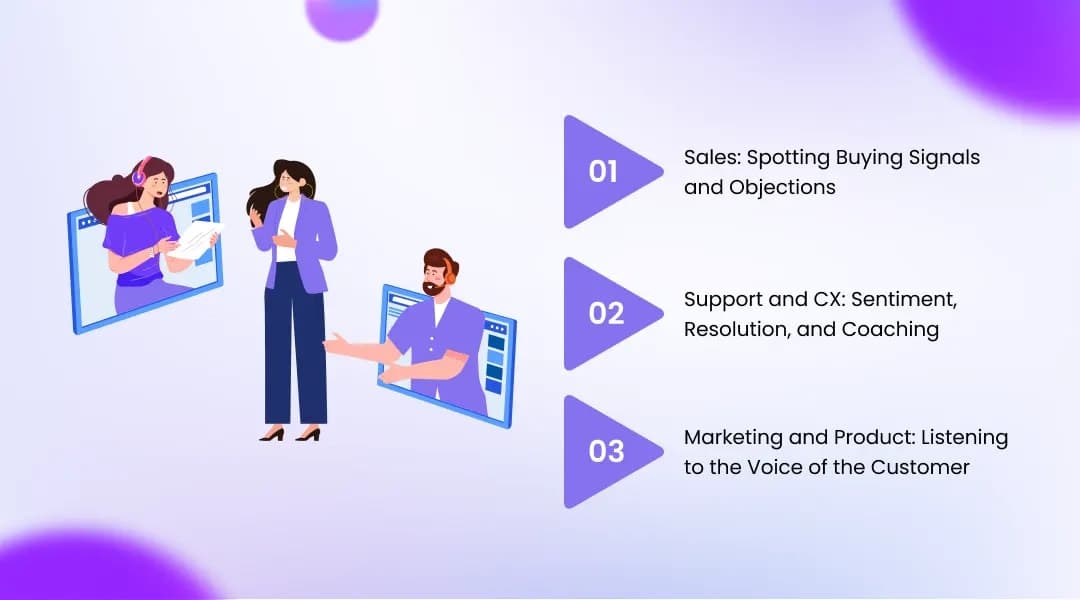
Capturing data is only half the work. The value of customer conversation insights shows up when different teams use the same conversation record for different jobs. One call can coach a sales rep, warn a support lead, and inform a product roadmap.
Sales: Spotting Buying Signals and Objections
Sales teams use AI call analytics to separate the prospects who are ready to buy from the ones who need nurturing. By analyzing how buyers respond to pricing and which questions they repeat, the system can flag high-intent conversations automatically. Reps then spend their hours on the leads most likely to convert, instead of scoring calls from memory.
The pattern view matters even more than the single call. When AI reviews an entire campaign of calls, it surfaces the objections that keep recurring and the talk tracks that top performers use to overcome them. Those winning patterns become training material for the whole team, which is how one strong closer quietly lifts everyone else.
Support and CX: Sentiment, Resolution, and Coaching
Support leaders live and die by a few metrics: first-call resolution, average handle time, and CSAT. Call analytics feeds all three with evidence rather than guesswork. Sentiment analysis detects a caller's emotional tone across a conversation, flagging frustration or satisfaction as it shifts, so a manager sees which interactions actually went sideways.
Consider a common example. If multiple callers stumble over a new billing statement, the system flags that trend long before it becomes a wave of complaints or a spike in churn with AI call analytics and conversation insights. You fix the statement, the confused calls drop, and you never needed a survey to find the problem. That is proactive service instead of firefighting.
Marketing and Product: Listening to the Voice of the Customer
Marketing and product teams gain something they rarely get cleanly: unfiltered language. The voice of the customer is the raw wording buyers use to describe their problems, and it is a goldmine for positioning. When customers keep saying a feature is "confusing," marketing can stop calling it "user-friendly" and start addressing the real friction.
Attribution improves too. Call analytics can show which campaigns and channels actually drive calls that turn into customers, closing the loop between ad spend and revenue. The insight moves from "we ran a campaign" to "this campaign produced these conversations with these outcomes."
Real-Time Agent Assist: A Coach on Every Call
Post-call analysis is powerful, but the newest gains happen while the call is still live. Real-time agent assist gives live, in-call guidance to agents, surfacing answers and next steps while the conversation is still happening. In 2026, this has moved from a premium extra toward a standard expectation.
How Live Guidance Changes the Conversation
Picture an agent who has a quiet expert on every call, without a supervisor breathing over their shoulder. As the customer speaks, the system detects the question or objection and offers the relevant answer, product detail, or next step in the moment. The agent stays in control and simply gets help faster.
Have you ever lost a deal because the right answer arrived ten minutes after the call ended? Real-time assist is built to kill that exact delay. It also cuts wrap-up work, because summaries and CRM updates are drafted automatically once the conversation closes.
Call Quality Monitoring and Compliance at Scale
Traditional quality assurance graded a tiny, random sample of calls. Modern call quality monitoring grades all of them. AI scores every conversation against your criteria, which removes the sampling bias where one lucky or unlucky call decided an agent's review with OnDial.
Compliance benefits directly from this coverage. In regulated industries, the system can confirm that required disclosures were spoken on every call and flag the ones that fell short. For a business handling finance or healthcare conversations, that is the difference between spot-checking and actually knowing.
Is AI Call Analytics Worth It? The Honest Limits
I would be doing you a disservice if I only listed the wins. It is genuinely useful, and it is also frequently oversold. Knowing where it stumbles is how you buy well instead of buying disappointment.
Where Sentiment Analysis Still Struggles
Sentiment scoring is impressive, not infallible. Many tools lean on acoustic cues like pitch and pace, which can misread a neutral caller with a strong accent or a fast speaker as agitated. Sarcasm, code-switching, and cultural tone still trip up models that were trained mostly on one accent or language.
This is not a small footnote for a market like India. In my work at OnDial across regional languages, I have seen accuracy swing hard depending on how well the underlying models were trained on local speech. The honest takeaway is to test any platform on your customers' actual accents and languages before you trust its sentiment scores.
The Real Test Is Insight-to-Action
Here is the failure mode nobody puts on the sales deck. Most call analytics projects do not fail at capturing insight. They fail at acting on it.
A dashboard full of sentiment scores changes nothing if no workflow turns a flagged call into a coaching session or a fixed process with call analytics. The tools that earn their cost connect insight to action, tagging tickets, prompting follow-ups, and feeding coaching plans, rather than leaving you to admire the charts. The payoff can be real when that loop closes, with IDC and Microsoft research cited by CloudTalk pointing to about $3.70 returned per $1 invested within roughly 13 months, but that return depends entirely on whether anyone acts on what the analytics reveal.
Conclusion
AI call analytics turns the conversations you were already having into a measurable asset, and that is the shift worth remembering. Three things matter most: it captures what surveys miss, it works only when insight connects to action, and its sentiment accuracy depends on how well the models understand your customers' real speech. You now have a clear picture of what the technology does and where it stops, which means you can evaluate it as a decisive buyer instead of a hopeful one.
If your calls are happening in multiple Indian languages or across global markets, accuracy on real accents is the detail that decides everything. At OnDial, we build voice AI and analytics tuned for exactly that kind of multilingual, human-centric conversation, and I would rather show you how it performs on your callers than ask you to take my word for it.