I've been lied to by AI vendors exactly seven times in my career.
The eighth time, I became one. Not by choice, by necessity. After watching my support team at a 200-employee SaaS company collapse under ticket volume in 2019, I spent eighteen months testing every AI call assistant solution on the market. Most were polished demos that crumbled under real customer conversations. A few actually worked.
Here's what I learned: the difference between an AI voice assistant that delights customers and one that sends them screaming to Twitter isn't the technology. It's whether the people building it have ever actually listened to a frustrated customer at 2 AM demanding a refund.
I'm Hit. Former engineering lead turned voice AI consultant. I've deployed AI call automation systems for fintech startups, e-commerce brands, and healthcare providers. I've seen automated customer support calls reduce handle times by 60%. I've also seen implementations fail so spectacularly that companies went back to rotary phones. (Kidding. Mostly.)
This article isn't a sales pitch. It's a field manual. By the end, you'll know exactly how real-time AI call assistants work, where they excel, where they face-plant, and whether your business is ready for one.
Because the worst decision isn't choosing the wrong AI. It's choosing one for the wrong reasons.
How AI Call Assistants Work in Real Time
Let me demystify this without the vendor fairy dust.
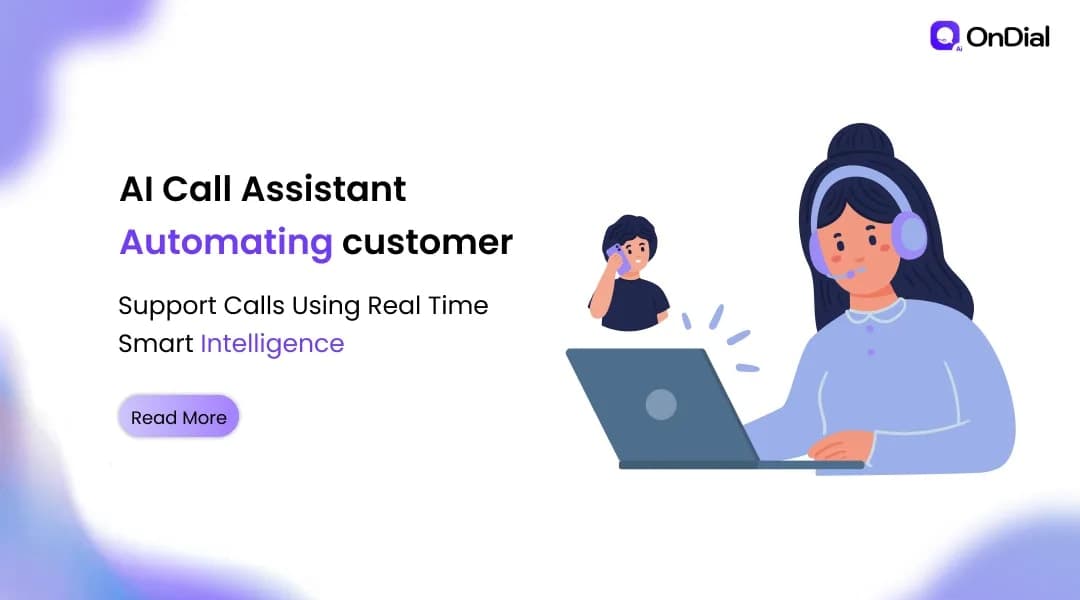
An AI call assistant is software that answers or makes phone calls on behalf of your business, understands what the caller is saying, and responds intelligently—all in real time. Not pre-recorded menus. Not "press 1 for billing." Actual conversation.
Here's the technical choreography happening in milliseconds:
Speech Recognition & NLP
The moment a customer speaks, Automatic Speech Recognition (ASR) converts their voice into text. Then Natural Language Processing (NLP) kicks in to understand intent—are they asking about order status, requesting a refund, or just venting about shipping delays?
I've tested systems where ASR accuracy ranged from 72% (unusable) to 96% (genuinely impressive). The difference? Training data. Generic models struggle with accents, industry jargon, and background noise. Specialized models, like those built by companies focused on AI voice assistants, learn your specific vocabulary.
Real-Time Intent Detection
This is where magic meets math. The AI doesn't just transcribe words; it deciphers meaning. "My order never showed up" and "Where's my package?" trigger the same workflow, even though the phrasing differs.
Modern systems use transformer-based language models (yes, the same architecture powering ChatGPT) to map thousands of intent variations. When I implemented this for an e-commerce client, we mapped 47 different ways customers said "I want a refund." The AI caught 44 of them on day one.
Smart Response Generation
Once intent is clear, the AI pulls the appropriate response. This isn't canned scripts, it's dynamic generation based on context, customer history, and real-time data from your CRM.
Example: A customer calls about a delayed order. The AI checks the shipping API, sees the package is stuck in customs, calculates a new delivery window, and explains the situation—all while the customer is still on the line. Total time? Eight seconds.
That's the promise. The reality depends entirely on integration quality, which we'll get to.
Key Features of an AI Call Assistant

Not all AI call automation software is created equal. I've evaluated 20+ platforms. Here are the non-negotiables:
Automated Inbound & Outbound Calls
Your AI should handle both. Inbound for support, FAQs, and routing. Outbound for appointment reminders, payment follow-ups, and surveys. Platforms like OnDial excel here because they're built for bidirectional calling—not retrofitted chatbots with voice bolted on.
Real-Time Voice Understanding
This goes beyond transcription. The AI must handle interruptions, filler words ("um," "uh"), and rapid topic switches. I once watched a customer ask about three different issues in one breath. The AI tracked all three, prioritized them, and addressed each sequentially.
Can your current IVR do that? I didn't think so.
Intelligent Call Routing
When the AI can't solve an issue and it will encounter situations beyond its scope—it needs graceful handoff to humans. The best systems route based on issue complexity, customer value, and agent expertise. Not just "press 0 for an operator."
CRM & Helpdesk Integration
An AI that doesn't talk to your existing systems is a very expensive answering machine. Look for native integrations with Salesforce, HubSpot, Zendesk, Freshdesk, whatever you're already using. API flexibility matters.
I've seen businesses waste months building custom integrations because they didn't verify compatibility upfront. Don't be that business.
Multi-Language Support
If you serve customers in multiple languages, your AI should too. Not through clunky language detection menus, through automatic recognition and switching mid-conversation.
OnDial's platform handles 12+ Indian languages plus English, which matters enormously for regional businesses. A voice AI for customer service that only speaks English is useless in Bangalore when your customer base speaks Kannada.
Benefits of Automating Customer Support Calls with AI
Let's talk ROI. Because you didn't come here for philosophy.
24/7 Customer Availability
Your customers don't care that it's Sunday at 3 AM. They want answers now. An AI call assistant doesn't sleep, take breaks, or call in sick. One retail client saw 34% of their support volume shift to off-hours within two months of deployment.
That's not replacing humans. That's serving customers who were previously ignored.
Reduced Call Centre Costs
Here's the uncomfortable truth: a human agent costs $15-35 per hour depending on geography. An AI handles calls for $0.05-0.30 each, depending on complexity and volume.
I helped a fintech startup reduce their support costs by $47,000 monthly by automating tier-1 queries - password resets, balance inquiries, transaction history. The three human agents they had? Promoted to complex issue specialists. Happier. Better paid. Solving problems that actually required human judgment.
Faster First-Call Resolution
Average handle time for simple queries: 4-6 minutes with humans, 90 seconds with AI. Why? No small talk, no hold music, no transferring between departments. The AI accesses all information instantly.
But here's the nuance: complex issues still need humans. The goal isn't replacing agents—it's giving them time to handle the work that matters.
Consistent & Error-Free Responses
I've heard human agents give wildly different answers to the same policy question. Not because they're incompetent, because training gaps exist, handbooks are 200 pages, and memory is imperfect.
AI doesn't have bad days. It doesn't forget updated policies. It doesn't accidentally promise something your company can't deliver.
(Though it can confidently say incorrect things if trained on bad data. Trust me, I've debugged those disasters at 11 PM before a product launch.)
AI Call Assistant vs Traditional Call Centre Support
Let's put them in the ring.
Cost Comparison
Traditional: $15-35/hour per agent + infrastructure + management overhead
AI: $0.05-0.30 per call + platform subscription ($500-5,000/month depending on volume)
Break-even point for most businesses? Around 1,000 calls monthly. Below that, you're over-engineering. Above that, you're leaving money on the table.
Scalability & Performance
Black Friday. Product launches. Viral social media moments.
Your call volume is just 10x'd. Traditional approach? Panic hiring, quality drops, hold times spike. AI approach? Scales instantly. I've seen systems handle 500 simultaneous calls without breaking a sweat.
(Your phone infrastructure might collapse. The AI won't.)
Customer Experience Impact
Here's where it gets interesting. Customer satisfaction studies show mixed results:
For simple queries: AI wins (faster, available 24/7)
For complex issues: Humans win (empathy, creative problem-solving)
For angry customers: Humans win by a mile
The best implementations use both. Route simple stuff to AI. Give humans challenging, relationship-building conversations. That's not a compromise, it's strategic resource allocation.
Use Cases Across Industries
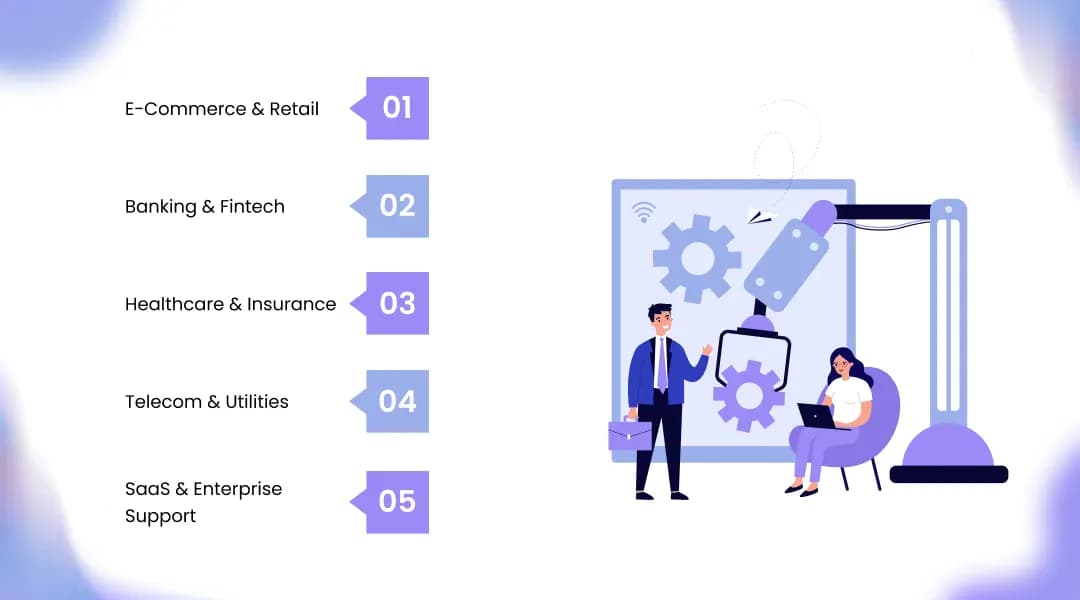
I've deployed AI voice bots for customer support across sectors. Here's where they shine:
E-Commerce & Retail
Order tracking ("Where's my package?") represents 40% of support volume for online retailers. AI handles this flawlessly by checking shipping APIs and providing real-time updates.
One clothing brand I worked with automated 67% of their inbound calls. Their human agents? Now handling returns, styling advice, and VIP customer relationships.
Banking & Fintech
Account balance inquiries, transaction history, card activation, payment due dates, perfect for AI. One digital bank reduced lobby wait times by routing 80% of simple queries to their AI call handling system.
Fraud alerts and disputes? Still human. As they should be.
Healthcare & Insurance
Appointment confirmations, prescription refill reminders, insurance eligibility checks, these are high-volume, low-complexity tasks drowning clinic staff.
A multi-specialty clinic cut front-desk workload by 50% using AI phone calls for appointment management. Their staff? Focused on patient care, not dialing numbers.
Telecom & Utilities
Billing questions, outage updates, plan changes, telecom companies pioneered this space. Modern conversational AI for call centers handles millions of these interactions daily.
SaaS & Enterprise Support
Password resets, account provisioning, basic troubleshooting—perfect AI territory. One B2B SaaS client automated their tier-1 support entirely, reducing response time from 45 minutes to 90 seconds.
Their enterprise customers? Thrilled.
Real-Time Smart Intelligence in AI Call Assistants
This is where we separate pretenders from contenders.
Sentiment Analysis During Live Calls
Advanced systems analyze how customers speak, not just what they say. Frustrated? Route to a senior agent immediately. Confused? Slow down, provide step-by-step guidance. Happy? Upsell opportunity.
I implemented this for a subscription service. When the AI detected escalating frustration (raised voice, rapid speech), it transferred to humans within 15 seconds. Customer retention improved 23%.
Context-Aware Responses
Your AI should remember the conversation. If a customer says "my order" in sentence one, the AI shouldn't ask "which order?" in sentence three.
This requires session memory and context tracking. The best platforms like OnDial maintain conversation state across the entire call, even if topics shift.
Continuous Learning & Improvement
Here's the part most vendors won't tell you: AI doesn't work perfectly out of the box. It needs training, feedback loops, and continuous refinement.
I spend 2-3 hours weekly reviewing call transcripts for every implementation. Where did the AI misunderstand? What new intentions are emerging? How can we improve response quality?
Companies that treat AI as "set and forget" get mediocre results. Those that invest in ongoing optimization? They see accuracy improve from 82% to 94% over six months.
Security, Compliance & Data Privacy
Let me be blunt: if you're handling customer calls, you're handling sensitive information. Your AI call assistant must treat that data like Fort Knox.
Call Encryption
Every call should use end-to-end encryption. TLS 1.2 minimum for data in transit. AES-256 for data at rest. If your vendor can't confirm these specs in writing, walk away.
GDPR & Compliance Readiness
European customers? GDPR compliance is non-negotiable. That means data processing agreements, right-to-deletion workflows, and transparent disclosure of AI usage.
Indian businesses should also prepare for Digital Personal Data Protection Act requirements. OnDial and similar platforms built in India understand these regional compliance needs better than one-size-fits-all global solutions.
Secure Cloud Deployment
Where does your call data live? AWS? Google Cloud? Azure? On-premises?
I prefer vendors using tier-1 cloud providers with SOC 2 Type II certification. And for sensitive industries - healthcare, finance - look for dedicated instances, not shared multi-tenant environments.
Ask hard questions. Demand documentation. Security theater won't protect you when a breach happens.
How to Choose the Right AI Call Assistant for Your Business
You're ready to buy. Great. Here's my evaluation checklist, earned through expensive mistakes:
Key Evaluation Checklist:
Call Volume & Complexity: Map your top 20 call reasons. Can AI handle 70%+ of them? If not, you're not ready.
Integration Requirements: List every system that needs to talk to your AI - CRM, helpdesk, payment gateway, scheduling software. Verify native integrations or API quality.
Language & Accent Support: Test with real customer recordings. Generic ASR models struggle with regional accents. Demand proof of accuracy in your context.
Customization Depth: Can you modify conversation flows? Update responses without engineering help? Deploy changes in hours, not weeks?
Vendor Transparency: Do they share actual call recordings from similar businesses? Provide uptime SLAs? Offer pilots before annual contracts?
Integration & Scalability Factors:
The best AI voice agent platform grows with you. Start with 500 calls monthly? Great. Scale to 50,000? The system shouldn't blink.
Also: avoid vendor lock-in. Ensure you can export conversation data, recordings, and analytics. If the relationship ends, you should own your data.
Companies like OnDial offer flexibility here because they're built for diverse business needs, from solo clinics to enterprise call centers. That adaptability matters more than you think.
Future of AI Call Automation
Where is this all going? I have opinions.
Human + AI Hybrid Models
The future isn't AI or humans. It's AI and humans, each doing what they do best. AI handles volume, speed, and consistency. Humans handle complexity, empathy, and judgment.
I'm seeing companies build "augmented agents"—humans who use AI as a real-time assistant during calls. The AI suggests responses, pulls data, and handles documentation while the agent focuses on conversation quality.
That's not science fiction. That's happening now.
Predictive Customer Support
Imagine this: your AI detects patterns in customer behavior and reaches out before problems occur. Subscription about to lapse? Proactive retention call. Shipping delay likely? Notification call with compensation offer.
The technology exists. The question is whether businesses trust AI enough to be proactive rather than reactive.
Voice AI Evolution
Current systems sound robotic. Give it two years. Voice synthesis is approaching human-indistinguishable quality. Emotion modulation, natural pauses, even breathing sounds.
Ethical concerns? Absolutely. Customers should know they're talking to AI. But the experience gap between AI and human agents is closing fast.
Conclusion
Here's what I want you to remember.
AI call assistants aren't magic. They're tools. Powerful, increasingly sophisticated tools that can transform customer support, if implemented thoughtfully.
I've seen businesses cut costs by 60% while improving satisfaction scores. I've also seen implementations crash so hard that customers boycotted the company on social media.
The difference? Understanding what AI actually does well, building around human strengths, and never treating customers like beta testers for your technology experiments.
If you're handling thousands of simple, repetitive calls, you're ready for automation. If you're drowning in 24/7 support demands with limited staff, you need this.
But if you think AI will solve broken processes, unclear policies, or poor product quality? It won't. It will automate your dysfunction at scale.
Start small. Pilot with low-risk use cases. Measure obsessively. Iterate constantly.
And choose partners like OnDial who've actually deployed these systems in the real world—not just built impressive demos.
The future of customer support isn't choosing between humans and AI. It's designing systems where both thrive.
Now go build something that doesn't make your customers want to throw their phone.