Here is a number that should change how you prepare. Around 78% of buyers now expect the person across the table to already understand their needs before the first conversation even starts, according to 2026 discovery-call report. That single expectation quietly rewrote the rules of the first client meeting. If you still plan to walk in, introduce yourself, and explain what your firm does, you are already a step behind.
Before the first client meeting, a consulting firm should know the client's business context, the specific problem driving the conversation, the people in the room and what each of them cares about, and the outcome that would make the engagement a clear success. That is the short answer. The longer answer is what separates firms that win the work from firms that get a polite thank-you email.
I understand the nerves. You get one first impression, the prospect's time is short, and it can feel like everything rides on saying the perfect thing. It does not. It rides on knowing the right things before you arrive. This guide covers what to research, which questions to ask, how to carry yourself in the room, and how modern tools can brief you before you ever say hello.
Why the First Meeting Carries More Weight Than the Pitch
The first client meeting is less about proving your firm is impressive and more about proving you already understand the person in front of you. Buyers decide fast, and much of that decision runs on feel rather than credentials. Get the opening right, and the rest of the engagement rides a wave of goodwill you did not have to earn twice.
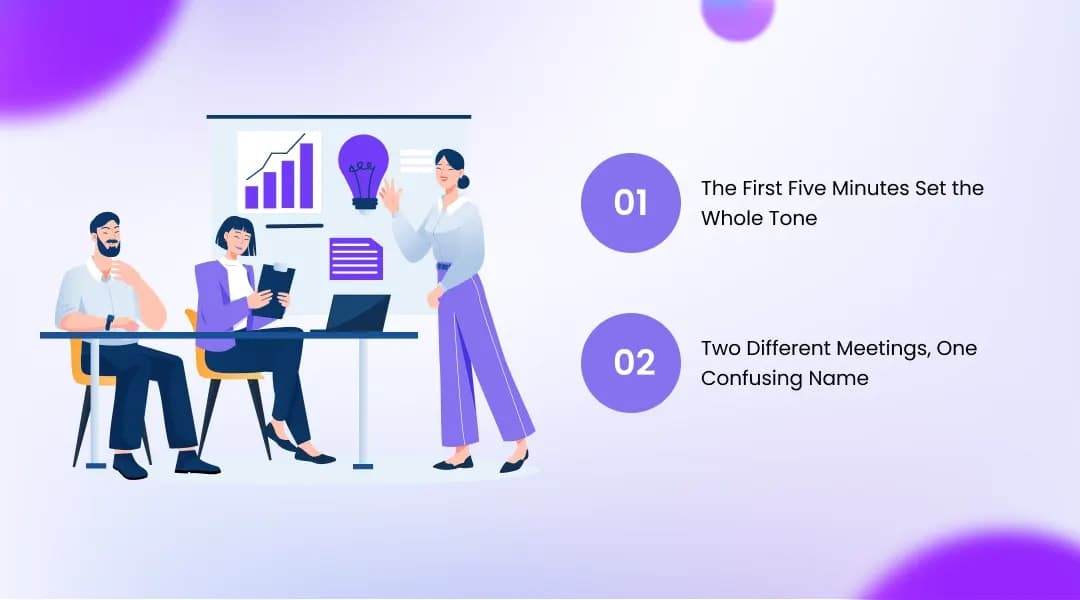
The First Five Minutes Set the Whole Tone
Most clients form a working impression of you within the first few minutes, long before you reach any slide about methodology. That impression is built on whether you seem prepared, whether you listen, and whether your questions show you have thought about their world. A confident opening question does more for your credibility than a ten-minute credentials walk-through ever will.
Consider the pattern that shows up again and again in professional services with OnDial AI voice agent services. RAIN Group research found that 58% of buyers consider their sales meetings unhelpful, mostly because the seller talked about themselves instead of the buyer's situation. That is a low bar. Clearing it simply requires you to make the first five minutes about them.
Two Different Meetings, One Confusing Name
Here is the distinction almost nobody makes clear, and it changes everything about how you prepare. There are two meetings that both get called the "first client meeting," and they demand different preparation.
The discovery meeting happens before any contract. A discovery call is a structured first conversation whose only job is to understand the client's situation, not to sell a solution. Your goal here is fit, trust, and a clear picture of the problem.
The kickoff meeting happens after the client signs. A kickoff meeting is the first official session after a client commits, used to align on goals, roles, and how success will be measured. Your goal here is leadership and momentum.
Confuse the two, and you will pitch when you should be listening, or coast when you should be setting direction. Know which meeting you are in, and prepare for that one specifically.
What to Know Before You Walk In

Strong client meeting preparation is the difference between a conversation that feels tailored and one that feels generic. The research you do beforehand is what lets you ask sharper questions and skip the obvious ones. Here is what to gather, and how deep to go.
How do you prepare for a first client meeting? Research the client's business, industry, and recent changes; identify the likely problem behind the meeting; learn who will attend and what each person cares about; prepare open questions instead of a pitch; and define what a successful outcome would look like for them.
Understand the Business Beyond Its Website
Skimming the client's homepage is table stakes, not preparation. Read their recent announcements, their earnings notes if they are public, their job postings, and any press about changes in their leadership or market. Job listings in particular tell you where a company is investing and where it is hurting, which is exactly the kind of context a prospect notices when you reference it naturally.
You want to understand what they do, what they have recently changed, who their competitors are, and where the friction likely sits. The aim is not to recite facts back at them. The aim is to ask questions that only someone who did the reading could ask.
Map the People and the Politics
A first meeting is rarely with a single decision-maker, and the quiet person in the corner is often the one who signs off. Before you arrive, list who is likely to attend and what each of them is measured on. Stakeholder mapping simply means knowing whose problem you are solving, whose budget it touches, and who can quietly kill the project.
The economic buyer controls the budget and cares about return and risk.
The technical or functional lead cares whether your approach will actually work in their environment.
The end users care whether this makes their day harder or easier.
Speak to all three, not just the loudest voice. When each person feels their specific concern was heard, you turn a room of skeptics into a room of quiet advocates.
Anticipate the Objections You Can Already See
Most objections are predictable if you have done the reading. Price, timing, internal capacity, and "we tried something like this before" come up in nearly every first meeting with enterprise AI voice agent services. Spend part of your prep listing the three objections most likely to surface, then decide how you will answer each one honestly.
You are not building rebuttals to win an argument. You are showing that you have thought about the hard parts before they have to raise them. That honesty, offered before you are pushed, is one of the fastest ways to build trust with a new client.
The Questions That Earn Trust
The questions you ask reveal more about your competence than any answer you give. This is where thoughtful questions to ask a new consulting client do the heavy lifting. Good questions signal that you listen, that you are curious about their actual problem, and that you are not just running a script.
Open With Their Problem, Not Your Pitch
What is the first question a consultant should ask? Ask what prompted them to look for help now, then stay quiet and let them fully explain the problem in their own words before you offer a single idea.
That "why now" question is deceptively powerful. It surfaces the real trigger behind the meeting, which is usually a change, a deadline, or a pain that finally got loud enough to act on. Once you understand the trigger, you understand the urgency, and urgency is what turns interest into a signed engagement.
Resist the urge to solve the problem in the room. I have seen sharp consultants lose winnable work by jumping to a solution in the first ten minutes, before the client felt understood. Diagnose first. Prescribe later.
Budget, Timeline, and the Cost of Doing Nothing
You cannot scope what you cannot size, so budget and timeline questions belong in the first meeting, handled with care with OnDial. Ask what range they have in mind, when they need results, and what happens if nothing changes. That last question, the cost of inaction, is often the most persuasive figure in the entire conversation, because it reframes your fee as a saving rather than a cost.
Frame these questions around their goals, not your invoice. "What would this need to achieve to be worth it for you?" invites a real number far better than a blunt "what is your budget?" ever will. The answer gives you both the size of the opportunity and the language to justify it back to them.
Should You Discuss Pricing in the First Meeting?
Should you discuss pricing in the first meeting? Yes. HubSpot data shows 58% of buyers want pricing raised on the first call, while only 23% of reps are willing to do it. Naming a rough range early filters serious buyers from browsers and signals confidence rather than evasion.
You do not need a precise quote to talk money. A range tied to the type of engagement is enough to test whether you are even in the same universe. If a prospect flinches at the low end of your range, you just saved both of you weeks of wasted proposals.
What Actually Wins the Room
Preparation gets you in the door, but your behavior in the meeting decides whether you stay. The mechanics here are simple to state and surprisingly hard to practice, especially when you are excited about the work. Master them, and you will feel the energy in the room shift toward you.
The Talk-to-Listen Ratio Nobody Teaches You
In a discovery meeting, the client should be doing most of the talking, full stop. The talk-to-listen ratio is the share of the conversation you spend speaking versus listening, and in a first meeting yours should lean heavily toward listening. When the client talks more, they feel understood, and people buy from those who understand them.
This runs counter to instinct. Most of us prepare so hard that we want to show our thinking, so we fill silences and answer questions with mini-lectures. Ask a question, then let the pause do its work. The insight you need is almost always on the other side of a silence you were tempted to fill.
The evidence backs this up plainly. Careertrainer. ai 's 2026 report found that consultants and reps who run thorough discovery see roughly 47% higher win rates, while 60% of sales leaders name weak discovery as the main reason deals are lost with AI voice agent platform features. Listening is not soft. It is the highest-return activity in the meeting.
Set Expectations Before You Set Scope
Ambiguity is the enemy of a healthy engagement, and it starts in the first meeting. Before you talk about deliverables, agree on how you will work together, how often you will meet, and how decisions will get made. The scope of engagement defines exactly what the project will and will not include, agreed before any real work begins.
In a kickoff meeting specifically, this is your moment to lead. Reconfirm the goals from the proposal, name the success metrics in plain language, and close with a simple mutual action plan that lists owners and dates. A short recap email afterward, capturing what was agreed, keeps momentum and prevents the quiet drift that sinks so many projects.
How AI and Voice Tools Reshape First-Meeting Prep
The uncomfortable truth is that the "do your homework" advice has not changed in decades, but the tools for doing that homework have changed completely. The best-prepared firms now arrive at the first meeting already briefed, because part of the discovery happened before a human ever joined the call. This is where conversational AI is quietly shifting the work.
Move Intake and Qualification Before the Meeting
A large share of a first meeting is spent on basic intake: confirming the problem, the timeline, the rough budget, and who is involved. Much of that can happen earlier through an automated AI voice assistant that qualifies inbound interest and captures the essentials in a natural conversation. The human meeting then starts at a deeper level, with the groundwork already laid.
Voice AI handles the repetitive qualifying questions so your first human conversation is not spent on logistics.
It captures answers directly into your CRM, whether that is HubSpot, Zoho, or a shared record your team already uses.
It follows up consistently, which matters because most deals need several touches before they close.
In the voice AI projects we build at OnDial, I have watched a single well-run intake call change the entire tone of the first human meeting, because the consultant walked in already knowing the problem and the players.
Show Up Briefed, Present, and Human
Automating intake is not about removing the human from the relationship. It is about protecting the part of the meeting that only a human can do. When a voice AI has already gathered the basics, you spend your attention on listening, reading the room, and asking the sharper questions that build trust with are ai voice agents worth it.
That said, I will be honest about the limits. No tool replaces genuine curiosity, and a voice agent that sounds scripted can do more harm than good. The point is not to sound automated. The point is to arrive so well prepared that you can be fully, unhurriedly human when it counts.
Conclusion
Knowing what to prepare for the first client meeting turns a nerve-wracking event into a repeatable process you control. The three things that matter most are simple: research the client and their people before you arrive, ask questions that center their problem instead of your pitch, and listen far more than you talk. Do those well, and the meeting stops feeling like an audition and starts feeling like the start of a partnership. You walk in prepared, you lead with genuine understanding, and you leave having earned trust rather than begged for it.
At OnDial, we help consulting firms and service businesses put intake and qualification on autopilot with conversational voice AI, so your team walks into every first meeting already briefed on the problem and the people. If you want your consultants spending their attention on listening rather than logistics, that is exactly the kind of first-meeting prep our voice agents were built to handle.