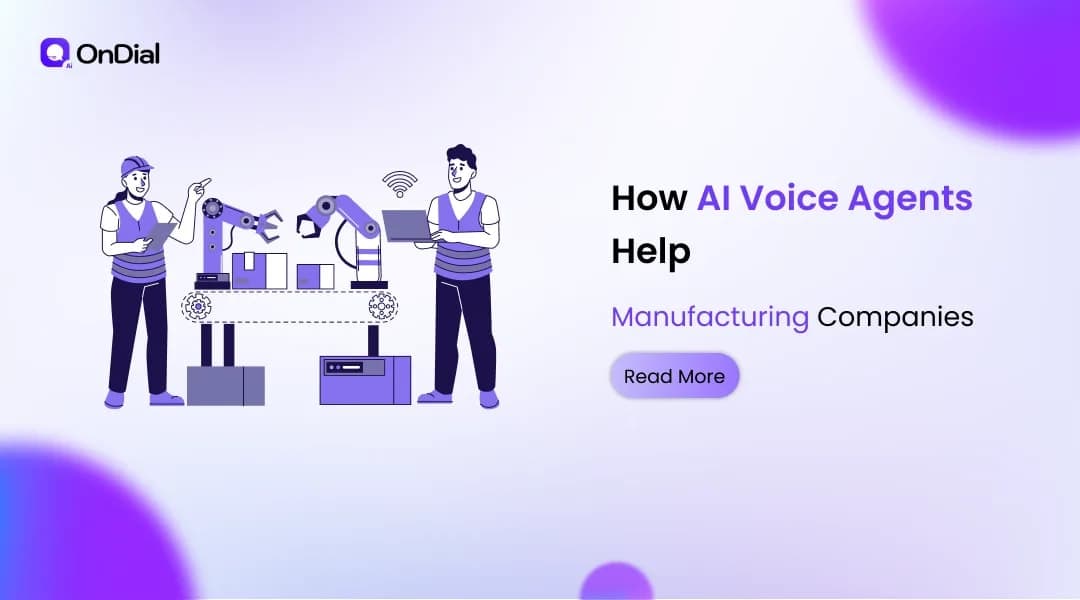
Manufacturing has the lowest voice AI adoption rate of any major industry, sitting at roughly 11 percent as of early 2026, according to AInora's voice AI market data. That figure is strange the moment you look at what these tools actually do. AI voice agents for manufacturing answer and place phone calls in natural language, so they can confirm order status, schedule deliveries, chase supplier updates, and field after-hours inquiries without a person picking up. They connect to your ERP and CRM, log every conversation, and pass a call to a human the moment it gets complicated.
I have watched manufacturers lose real orders to a missed six o'clock call, so I understand the quiet frustration of knowing your phone coverage has gaps you cannot staff around. Most of the noise online talks about robots on the assembly line, which is not the same problem at all. This guide breaks down where voice agents earn their keep on the manufacturing front office, where they fall short, and how to judge whether the investment is worth it for your operation.
Why Manufacturing Is the Most Underserved Market for Voice AI
Here is the counterintuitive part. The industry with the strongest case for automating phone work is also the slowest to adopt it. That mismatch is the real story behind voice AI adoption in manufacturing, and it is why a well-timed move now carries an advantage.
The adoption gap nobody talks about
The demand-side numbers are moving fast. An estimated 40 to 60 percent of B2B manufacturing software research now begins inside AI search interfaces like Google AI Overviews and ChatGPT, up from under 10 percent in 2023, per SensFlo's 2026 State of AI in Manufacturing Report. Your buyers and suppliers have already changed how they look for you, even if your phone lines have not changed how they respond.
At OnDial, most of the manufacturing conversations we have start the same way: a leader who has been burned by an old touch-tone menu and assumes voice AI is more of the same. That skepticism is fair, and it is exactly why adoption lags. The plants that move first are not chasing a trend; they are closing a coverage gap their competitors are still ignoring.
Two very different "voice AI" stories
A shop-floor voice interface lets a gloved worker log a task hands-free; a voice agent handles the phone calls your office cannot always answer. These are separate tools solving separate problems, and conflating them is why so many buyers get confused.
The shop-floor story is real and growing, with voice used for hands-free diagnostics and safety commands in noisy plants, as Techstrong AI has documented. OnDial's work sits in the second story, the communication layer, where the caller is a customer, a supplier, or a driver and the channel is a phone line. Keeping these straight matters, because the ROI, the integrations, and the risks are completely different.
How AI Voice Agents Actually Work on the Front Line
Skepticism usually melts once people hear a modern agent handle a real call. The gap between a 2019 phone menu and a 2026 voice agent is not incremental. It is the difference between pressing buttons and having a conversation.
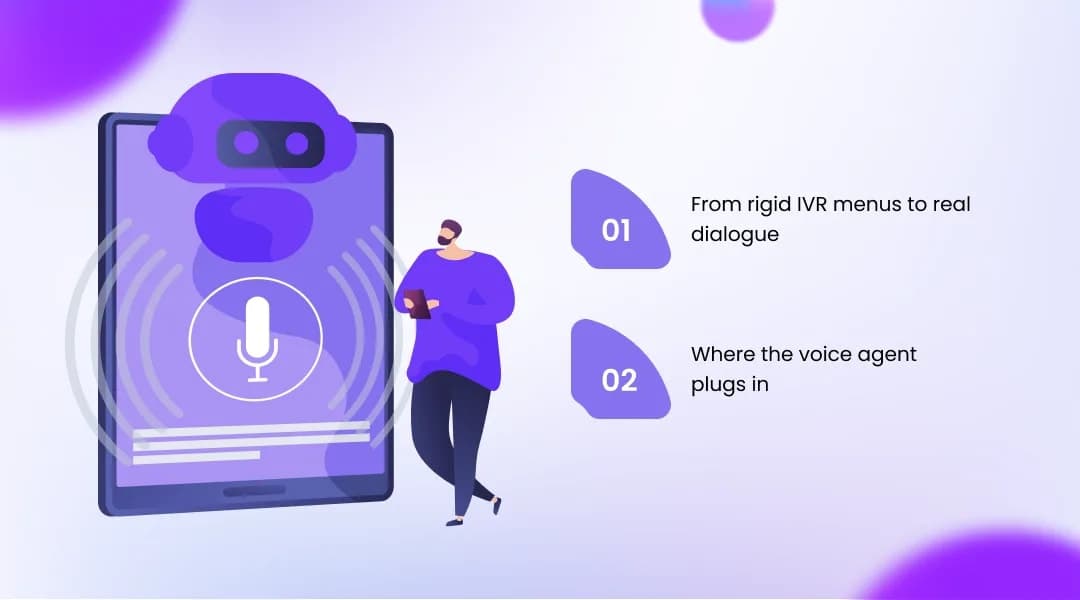
From rigid IVR menus to real dialogue
An AI voice agent for manufacturing is software that answers and makes phone calls in natural language. It uses speech recognition and a language model to understand a caller, then acts inside your ERP or CRM to confirm orders, book deliveries, or log requests, escalating to a human when needed.
Unlike a traditional IVR that traps callers in a fixed menu, a voice agent understands intent across different phrasings with AI voice agents for call centers. "Where is my order," "has my pallet shipped," and "what is the status on PO 4471" all route to the same action. Modern speech recognition already exceeds 97 percent accuracy for English, according to AInora, which is what makes this conversational flow reliable enough for business use.
Where the voice agent plugs in
The value lives in the integration, not the voice. A talking interface that cannot take action is close to useless, so the agent connects to your existing stack through telephony providers, your CRM such as Salesforce, and your ERP such as SAP. When a caller asks for order status, the agent queries the live record and reads back the real answer.
This is also where the honesty about data comes in. Every call becomes a structured, searchable record, which turns your phone line into a source of operational insight rather than a black hole. Compliance frameworks like GDPR and consent handling are non-negotiable here, and any serious platform builds a human-in-the-loop escalation path from day one.
Voice AI for Order Status, Delivery, and Dispatch
If you want the fastest payback, start with voice AI for order and delivery management. These calls are high in volume, predictable in shape, and painful when they pile up on a human team. They are the textbook fit for automation.
Order status and tracking calls
Ask yourself how many times a week your team reads the same shipment status off the same screen. Each of those calls is a few minutes of skilled staff time spent on something a machine can do instantly. A voice agent pulls the live record and answers on the first ring, every time, without a hold queue.
Industry-wide, manufacturing and B2B services are already piloting voice agents specifically for parts ordering, delivery scheduling, and supplier status updates, with India among the regions leading that push, as CallMissed reported in mid-2026. That regional signal matters for anyone building for the Indian market. The demand is not theoretical; it is being deployed right now.
Delivery scheduling and dispatch coordination
Delivery windows are where phone tag quietly drains hours. A driver calls to confirm a slot, nobody picks up, the slot slips, and a delivery dispute follows. A voice agent handles the confirmation call, books the window against your schedule, and logs it, closing the loop before it becomes a problem.
The measurable upside is not small. Contact center operations using voice AI see call handling time drop by around 35 percent and operational costs fall by 20 to 30 percent, per the Voice AI Trends 2026 data compiled by NextLevel AI. For a dispatch desk drowning in confirmation calls, that recovered time goes straight back into work that needs a human brain.
Supplier and Procurement Coordination Without the Phone Tag
Procurement runs on follow-ups, and follow-ups run on the phone. This is a natural home for supplier communication automation, because the calls are routine, repetitive, and easy to define. The agent becomes a tireless coordinator that never forgets to chase a quote.
RFQ intake and quote follow-ups
Supplier coordination is the routine back-and-forth of requesting quotes, confirming lead times, and chasing purchase order updates by phone. A voice agent can place outbound calls to collect quote confirmations and log the responses directly against the right record. That removes the "I meant to call them back" gap that costs procurement teams real days.
In projects we have run at OnDial, the outbound follow-up use case tends to surprise people the most. It is not glamorous, but a system that reliably calls twelve suppliers and records twelve answers by lunchtime changes how a small procurement team spends its week. The agent asks the same crisp questions every time, which also cleans up your data.
Purchase order confirmations
Confirmations are the definition of predictable work. A voice agent can verify a purchase order, read back the key line items, and flag a mismatch before it turns into a wrong shipment. Preventing an error at this stage is far cheaper than fixing it after fulfillment.
There is a limit worth naming here, and I will come back to it. Negotiation and dispute resolution should stay with your people, because those calls need judgment the agent does not have. The agent handles confirmation; the human handles conflict.
Always-On, Multilingual Inbound Coverage
Your customers do not think about your office hours. A buyer with a live requirement calls when the need hits, and if nobody answers, the next call goes to a competitor. This is where 24/7 inbound call handling stops being a luxury and becomes a defensive necessity.
Yes, AI voice agents work around the clock. They answer every inbound call on the first ring, day or night, handling order and delivery questions in multiple languages, so buyers in different time zones never reach a busy signal or a closed office.
Never missing a buyer's call
The math on missed calls is brutal and simple. A single missed inquiry from a serious buyer can outweigh a month of subscription cost. An always-on agent gives you a consistent response layer during off-hours without changing a single staffing schedule.
Well-configured voice agents already resolve 92 to 96 percent of standard business calls such as bookings, status checks, and routing, according to AInora with Turn Missed Calls Into Sales With AI Voice. That "well-configured" qualifier is doing a lot of work, and it depends on the quality of your knowledge base and call design, not just the underlying model. Get that right, and the coverage is genuinely dependable.
Multilingual support for global and Indian manufacturers
Language is a real barrier in industrial trade, and voice handles it better than forms. A voice agent can field a call in Hindi, Gujarati, or Tamil and switch as needed, which matters enormously for manufacturers serving a domestic Indian base alongside export customers. Our sister brand KriraAI has deployed exactly these multilingual flows across Indian industries.
This is also where voice beats every text channel for accessibility. A supplier's driver is not going to fill out a web form, but he will happily speak a confirmation into a phone. Voice meets people where they already are.
What Voice AI Cannot Do Yet, and How to Get Adoption Right
Now the part most vendor pages skip. Voice AI is not a magic staff replacement, and pretending otherwise is how deployments fail and reputations get damaged. The honest framing is what actually builds trust.
Where human handoff still matters
The pattern that holds up in production is bounded scope: the agent handles the routine 60 to 70 percent of calls, and humans handle the complex 30 to 40 percent, a split documented across production deployments by JustCall. Agents that try to handle everything fail in ways that hurt your brand. Complex diagnostics, price negotiation, and angry escalations belong with your team.
Skepticism about voice AI is earned, not irrational. Surveys such as Five9's have consistently shown that people often prefer a human, driven by past experiences with brittle, ineffective automated systems. A good deployment respects that history by making the handoff to a person fast and obvious, never a trap.
Getting adoption and ROI right
The economics are compelling when the volume is there. The operational cost of a managed voice AI call sits near seven cents per minute in 2026, against roughly seventy-five cents per minute for a human handling the same predictable calls, according to AI Agency Plus. Below about 600 inbound calls a month, the investment may not pay back; above 1,000 calls a month, the math works at most price points.
Should you rush in everywhere at once? No. The manufacturers who succeed start with one bounded use case, prove it, and expand, rather than trying to automate the whole phone line on day one. The broader operational upside is real, with manufacturers reporting 31 to 47 percent unplanned-downtime reductions after twelve or more months of AI deployment per SensFlo's 2026 report, but that comes from disciplined rollout, not a switch you flip.
Conclusion
AI voice agents for manufacturing are not a shop-floor robot and not a consumer gadget; they are a specific fix for the phone work that clogs your front office. The three things worth remembering: they excel at high-volume, predictable calls like order status, delivery, and supplier follow-ups; they should handle the routine majority while humans keep the complex minority; and the ROI is real once your call volume clears a modest threshold. You now have the frame to judge this for your own plant, not on hype, but on your actual numbers.
If missed calls and phone tag are costing you orders, the smartest first step is to pick one bounded use case and test it. At OnDial, we build tailored voice agents around exactly that kind of narrow, high-volume workflow, so you can prove the value on your own order or supplier calls before scaling anywhere else with AI voice agent industry solutions. Start with the call that hurts most.