A single automated voice call costs between $0.50 and $1.00 to place, while the same call handled by a staff member runs $5 to $8 for human-handled calls. That gap is the whole reason voice automation has moved from novelty to infrastructure. AI voice agents automate notifications, alerts, and customer reminders by placing and answering phone calls that hold a real conversation: they confirm an appointment, flag an overdue invoice, or warn a customer about a service disruption, then update your systems based on what the person actually says.
If you have been burned by a clunky robocall, or you feel a little uneasy about the legal side of dialing customers with a machine, that hesitation is fair. Most people have only ever heard the bad version of this technology. What follows is the practitioner's view: how these systems work under the hood, what the research really says about reminders, where they earn their keep, and the compliance rules you cannot skip. By the end, you will know whether this belongs in your operation and what a serious deployment looks like.
What AI Voice Agents Actually Do (And Why They Are Not Robocalls)
Conversational AI is the piece that separates a modern voice agent from the recorded message you have learned to hang up on. An AI voice agent is software that makes and answers calls using natural language, holding a two-way conversation instead of playing a recording. The distinction is not cosmetic. It changes what the call can accomplish and how customers respond to it.
The difference between a robocall and a conversation
A robocall is a broadcast. It plays the same audio to everyone, cannot hear a reply, and treats a confused senior and an annoyed executive identically. That rigidity is exactly why response rates on old-style automated reminders were always mediocre.
An AI voice agent listens and adapts in real time. Powered by natural language processing (NLP) and speech recognition, it can answer a clarifying question, accept a reschedule, detect an opt-out, and change its script based on what the caller said a moment ago. In deployments we have built at OnDial, the single biggest driver of completion is this back-and-forth: a customer who can say "actually, can we move that to Friday?" and get it handled on the same call finishes the interaction instead of abandoning it.
The three jobs: notifications, alerts, and reminders
These three words get used interchangeably, and they should not be. A notification tells someone something happened; an alert flags something urgent; a reminder prompts an action before a deadline. Each carries a different tone, timing, and escalation path, and a good voice agent treats them differently.
Here is how the jobs break down in practice:
Notifications are informational updates. Order shipped, application received, prescription ready for pickup. Low urgency, high volume, and ideal for full automation.
Alerts are time-sensitive warnings. A flight change, a fraud flag, a service outage. These often need immediate acknowledgment and a fast route to a human if something is wrong.
Reminders are nudges toward an action. Appointment tomorrow, payment due, contract renewal approaching. This is where a two-way conversation pays for itself, because the agent can confirm, reschedule, or collect right on the call.
How AI Voice Agents Automate Reminder Calls Step by Step
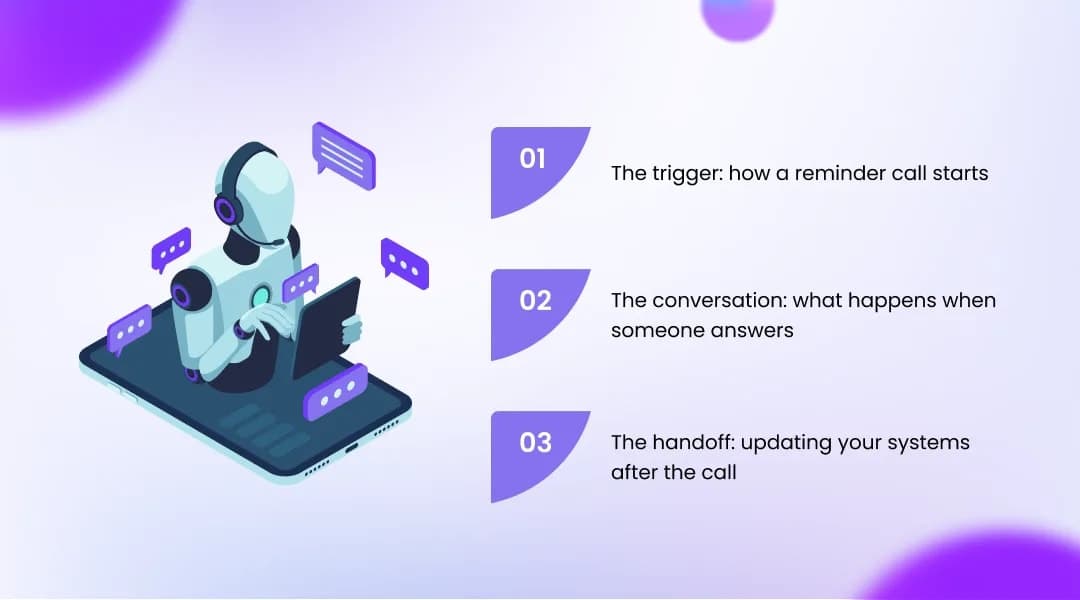
Automated reminder calls are not magic, and understanding the plumbing helps you judge vendors honestly when automating inbound customer calls in call centers. The whole cycle runs on three moving parts: a trigger, a conversation, and a handoff. Miss anyone, and the system leaks value.
The trigger: how a reminder call starts
Every call begins with an event in a system you already run. A booking created in your calendar, an invoice hitting its due date, or a status change in your CRM fires a signal that tells the voice agent who to call, when, and why. Good platforms let you set timing rules, so a reminder goes out 48 hours and again 24 hours before an appointment rather than at some arbitrary moment.
The trigger layer is also where personalization lives. The agent pulls the customer's name, the specific appointment or amount, and prior history, so the call opens with context instead of a generic greeting. When a platform can only fire on a narrow set of events, or only reads an email address and nothing else, that is a real limitation worth catching early.
The conversation: what happens when someone answers
The moment the call connects, the agent has to figure out who or what picked up. This is where Answering Machine Detection (AMD) matters: if a voicemail answers, the flow switches to leaving a concise message, and if a human answers, the agent starts the actual conversation. If a machine is detected, the call flow switches to a voicemail prompt, and if a human answers, the agent confirms attendance and can reschedule by calling backend functions that fetch available time slots and update the schedule.
From there, the agent runs its job. It confirms the appointment, offers to reschedule, answers a simple question, or routes to a person when the request goes beyond its scope. The best implementations keep the agent narrow on purpose, guiding the caller back to the task rather than trying to answer legal or technical questions it has no business handling.
The handoff: updating your systems after the call
A reminder call that does not write back to your systems is half a system. When the customer confirms, reschedules, or opts out, that outcome has to land in your calendar, CRM, or billing tool automatically. Otherwise, your staff spends the saved time reconciling records by hand.
This closing step is also where compliance data gets recorded. A responsible agent logs the consent status, the opt-out if one was given, and a timestamp, so you have a defensible trail. (We will get to why that trail is not optional in a moment.) The handoff is unglamorous, but it is the difference between automation that reduces work and automation that just moves it.
Do Automated Reminder Calls Actually Reduce No-Shows?
Here is the uncomfortable truth the vendor pages skip: for years, automated reminders were measurably worse than a human making the call. That finding is exactly why the conversational part matters so much.
Featured answer: Yes. Controlled studies found automated reminders cut no-shows by a weighted mean of about 29%, and staff phone calls by about 39%, relative to no reminder at all with aI Voice Agents Handle Inbound Calls Automatically. The gap between the two comes down to the two-way conversation, which is precisely what conversational AI now makes affordable at scale.
What the research says about reminders and attendance
The evidence base here is unusually strong. Controlled studies show automated reminders cut no-shows by a weighted mean of 28.9%, and staff phone calls by 39.1%, relative to no reminder (Hasvold and Wootton, 2011). In the most cited single study, non-attendance fell from 18.1% to 11.2% with SMS reminders, a 38% relative reduction (Koshy, Car and Majeed, 2008).
There is also a recall dimension that people forget. A Cochrane review of 55 studies covering 138,625 participants found that patient reminder and recall systems raised receipt of preventive care by 8 percentage points on average, and telephone outreach was the most effective channel. That last detail is the quiet headline for anyone building voice programs: the phone, done conversationally, still outperforms.
Why conversation beats a one-way recording
So why did live staff calls beat the machines? Because reminders only fix forgetting. A recording cannot handle the person who remembers perfectly well but has a conflict, a question, or a reason to cancel.
A conversational agent can. It resolves the conflict on the call, rebooks the slot, and captures the reason, which turns a would-be no-show into a kept or rescheduled appointment. This is the core argument for AI voice agents over both robocalls and plain text: they deliver the interactivity that made human calls effective, at something close to the cost of a recording. In client work, this is where the return on investment actually shows up, not in the dial itself but in the save.
Real-World Use Cases for Notifications and Alerts
The technology only matters where it maps to a painful, repetitive job. Outbound notification calls and reminders show up across industries, but a few verticals feel the impact fastest.
Healthcare and appointment-heavy services
Clinics, dental practices, salons, and any business that lives on a calendar bleed money to no-shows with AI voice agents for business calls. An agent that confirms, reschedules, and fills cancellations directly attacks that loss, and in regulated healthcare, it must do so under HIPAA and equivalent privacy rules. This is a domain where accuracy and a clean human handoff matter more than raw call volume.
The pattern extends to service reminders of every kind. Vehicle servicing due, an annual inspection approaching, a membership about to lapse. Each is a scheduled event that a voice agent can act on the moment it fires.
Payments, billing, and account alerts
Money conversations are awkward, and staff avoid them, which is exactly why they automate well. Payment reminder calls for overdue invoices, failed auto-payments, or upcoming renewals recover revenue that otherwise slips through, while keeping the tone neutral and consistent. The agent can verify identity, state the balance, and guide the customer to the next step without a human ever picking up a difficult call.
Account alerts follow the same logic with higher urgency. A fraud flag, a suspicious login, or a service that is about to be cut off needs to reach the customer fast, and confirm they heard it. Automating the first touch means the alert goes out at machine speed, and only genuine problems escalate to your team.
Operational and service notifications
Not every call is about a customer's calendar or wallet. Delivery windows, outage updates, event changes, and internal alerts all benefit from a system that can reach hundreds of people in minutes and record who acknowledged. The momentum behind this is real: 42% of businesses had already adopted AI voice assistants in the last year, while 58% plan deployment, and AI voice agents now handle 70% of routine inbound calls in many operations. Analysts frame the stakes plainly, with Gartner predicting conversational AI deployments would reduce contact center agent labor costs by $80 billion globally in 2026.
The Compliance Question: Can AI Voice Agents Legally Make These Calls?
This is the section that should decide your vendor, and it is the one most buyers underestimate. Can AI voice agents legally make outbound calls? Yes, but only if you treat consent and disclosure as load-bearing, not paperwork.
I have to be candid here, because getting this wrong is expensive rather than embarrassing. Rules vary by country, so treat the following as an informed starting point in the United States context and confirm your own program with qualified counsel, plus the equivalent local regime, such as India's TRAI Do Not Disturb framework if you operate there.
Consent, disclosure, and the informational advantage
In the United States, the ground shifted in early 2024. The FCC's February 2024 ruling confirmed that AI-generated voice is an "artificial voice" under the TCPA, so consent is mandatory, and outbound AI voice calls require prior express consent for informational messages or prior express written consent for marketing. The penalties are not trivial: TCPA violations carry $500 to $1,500 per call with no cap, and recent-year TCPA lawsuits and settlements exceeded $2.3 billion.
Here is the good news about the jobs in this article. Notifications, alerts, and reminders are usually informational, not marketing, which places them in a lighter consent tier with alerts customer reminders. Informational calls about appointments fall under the lighter prior-express-consent tier, which permits voluntary number provision as consent. In plain terms: when a customer gives you their number to book an appointment, you generally have the consent you need to remind them about it, which is not true for a sales pitch.
Do Not Call lists, calling windows, and caller ID
Consent is necessary but not sufficient. You still have to respect suppression lists, timing, and identification. Any outbound list must be scrubbed against the federal DNC Registry, which contains 240 million-plus numbers, within 31 days of dialing for telemarketing purposes, and US carriers have required STIR/SHAKEN call attestation on all outbound calls since 2021.
A serious platform automates these checks at dial time. It scrubs against the Do Not Call (DNC) Registry, honors calling windows by time zone, writes opt-outs to an internal suppression list in real time, and keeps consent records. The honest vendors, in my experience, tell you where their tooling stops: the consent strategy and registry scrubbing stay with you, the calling business, while the platform enforces do-not-contact and opt-out at the contact level and logs every override. If a vendor claims they make you automatically compliant, be skeptical. The legal burden sits with you.
What to Look For When Choosing an AI Voice Agent Platform
You now know the mechanism, the evidence, and the rules. Choosing well comes down to two questions: does it fit your systems, and is it honest about compliance?
Integration and trigger flexibility
The platform has to speak to the tools you already run. If it cannot fire from your calendar, CRM, or billing events, or cannot look up a contact by phone number rather than only email, it will create manual work instead of removing it. Ask specifically how triggers are configured and how outcomes get written back.
Flexibility on the conversation side matters just as much. You want control over scripts, timing, escalation rules, and the point at which the agent hands off to a person. A narrow, well-scoped agent that does three jobs well beats a sprawling one that does ten jobs badly.
Compliance tooling and honest vendor boundaries
Treat the compliance checklist as a filter, not a footnote. The platform should handle DNC scrubbing, time-zone-aware calling windows, real-time opt-out capture, mandatory AI disclosure at the start of the call where required, and multi-year record retention with OnDial. Maintaining consent records, DNC scrub records, and call logs for at least five years is a reasonable baseline.
Then judge the vendor on candor. The ones worth trusting name their limits, recommend you start with inbound and consented outbound, and never pretend the law is simpler than it is. That honesty is a feature, and at OnDial, it is the standard we hold ourselves to when we build for a client.
Conclusion
AI voice agents automate notifications, alerts, and customer reminders by turning a scheduled event into a real conversation that confirms, reschedules, collects, or escalates, then writes the outcome back to your systems. Three things should stay with you: the two-way conversation is what makes reminders actually work, the economics favor automation for repetitive jobs, and consent and disclosure are non-negotiable rather than optional. Deploy against those principles, and this stops being a gamble and becomes a controllable operations decision.
You do not have to figure out the plumbing alone. At OnDial, we build voice agents around your specific triggers, your calendar and CRM, and your compliance obligations, starting with the highest-return, lowest-risk calls so you see the savings before you scale. If no-shows, missed payments, or manual dialing are quietly draining your team, that is exactly the problem this was built to solve.