Here is a number that should stop you: in controlled blind tests, 67% of callers could not tell they were speaking with an AI voice agent. Not 10%. Not 30%. Two out of three real people, on real calls, had no idea.
If you have ever winced at an automated phone menu, pressed 0 desperately to reach a human, or watched a customer hang up because your IVR sounded like a robot from 2003, that number deserves a moment of your attention.
AI call agents have crossed a threshold that most business owners do not know about yet. The question is no longer "can AI answer phones?" The real question is: can it actually sound like a person you would trust?
I have spent years at the intersection of voice AI and real-world business communication, and I understand why skepticism runs deep. The old systems earned it. But the technology has moved. Significantly.
In this article, you will learn exactly how conversational AI voice agents produce human-like speech, where the technology genuinely excels, where its honest limits lie, and how to make a clear-headed decision about whether AI voice is right for your business.
How Do AI Call Agents Actually Work?
An AI call agent is an autonomous software system that listens to spoken language, understands intent, generates a response, and speaks it back, all in real time. That definition sounds simple. The engineering underneath it is anything but.
The Technology Stack Behind the Voice
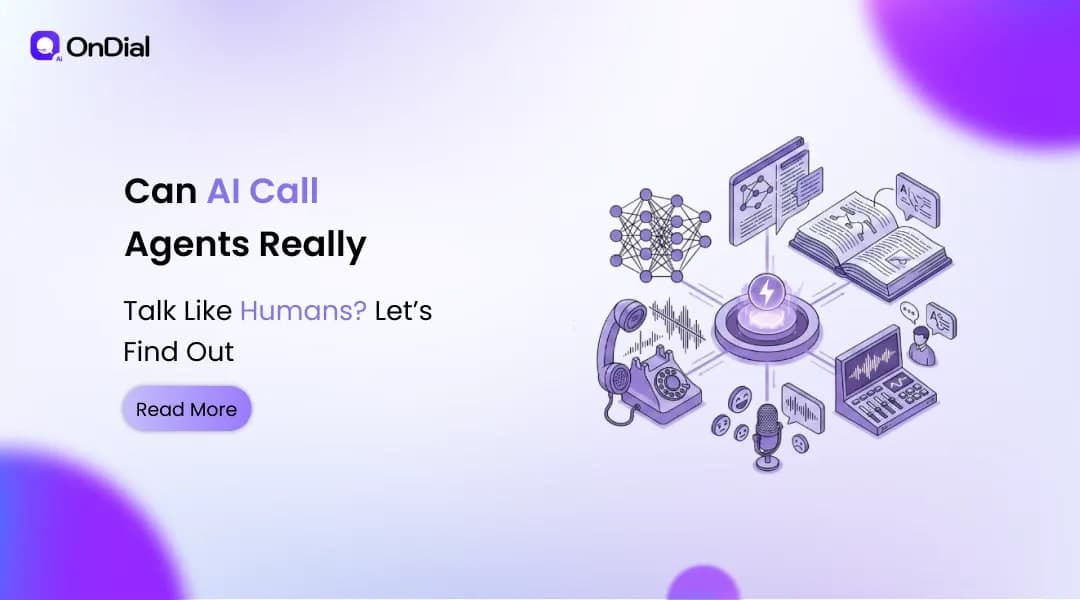
Every human-sounding AI call agent runs on three core layers working in sequence.
Automatic Speech Recognition (ASR) converts what a caller says into text, in real time, accounting for accents, background noise, and natural speech patterns. The accuracy of this layer sets a ceiling on everything else.
Large Language Models (LLMs) take that text, understand the intent behind it, access backend data (your CRM, calendar, or knowledge base), and generate an appropriate, contextually aware response. This is where the "thinking" happens.
Text-to-Speech (TTS) converts the generated text back into spoken audio. Top AI call agents now use neural text-to-speech and prosody control to sound very close to human, including natural pauses and turn-taking.
Each layer has to perform under time pressure. In modern systems, the entire cycle of listening, understanding, generating a response, and speaking takes only 300 to 700 milliseconds in advanced systems.That is fast enough that the gap is imperceptible to most callers.
From Words to Conversation: What Happens in Real Time
What separates a modern AI call agent from an old IVR is not just speed. It is understanding.
Natural Language Processing figures out what the customer means. It detects the intent behind phrases like "I want to cancel my order" or "Can I reschedule my appointment?" Once it understands the request, the AI checks business systems or databases to take action.
This matters enormously in practice. A caller does not have to say a scripted phrase. They can speak naturally, change their mind mid-sentence, or add new information with industry specific AI voice solutions. The agent adapts. That adaptability is what creates the feeling of talking to someone, rather than navigating a menu.
What Makes an AI Voice Agent Sound Human?
This is the question I get asked most often. And the answer surprises people every time.
Neural Text-to-Speech and Prosody Control
The voice quality gap between older voice AI and what exists today is not incremental. It is categorical.
AI voice agents are now trained to recognize emotions in speech and adjust their delivery accordingly. Whether it's detecting urgency in a service request or picking up hesitation in a sales inquiry, emotional intelligence is making voice interactions more human-like and effective.
Modern neural TTS engines do not just "read" text aloud. They interpret it. They understand whether a sentence should sound apologetic, informative, or urgent, and they modulate pitch, pacing, and emphasis accordingly with AI voice agents for business calls. ElevenLabs, one of the leading voice AI platforms, offers ultra-low latency across 70+ languages with support for thousands of expressive voices or voice cloning for brand-consistent customer experience.
(Here is the part most people do not realize: the breakthrough was not in making AI sound smoother. It was in making it sound imperfect in exactly the right ways.)
Turn-Taking, Backchanneling, and the Art of Listening
Human conversation is not a sequence of monologues. It is layered, overlapping, full of micro-signals.
Features such as voice activation detection (VAD) and turn-taking models enable AI voice agents to understand caller speech patterns and engage in a natural conversation cadence. Additionally, backchanneling gives agents the ability to produce natural conversation cues like "uh-huh" to keep callers engaged and heard.
These details are not cosmetic. They are what make a caller feel heard. When an AI says "mm-hmm" at the right moment, it is not a trick. It is a signal that the system is genuinely tracking the conversation. That signal is what makes two out of three callers believe they are talking to a person.
Retell AI, one of the industry benchmarks in this space, reports a latency of approximately 600ms, which keeps conversations smooth and fluent, with proprietary turn-taking models that know when to speak and when to wait.
Where AI Call Agents Are Genuinely Impressive
Let me be direct: AI call agents have earned their place. Not for everything. But for specific use cases, they are not just adequate. They are better than the human alternative.
High-Volume, Repetitive Call Scenarios
Ask yourself how much of your current call volume is genuinely complex. For most businesses, the honest answer is: not much of it.
Password resets. Order status checks. Appointment reminders. FAQ responses. After-hours inquiries. These are high-volume, pattern-predictable, and exactly where AI call agents perform at their peak with AI voice agents for call centers. 60-80% of call volume is repetitive, and that's exactly where AI excels.
At OnDial, we have seen this play out across sectors. A healthcare provider deploying an AI voice assistant to handle appointment scheduling does not just save money. It frees the human staff to do work that actually requires human judgment. The math is compelling, but the operational benefit is the real story.
Real Business Results: What the Data Shows
The numbers from real deployments are hard to dismiss.
Conversational AI is expected to save contact centers $80 billion in agent labor costs in 2026, according to Gartner.Voice AI calls cost roughly $0.40 each compared to $7 to $12 for a human agent. For businesses fielding hundreds of calls daily, that is not a marginal gain. It is a structural change.
Klarna's AI reduced average issue resolution time from 11 minutes to 2 minutes, an 82% improvement, while customer satisfaction scores remained comparable to human agents.
That last part is the one I want you to notice. Satisfaction held. Speed improved dramatically. The customer did not feel shortchanged by the AI. They felt served faster.
Where AI Voice Still Falls Short
I promised you an honest account. Here it is.
Emotional Complexity and High-Stakes Conversations
There is a reason every well-designed AI voice deployment includes a human escalation path. And it is not because the technology failed. It is because some conversations should not be handled by an algorithm.
A caller disputing a charge they believe is fraudulent. A patient anxious about a diagnosis. A customer who is genuinely upset and needs to feel that a real person cares about their situation. These interactions carry emotional stakes that AI handles poorly, not because it cannot generate empathetic-sounding words, but because the caller knows, on some level, that empathy needs to be real to land.
Only 11% of organizations report being highly effective at using AI to deliver human-like conversations, according to a Harvard Business Review Analytic Services study with AI voice tools that improve customer satisfaction. Most deployments are effective at the transactional layer. The emotional layer remains genuinely hard.
The Honest Limitation Every Business Should Know
Should you trust AI to handle all your calls? No. And any vendor who tells you otherwise is selling you something.
The technology is genuinely impressive for defined, structured, high-volume scenarios. It struggles with the unexpected, the emotionally charged, and the ambiguous. The right deployment is one where the AI handles what it handles well, and hands off cleanly when a human is genuinely needed.
That handoff quality, the moment when an AI agent transfers context to a human without making the caller repeat themselves, is actually one of the most important features to evaluate when choosing a voice AI platform.
Should You Really Use AI Voice Agents for Your Business?
The question is not whether the technology is good. It clearly is. The question is whether it fits your specific situation.
The Human-AI Hybrid Model That Actually Works
76% of CX leaders are now formalizing a split where AI handles routing and availability while humans manage complex, emotional, and high-stakes interactions.
That model is not a compromise. It is the right architecture.
Think of it as a staffing decision, not a technology one. You would not use your best human agent to remind 200 people about tomorrow's appointment. You would use them to retain an unhappy customer who is considering leaving. AI voice handles the first job. Your human team owns the second.
At OnDial, the voice AI platforms we build are designed around this principle from day one. We do not build systems that try to automate everything. We build systems that know their lane.
What to evaluate before you deploy:
Call volume and composition: What percentage of your calls are genuinely repetitive? This is your automation opportunity.
Latency benchmarks: Sub-700ms response time is the standard for natural conversation. Anything slower will feel off.
Escalation design: How the AI hands off to humans is as important as how it handles calls. Context continuity is non-negotiable.
Compliance fit: In healthcare, finance, or any regulated sector, GDPR and HIPAA compliance are not optional features. They are requirements.
Voice quality and customizability: Does the platform let you match your brand's tone and style, or are you stuck with a generic voice?
Conclusion
AI call agents can genuinely talk like humans. For a defined, important class of conversations, the technology has crossed the threshold.
What matters is knowing where that threshold sits. Conversational AI voice technology excels at high-volume, structured, and time-sensitive interactions. It still needs a thoughtful human handoff design for complex and emotionally charged ones. The businesses winning right now are not the ones who replaced their teams with AI. They are the ones who built smart hybrid models, kept humans in the seats that matter, and used AI to stop dropping calls, losing leads, and exhausting good people on repetitive work.
If you are evaluating whether AI voice fits your business, start with an honest audit of your call composition. Then design around it.
At OnDial, we help businesses across industries build voice AI systems that are tailored to how your customers actually communicate, not off-the-shelf bots that force callers into menus. If you want a real conversation about whether AI voice is the right fit for your operation, and an equally honest one if it is not, that is exactly the kind of partnership we believe in.