A customer rarely begins a difficult call by saying, "I am frustrated." More often, frustration appears through faster speech, repeated questions, sharper tone, longer pauses, negative language, or a sudden change in conversational behavior.
That creates a problem for customer support teams. By the time a human agent realizes that a caller is close to hanging up, the opportunity to recover the interaction may already be gone.
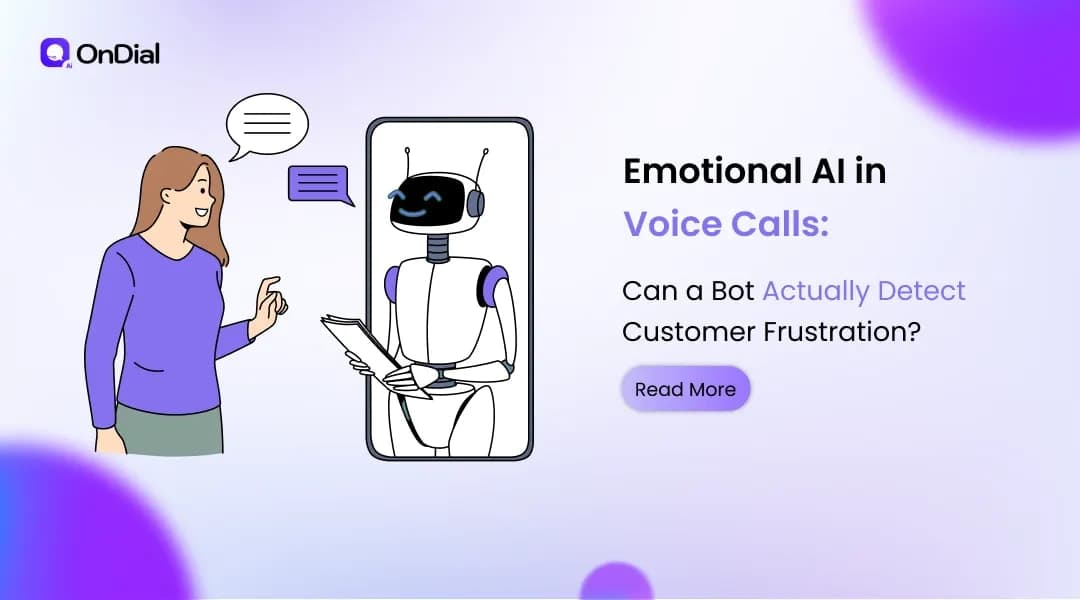
AI voice systems can help by analyzing conversational signals while the call is happening. Instead of treating emotion detection as a final verdict, businesses can use it as an early warning system that tells an AI agent or human representative when the conversation needs a different response.
For businesses handling large call volumes, this can turn voice sentiment analysis from a reporting feature into an operational tool.
What Is Customer Frustration Detection in AI Voice Calls?
Customer frustration detection is the use of AI to identify signals associated with negative sentiment or increasing emotional intensity during a phone conversation.
The system can examine both what the customer says and how the customer says it. Looking at only one of these signals creates blind spots.
For example, a caller might say, "Sure, that's fine," while using an unusually sharp tone and speaking much faster than earlier in the conversation. A text-only system may interpret the statement as positive. A voice-aware system has more context.
This is why modern voice sentiment analysis combines speech recognition, natural language processing, acoustic analysis, conversation context, and behavioral signals.
How AI Detects Frustration During a Live Call
A useful emotion detection system does not rely on a single keyword or vocal characteristic. It combines multiple signals and looks for changes over the course of the conversation.
1. It analyzes the customer's words
The first layer is linguistic analysis.
AI can identify words and phrases associated with dissatisfaction, urgency, confusion, repetition, or escalation. Examples include statements such as:
"I've already called twice."
"Nobody is helping me."
"I need this fixed today."
"Why am I being asked this again?"
"This is the third time I've explained it."
The important part is context. A phrase should not automatically be treated as evidence of anger. The system needs to understand what happened before and after the statement.
2. It analyzes tone and speech patterns
The second layer looks at the acoustic properties of speech.
Depending on the system and model, this can include:
Pitch changes
Speech rate
Vocal energy
Pauses
Rhythm
Stress patterns
Changes from the customer's earlier speaking baseline
A customer who gradually starts speaking faster and interrupting more frequently may be showing a different emotional state from the beginning of the call.
The system can track those changes continuously rather than waiting for the customer to explicitly complain.
3. It compares signals with conversation context
Context makes emotion detection more useful.
Suppose a customer speaks quickly throughout the entire call because they are in a hurry. Fast speech by itself does not necessarily mean frustration.
Now imagine the same customer starts repeating the same question, interrupts the AI, uses negative language, and becomes louder after receiving an incorrect answer.
The combination is more meaningful than any single signal.
This is one reason businesses should evaluate AI voice systems based on their ability to understand complete conversations rather than isolated sentiment scores.
4. It identifies changes in sentiment
Absolute sentiment is useful, but sentiment movement can be even more valuable.
A conversation might begin as neutral, become slightly negative, and then rapidly deteriorate after an unresolved issue.
An AI system can monitor this trajectory and identify a potential escalation point.
That gives the business an opportunity to act before the caller reaches the point where they simply hang up.
What Happens When AI Detects Frustration?
Detection by itself does not improve customer experience.
The real value comes from what happens after the signal is detected.
A well-designed voice workflow can trigger different actions depending on the severity and confidence of the signal.
Adjust the AI's response
If the frustration level is relatively low, the AI can change its conversational approach.
For example, instead of continuing with a long explanation, it could acknowledge the problem, give a concise answer, and move directly toward resolution.
The goal is not to make the AI pretend to have human emotions. It is to make the conversation more appropriate to the customer's state.
Escalate to a human agent
If frustration continues to increase, the system can initiate a human handoff.
This is particularly important for situations involving complaints, billing disputes, sensitive personal matters, complex technical problems, or customers who explicitly request a human.
The human agent should receive the conversation context instead of asking the customer to start again.
Alert a supervisor
For contact centers, certain sentiment patterns may justify a supervisor alert.
For example, a high-value customer with an unresolved complaint could be flagged for priority attention.
The objective is not to send every negative call to management. It is to identify conversations where intervention has a meaningful business or customer experience benefit.
Prioritize the next action
Emotion data can also become part of workflow prioritization.
A support system could combine sentiment with intent, customer value, issue complexity, and previous interactions to determine what should happen next.
That creates a more useful model than simply labeling calls as positive, neutral, or negative.
Real-Time Detection vs Post-Call Sentiment Analysis
These two capabilities are often confused.
Post-call analysis examines a conversation after it has ended. It is useful for quality assurance, reporting, coaching, compliance reviews, and identifying recurring customer complaints.
Real-time sentiment analysis operates during the conversation. It can influence the interaction while there is still time to change the outcome.
Both are valuable, but they solve different problems.
If a business discovers after 10,000 calls that customers consistently became frustrated during a particular workflow, post-call analysis can reveal the pattern.
If a customer is becoming frustrated on call number 10,001, real-time detection gives the business a chance to intervene.
For teams that want deeper visibility across their conversations, AI call analytics from OnDial combines transcription, sentiment, conversation analysis, scoring, CRM write-back, and real-time alerts.
How Accurate Is AI Emotion Detection?
This is where businesses need to be careful.
There is no universal accuracy percentage that applies to every voice sentiment system, language, accent, industry, recording environment, and emotional state.
A controlled test using clean audio can produce very different results from a real customer call containing background noise, interruptions, code-switching, overlapping speech, and regional accents.
The safest approach is to treat emotion detection as a signal rather than a final judgment.
An AI system may correctly identify that a conversation has become more negative without knowing exactly why. It may also misinterpret a customer who speaks quickly because they are busy rather than angry.
The best implementations therefore combine sentiment with other information.
Accuracy depends on language and accent
This matters particularly in multilingual markets such as India.
A customer may switch between English and Hindi during a call. Another may speak Gujarati, Marathi, Tamil, or another regional language. Speech patterns and conversational norms can vary considerably between groups.
A model that performs well on one language or accent should not automatically be assumed to perform equally well across another.
Businesses should test AI voice systems using real-world examples that reflect their actual customers.
Accuracy depends on audio quality
Poor audio can make emotion detection harder.
Background noise, network problems, microphone quality, interruptions, overlapping speakers, and call compression can all affect speech analysis.
For this reason, production testing matters more than a polished vendor demonstration.
Accuracy depends on context
Sarcasm is a classic example.
A customer might say something that sounds positive while clearly communicating dissatisfaction through context and tone.
AI systems are improving at handling these cases, but businesses should not design critical customer decisions around the assumption that emotion classification will always be correct.
Why Human Handoff Matters
One of the most important parts of an emotion-aware voice system is what happens during escalation.
Imagine an AI detects rising frustration and transfers the customer to an employee.
The employee answers:
"Hello. How can I help you today?"
The customer now has to explain the entire situation again.
The sentiment detection technically worked, but the customer experience did not improve.
A better handoff gives the human agent useful context before or as the transfer occurs.
That can include:
Customer identity
Reason for the call
Conversation summary
Previous actions
Detected sentiment trend
Unresolved issue
Relevant CRM information
Reason for escalation
This allows the human to begin with the actual problem instead of restarting the conversation.
OnDial's broader AI voice agent platform is designed around automated conversations combined with escalation and business-system integration, so AI can handle structured interactions while human teams remain available for cases that require judgment or empathy.
Where Emotion Detection Can Improve Customer Experience
Emotion-aware voice AI can be useful across many industries, but the workflow should be adapted to the actual customer journey.
Healthcare
Healthcare calls can involve appointments, billing questions, scheduling problems, and sensitive concerns.
A frustrated caller may need faster access to a human representative rather than another automated response.
Emotion detection can therefore act as an escalation signal, while healthcare workflows determine what the appropriate next step should be.
Financial services and insurance
Customers may become frustrated when dealing with payments, claims, verification, account issues, or unexpected charges.
In these environments, sentiment should work alongside authentication, compliance, and routing rules rather than overriding them.
E-commerce and retail
Order delays, returns, refunds, and delivery problems are common sources of customer frustration.
An AI system can identify rising dissatisfaction and prioritize resolution before the issue develops into a larger complaint.
Real estate
Real estate conversations can involve high-value decisions and time-sensitive leads.
Emotion and intent signals can help sales teams understand whether a caller is confused, highly interested, dissatisfied, or ready for a human conversation.
Businesses operating across multiple sectors can also explore OnDial's industry-specific AI voice solutions to see how voice automation can be adapted to different workflows.
How Businesses Should Measure the Impact
Adding sentiment analysis to a call center should not be considered successful simply because the dashboard shows thousands of sentiment classifications.
The important question is whether those classifications improve business outcomes.
Track metrics such as:
Call abandonment rate
Are fewer frustrated customers hanging up before resolution?
First-call resolution
Are more issues being solved without repeat calls?
Escalation quality
Are the right conversations reaching human agents rather than sending every negative call to a person?
Customer satisfaction
Do CSAT scores improve after implementing emotion-aware workflows?
Average handling time
Does intelligent escalation reduce unnecessary back-and-forth, or does it create additional transfers?
Repeat contact rate
Are customers calling again because their original problem was not properly resolved?
These metrics provide a more meaningful evaluation than sentiment accuracy alone.
How to Implement Voice Emotion Detection Responsibly
Businesses should start with a clearly defined use case.
Do not begin by attempting to detect every possible emotion across every customer interaction.
Instead, identify one operational problem.
For example:
"When a customer shows sustained frustration during a billing call, escalate the conversation to a trained support specialist with the conversation summary attached."
That is measurable and operational.
Then define the signals that should trigger the workflow, test the system against real calls, review false positives and false negatives, and continuously refine the thresholds.
The AI should support human decision-making rather than replace it.
This approach is particularly important when the consequences of misclassification are significant.
The Future of Emotion-Aware Voice AI
Voice AI is moving beyond simple speech recognition.
Future systems will increasingly combine conversation history, customer intent, sentiment changes, business context, and workflow data to make better decisions during calls.
The most useful systems will not simply tell a manager that a customer sounded angry.
They will help answer a more practical question:
What should happen next?
That might mean changing the AI's response, shortening the explanation, offering a specific resolution, routing the call to a specialist, or notifying a supervisor.
This is where voice AI becomes operational intelligence rather than another analytics layer.
For businesses in India, multilingual capability will also remain important. Customers may move between languages naturally during a single call, and systems need to preserve context while recognizing that conversational style can vary across regions.
OnDial's AI voice agents for customer experience provide another example of how voice automation can be applied to response speed, multilingual conversations, personalization, and human escalation in customer operations.
Final Takeaway
AI can detect signals associated with customer frustration during voice calls, but the technology should not be treated as a perfect emotion reader.
Its real value comes from combining multiple signals, understanding conversational context, and taking the right action while the call is still happening.
The strongest implementations use emotion detection as an early warning layer. They adjust responses when appropriate, escalate genuinely difficult interactions, give human agents full context, and measure whether those interventions actually improve customer outcomes.
The goal is not to build an AI that claims to understand every human emotion.
The goal is to build a customer communication system that notices when a conversation is going wrong and gives the business a better chance to fix it.