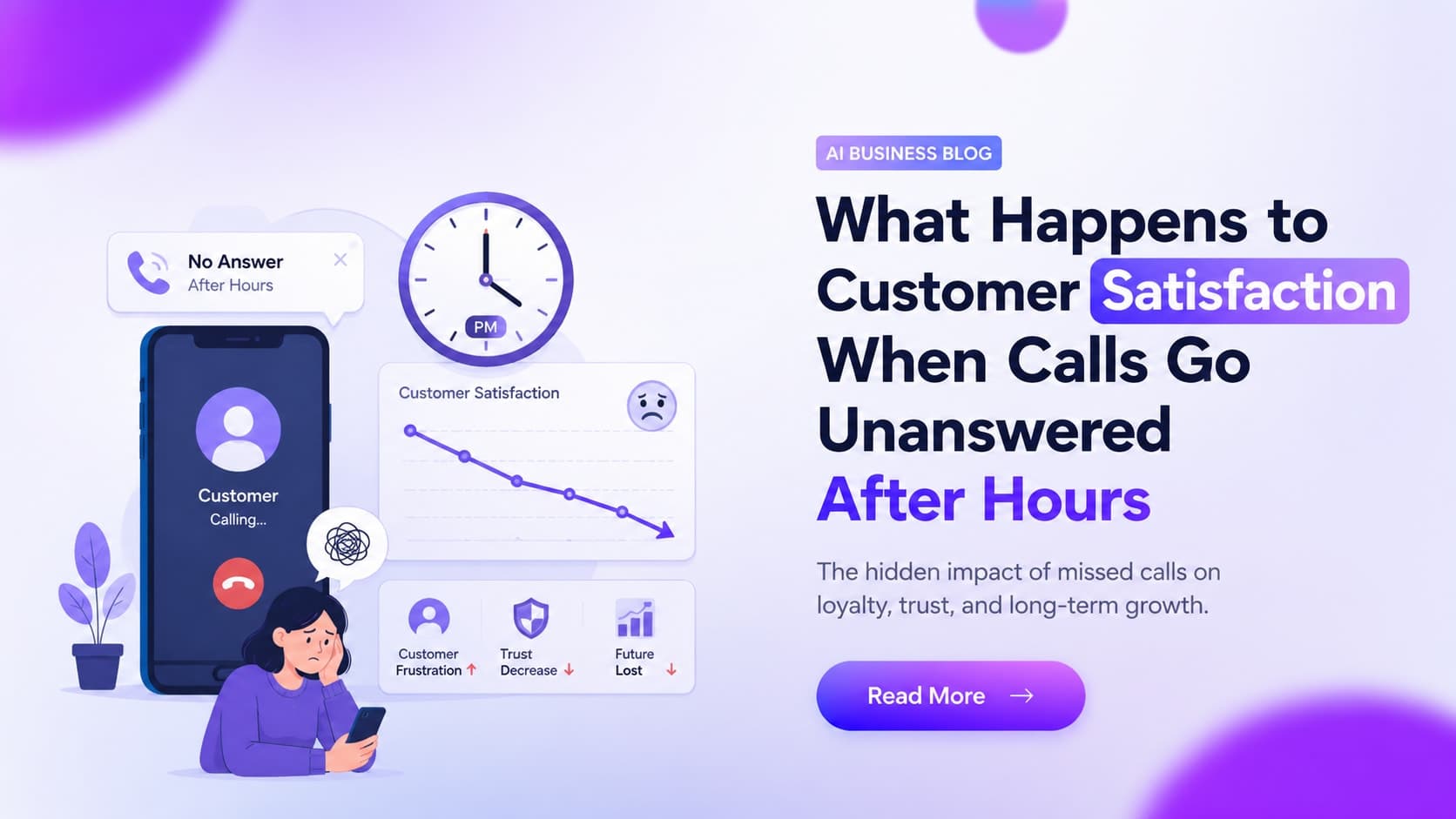
Every night, across thousands of businesses in every industry, phones ring in empty offices. Customers calling about a delayed order, a billing concern, a service emergency, or a simple product question hear a voicemail recording if they hear anything at all. Most hang up. Some try a competitor. A few post a frustrated review online before going to bed.
The damage from a single unanswered call is invisible at the moment. It does not appear on any dashboard. It generates no alert, no ticket, and no immediate financial consequence. But it accumulates. Over weeks and months, a pattern of missed after-hours calls quietly erodes customer satisfaction, inflates churn rates, and chips away at the brand reputation a company has spent years building.
This is not a problem confined to small businesses with limited resources. Enterprises with sophisticated support infrastructure routinely leave after-hours calls unaddressed because they assume the issue is minor or that customers will call back during business hours. That assumption is increasingly dangerous in a marketplace where customer expectations have permanently shifted toward immediacy.
This article examines what actually happens operationally, psychologically, and financially when businesses allow calls to go unanswered after hours. It also provides a clear strategic framework for reversing this pattern before the compounding cost becomes irreversible.
The Silent Cost of Unanswered Calls After Hours
Business leaders tend to measure what they can see. Revenue, ticket resolution time, NPS scores, and customer acquisition cost all appear in reports and dashboards. What rarely appears is the precise cost of a customer who called, received no answer, and quietly decided not to do business again.
This invisibility is precisely what makes unanswered after-hours calls so dangerous. Unlike a failed product delivery or a billing error, a missed call leaves no internal record unless someone creates one deliberately. The customer experienced the failure. The business did not. That information asymmetry allows the problem to grow unchecked for months.
Research consistently shows that the majority of customers who reach out after hours are not making casual inquiries. They are reaching out because something in their relationship with the business has created urgency. A missed shipment, an unexpected charge, a malfunctioning product, or a time-sensitive purchase decision. These are moments when the customer is most emotionally engaged and most likely to form a lasting impression based on the response they receive.
When the response is silence, the emotional impact is disproportionate. The customer does not think, "They were closed, I will call tomorrow." They think, "This company does not care enough to be available when I need them." That shift in perception is the beginning of a customer satisfaction problem that no after-the-fact apology fully corrects.
How Missed Business Calls Directly Damage Customer Satisfaction
Customer satisfaction is not a single data point. It is a composite of every interaction a customer has with a business across time. A single unanswered call does not destroy the relationship by itself, but it applies pressure to every positive interaction that came before it.
The Trust Deficit Created by Silence
When a customer makes the effort to call, they are signaling that they value the relationship enough to invest time in it. An unanswered call sends the opposite signal back. It tells the customer that the investment is not reciprocated. Trust, which takes dozens of positive interactions to build, can be meaningfully damaged by a single negative one particularly during a moment of need.
Customer satisfaction research from contact center analysts consistently finds that resolution on first contact is the single most powerful driver of satisfaction scores. When first contact produces silence, not only does satisfaction drop for the immediate issue, but the customer's confidence in future interactions also declines. They become less likely to reach out proactively and more likely to escalate minor problems because they anticipate being ignored again.
Compounding Dissatisfaction Across the Customer Journey
A customer who experiences an unanswered call does not reset their expectations the next time they interact with the business. They approach that interaction with a lower baseline of trust and a higher emotional sensitivity. What might have been a minor friction point in a normal interaction becomes a significant source of dissatisfaction when layered on top of a previous negative experience.
This compounding effect is why businesses that track CSAT scores often find that customers who have had a single poor service experience rate subsequent interactions lower than comparable customers who have not had that experience even when the subsequent interactions are objectively identical.
The Emotional Weight of Being Unheard
Customer satisfaction is ultimately an emotional measure. When customers feel unheard, they do not simply feel neutral about their experience. They feel dismissed, undervalued, and frustrated. Those emotions do not stay contained to the specific issue that prompted the call. They color the customer's entire perception of the brand.
This is why businesses that invest in after-hours customer service coverage see improvements not only in satisfaction scores related to after-hours interactions but across the entire customer relationship. Customers who know they can reach the business when they need to feel more secure in the relationship overall, which translates into higher satisfaction scores even during ordinary daytime interactions.
The Psychology Behind Response Time Expectations
The business world has not led the shift in customer expectations around response time. Consumers have. Years of experience with instant digital services real-time order tracking, immediate app responses, same-day delivery, and 24-hour retail access have fundamentally recalibrated what customers consider reasonable.
What Customers Consider "Fast Enough"
Customer research conducted across industries consistently shows that response time expectations have compressed dramatically over the past decade. A significant portion of customers who contact a business by phone expect to speak with someone within minutes, not hours. When that expectation applies to after-hours calls, the gap between what customers want and what most businesses offer becomes immediately apparent.
The expectation is not always rational from a business operations perspective, but it is real from a customer experience perspective. A customer calling at 9:00 PM about a service issue does not necessarily expect the same staffing levels as a 2:00 PM call, but they do expect some form of acknowledgment, assistance, or clear communication about when and how they will be helped.
Why Voicemail No Longer Satisfies the Expectation
Voicemail was an adequate response to after-hours calls in a world before smartphones, texting, and real-time digital communication. In that world, a recorded message was a meaningful signal that the business had acknowledged the contact. Today, voicemail sits at the bottom of the responsiveness hierarchy for most customers.
Many customers particularly those under 40 do not leave voicemail messages and will not call back after receiving a voicemail prompt. They interpret the voicemail prompt as a signal that the business cannot help them in real time, and they immediately evaluate whether a competitor can. For these customers, an unanswered call with a voicemail prompt is effectively the same as no response at all.
How Response Time Affects Perceived Brand Quality
Customers consistently rate businesses that respond quickly as more professional, more trustworthy, and higher quality even when the content of the response is equivalent. Speed of response has become a proxy signal for operational competence. A business that answers calls after hours, even to acknowledge the issue and set a clear expectation for resolution, signals a level of organizational maturity and customer commitment that competitors who rely on voicemail cannot match.
This has direct implications for [customer satisfaction](Customer Satisfaction) scores. Response time is one of the most consistently weighted variables in customer satisfaction surveys across industries. Businesses that improve response time see corresponding improvements in satisfaction scores that are often larger than those generated by improvements to the actual resolution quality.
Brand Reputation Impact: When One Missed Call Becomes a Public Problem
A customer's reaction to an unanswered call rarely stays private. In a world where every dissatisfied customer has an audience of hundreds or thousands on social media and review platforms, a single frustrating experience has the potential to reach far more people than the interaction itself.
The Review Economy and After-Hours Failures
Review platforms like Google Business Profile, Yelp, and Trustpilot have created a permanent public record of customer experiences. Reviews mentioning difficulty reaching a business, unanswered calls, or lack of after-hours availability are among the most common negative review themes across service industries.
The brand reputation impact of these reviews is compounding. A prospect evaluating two competing businesses will consistently choose the one with fewer reviews citing communication problems, even if other aspects of the two businesses are comparable. After-hours call failures, documented in public reviews, become a persistent drag on customer acquisition that continues long after the original interactions that generated the reviews.
Social Media Amplification of Service Failures
Customers who feel ignored by a business are significantly more likely to share that experience publicly than customers who had a positive interaction. This negativity bias in sharing behavior means that the social media impact of missed calls is disproportionate to the number of incidents.
A single tweet, LinkedIn post, or Facebook comment describing a frustrating experience with a business that could not be reached after hours can reach thousands of potential customers. When that post receives engagement from other customers who had similar experiences, it becomes a public indictment of the business's customer commitment that prospective customers take seriously.
How Brand Perception Shifts Over Time
Brand reputation is built slowly and eroded quickly. A business that consistently fails to respond to after-hours calls accumulates reputation damage in a way that is difficult to reverse through marketing or promotional activity alone. The only reliable remedy is operational change actually improving after-hours availability combined with active reputation management.
Businesses that have made the operational investment in after-hours coverage consistently report that their review profiles improve not only in the volume of positive reviews but in the specific language customers use. Reviews shift from noting limited availability to praising responsiveness, which signals to prospects that the business takes customer communication seriously.
Customer Churn Rate: The Numbers Behind the Silence
Churn is the ultimate measure of customer satisfaction failure. A customer who churns is a customer who evaluated the relationship and decided that the cost of continuing it exceeded the benefit. Unanswered after-hours calls are a meaningful contributor to that calculation.
What the Data Shows About Communication and Churn
Research across B2B and B2C industries consistently finds that communication quality is among the top three reasons customers report for ending a business relationship. Within the category of communication quality, availability and response time are the most frequently cited specific issues.
The relationship between missed business calls and churn is not always immediate. Customers often tolerate one or two negative communication experiences before making a switching decision. But each missed call moves them closer to that decision and increases their receptiveness to approaches from competitors.
The Lifetime Value Math of a Missed Call
For any business where customer lifetime value exceeds the value of a single transaction which includes virtually every service business, subscription model, and B2B company the cost of a missed call must be evaluated in terms of the lifetime value at risk, not the value of the immediate interaction.
If a customer has a lifetime value of $5,000 and a missed after-hours call contributes to a churn decision, the cost of that missed call is not zero it is a significant fraction of $5,000. When that calculation is applied across hundreds or thousands of missed calls per quarter, the financial case for investing in after-hours coverage becomes immediately clear.
Repeat Customers Are Not Immune
One of the most damaging assumptions businesses make about after-hours call handling is that loyal, long-term customers will be more forgiving than new customers. The opposite is often true. Long-term customers have built expectations based on their history with the business, and a communication failure feels like a violation of the relationship they believed they had.
Churn among long-term customers is particularly damaging because these customers often have higher lifetime value, are less price-sensitive, and are more likely to refer new customers. Losing them to an after-hours communication failure is among the most preventable and most costly forms of attrition.
Industries Most Vulnerable to After-Hours Call Abandonment
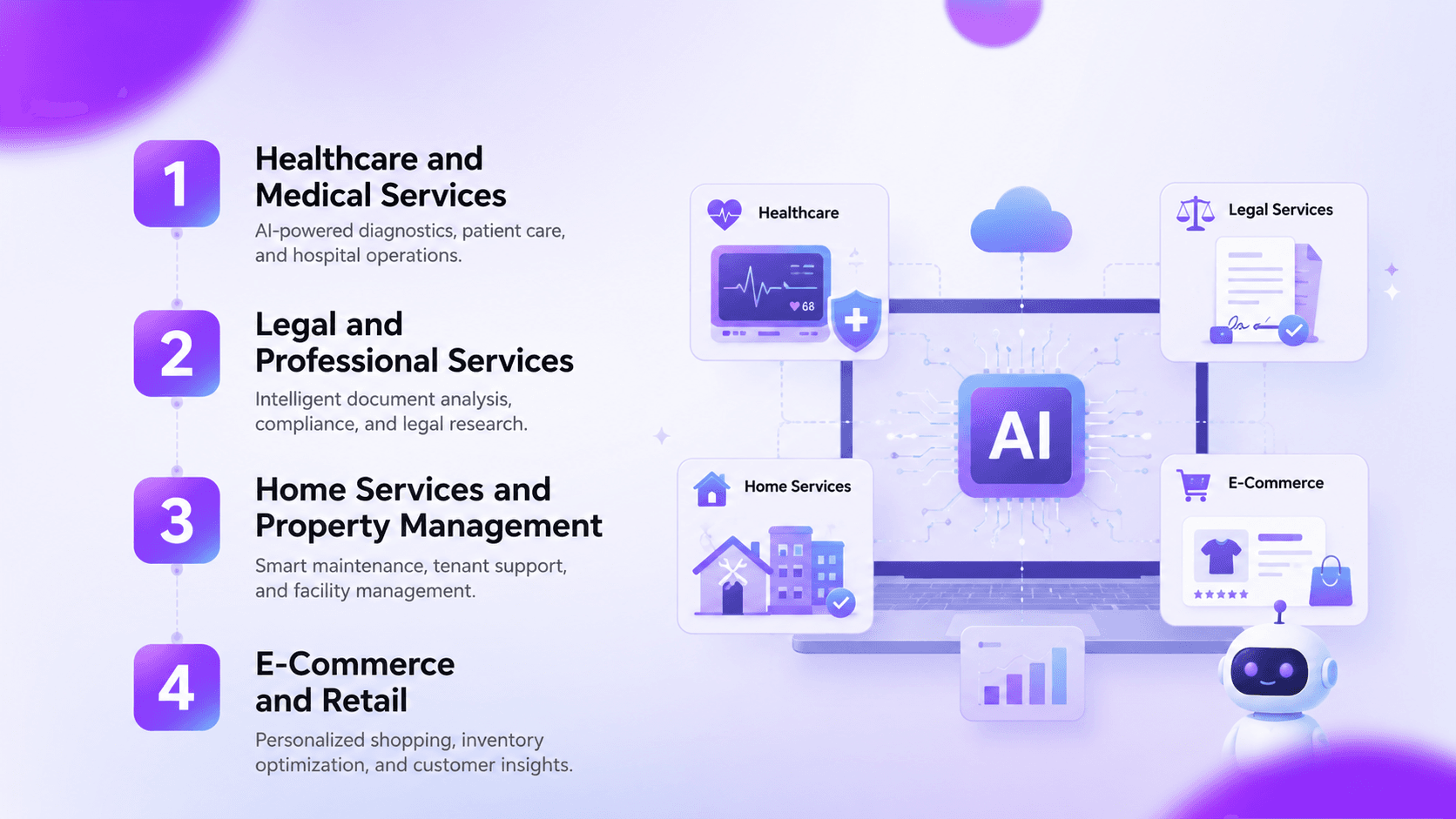
While no industry is immune to the consequences of missed after-hours calls, some sectors face disproportionate risk because of the nature of their customer relationships or the time-sensitivity of the issues customers call about.
Healthcare and Medical Services
Patients calling a healthcare provider after hours are almost never calling about something trivial. Symptoms, medication questions, appointment urgency, and insurance concerns all create genuine stress. When calls go unanswered, the consequences extend beyond customer satisfaction into patient safety. Healthcare providers that implement after-hours answering services consistently report higher patient satisfaction scores and lower appointment abandonment rates.
Legal and Professional Services
Clients of law firms, accounting firms, and consulting practices often have time-sensitive concerns that arise outside of business hours. A client facing a contract deadline, a regulatory notice, or a financial decision cannot always wait until 9:00 AM Monday morning. Professional services firms that provide after-hours coverage differentiate themselves meaningfully in a competitive market where client trust is the primary commercial asset.
Home Services and Property Management
Plumbing failures, electrical problems, HVAC breakdowns, and property emergencies do not respect business hours. Home service companies that are reachable after hours capture emergency calls that would otherwise go directly to a competitor. Customer satisfaction in this sector is heavily influenced by response time during high-stress, time-sensitive situations.
E-Commerce and Retail
Online shoppers make purchase decisions at all hours. Questions about order status, returns, product specifications, and promotional eligibility arise whenever the customer is shopping, which is increasingly in the evening. E-commerce businesses that supplement digital support channels with after-hours phone coverage capture conversion opportunities that pure self-service models miss.
What Customers Do After a Call Goes Unanswered
Understanding the specific behaviors customers exhibit after an unanswered call is essential for quantifying the business risk. The response varies by customer type and urgency, but the patterns are consistent enough to inform strategic decisions.
They Contact a Competitor Immediately
For customers with urgent needs, the competitor search begins within minutes of reaching a voicemail or no-answer. This is particularly true in competitive markets where viable alternatives are readily discoverable through a simple web search. A missed call in a competitive market is not a deferred interaction it is a transferred one.
They Leave Negative Reviews Without Calling Back
A substantial portion of customers who experience an unanswered after-hours call will not call back the next day. Instead, they will leave a review describing the experience, post on social media, or simply find another provider. The business never knows the customer attempted contact because no record was created.
They Escalate Internally
In B2B contexts, a buyer or end user who cannot reach a vendor after hours often escalates the issue to their management. That escalation creates organizational awareness of the vendor's communication limitations, which can influence contract renewal decisions and expansion opportunities far beyond the individual customer's experience.
They Reduce Future Engagement
Even customers who do not immediately churn or complain publicly often respond to an unanswered call by reducing their future engagement with the business. They become less likely to call with questions, less likely to explore upsell opportunities, and less likely to refer others. This silent withdrawal is often invisible in satisfaction surveys but shows up in reduced revenue per customer over time.
After-Hours Customer Service: What Best-in-Class Businesses Do Differently
Businesses that consistently achieve high (Customer Satisfaction) scores share a common characteristic: they treat after-hours coverage as an operational priority, not an optional enhancement.
They Define "After Hours" From the Customer's Perspective
Best-in-class businesses do not define after-hours coverage based on when their offices are staffed. They define it based on when their customers need to reach them. For a B2B technology company whose clients operate globally, "after hours" might mean any time outside a narrow window. For a local home services company, it might mean evenings and weekends. The starting point is always customer need, not operational convenience.
They Use a Tiered Response Model
High-performing customer service organizations use a tiered model for after-hours contact. Urgent issues, such as service outages or emergency situations, route to live agents with authority to act. Non-urgent inquiries receive a meaningful acknowledgment with a specific callback commitment. This model manages staffing costs while ensuring every customer who calls feels that their contact was received and will be addressed.
They Track and Analyze After-Hours Contact Data
Businesses that excel at after-hours service do not rely on assumptions about when customers call or what they call about. They track this data systematically and use it to optimize coverage. This analysis often reveals patterns specific time windows with high call volume, recurring issue types, or customer segments with elevated after-hours contact rates that allow for more targeted investment.
They Train After-Hours Staff Differently
The customers who call after hours are often more stressed, more urgent, and less patient than those who call during normal business hours. After-hours agents need specific training in de-escalation, empathy, and issue triage that may differ from standard agent training. Best-in-class businesses recognize this and invest in after-hours-specific capability development.
Step-by-Step Framework for Closing the After-Hours Gap
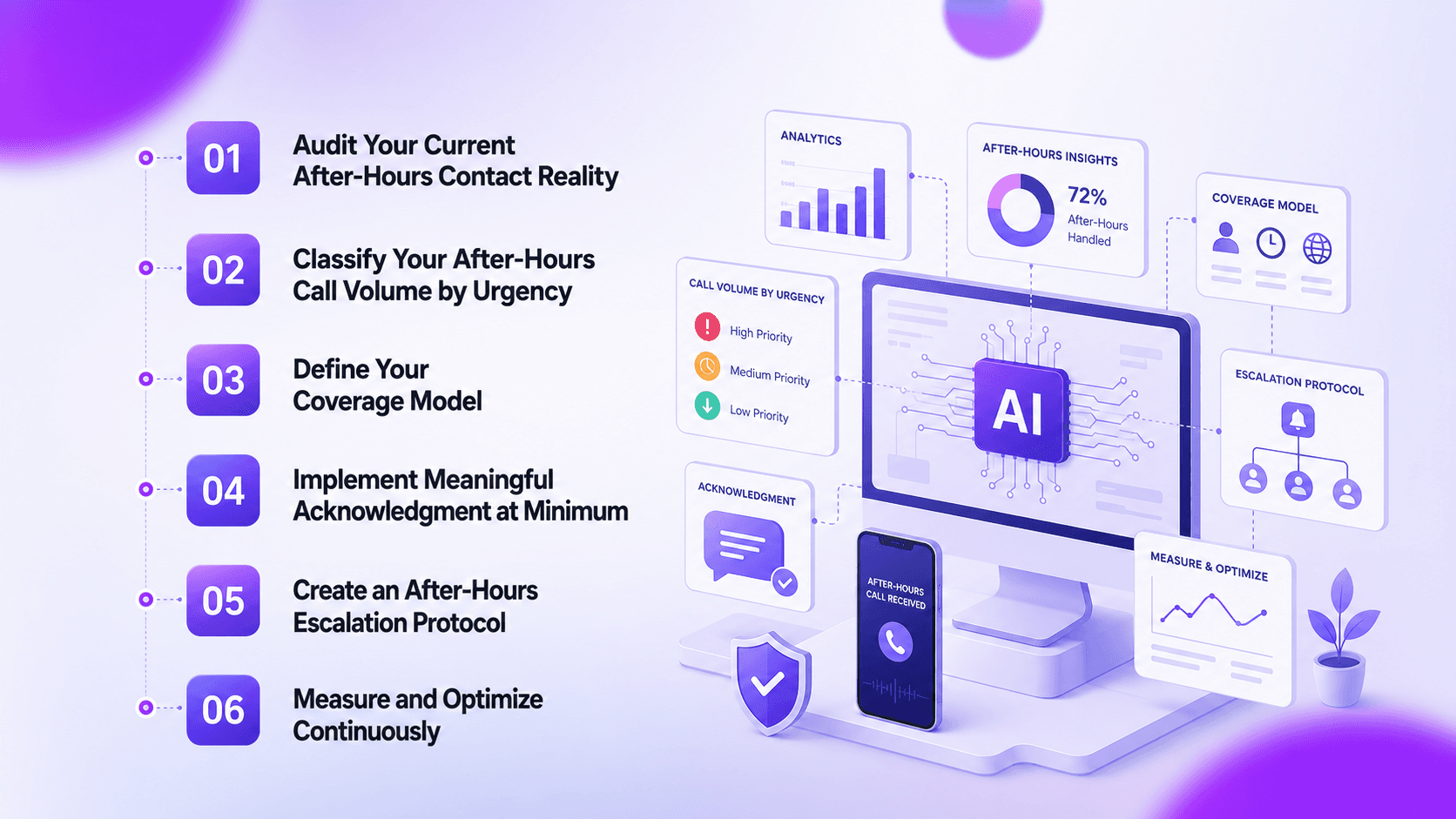
Organizations that want to systematically improve after-hours customer service coverage can follow a structured approach that balances customer experience quality with operational sustainability.
Step 1: Audit Your Current After-Hours Contact Reality
Before making any changes, understand what is actually happening. Pull call data to identify how many calls come in outside business hours, what percentage go unanswered, and what your current voicemail completion rate looks like. If you do not have this data, implementing call tracking is the necessary first step.
Step 2: Classify Your After-Hours Call Volume by Urgency
Not all after-hours calls carry the same urgency or risk. Analyze a sample of after-hours calls (or voicemails, if they are recorded) to understand the distribution of issue types. Emergency service requests, billing disputes with financial immediacy, and time-sensitive purchase inquiries require different response models than general questions that can comfortably wait until the next business day.
Step 3: Define Your Coverage Model
Based on your call volume analysis and urgency classification, define the specific coverage model that fits your business. Options include live agent coverage for all after-hours calls, live coverage for urgent calls with automated triage for others, AI-powered interactive response for non-urgent calls, and scheduled callback commitments for all after-hours contacts. Each model has different cost and experience implications.
Step 4: Implement Meaningful Acknowledgment at Minimum
If full after-hours coverage is not immediately feasible, implement meaningful acknowledgment as an interim step. This means replacing generic voicemail with a dynamic message that acknowledges the customer, validates the urgency of their call, and makes a specific, credible commitment about when they will receive a callback. Generic voicemail prompts that say nothing meaningful are nearly as damaging as no answer at all.
Step 5: Create an After-Hours Escalation Protocol
Establish a clear internal protocol for after-hours escalations. Who receives urgent after-hours communications? What constitutes an urgent escalation? What authority do after-hours contacts have to make commitments on behalf of the business? These questions need answers before coverage is expanded, not after.
Step 6: Measure and Optimize Continuously
After-hours coverage is not a set-and-forget investment. Customer needs change, call volumes shift, and technology capabilities evolve. Establish specific metrics for after-hours performance including answer rate, callback completion rate, first-contact resolution for after-hours issues, and customer satisfaction scores for after-hours interactions and review them regularly.
Common Mistakes Businesses Make with After-Hours Communication
Even businesses that recognize the importance of after-hours customer service frequently make avoidable mistakes in how they implement and manage their response.
Treating Voicemail as a Solution
Voicemail is infrastructure, not a customer service solution. Businesses that route all after-hours calls to voicemail and consider the problem addressed are solving for the easiest internal outcome, not the best customer outcome. Voicemail completion rates have declined dramatically over the past decade, and callback rates on after-hours voicemails are even lower than they used to be.
Failing to Follow Through on Callback Commitments
One of the most damaging things a business can do is promise a callback and not deliver it. A missed callback on an after-hours contact combines two service failures into one the original missed call and the broken commitment and dramatically increases the likelihood of churn and negative public feedback.
Understaffing After-Hours Coverage
Businesses that implement after-hours coverage but staff it inadequately create a new problem. Long hold times, undertrained agents, and limited authority to resolve issues during after-hours interactions can produce customer satisfaction outcomes that are worse than a well-managed voicemail with a credible callback commitment.
Treating After-Hours Contacts as Lower Priority
Some businesses route after-hours calls to a queue that is deprioritized relative to next-day incoming calls. Customers who called after hours are then waiting even longer for a response because they were placed behind new contacts. This approach signals to the customer that their after-hours call was an inconvenience, not a valued communication.
Not Capturing After-Hours Contact Data
If after-hours calls are not tracked, measured, and analyzed alongside regular business hours contacts, the business cannot understand the full scope of its customer service performance. Data gaps create decision gaps, and businesses without after-hours contact data consistently underestimate the scale and impact of the problem.
ROI of Investing in After-Hours Customer Service Coverage
The business case for after-hours coverage is not difficult to construct, but it does require applying the right metrics to the analysis.
Revenue Retention Through Churn Reduction
The most direct ROI calculation involves churn reduction. If an investment in after-hours coverage reduces customer churn by even a small percentage, the revenue retained from those customers must be weighed against the cost of the coverage. For most businesses where customer lifetime value exceeds several hundred dollars, even a fractional improvement in churn rate produces a positive return.
Conversion of After-Hours Inquiries
For businesses with purchase intent in their after-hours call volume which includes most e-commerce, home services, professional services, and technology companies after-hours coverage creates a direct conversion opportunity. Calls that would otherwise end in voicemail and lost intent instead connect with a qualified person who can move the customer toward a transaction.
Brand Equity and Referral Value
Customer satisfaction is not just about retention. Satisfied customers refer. They leave positive reviews. They expand their own relationship with the business over time. The brand equity value of a consistent, high-quality after-hours response accumulates over months and years in ways that show up in net revenue even when the direct connection is difficult to attribute.
Reduced Escalation Costs
Customers who cannot reach a business after hours and whose issues worsen overnight often become escalated cases the next day. These escalations consume more agent time, may require management involvement, and frequently result in concessions — discounts, credits, or free service — that eat into margin. A business that resolves issues at first after-hours contact avoids the downstream cost of these escalations.
Future Trends in After-Hours Customer Engagement
The landscape for after-hours customer service is evolving rapidly. Businesses that understand where the technology and customer expectations are heading can position themselves ahead of the curve rather than behind it.
AI-Powered Conversational Agents
Artificial intelligence is already capable of handling a broad range of customer inquiries at any hour. AI-powered voice and chat agents can triage issues, answer frequently asked questions, process basic transactions, and route complex issues to appropriate human follow-up. The quality of these interactions is improving at a pace that is making AI-first after-hours coverage a viable strategy for businesses of all sizes.
Predictive Availability Signals
Emerging customer communication platforms are beginning to incorporate predictive features that flag customers likely to reach out after hours based on behavioral signals browsing patterns, account activity, delivery tracking behavior and proactively engage them before they reach the point of calling. This shifts after-hours customer service from reactive to proactive, improving (Customer Satisfaction) without proportionally increasing contact volume.
Omnichannel After-Hours Integration
Customers increasingly use multiple channels to reach businesses, and they expect these channels to be coordinated. A customer who sends an after-hours chat message and then calls expects the agent who answers to know about the chat. Businesses that integrate their after-hours channels into a unified view will significantly outperform those that manage channels independently.
Real-Time Sentiment Analysis
Contact center technology is increasingly capable of detecting customer sentiment in real time during calls. Applied to after-hours contexts, this allows businesses to identify high-risk interactions customers who are particularly distressed or on the verge of churn and escalate them to senior agents or management instantly, rather than discovering the problem after the customer has already left.
Conclusion
The cost of an unanswered after-hours call is not a rounding error. It is a cumulative, compounding liability that shows up in churn rates, brand reputation metrics, and lifetime revenue figures. Every call that goes unanswered represents a customer who made the effort to reach out, received silence in return, and formed a judgment about the business that will influence every subsequent decision they make about the relationship.
The businesses that win on customer satisfaction in competitive markets are not necessarily those with the largest support teams or the most sophisticated technology. They are the ones that understand when their customers need them most and make credible, consistent investments in being present at those moments — including and especially after hours.
Closing the after-hours gap is not a luxury investment reserved for enterprises with unlimited resources. It is a fundamental component of a customer retention strategy that takes customer needs seriously. The framework exists, the technology is accessible, and the business case is clear. The only remaining question is how long a business can afford to let the phone ring in an empty room.