An automated voice interaction now costs somewhere between $0.30 and $0.50. A human-handled support call costs $6.00 to $7.68. That gap, a 93 to 95 percent reduction according to research cited by WorkHub AI, is a big reason so many online stores are rethinking how they answer the phone.
AI voice agents for e-commerce answer calls, track orders, process returns, and even call shoppers back about abandoned carts, all without a hold queue. I've watched this shift happen up close at OnDial, building voice AI for businesses that used to dread their own support line ringing during a sale. If you're wondering whether this is real infrastructure or another overhyped AI product, here's what these agents actually do well, what they cost, and where a human still needs to pick up the phone.
What Is an AI Voice Agent for E-commerce?
An AI voice agent for e-commerce is software that holds a real spoken conversation with a customer and takes action inside your store's systems. That's different from a script that just plays back pre-recorded answers. It listens, understands intent, and responds like someone who actually has your order data open in front of them.
Quick answer: An AI voice agent for e-commerce is a phone-based AI system that understands spoken customer questions, pulls real order and product data from your store, and resolves requests like order status, returns, and product questions without needing a human on every call.
How It Differs From a Chatbot or Old-School IVR
Chatbots handle typed conversations on your website. A voice agent runs on the actual phone line, which is still where customers go when something feels urgent or has gone wrong. Old-school IVR trees force people through rigid menus ("press 1 for orders, press 2 for returns"). A modern voice agent understands plain language, asks a clarifying question when it needs one, and moves the call forward without the maze.
The Technology Behind the Conversation
A few components work together to make this feel like a normal phone call rather than a robot reading a script:
Speech-to-text (ASR): converts the caller's spoken words into text the system can process, tuned to handle accents and background noise.
Natural language processing (NLP): interprets intent, so "where's my stuff" and "can you track my order" trigger the same lookup.
Text-to-speech (TTS): turns the response into natural-sounding audio. Neural TTS from providers like ElevenLabs has closed most of the gap with human voices.
System integration: connects the agent to your Shopify, WooCommerce, or CRM data, so it's reading your actual order record instead of guessing.
Where AI Voice Agents Actually Help E-commerce Businesses
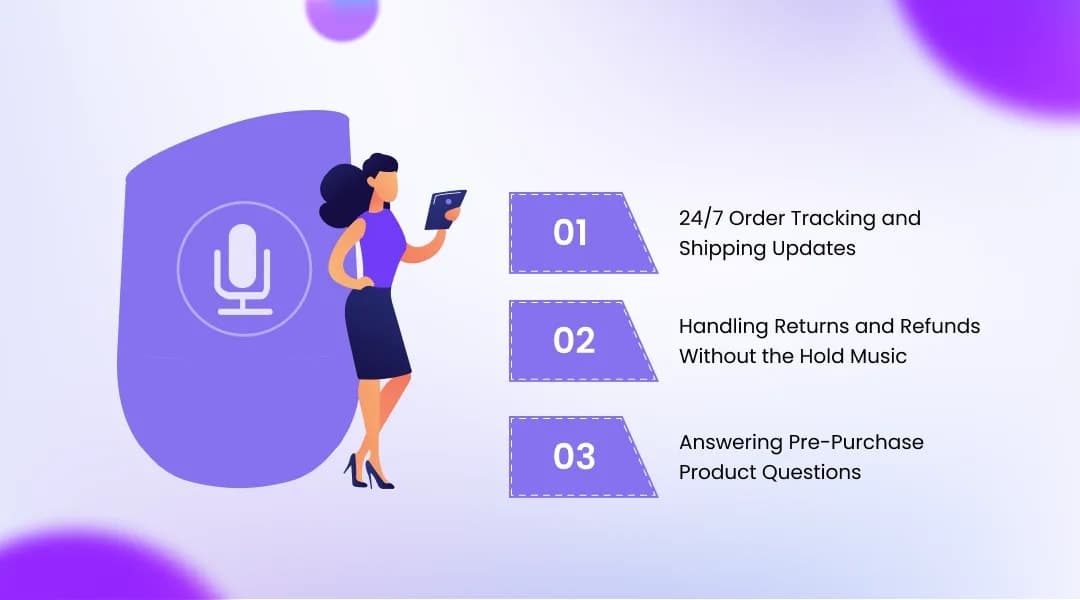
The phone never really went away in e-commerce; it just got harder to staff. Most of the value in an AI voice agent for customer support shows up in three repetitive call types that eat human agent time without needing much judgment.
24/7 Order Tracking and Shipping Updates
"Where is my order?" is consistently one of the most common calls a store gets. A voice agent reads live shipping and fulfillment data, so a caller gets a real answer at 11 p.m. on a Sunday instead of a callback promise. This tends to be the first use case brands turn on, since the data already lives in the store's admin panel.
Handling Returns and Refunds Without the Hold Music
Return policies get confusing fast: different windows by category, exchange versus refund, who covers return shipping. A voice agent walks a caller through the actual policy for their specific order and can trigger the return request on the same call. That consistency also means fewer policy mistakes than a rushed human rep might make on a busy day.
Answering Pre-Purchase Product Questions
Before someone buys, they often want to ask something the product page doesn't answer clearly: sizing, material, compatibility with something they already own. A voice agent trained on the catalog can answer this on the spot instead of losing the shopper to "we'll email you back." That moment is the closest thing to a sale, and it's also where stores quietly lose the most customers to silence.
Can AI Voice Agents Help Recover Abandoned Carts?
Yes. Outbound AI voice calls placed 48 to 72 hours after a high-value cart is abandoned are one of the more effective recovery channels available. They tend to outperform email-only sequences because a live conversation can resolve the actual objection (price, shipping cost, a delivery question) instead of just repeating a reminder nobody reads twice.
How Outbound Voice Recovery Works
A cart value threshold, set by the merchant, decides whether an email sequence runs first or a call gets queued right away. The agent opens with the brand name and the reason for the call (the kind of detail that turns a robocall into an actual conversation). If the shopper wants to complete the purchase, the agent can send a secure payment link before the call even ends.
Why Voice Outperforms Email-Only Recovery
Adobe Analytics found AI-referred shoppers converted 31 percent higher over the last holiday season. Voice adds something email can't: a live back-and-forth that resolves hesitation in real time, not three days later. For high-ticket items like furniture or electronics, that one call can be the difference between a lost sale and a five-figure order. Email still earns its place for lower-value carts, where a phone call wouldn't be worth the cost.
What Does an AI Voice Agent Cost Compared to a Human Team?
Quick answer: Automated voice interactions typically cost $0.30 to $0.50 each, compared to $6.00 to $7.68 for a human-handled call, a 93 to 95 percent reduction per interaction, according to research cited by WorkHub AI. Most stores don't replace their team outright. They redirect routine calls to the agent and keep humans for complex or sensitive cases.
Cost Per Conversation: The Real Numbers
In practice, AI voice agents resolve around 73 percent of e-commerce support calls without a human, based on data from Ringly io covering real store deployments. That leaves the harder, judgment-heavy calls, like a genuinely upset customer or an unusual order dispute, for your actual team. Forrester's research puts enterprise voice AI ROI between 331 and 391 percent over three years, with payback typically under six months.
Where the Savings Actually Come From
The cost reduction isn't just a lower per-minute rate. It comes from a few compounding effects:
Fewer missed calls: after-hours and holiday-spike calls that used to go to voicemail get answered and resolved, instead of turning into lost sales.
Less time per call: agents don't toggle between systems looking up an order; the AI already has it loaded.
Lower headcount pressure during peak season: volume spikes get absorbed without emergency hiring or overtime.
Fewer repeat contacts: a consistent, correct answer the first time cuts down on the follow-up calls that come from unclear information.
Are AI Voice Agents Worth It for Small and Mid-Size Ecommerce Brands?
Is this actually worth it for a store your size, or is it built for enterprise call centers with a thousand agents? Fair question. The honest answer is: it depends on your call volume and what those calls actually cost you today.
When It Makes Sense
A voice agent tends to pay for itself quickly when a few things are true:
You get a real, repeatable volume of "where is my order" or return calls that follow a predictable pattern.
Your team is missing calls after hours or during sales spikes, and those missed calls represent lost revenue or frustrated customers.
You want to test one use case first, like inbound order status, before expanding into outbound recovery calls.
When It Doesn't
I'll be candid here: a voice agent isn't the right first move for every store. If your call volume is low, the setup and monitoring time can outweigh the savings. And no matter how natural neural TTS sounds now, some conversations- a genuinely distressed customer, a legal dispute, a VIP account issue- still need a human on the line. Any vendor who tells you otherwise is selling you something, not solving your problem.
How to Roll Out a Voice AI Agent in Your Store
Start With One Use Case, Not Everything at Once
In the deployments I've been part of at OnDial, the stores that got the most value started narrow: order tracking and returns first, then expanded once the team trusted the agent's accuracy. Trying to launch outbound sales calls, support, and cart recovery on day one usually just creates more to debug at once. Pick the call type costing you the most support hours today and start there.
What to Ask Any Vendor Before You Sign
A few direct questions tend to separate a serious platform from a demo that only works on stage:
Does it read your actual store data, or is it working off a script someone typed in once?
What happens when it can't resolve something, and how fast does a human get looped in?
Is pricing transparent, per minute or per resolution, or do you need a sales call just to get a number?
Can you hear real sample calls built for a store like yours before you commit to anything?
Conclusion
AI voice agents for e-commerce work best on repetitive, data-driven calls: order tracking, returns, and cart recovery, where a fast, accurate answer matters more than a human touch. The economics are real too, with cost reductions of up to 95 percent per interaction and resolution rates around 73 percent, but they work alongside your team, not instead of it. Start with one use case, ask vendors hard questions, and keep a human on the line for anything sensitive.
At OnDial, we build voice AI around your actual store data, because a generic script never earns a customer's trust. If you're deciding whether this fits your business, we'll show you real sample calls built on your own catalog before you commit to anything.