Over half of the people who called the Social Security Administration this year never reached a human being, and those who did waited an average of 102 minutes, according to an investigation by Senator Elizabeth Warren's staff. AI voice agents reduce government contact center costs by resolving these routine, high-volume calls automatically, often for under a dollar instead of the seven dollars or more a human-handled call typically costs, which cuts labor spend while also cutting the wait.
That is not just a technology story. It is a budget story wearing a customer service costume. An AI voice agent is software that listens to a caller, understands the request, and responds in real time, without a phone menu. For agencies handling benefits, permits, and case updates, this is the layer that closes the gap between rising call volume and flat headcount.
I've spent years at OnDial building voice AI for organizations that live or die by how well they handle phone volume, and government contact centers are some of the most cost-constrained environments I have come across. If you're wondering whether this actually pays off, or whether it just moves the problem somewhere else, here's what the cost math, the case data, and what I've seen in practice all point to.
Why Government Contact Centers Are Under So Much Cost Pressure Right Now
Government call center costs have been climbing for years, and it has almost nothing to do with agencies wanting to spend more. Call volume keeps rising while staffing budgets stay flat, sometimes shrinking, which forces every existing employee to absorb more calls in the same number of hours.
Add rising citizen expectations for fast, accurate answers, and you get a structural mismatch that no amount of overtime can fix on its own.
The Legacy Infrastructure Problem
Most government phone systems were built for a different era of call volume. They were designed as voice-only, on-premise setups, and that infrastructure has since been stretched to cover omnichannel citizen expectations it was never built to handle. Maintenance contracts on this old hardware compound every year, even as the systems themselves fall further behind.
Agencies rarely modernize because they get a new budget line. Most modernize because the cost of staying on legacy infrastructure finally outgrew the cost of change. That threshold, once it's crossed, tends to arrive quietly and then all at once.
Why Citizens Give Up Before They Get Help
The abandonment numbers here are hard to read comfortably. In Missouri, records showed that 72 percent of callers hung up before reaching a representative on the state's general benefits line during a particularly overloaded month, with average holds exceeding an hour and 45 minutes. A separate audit of major Canadian government call centres found that roughly half of the millions of citizens who called in a single year could not get through to an agent at all.
Ask yourself: when was the last time you called a government office and got a useful answer in under two minutes? For most people, the honest answer is "I don't remember," which is exactly the trust gap AI voice agents are built to close.
Abandoned calls still cost money. Every hang-up after a citizen has waited on hold represents staff time, telephony minutes, and infrastructure capacity spent for zero resolution.
Repeat calls compound the problem. A citizen who couldn't get through the first time often calls back multiple times, multiplying the load on the exact same queue.
Public trust erodes with each unresolved call, which pushes more people toward emails, walk-ins, and appeals, each of which costs more to process than the original phone call would have.
What an AI Voice Agent Actually Does Inside a Government Contact Center
Citizen service automation starts with a fairly simple premise: most calls to a government line are not actually complicated. They are the same handful of questions, asked thousands of times a week, in slightly different words.
An AI voice agent listens for the intent behind those words, pulls the relevant record, and answers or acts on it directly, no transfer required for the majority of cases.
The Technology Stack Behind the Conversation
Underneath the conversation, a voice AI platform typically combines a few distinct components working together in real time.
Automatic speech recognition (ASR) converts the caller's spoken words into text the system can process.
Natural language processing (NLP) interprets what the caller actually wants, even when they don't phrase it the way a script would expect.
Text-to-speech (TTS) delivers the response in a natural, conversational voice rather than a robotic menu tree.
System integrations, connecting into case management platforms like Salesforce for Public Sector or OpenText Lagan, let the agent actually retrieve or update a record instead of just talking about it.
None of these pieces is new by itself. What has changed recently is how well they work together in real time, which is what makes a call feel like a conversation instead of an interrogation by keypad.
The Calls Government Agencies Automate First
Agencies that get the most value from voice AI tend to start with the same category of calls: high volume, low ambiguity, and low emotional stakes. Case status checks, appointment scheduling, hours and location lookups, and document requirements sit at the top of that list almost everywhere.
Benefit and case status checks, where the caller mainly wants a yes, no, or a date.
Appointment scheduling and rescheduling are fully transactional and rarely need judgment.
Password resets and account verification follow a predictable, repeatable script.
Eligibility and document requirement questions, where the answer comes straight from policy, not discretion.
These categories reportedly make up 70 to 80 percent of total contact volume in many government contact centers, which is exactly why they're the first and highest-leverage place to automate.
How Much Do AI Voice Agents Really Cost Compared to Human Agents
This is usually the question that ends the debate one way or the other, so let's get straight to the numbers.
The Per Call Math
A government contact center typically pays $7 to $12 or more for a single human-handled call, once you factor in salary, benefits, training, and overhead with industry specific AI voice solutions. An AI voice agent resolves the same routine call for roughly $0.07 to $0.40, a reduction of 90 percent or more. That gap holds even after accounting for platform fees, integration work, and ongoing monitoring.
McKinsey puts the average inbound human agent call at $7.16, which the firm notes is 18 percent higher than an email interaction and 42 percent higher than a web chat interaction. A U.S.-based agent costs an agency $29 to $42 per hour once salary, benefits, management overhead, and infrastructure are included, while AI voice agents run roughly $0.07 to $0.15 per minute depending on configuration.
What This Looks Like at Scale
Numbers on a slide are one thing. Numbers against an agency's actual call volume are what get budget approval.
Take an agency handling 100,000 contacts a year. Shifting just 25 percent of those to AI-driven self-service can avoid an estimated $75,000 to $175,000 in annual interaction costs, against a platform investment that's typically a fraction of that figure. Gartner projects conversational AI will cut $80 billion in aggregate labor costs across the industry this year alone, and most contact centers see a 30 to 50 percent cost reduction specifically on the call types they choose to automate.
That is the entire pitch, in one sentence: automate the calls that don't need a human, and redirect the savings toward the calls that do.
Where the Savings Actually Come From
The per-call price tag is not actually where most of the savings hide. It's the largest number on the page, but it isn't the whole story.
Lower Abandonment and Fewer Repeat Calls
When wait times drop, abandonment drops with them, and that has a direct financial effect that rarely makes it into the first slide of a business case. Fewer abandoned calls mean fewer repeat attempts clogging the same queue, and fewer citizens escalating to emails, complaint letters, or in-person visits that cost far more to resolve than the original phone call would have.
Amazon's public sector team cites a Child Support Services deployment that saved more than $1 million in upgrade costs and eliminated $75,000 in annual maintenance spend simply by modernizing the contact center layer, savings that had nothing to do with the per-call automation rate itself.
Reduced Attrition and Training Costs
Call center attrition runs 30 to 45 percent annually in many organizations, and each departed agent costs an estimated $10,000 to $20,000 to replace once recruiting, training, and lost productivity are factored in. For a 100-seat operation running at high turnover, that adds up to hundreds of thousands of dollars a year walking out the door.
AI voice agents reduce this in a fairly direct way: they absorb the repetitive, low-satisfaction calls that drive burnout in the first place, leaving human agents with more of the complex, meaningful work that actually keeps people in the job. (Worth remembering the next time someone assumes automation is only about replacing headcount.)
Real Use Cases: What This Looks Like Inside Government Contact Centers
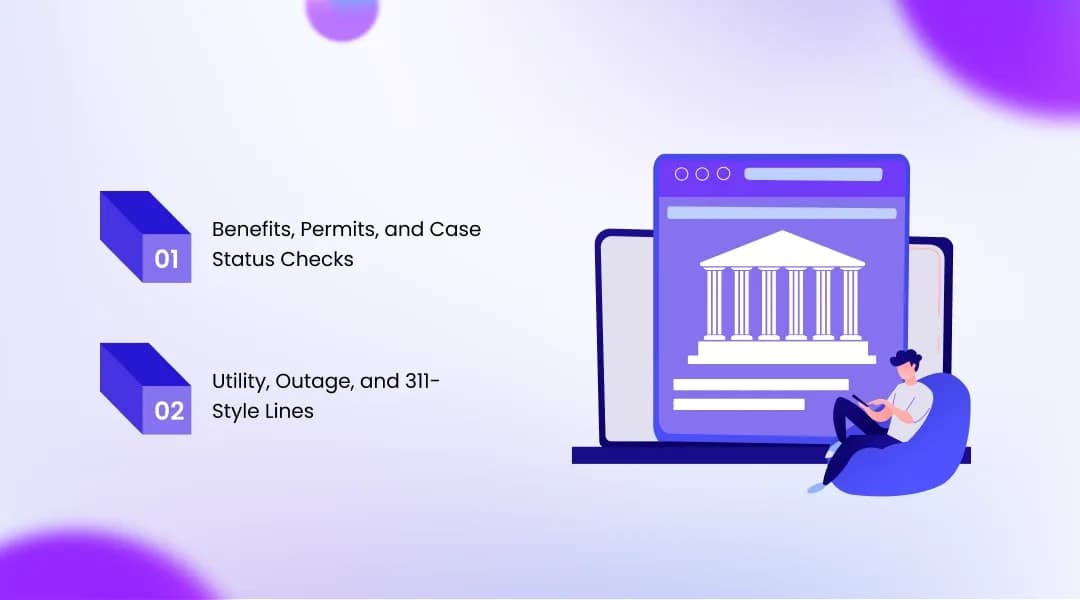
Abstract percentages are easy to nod along to. Specific call types are where an agency actually decides whether to move forward.
Benefits, Permits, and Case Status Checks
Benefits agencies, from unemployment insurance to housing assistance, tend to see the fastest return because eligibility and status questions are both high-volume and low-ambiguity. A caller wants to know if their application moved forward, and an AI voice agent with read access to the case management system can usually answer that in under a minute.
Permit offices see similar patterns. A caller asking about zoning requirements or renewal deadlines after hours doesn't need a person; they need an accurate answer pulled from the same source of truth the staff would use anyway.
Utility, Outage, and 311-Style Lines
Municipal utility and 311 lines face a different kind of pressure: volume spikes that are sudden and unpredictable rather than steady. During a power outage or major weather event, thousands of residents may call within the same hour asking the exact same question.
An AI voice agent can handle every one of those calls simultaneously, providing consistent, authority-sourced information instead of a busy signal. Fewer than 2 percent of cities can currently afford a centralized 311 call center of their own, which is precisely the gap this kind of automation is built to close for smaller municipalities that could never staff one otherwise.
What Government Agencies Need to Get Right Before Deploying
I want to be honest about something here, because a lot of vendors won't be: not every call belongs in front of an AI voice agent, and pretending otherwise is how agencies lose public trust instead of building it.
Compliance and Data Sovereignty
Government deployments carry a different compliance burden than a typical business call center. In the United States, that often means FedRAMP-authorized infrastructure; in India, it means working within the Digital Personal Data Protection Act's consent and processing requirements. Both frameworks demand purpose-limited data handling, audit trails, and a clear human escalation path, not just a polite disclaimer at the start of the call.
At OnDial, this is the conversation we have first with any public sector prospect, not last. An agency that skips this step doesn't save time; it just moves the risk further down the road, where it's more expensive to fix.
Where Human Agents Still Matter Most
I've listened in on calls where the caller was clearly frightened about losing a benefit they depend on. No script should have ever been allowed to answer that call. A trained human should.
AI voice agents should never serve as the primary interface for genuine emergencies, welfare checks, or highly emotional cases. The right architecture routes those calls to a human immediately, ideally with the AI having already gathered basic context so the person doesn't have to repeat themselves. Getting that handoff right is one of the most important things to evaluate in any voice AI platform, more important, honestly, than almost any other feature on the spec sheet.
Conclusion
AI voice agents reduce government contact center costs by taking on the routine, high-volume calls that were never a good use of a trained employee's time in the first place. The three numbers worth remembering: human-handled calls run $7 to $12 or more, AI-handled equivalents run $0.07 to $0.40, and agencies that shift even a quarter of their volume can avoid six figures in annual costs.
None of that requires replacing your team. It requires giving them fewer repetitive calls and more of the ones where a person genuinely makes a difference. If you're an agency leader trying to figure out where your own call volume splits between "routine" and "needs a human," that's exactly the conversation I'd want to have with you at OnDial, starting with your actual call data, not a generic demo script.