Every year, the healthcare industry loses an estimated $150 billion in the United States alone due to missed appointments. That figure, widely cited by the Healthcare Financial Management Association, represents revenue that simply vanishes when patients fail to show up for scheduled visits, procedures, and follow-ups. For an individual physician practice, the cost is no less painful. A single provider averaging three to five no-shows per day can lose between $500 and $1,000 daily, compounding into six figures of lost revenue annually. The problem is not limited to lost income. No-shows delay diagnoses, disrupt clinical workflows, increase wait times for other patients, and erode the trust between providers and the communities they serve.
Traditional approaches to reducing no-shows have relied on manual reminder calls, SMS messages, or basic automated dialers. These methods help, but they plateau quickly. Manual calls are expensive and inconsistent. Text messages are easy to ignore. Automated dialers sound robotic, cannot answer patient questions, and fail entirely when patients speak regional languages or need to reschedule on the spot. The gap between what traditional reminder systems can do and what patients actually need is where AI voice agents have emerged as a transformative solution for healthcare organizations of every size.
AI voice agents for healthcare represent a fundamentally different approach to patient engagement. Rather than sending a one-way notification and hoping the patient responds, an AI voice agent conducts a real conversation. It calls the patient, confirms the appointment, answers questions about preparation or directions, offers rescheduling options if the patient cannot make the original time, and updates the provider's calendar in real time. It does all of this in the patient's preferred language, at any hour of the day, with response latency so low that the conversation feels natural. This blog examines exactly how this technology works in healthcare settings, what results clinics and hospitals are achieving, and what implementation looks like in practice.
The True Cost of Patient No-Shows for Healthcare Organizations
The financial impact of no-shows is well documented, but most healthcare leaders underestimate how deeply the problem affects their operations beyond the obvious lost revenue. To understand why AI voice agents have become a priority investment for forward-thinking healthcare organizations, it is important to see the full picture of what no-shows actually cost.
Direct Revenue Loss
When a patient misses a scheduled appointment, the revenue for that time slot is gone. Unlike retail or hospitality, healthcare providers cannot easily fill a cancelled slot with a walk-in customer. The American Medical Association reports that no-show rates across specialties range from 5% to 30%, with community health centres and behavioural health practices often exceeding 30%. For a mid-sized clinic with 80 appointments per day, even a 15% no-show rate means 12 empty slots daily. At an average reimbursement of $150 per visit, that represents $1,800 in lost revenue every single day, or approximately $468,000 per year for a single location.
Operational Inefficiency and Staff Burden
No-shows do not just cost money in lost appointments. They create a cascade of operational problems that consume staff time and energy. Front desk teams spend hours each week making reminder calls, often reaching voicemail or encountering patients who need to reschedule but cannot navigate the process quickly. Nurses and medical assistants prepare rooms and materials for patients who never arrive. Physicians sit idle during gaps that could have been filled if the cancellation had come earlier. The staff time spent chasing, preparing for, and recovering from no-shows is a hidden cost that rarely appears on financial reports but significantly affects clinic efficiency and employee morale.
Clinical Consequences
The clinical impact of no-shows is equally serious. Patients who miss follow-up appointments after a diagnosis, procedure, or medication change are at higher risk for complications, hospital readmissions, and worsening chronic conditions. Continuity of care suffers, particularly for patients managing diabetes, hypertension, mental health conditions, or post-surgical recovery. For the healthcare system as a whole, no-shows contribute to longer wait times for all patients, because the scheduling gaps they create are difficult to redistribute efficiently.
Why Traditional Reminder Systems Hit a Ceiling
Most healthcare organizations already use some form of appointment reminder system. The question is not whether reminders help, because they clearly do, but why traditional approaches consistently fail to push no-show rates below a certain floor. Understanding these limitations clarifies why conversational AI voice agents represent a genuine step forward rather than an incremental improvement.
The Limitations of SMS and Email Reminders
Text message reminders have become standard practice in healthcare. They are inexpensive to send at scale and do reduce no-show rates compared to no reminders at all. However, studies consistently show that SMS reminders alone reduce no-shows by only 5% to 10% from baseline. The reasons are straightforward. Text messages are passive. They require the patient to read, comprehend, and act. Patients who need to reschedule must call the clinic back during business hours, which many never do. Patients who have questions about preparation instructions, insurance, or directions have no way to get answers from a text message. And patients who speak languages other than the primary language of the clinic may not fully understand the message at all.
The Problem with Manual Reminder Calls
Manual phone calls from staff are more effective than text messages because they create a two-way interaction. But they are also far more expensive and difficult to scale. A front desk coordinator making reminder calls can reach perhaps 15 to 20 patients per hour, accounting for voicemails, busy signals, and actual conversations. For a busy clinic, this means dedicating significant staff hours to a task that, while valuable, competes with check-ins, scheduling, insurance verification, and patient questions at the front desk. The quality of these calls also varies enormously depending on the individual staff member, their training, their mood, and how busy the clinic is that day.
The Failure of Basic Automated Dialers
Robocall-style automated dialers attempt to bridge the gap between manual calls and text messages, but they create their own problems. Patients increasingly screen calls from unknown numbers, and those who do answer are greeted by a robotic, pre-recorded message that cannot respond to questions or handle rescheduling. In multilingual communities, these dialers typically operate in a single language, excluding patients who would benefit most from a reminder call. The result is a system that feels impersonal, fails to engage the patients most likely to no-show, and cannot handle the interactive elements that make reminder calls effective.
How AI Voice Agents Transform Patient Appointment Management
AI voice agents for healthcare solve the no-show problem by combining the scalability of automation with the interactivity of a human phone call. Unlike any previous reminder technology, a well-deployed AI voice agent conducts a genuine two-way conversation with each patient, adapting to their responses, answering their questions, and completing actions like rescheduling in real time.
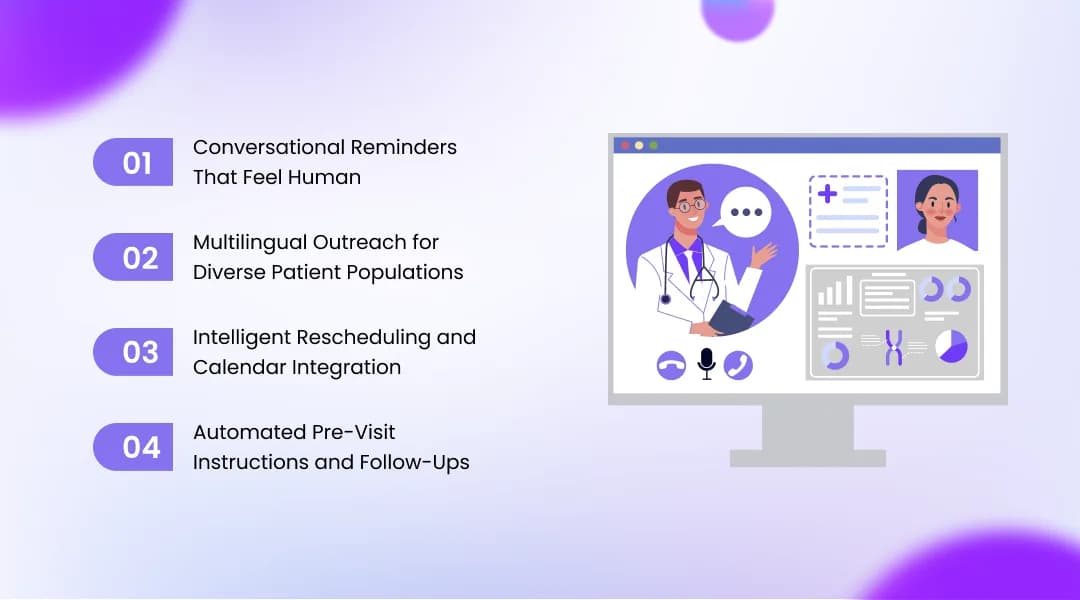
Conversational Reminders That Feel Human
When an AI voice agent calls a patient to confirm an upcoming appointment, the interaction sounds and feels like a call from a well-trained staff member. The agent greets the patient by name, states the appointment details, and asks whether the patient can confirm. If the patient says yes, the agent provides any relevant preparation instructions and ends the call. If the patient hesitates, asks a question, or says they cannot make it, the agent responds naturally, offering alternative times, providing directions, or explaining what to bring. The entire conversation happens with sub-500 millisecond response latency, meaning there is no awkward pause that signals to the patient they are speaking with a machine. OnDial's AI voice agents are specifically engineered for this kind of natural, low-latency conversation, which is critical in healthcare where patient trust directly affects engagement.
Multilingual Outreach for Diverse Patient Populations
One of the most significant advantages of AI voice agents in healthcare is their ability to communicate with patients in their preferred language. In countries like India, where a single hospital may serve patients speaking Hindi, Tamil, Telugu, Bengali, Marathi, and English, language barriers are a major contributor to no-shows. Patients who do not fully understand an English-language reminder are far more likely to miss or forget their appointment. OnDial supports over 100 languages including 9 Indian languages with more than 80 Indian voice variations, making it possible for healthcare organizations to reach every patient in the language they are most comfortable with. This capability is not a nice-to-have feature. For hospitals and clinics serving multilingual communities, it is the difference between a reminder that works and one that gets ignored.
Intelligent Rescheduling and Calendar Integration
The moment a patient indicates they cannot keep their original appointment, the AI voice agent can offer available alternative slots in real time. This is possible because the agent integrates directly with the provider's scheduling system, pulling live availability and booking the new appointment during the call itself. The patient does not need to call back, wait on hold, or navigate an online portal. The rescheduling happens conversationally, in under a minute, and the updated appointment immediately appears in both the patient's confirmation and the clinic's calendar. This single capability, the ability to convert a potential no-show into a rescheduled visit during the reminder call, is responsible for a large share of the no-show reduction that healthcare organizations achieve with AI voice agents.
Automated Pre-Visit Instructions and Follow-Ups
Beyond appointment confirmation, AI voice agents can deliver pre-visit instructions such as fasting requirements before blood work, documents to bring for a first visit, or post-procedure care reminders after a discharge. These calls ensure that patients arrive prepared, which reduces last-minute cancellations caused by patients realizing they have not followed preparation steps. After the appointment, the same AI agent can call the patient to check on recovery, remind them about medication, or schedule follow-up visits, creating a continuous engagement loop that improves clinical outcomes and patient satisfaction.
Quantified Results: What Healthcare Organizations Achieve with AI Voice Agents
The impact of AI voice agents on healthcare no-show rates is measurable and significant. While results vary by organization size, patient population, and specialty, the data from early adopters and industry research consistently shows substantial improvement across several key metrics.
Healthcare organizations that deploy conversational AI voice agents for appointment reminders typically see no-show rate reductions of 25% to 40% compared to their previous reminder systems. This improvement comes from the combination of higher patient contact rates, because the AI agent can call at times when patients are most likely to answer, and higher engagement rates, because patients who do answer are more likely to confirm or reschedule when speaking with a conversational agent rather than hearing a recorded message.
The revenue recovery from this reduction is immediate and significant. A clinic that was losing $468,000 per year to no-shows at a 15% rate can recover between $117,000 and $187,000 annually by reducing that rate to 9% or 10%. For hospital systems with multiple locations and hundreds of daily appointments, the annualized savings reach into the millions. These figures do not account for the additional revenue generated when cancelled slots are filled through real-time rescheduling, which further increases the return on investment.
Staff time savings are equally measurable. When AI voice agents handle appointment confirmation calls, front desk staff are freed from two to four hours of daily phone work. This time can be redirected to patient check-in, insurance coordination, and in-person patient experience, all of which directly affect patient satisfaction scores and operational efficiency. Organizations using OnDial's platform for healthcare call automation report that their staff can focus on higher-value tasks while the AI agent manages the entire outreach workflow, from initial reminder to confirmation to rescheduling.
Implementing AI Voice Agents in a Healthcare Setting
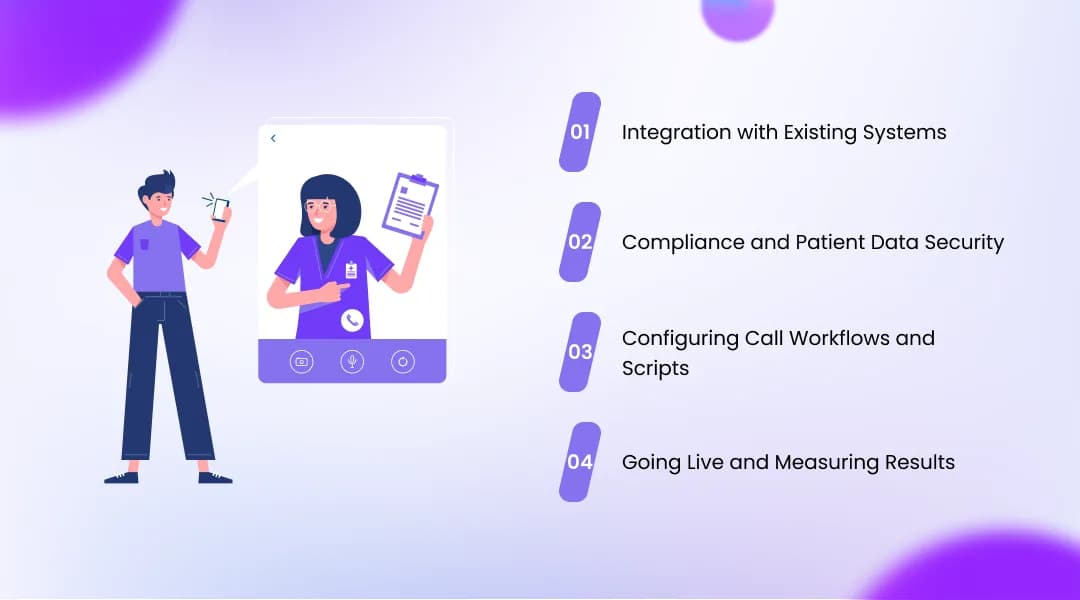
For healthcare leaders considering AI voice agents, understanding what implementation actually involves is essential for setting realistic expectations and achieving results quickly. The process is more straightforward than many assume, particularly with platforms designed for rapid deployment in healthcare environments.
Integration with Existing Systems
The first step in deploying an AI voice agent for appointment management is connecting it with the organization's existing electronic health record or practice management system. Most modern AI voice platforms, including OnDial, offer both API integrations for organizations with technical teams and no-code deployment options for smaller practices that need a simpler setup. The integration allows the AI agent to pull appointment data, access patient contact information, check scheduling availability, and write back confirmed or rescheduled appointments directly into the system of record. This eliminates the need for staff to manually update records after AI-handled calls.
Compliance and Patient Data Security
Healthcare organizations operate under strict data privacy regulations including HIPAA in the United States and various data protection frameworks in other jurisdictions. Any AI voice agent deployed in healthcare must handle patient data with the same level of security and compliance required of all other systems in the organization. OnDial's platform is built with GDPR and CCPA compliant data handling, and healthcare deployments are configured to meet the specific privacy requirements of medical data. Call recordings, patient information, and scheduling data are encrypted and stored according to the organization's data governance policies. This compliance infrastructure is not optional. It is a foundational requirement for any AI system that interacts with patient information.
Configuring Call Workflows and Scripts
After integration, the healthcare organization configures the call workflows that the AI agent will follow. This includes defining when reminder calls should be placed (typically 48 hours and 24 hours before the appointment), what information the agent should confirm, what rescheduling options to offer, and what pre-visit instructions to deliver based on the type of appointment. The best platforms allow these workflows to be customized by appointment type, so that a surgical pre-op reminder includes different preparation instructions than a routine check-up confirmation. The configuration process is collaborative, with the healthcare team providing clinical accuracy and the AI platform providing conversational design expertise.
Going Live and Measuring Results
Most healthcare organizations can move from initial setup to live patient calls within two to four weeks, depending on the complexity of their scheduling systems and the number of appointment types they want to cover. The key to a successful launch is starting with a defined scope, such as reminder calls for one department or location, measuring results over the first 30 days, and then expanding to additional use cases based on the data. OnDial's smart analytics and call sentiment tracking provide healthcare teams with detailed visibility into call outcomes, patient responses, and no-show rate trends from day one, enabling data-driven decisions about how to optimize the system over time.
Beyond Reminders: The Full Spectrum of Healthcare AI Voice Applications
While appointment reminders and no-show reduction are the most common starting point, AI voice agents in healthcare have a much broader range of applications that compound the value of the initial investment.
Patient intake is one of the most time-consuming processes in healthcare administration. AI voice agents can call patients before their first visit to collect demographic information, insurance details, medication lists, and symptom descriptions, allowing clinical staff to review the information before the patient arrives rather than spending the first 15 minutes of the visit on paperwork. This improves both the patient experience and the provider's efficiency.
Post-discharge follow-up is another high-impact application. Hospitals are increasingly measured on readmission rates, and timely follow-up calls after discharge are one of the most effective ways to reduce preventable readmissions. An AI voice agent can call discharged patients to check on symptoms, confirm they are taking prescribed medications, and flag any concerns for a nurse or physician to review. Because the agent can make these calls 24/7 and in the patient's preferred language, the coverage is far more comprehensive than what a hospital's care coordination team can achieve with manual outreach alone.
Prescription refill reminders, preventive care notifications, patient satisfaction surveys, and waitlist management are additional use cases where AI voice agents are already delivering measurable results in healthcare settings. Each of these applications shares the same fundamental advantage: the AI agent can conduct a real conversation at massive scale, in any language, at any time, without the variability, fatigue, or capacity constraints that limit human-powered outreach.
Conclusion
Patient no-shows are not an inevitable cost of running a healthcare organization. They are a solvable problem, and the solution has moved well beyond text messages and manual phone calls. Three points stand out from the evidence and implementation experience covered in this blog. First, the financial and clinical cost of no-shows is far larger than most organizations realize when they account for lost revenue, wasted staff time, and disrupted patient care. Second, traditional reminder systems have a ceiling that conversational AI voice agents break through by combining scalability with genuine interactivity, multilingual support, and real-time rescheduling. Third, implementation is faster and less complex than many healthcare leaders expect, with most organizations achieving measurable results within the first month.
OnDial delivers exactly this combination of capabilities for healthcare organizations ready to solve their no-show problem. With sub-500 millisecond response latency, support for over 100 languages including 9 Indian languages, seamless calendar integration, GDPR and CCPA compliant data handling, and both API and no-code deployment options, OnDial provides the infrastructure that healthcare teams need to reach every patient, in every language, at every hour. If your organization is ready to recover the revenue and clinical capacity that no-shows are costing you, schedule a demo with OnDial today to see how AI voice agents perform in a healthcare environment built around your specific workflows and patient population.