A lead fills out your form at 9 PM on a Tuesday. Your fastest rep sees it Wednesday morning. By then, according to Artemis GTM's 2026 benchmark of more than 250,000 B2B leads, that prospect is roughly nine times less likely to become a customer than if you'd called back within five minutes. That's not a slow quarter; that's the industry average: the median B2B lead response time sits at 42 hours, while conversion rates for five-minute responders run near 21%, compared with about 2.3% after a full day of silence.
AI voice agents close that gap by picking up the phone the moment a lead comes in, any hour, and starting the qualifying conversation before the prospect's interest cools. If you've watched good leads go cold because nobody called back in time, this is what fixes it. Here's how the technology collapses response time to seconds, what the data says about the payoff, and where it still needs a human to take over.
Why Speed to Lead Decides Who Wins the Deal: How AI Voice Agents Actually Cut Response Time to Seconds
The Five-Minute Window Is Real
The term "speed to lead" describes how long it takes a business to make first contact after a prospect raises their hand. Research tracing back to the original MIT and InsideSales Lead Response Management study found that a callback within five minutes made a rep dramatically more likely to actually reach and qualify a prospect than one placed at the thirty-minute mark. Artemis GTM's 2026 benchmark confirms the pattern still holds today: sub-five-minute responders convert at roughly 21%, while responders who wait a full day convert at just 2.3%.
Why does five minutes matter this much? Intent has a shelf life. The moment someone fills out a form, they're still at their desk, still comparing competitors in another tab, still primed to talk. Wait thirty minutes, and that context is gone: they've moved on to a meeting, a call, or a rival's demo page.
What Happens When You Miss the Window
Missing the window doesn't just slow a deal down; it usually kills it with AI voice agents that qualify leads automatically. Multiple 2026 industry analyses point to the same blunt figure: as much as 78% of buyers go with whichever company reaches them first, regardless of price or product fit. That's an uncomfortable number for any sales leader to sit with.
So ask yourself: how many of last month's "lost" deals were actually lost on product, and how many were lost on a callback that came six hours too late? Speed to lead is the time between when a prospect shows interest, such as filling out a form, and when a business makes first contact. It is the strongest predictor of whether that inquiry converts, with five-minute responders converting roughly nine times more often than those who wait a full day.
The Real Cost of a Slow Sales Response Time
Where the Delay Actually Comes From
Most teams assume their response time problem is a rep problem, someone simply not picking up the phone fast enough. In practice, the delay is baked into the process before a rep ever sees the lead. Data enrichment, routing rules, and round-robin assignment can each add minutes or hours before a human even knows a lead exists (the kind of gap that shows up in your CRM weeks later as a lost opportunity, not a missed call).
Workato's audit of more than 100 B2B companies found that over 99% failed to respond within five minutes, with average response times stretching past 11 hours by email and 14 hours by phone. Aircall has documented real cases of cutting first-response time from 29 hours down to 12 simply by adding an AI layer to the queue. That is the difference between a lead going cold and staying warm.
What This Actually Costs Your Pipeline
Run the math on a mid-size sales team, and the number gets uncomfortable fast. If a rep loses even a couple of hours a day to manual triage and chasing leads that have already gone cold, that adds up to hundreds of lost selling hours a year. Multiply that across a ten-person team, and you're looking at thousands of hours that could have gone toward actual selling.
I've seen this pattern play out across the industries OnDial works with, from real estate and healthcare to insurance and retail. The businesses losing the most leads are rarely the ones with a weak product. They're the ones where a good lead sits in a queue for six hours because nobody was free to call.
How AI Voice Agents Actually Cut Response Time to Seconds
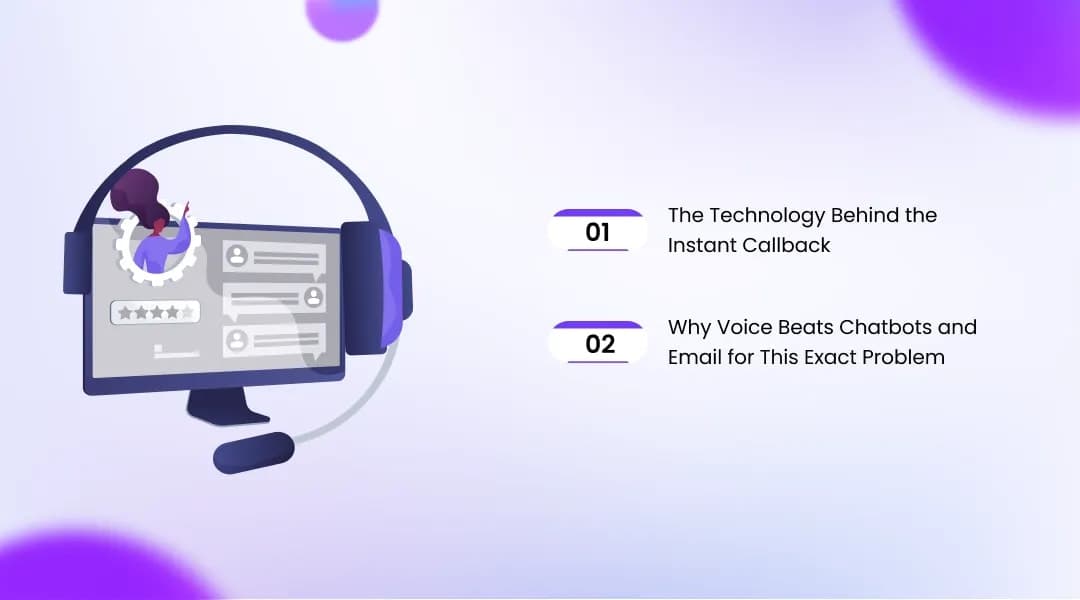
The Technology Behind the Instant Callback
An AI voice agent works through three connected steps happening in real time. Automatic speech recognition (ASR) converts the caller's voice into text, a large language model (LLM) interprets intent and decides how to respond, and text-to-speech (TTS) turns that response into natural-sounding audio, all within a fraction of a second. In the systems I've worked with at OnDial, that loop runs in under 200 milliseconds, fast enough that it feels like talking to a person, not a machine.
An AI voice agent can call a new lead within seconds of a form submission, at any hour of the day, because it doesn't wait on a rep's calendar or shift schedule. Once connected, response latency inside the call itself typically runs under 300 milliseconds, close enough to real time that the conversation feels natural rather than automated.
This matters because the agent isn't just faster at picking up; it's faster at getting to the point. It asks qualifying questions on budget, timeline, and intent, adapts based on what it hears, and logs everything straight into your CRM, whether that's HubSpot or Salesforce, without a rep touching a keyboard.
Why Voice Beats Chatbots and Email for This Exact Problem
Text-based tools can acknowledge a lead instantly, but acknowledgment isn't qualification. A chatbot can confirm "we got your message," while a voice agent can actually have the conversation: ask what the prospect needs, handle an interruption mid-sentence, and book a meeting before the tab is closed.
Here's the counterintuitive part. The channel that feels most human, a live phone call, is also the easiest one to automate at scale once the underlying voice model is good enough. Email gets ignored. Chat gets abandoned mid-conversation. A ringing phone gets answered.
AI Voice Agents vs Human Sales Reps: Where Each One Actually Wins
What the AI Should Own
The clearest win for AI voice agents is the repetitive, time-sensitive front end of the funnel: instant callbacks, after-hours coverage, initial qualification, and follow-ups with prospects who've gone quiet. These are high-volume, low-judgment tasks where speed matters more than nuance.
Inbound lead qualification: Calling a new form fill within seconds and asking the same structured questions every time, so no lead sits untouched.
After-hours coverage: Picking up calls at 9 PM or on a Sunday, when a large share of inbound interest actually arrives.
Appointment confirmations: Calling ahead of a demo to confirm attendance and reschedule automatically, cutting no-shows without a rep's time.
What Still Needs a Human
Complex negotiations, relationship-driven enterprise deals, and sensitive conversations still belong with a person. An AI voice agent can qualify a lead in ninety seconds, but closing a six-figure contract usually depends on trust built over multiple human conversations, not one automated call.
The honest answer, and I'd rather say this plainly than oversell it, is that voice AI works best as a handoff system, not a replacement. It should qualify, route, and log, then step aside once a deal needs real judgment with AI voice agent industry solutions. Teams that treat it as a total replacement tend to be disappointed; teams that treat it as the front line tend to see the biggest lift.
How to Implement an AI Voice Agent Without Breaking Your Sales Process
Start With One Workflow, Not Everything
The teams that get the most value don't flip a switch on their entire funnel at once. They pick one high-friction workflow, usually inbound lead callbacks, and prove it out before expanding into outbound, reminders, or post-sale check-ins.
Before touching any technology, define what "sales-ready" actually means for your team: budget range, company size, timeline, specific triggers. An AI agent can only qualify against criteria you've given it, so vague criteria produce vague results, no matter how good the voice model is.
What to Check Before You Sign a Contract
CRM and workflow fit: Confirm the platform connects natively to what you already run, whether that's HubSpot, Salesforce, Twilio, Zapier, or Calendly, so every call logs automatically.
Compliance coverage: Ask specifically about GDPR and data-handling practices for voice recordings and transcripts, especially across regions with different consent rules.
Handoff quality: Test what happens when a prospect asks for a human. A good system passes full context and qualification notes to the rep; a weak one makes the prospect start over.
This is also where transparency matters most, and it's something we build every OnDial rollout around: a client should always know what the agent is doing, what it's logging, and when it's escalating to a person. That clarity is what turns a pilot into something a sales team trusts enough to scale.
Conclusion
AI voice agents reduce sales response time by removing the one variable that decays fastest: the gap between interest and first contact with AI voice agents for business calls. The data lines up across every benchmark cited here, from the original MIT and InsideSales research to the 2026 Artemis GTM study. Leads called back within minutes convert at multiples of the rate of leads left waiting hours, and that gap is exactly what this technology closes.
The technology isn't about replacing your sales team. It's about making sure no lead sits in a queue long enough to go cold. OnDial builds AI voice agents around how your team already sells, with CRM sync, compliance, and human handoff built in, and we're happy to show you a live call first.