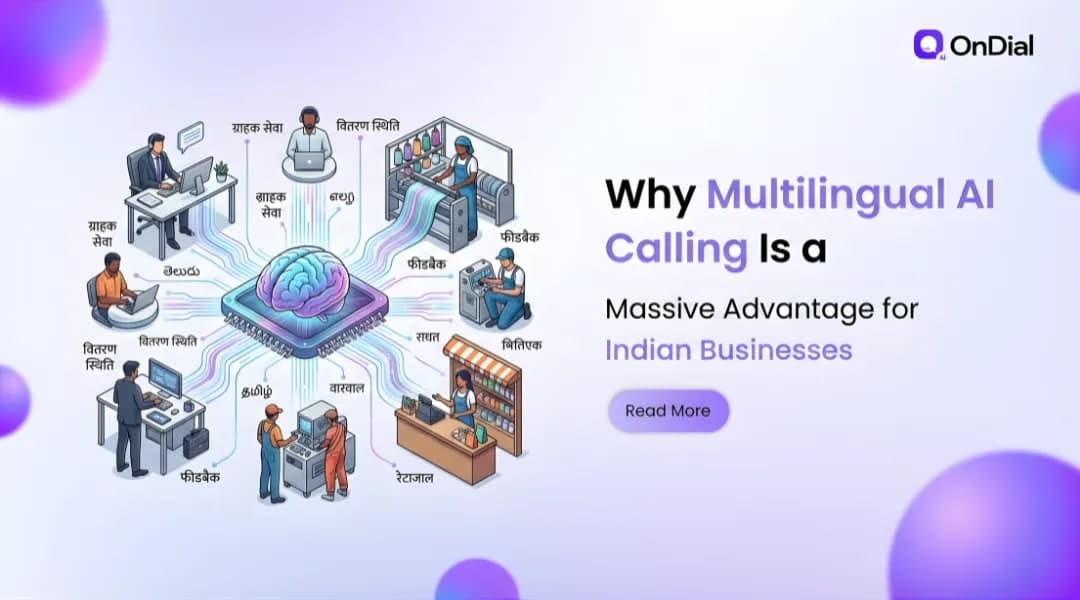
For businesses operating across India, a phone conversation can change completely depending on the language a customer is comfortable speaking.
A customer may understand English but prefer Hindi when discussing a loan. A patient may use English to book an appointment but switch to Gujarati when explaining a concern. A buyer in Tamil Nadu may begin in English, move into Tamil, and use familiar English terms for product or payment details.
This is why multilingual AI calling is becoming more relevant for Indian businesses.
The value is not simply that an AI voice agent can speak multiple languages. The real advantage comes from being able to understand customer intent, respond naturally, handle regional language preferences, complete business tasks, and transfer complex conversations to human employees when necessary.
For businesses with customers across multiple states, multilingual voice automation can make phone communication more accessible without requiring separate language teams for every region.
What Is Multilingual AI Calling?
Multilingual AI calling uses AI voice technology to conduct inbound and outbound phone conversations in multiple languages.
A typical conversation involves several connected capabilities. Speech recognition converts the caller's speech into information the AI can process. The conversational AI interprets the caller's intent and context. Voice generation then produces the response in the appropriate language.
The important difference between a basic translation system and a useful multilingual AI calling system is conversational context.
A business conversation is rarely a sequence of perfectly formed sentences. Customers interrupt themselves, change topics, use regional expressions, mix languages, and speak with different accents.
A useful voice agent therefore needs to understand the meaning behind the conversation rather than simply translate individual sentences.
OnDial's multilingual voice platform currently supports more than 100 languages and includes automatic language detection, regional language support, and code mixed conversations such as Hinglish.
Why Language Matters in the Indian Customer Experience
India presents a different challenge from markets where one or two languages dominate customer communication.
Businesses can serve customers in multiple states while dealing with significant differences in language preference, pronunciation, vocabulary, and conversational style.
English may work well for some customers, but that does not mean it is the most comfortable language for every phone interaction.
This matters particularly when the conversation involves something important or personal.
A customer discussing a financial product, insurance policy, healthcare appointment, property purchase, education admission, or payment issue may communicate more clearly in the language they use every day.
The objective is not to force every customer into a regional language. It is to remove unnecessary friction from the conversation.
A multilingual AI voice agent can allow businesses to offer that flexibility without building a separate calling operation for every language.
Multilingual AI Calling Goes Beyond Translation
Translation alone does not create a natural phone conversation.
Consider a customer saying:
"Sir, loan ka status check karna tha. Can you tell me whether the documents are approved?"
The customer has switched between Hindi and English naturally.
A rigid language system may treat this as two separate linguistic inputs. A conversational voice agent needs to understand that both parts relate to the same request.
This is commonly known as code switching.
Indian customers may also use English words inside regional language conversations because those words are common in business, technology, banking, retail, healthcare, and everyday communication.
A multilingual AI system should therefore be evaluated on more than the number of languages it lists.
Businesses should test:
Language detection
Accent recognition
Code switching
Regional vocabulary
Conversational context
Pronunciation quality
Response consistency
Handling of interruptions
Ability to transfer conversations to humans
A platform that supports ten languages on paper may deliver a poorer customer experience than a platform that handles fewer languages naturally and consistently.
Which Indian Languages Should Businesses Prioritize?
There is no universal language list that works for every company.
The right approach is to look at the actual customer distribution.
A business operating primarily in Gujarat may prioritize Gujarati, Hindi, and English. A company expanding across southern India may need Tamil, Telugu, Kannada, and Malayalam. A nationwide consumer business may require a broader language strategy.
The first step should therefore be analysing:
Customer Location
Look at where inbound calls, leads, orders, appointments, and support requests originate.
Existing Call Data
Review the languages customers already use with human agents.
Conversion and Drop Off
Compare lead progression, call completion, and resolution rates across customer segments where language differences are visible.
Business Priority
A company should prioritize languages connected to revenue, customer support volume, service expansion, or strategic geographic growth.
The goal is not to support every possible language immediately. The goal is to support the languages that create measurable business value.
Where Multilingual AI Calling Creates the Most Value
Multilingual voice automation can support several business functions, but some use cases are particularly well suited to it.
Customer Support
Customers often call when they cannot find an answer through a website or app.
A multilingual AI voice agent can handle structured requests such as order information, service questions, account information, operating hours, and basic troubleshooting.
When the issue requires human judgment, the conversation can be transferred to an employee with relevant context.
This creates a hybrid support model where AI handles repetitive interactions while human agents focus on cases that require empathy, judgment, or specialized knowledge.
OnDial's broader customer experience approach follows this model, combining automated conversations with human escalation for complex situations.
Lead Qualification
Lead response is particularly important when customers are contacting multiple businesses at the same time.
A multilingual AI voice agent can answer immediately, ask qualifying questions, identify buying intent, collect relevant information, and pass qualified leads to sales teams.
For businesses expanding beyond major metropolitan areas, language flexibility can help sales teams communicate with prospects without adding separate calling teams for every region.
Appointment Scheduling
Appointment based businesses can use multilingual AI calling to manage booking, cancellation, and rescheduling conversations.
Healthcare is a strong example.
A patient may be comfortable using English to provide basic information but prefer a regional language when communicating about an appointment or explaining what they need.
OnDial's healthcare calling solution combines multilingual conversations with appointment scheduling, CRM or data lookups, and human escalation for cases that require staff involvement.
Payment and Reminder Calls
Financial services, education providers, healthcare organizations, subscription businesses, and other companies frequently need to make reminder calls.
These conversations are often structured enough for automation.
A multilingual voice agent can identify the customer, explain the purpose of the call, provide approved information, record the customer's response, and escalate when necessary.
For sensitive financial conversations, businesses should apply appropriate consent, privacy, calling time, and regulatory controls.
E Commerce Operations
E commerce businesses can use voice automation for order confirmation, delivery updates, return related communication, customer support, and other repetitive conversations.
Regional language support can be especially useful when businesses expand into markets where customers may prefer speaking rather than navigating an English only digital interface.
How Multilingual AI Calling Can Support Tier 2 and Tier 3 Markets
Geographic expansion often creates a communication problem.
A company may have strong digital infrastructure but still depend on phone conversations for sales, support, collections, appointments, or verification.
Hiring multilingual employees for every new market can become operationally difficult.
AI voice automation creates another option.
Instead of building a separate phone operation for every geography, a business can configure automated conversations around the languages and workflows that matter for each market.
For example, a business expanding from metropolitan markets into Gujarat could introduce Gujarati support for selected call flows. The same business could later add Marathi, Tamil, Telugu, or other languages based on demand.
This creates a more structured approach to geographic expansion.
Language becomes part of the customer acquisition and service strategy rather than an afterthought.
Multilingual AI Calling vs Traditional Multilingual Call Centers
Traditional call centers remain valuable for complex customer interactions, but scaling multilingual operations can introduce several challenges.
Businesses need to recruit people with the right language skills, train them on products and processes, manage availability, maintain consistent quality, and handle demand spikes.
AI voice agents approach the problem differently.
Factor | Multilingual AI Calling | Traditional Multilingual Team |
Availability | Can operate continuously | Depends on staffing |
Concurrent calls | Scales with platform capacity | Limited by available agents |
Language coverage | Configurable across supported languages | Depends on employee skills |
Repetitive workflows | Highly suitable for automation | Requires repeated manual handling |
Complex conversations | Human escalation recommended | Strong |
Consistency | Automated workflows provide consistent responses | Can vary between agents |
CRM integration | Can trigger automated updates | Usually requires manual workflows |
Scaling | Software based | Recruitment and training required |
The strongest model is usually not AI versus humans.
It is AI plus humans.
AI can handle predictable, high volume conversations while employees take ownership of complex, sensitive, or high value interactions.
What Businesses Should Check Before Choosing a Multilingual AI Voice Platform
Language count should not be the deciding factor.
A better evaluation process includes real conversations from the business.
Test Real Customer Speech
Use actual examples that represent how customers speak.
Include accents, interruptions, code switching, informal language, and regional expressions.
Test Business Terminology
A banking company should test terms related to loans, EMIs, KYC, payments, and account services.
A healthcare organization should test its approved terminology and escalation scenarios.
A real estate company should test property names, locations, project details, pricing terminology, and appointment requests.
Check CRM and Workflow Integration
A voice agent becomes more useful when it can do more than talk.
The system should be able to connect with relevant business tools and trigger actions such as lead creation, appointment scheduling, notifications, or customer record updates.
Evaluate Human Handoff
A failed AI interaction should not become a failed customer interaction.
When escalation is required, the human agent should receive relevant conversation context so the customer does not have to repeat everything.
Review Privacy and Compliance
Phone conversations can contain personal and business sensitive information.
Before deployment, businesses should understand how recordings, transcripts, customer information, consent, access controls, and data retention are handled.
How Businesses Can Measure the Impact
Multilingual AI calling should be evaluated through business metrics rather than language support alone.
Useful measurements include:
Call answer rate
Call completion rate
Lead qualification rate
Appointment booking rate
First call resolution
Average handling time
Human escalation rate
Customer satisfaction
Missed call volume
Cost per completed interaction
Conversion rate by language
Customer retention by segment
One particularly useful measurement is performance by language.
If Hindi conversations have strong completion rates but a regional language has a much higher escalation rate, that difference can reveal where conversation design or speech quality needs improvement.
The same analysis can be used to determine which languages should be added next.
Multilingual AI Calling Should Be Designed Around Business Workflows
Adding a language to an existing voice bot is not enough.
Each conversation should have a clear business objective.
For example:
A lead qualification call should collect the information required by sales.
An appointment call should complete the booking rather than simply provide information.
A support call should resolve the issue or route it correctly.
A reminder call should record the customer's response and trigger the appropriate next step.
This is why multilingual voice automation should be designed around workflows, not just conversations.
The AI needs to understand what the customer is saying and what the business needs to happen next.
For companies evaluating this approach, multilingual AI voice automation can provide a useful reference for how language detection, business workflows, CRM connectivity, and human handoff can work together.
The Future of Multilingual Customer Communication
Voice is becoming an increasingly important interface for businesses that need to serve customers across different regions.
The next stage is not simply adding more languages.
It is making conversations more context aware.
An effective voice agent should understand why a customer is calling, remember relevant information during the conversation, adapt to the customer's language preference, complete the required task, and know when a human should take over.
This creates a more practical form of customer communication automation.
Businesses do not need to automate every conversation. They need to automate the conversations where speed, consistency, availability, and language accessibility create measurable value.
For companies building customer communication strategies across India, AI voice agents for Indian customer experience provides additional context on how voice automation can support response times, customer service, lead handling, and regional language interactions.
Final Takeaway
Multilingual AI calling matters because India's customer base is linguistically diverse.
The business opportunity is not simply to make an AI voice agent speak another language. It is to make customer communication easier, more accessible, and more useful across different regions.
For the right use cases, businesses can use multilingual AI voice agents to answer calls, qualify leads, schedule appointments, manage routine support, conduct reminders, and route complex conversations to human teams.
The most important consideration is quality.
Businesses should test real customer conversations, regional language behavior, code switching, business terminology, integrations, privacy controls, and human handoff before choosing a platform.
When implemented around clear workflows, multilingual voice automation can become part of a scalable customer communication strategy rather than another isolated technology project.
Businesses exploring AI based calling can also learn more about OnDial's AI voice automation platform, including multilingual conversations, inbound and outbound calling, workflow automation, CRM connectivity, and human handoff.