Let me start with a confession.
For years, I didn’t believe AI could replace a call center.
I had worked with IVR systems. Built telecom APIs. Integrated speech recognition engines that misheard half the sentences customers spoke.
So when people said AI call centers would replace human agents, I rolled my eyes.
Then something changed.
Conversational AI matured. Speech recognition improved dramatically. Natural language systems became smarter, faster, and importantly, context aware.
And suddenly the math started making sense.
Today I’m watching companies quietly replace massive call center operations with AI voice agents that answer thousands of calls every day.
Not in some futuristic experiment.
In production.
But here’s the key detail most blog posts ignore.
AI doesn’t replace call centers by magic. It replaces them through careful design, training, and workflow automation.
Let me show you how it actually works.
What Are AI Call Center Agents?
An AI call center agent is a software system that can answer phone calls, understand human speech, and respond naturally using conversational AI.
Think of it as a digital support representative.
But one that never sleeps.
These systems combine several technologies:
Speech recognition
Natural language processing (NLP)
Dialogue management
Text-to-speech voice synthesis
Backend integrations with CRM systems
The result?
A system capable of holding real conversations with customers.
Not menu trees.
Not robotic prompts.
Actual conversations.
Customers ask questions. The AI understands intent. Then it responds.
When implemented properly, AI voice agents can handle a surprising amount of customer support work.
And yes… customers often don’t even realise they’re speaking with AI.
Why Businesses Are Replacing Call Centers with AI
Let’s talk about the elephant in the room.
Call centers are expensive.
Really expensive.
A single support agent costs far more than just their salary. There’s hiring, training, office infrastructure, management overhead, turnover, and scheduling complexity.
Multiply that by hundreds of agents.
You start to see the problem.
Now imagine an AI system that can handle thousands of calls simultaneously.
No shifts.
No fatigue.
No wait times.
Businesses aren’t replacing call centers because AI sounds interesting.
They’re doing it because the economics are undeniable.
I’ve worked with companies where 60–70% of support calls were repetitive questions:
Order status
Appointment scheduling
Account information
Basic troubleshooting
Tasks like these are perfect for AI customer support systems.
And once businesses realise how much volume can be automated…
They rarely go back.
Key Benefits of AI Customer Support
Let’s break down the real advantages.
Not marketing promises.
Actual operational improvements I’ve seen companies achieve.
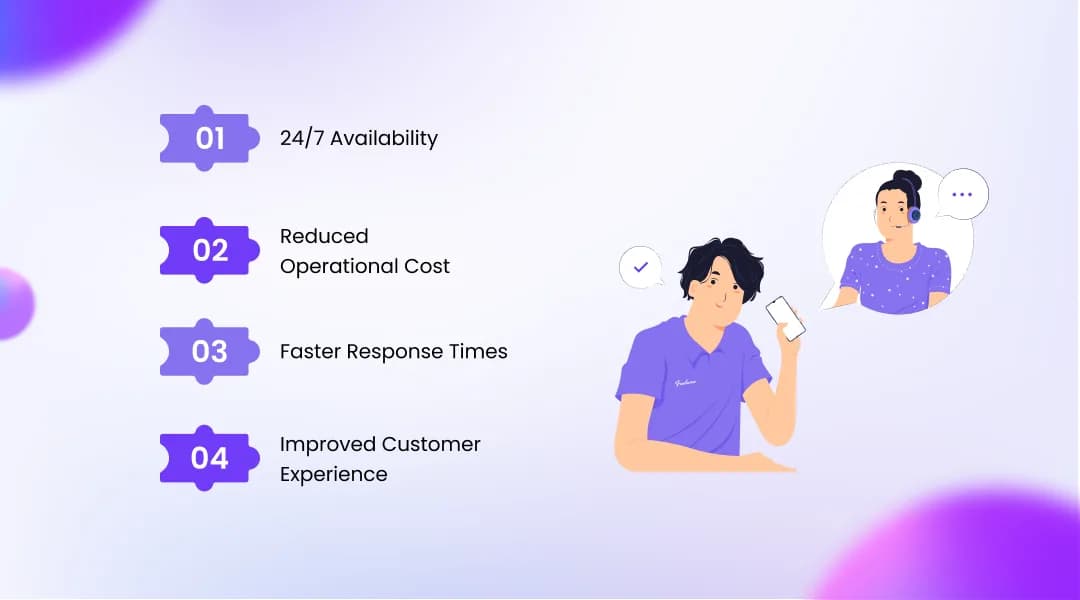
24/7 Availability
Human teams work shifts.
AI systems work continuously.
Customers calling at midnight get the same level of service as someone calling at noon.
That alone can dramatically improve customer satisfaction.
Reduced Operational Cost
A traditional call center scales with people.
An AI contact center scales with software.
Once deployed, the system can handle massive call volumes without proportional cost increases.
Faster Response Times
No queues.
No hold music.
Customers get immediate responses.
Which means fewer frustrated callers and shorter resolution times.
Improved Customer Experience
This surprises many people.
But well-trained conversational AI can often provide more consistent support than human teams.
Why?
Because it never forgets a process.
Never skips a step.
Never has a bad day.
How AI Voice Agents Handle Customer Calls
Let’s go under the hood for a moment.
When a customer calls an AI phone answering system, several things happen almost instantly.
The system converts speech into text using speech recognition.
Natural language processing analyzes the meaning of the request.
The system identifies the customer’s intent.
A response is generated based on the workflow.
The reply is converted back into human-like speech.
All of this happens in seconds.
Sometimes faster than a human could even read the message.
Modern conversational AI platforms also maintain context during the conversation.
So if a customer asks:
“Where’s my order?”
…and then says:
“Can you change the delivery address?”
The system understands that both questions relate to the same order.
That level of conversational awareness is what makes automated customer service actually usable.
Tasks AI Call Center Agents Can Perform
Here’s where things get practical.
What exactly can AI agents do?
Quite a lot, actually.
Answering Customer Queries
AI systems can respond to common questions instantly.
Shipping policies. Pricing. Account details. Product information.
Booking Appointments
Many businesses automate scheduling completely.
Customers call, request a date, and the AI confirms the booking in the system.
Handling Support Requests
Troubleshooting steps. Service requests. Issue reporting.
These workflows can all be automated.
Order Tracking
One of the most common support requests.
Customers ask about order status.
The AI retrieves information from the backend system and responds immediately.
Simple.
Efficient.
And incredibly scalable.
AI vs Traditional Call Centers: Cost Comparison
Let’s talk numbers.
Because this is where the decision becomes obvious.
A traditional call center might require:
50–200 agents
Multiple supervisors
Office space
Training teams
Recruitment cycles
Annual costs can easily reach millions.
An AI call center, on the other hand, primarily involves:
Platform licensing
Implementation
Training conversational models
System integrations
Once operational, the marginal cost per call becomes extremely low.
That’s why many businesses now combine small human teams with AI support automation handling the bulk of interactions.
Humans focus on complex cases.
AI handles everything else.
Steps to Replace Your Call Center with AI
Now the important question.
How do you actually do this?
Not theoretically.
Operationally.
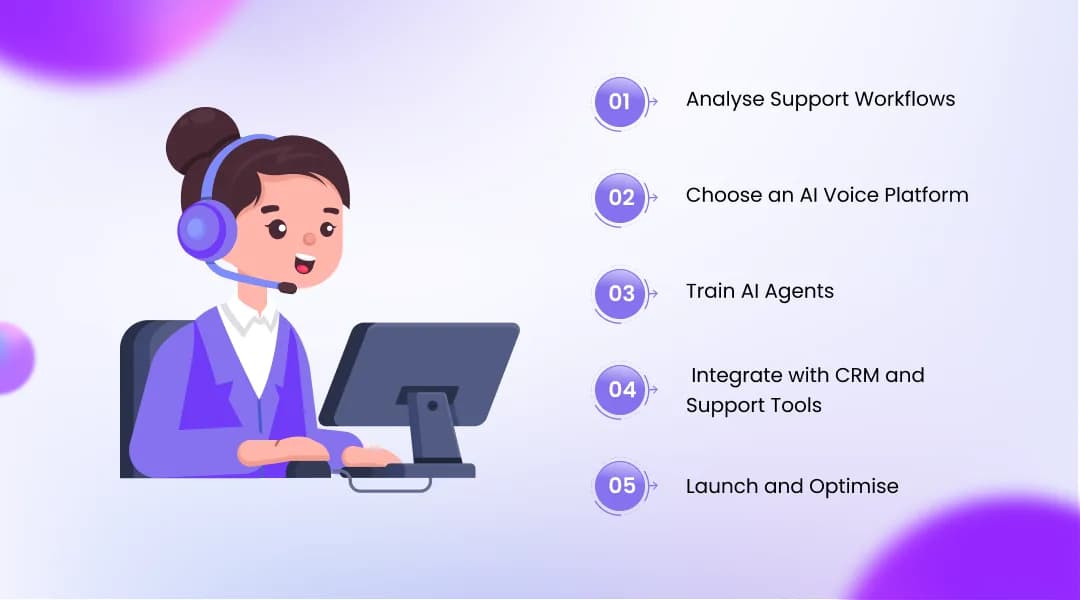
1. Analyse Support Workflows
Start by identifying repetitive customer requests.
These are your automation opportunities.
2. Choose an AI Voice Platform
Select a conversational AI system capable of handling phone calls, language understanding, and integrations.
This is where many companies explore solutions built specifically for AI Voice Agents.
3. Train AI Agents
The system needs to learn:
Customer questions
Support flows
Response structures
Training data matters.
A lot.
4. Integrate with CRM and Support Tools
Your AI system must connect with existing systems like:
CRM
order databases
scheduling tools
Otherwise it can’t complete real tasks.
5. Launch and Optimise
No AI system is perfect on day one.
You monitor conversations.
Improve responses.
Expand capabilities.
Over time the system becomes smarter.
And more useful.
Challenges Businesses Should Consider
Let’s be honest.
AI isn’t perfect.
Not yet.
There are several challenges companies must consider.
Complex Queries
Some customer issues require human judgment.
AI should always have escalation paths to human agents.
Training Requirements
Poorly trained systems lead to frustrating experiences.
Quality training data is essential.
Customer Expectations
Transparency matters.
Customers should know when they’re interacting with AI.
Trust builds better experiences.
Future of AI Contact Centers
We’re still early in this transformation.
But the direction is clear.
AI systems are becoming:
more conversational
more context-aware
more emotionally responsive
Soon, AI support systems won’t just answer questions.
They’ll predict problems.
Offer proactive assistance.
And personalise conversations based on customer history.
The call center of the future won’t be a building filled with agents.
It will be an intelligent network of AI virtual agents supported by specialized human teams.
Smaller.
Smarter.
And dramatically more efficient.
Conclusion
Replacing a call center with AI isn’t about eliminating people.
It’s about eliminating inefficiency.
The reality I’ve seen repeatedly is this:
AI handles the repetitive workload.
Humans focus on the meaningful conversations.
The result?
Better customer experiences.
Lower operational costs.
And support systems that scale effortlessly.
So if you’re wondering whether AI can replace your call center…
The better question might be this:
How long can your business afford not to automate it?