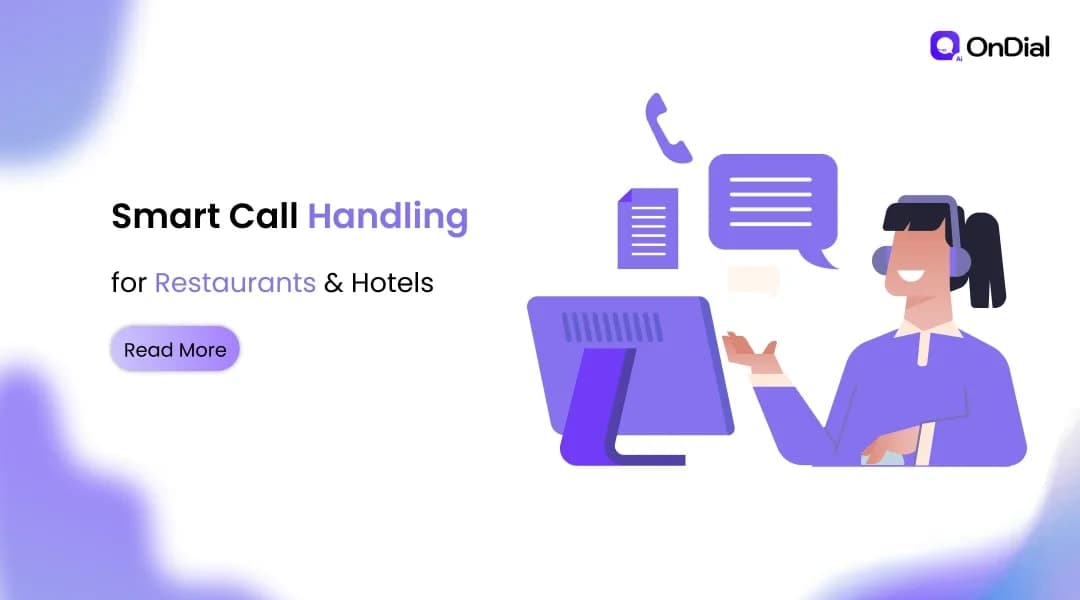
Smart call handling for restaurants and hotels is not simply about answering a ringing phone. It is about making sure reservations, guest questions, order inquiries, and service requests reach the right outcome even when the front desk or restaurant team is busy.
During peak service, the phone competes with every other task happening on site. A host may be seating guests, a receptionist may be checking someone in, and a manager may be resolving an issue. When no one can answer, a potential booking can become a missed opportunity.
AI voice agents can provide a first layer of support for these routine, high-volume conversations while human staff remain available for situations that need judgment, empathy, or direct intervention.
Why Restaurants and Hotels Struggle With Phone Calls
Peak-hour calls arrive when teams are busiest
Restaurant calls often increase around the same time staff are preparing for or serving guests. Hotels face a similar problem during check-in, check-out, and other busy periods.
The issue is not always a lack of staff. It is a mismatch between when callers need help and when employees have enough attention to provide it.
A caller may only need to ask about availability, reserve a table, confirm a booking, check an amenity, or change a reservation. Yet every request can interrupt an employee who is already serving someone in person.
After-hours calls can become lost demand
Hospitality businesses operate beyond conventional office hours. A guest may call late at night because of a different time zone. A diner may want to reserve a table after closing. A traveler may need information before arriving early the next morning.
If those calls go directly to voicemail, the business creates friction at the exact moment the customer is trying to act.
AI call handling provides a continuous first response without requiring a full human phone team to work every hour.
What AI Call Handling Means for Hospitality
AI call handling uses conversational voice technology to answer calls, understand what the caller wants, retrieve relevant information, and complete an approved action.
A modern AI voice agent can move beyond fixed IVR menus. Instead of asking a caller to press a number for reservations, the system can understand a request such as, "Can you book a table for four tomorrow evening?" and continue the conversation naturally.
The value comes from connecting the conversation to business systems. OnDial supports natural speech, real-time context, inbound and outbound calling, call routing, knowledge base lookup, analytics, workflow automation, and human handoff.
For hospitality businesses evaluating this approach, the goal should not be to automate every conversation. The better objective is to automate predictable workflows while giving employees control over complex interactions.
Restaurant Use Cases for AI Call Handling
Table reservations
Restaurant reservations are a strong starting point because the workflow is structured.
An AI voice agent can collect party size, preferred date and time, guest name, contact details, and relevant notes. When connected to an appropriate reservation system, it can check availability and support the booking process.
The important part is not simply taking a message. The goal is to move the caller from intent toward a confirmed outcome without forcing staff to re-enter the same information.
Menu, hours, parking, and location questions
Restaurants receive many repetitive questions. Guests may ask when the kitchen closes, whether parking is available, whether a menu item is offered, or whether the restaurant can accommodate a particular request.
These questions can be handled from a controlled knowledge base. The AI should provide approved business information and transfer the call when the question falls outside its defined scope.
Order and service inquiries
For restaurants that accept phone orders, AI can support defined order workflows when the necessary systems and controls are available.
The agent may collect order details, confirm customer information, provide an order status, or route a complicated issue to staff. The exact workflow should match the restaurant's ordering and POS environment.
Multi-location restaurant support
Restaurant groups have another challenge: information can differ by location.
A well-designed voice agent should identify the relevant branch before providing location-specific hours, reservation availability, menu information, or routing instructions. This reduces the risk of giving guests information for the wrong property.
Hotel Use Cases for AI Call Handling
Room availability and reservations
Hotel reservation calls often require several details, including arrival date, departure date, room preference, and number of guests.
An AI voice agent can collect these details conversationally and, when connected to the appropriate property or reservation system, use current availability to support the booking workflow.
This is more useful than a basic answering service because the conversation can progress toward an actual reservation rather than ending with a message for the front desk.
For a deeper look at reservation automation, see AI Booking Calls: Hotels & Restaurants Handle Reservations 24/7.
Reservation changes and cancellations
Existing guests frequently call to change dates, ask about policies, or cancel a booking. These requests can consume front desk time even when the workflow is standardized.
AI can handle defined modification and cancellation flows, verify required information, and escalate cases that need human approval.
Guest questions before arrival
Guests may ask about breakfast, parking, check-in times, airport transfers, amenities, accessibility, or property policies.
A knowledge-driven voice agent can answer approved questions consistently. If the request involves a special exception, complaint, sensitive issue, or service recovery, the call can be transferred to the appropriate employee.
Front desk overflow
The front desk is often busiest when several guests arrive at once. Calls during that period create another queue.
AI can act as an overflow layer for routine requests while employees focus on guests who are physically present. Human handoff remains important for complaints, emergencies, unusual service requests, and situations requiring judgment.
Hospitality teams can also use AI Voice Agents for Hospitality to evaluate how these workflows can be adapted specifically for hotels, resorts, and guest-service operations.
What a Good Hospitality AI Call Flow Looks Like
A practical AI call flow should be designed around the customer's goal rather than around a long list of technical features.
1. Answer and identify intent
The agent answers promptly and identifies whether the caller wants to make a reservation, modify a booking, ask a question, place an order, request assistance, or speak with a person.
2. Collect only the required information
The agent should not turn a simple request into a long questionnaire. It should collect the information required for that workflow and avoid unnecessary questions.
3. Check trusted business information
For reservations, this may mean checking current availability. For guest questions, it may mean retrieving approved information from the hotel's knowledge base or restaurant's operating information.
4. Complete the approved action
The system should perform only actions it is authorized to perform, such as confirming a reservation, logging a request, updating an appointment, or creating a follow-up task.
5. Escalate when automation should stop
A reliable hospitality voice agent needs clear boundaries.
Complaints, payment disputes, emergencies, unusual exceptions, sensitive requests, and situations outside the AI's authority should be routed to a human. The handoff should preserve conversation context so the caller does not have to repeat everything.
Why Integrations Matter
Integration is one of the biggest differences between a useful AI voice agent and a basic answering service.
For hotels, relevant systems can include property management, reservation, CRM, communication, and guest-service tools. For restaurants, the stack may include reservation platforms, POS systems, ordering tools, CRM systems, and location-specific databases.
OnDial supports CRM and calendar connections, APIs, webhooks, telephony, workflow automation, and knowledge-driven responses. The appropriate integration depends on the business process and existing technology stack.
Before deployment, define the system of record for each workflow. If a reservation exists in one system, the AI should not maintain a separate unofficial version of that booking.
Multilingual Call Handling for Hospitality
Language can add another layer of friction for hotels, resorts, restaurants, and travel businesses serving diverse guests.
OnDial states that its voice platform supports more than 100 languages and can detect and respond in the caller's language. For Indian hospitality businesses, multilingual support can be useful when guests move between English, Hindi, and regional languages during natural conversations.
The objective should not be to support languages simply for marketing purposes. The useful question is whether the system supports the languages, accents, business terminology, and escalation rules that actual callers need.
How to Measure AI Call Handling Performance
Launching an AI voice agent is not the finish line. Hospitality teams should measure operational outcomes.
Call answer rate
Track how many inbound calls receive an answer and how many still reach voicemail or fail before connection.
Resolution rate
Measure how many calls are completed without human intervention and which intents most frequently require escalation.
Booking conversion
For reservation calls, compare booking opportunities with completed reservations. This helps separate call volume from actual business value.
Transfer rate
A high transfer rate is not automatically a problem. It may indicate that the AI is correctly recognizing conversations that require human judgment.
Review the reasons for transfers rather than looking at the percentage alone.
Repeat calls
Repeat calls can reveal that the first interaction did not resolve the customer's need. They can also expose gaps in the knowledge base or workflow design.
Guest satisfaction
Use post-call feedback, surveys, reviews, and staff feedback to determine whether automation is improving the customer experience rather than simply reducing workload.
How to Implement AI Call Handling Without Disrupting Operations
Start with one high-volume workflow
Do not automate every hospitality call on day one.
Start with a defined use case such as reservations, frequently asked questions, booking confirmations, or overflow support. Once the workflow performs reliably, expand the scope.
Build the knowledge base carefully
Document operating hours, policies, menus, room information, cancellation rules, escalation contacts, and location-specific details.
Remove outdated information before connecting it to the AI. Incorrect information can create more customer-service problems than an unanswered call.
Define human handoff rules
Write down which situations require a person.
Include complaints, sensitive requests, emergencies, payment issues, unusual booking conditions, and anything outside approved actions.
Test real conversations
Test accents, interruptions, background noise, unclear requests, cancellations, changes, and edge cases.
A hospitality voice agent should be evaluated using the conversations your team actually receives rather than only ideal demonstration calls.
Review calls after launch
Use transcripts, summaries, outcomes, and escalation reasons to identify gaps. Update the knowledge base and conversation flows based on real interaction data.
For businesses that want to understand the broader scheduling workflow, How AI Appointment Scheduling Works From Call to Calendar provides a related look at how voice-based scheduling moves from a live call to a confirmed booking.
AI Call Handling vs. a Traditional Answering Service
A traditional answering service generally focuses on receiving a call and passing information to a human team.
AI call handling can go further when the underlying systems are connected. It can understand intent, retrieve approved information, complete defined workflows, log the interaction, and escalate the conversation when necessary.
The difference is not that AI should replace every receptionist. The practical value is that routine phone work can be handled consistently while employees spend more time with guests who need personal attention.
OnDial's AI Voice Agent Features include call routing, human handoff, knowledge base lookup, multilingual communication, call recording, conversation summaries, analytics, and workflow automation.
What Restaurants and Hotels Should Look for in an AI Voice Platform
Before choosing a provider, ask practical questions.
Can it connect to the systems that control reservations or customer records? Can it handle the languages and accents your guests use? Can it transfer calls with context? Can your team review transcripts and outcomes? Can you control what the agent is allowed to say and do?
Security also matters. Guest information, contact details, booking history, and payment-related conversations should be handled using appropriate access controls, encryption, retention policies, and compliance practices.
Finally, consider operational fit. A good platform should make the team's work easier rather than create another system employees must constantly manage.
Conclusion
Smart call handling for restaurants and hotels works best when it is treated as an operational system rather than a standalone phone feature.
The strongest use cases are clear: reservations, repetitive questions, booking changes, order or service inquiries, after-hours calls, multilingual conversations, and front desk overflow.
When the AI is connected to trusted business systems and given clear boundaries, it can complete routine work while escalating conversations that need a person.
For hospitality teams, the goal is simple: answer more calls, remove avoidable friction, protect booking opportunities, and give employees more time to serve the guests already in front of them.
OnDial AI Voice Agents provide AI-powered inbound and outbound call automation for businesses, with capabilities covering conversation management, integrations, multilingual communication, analytics, and workflow automation.