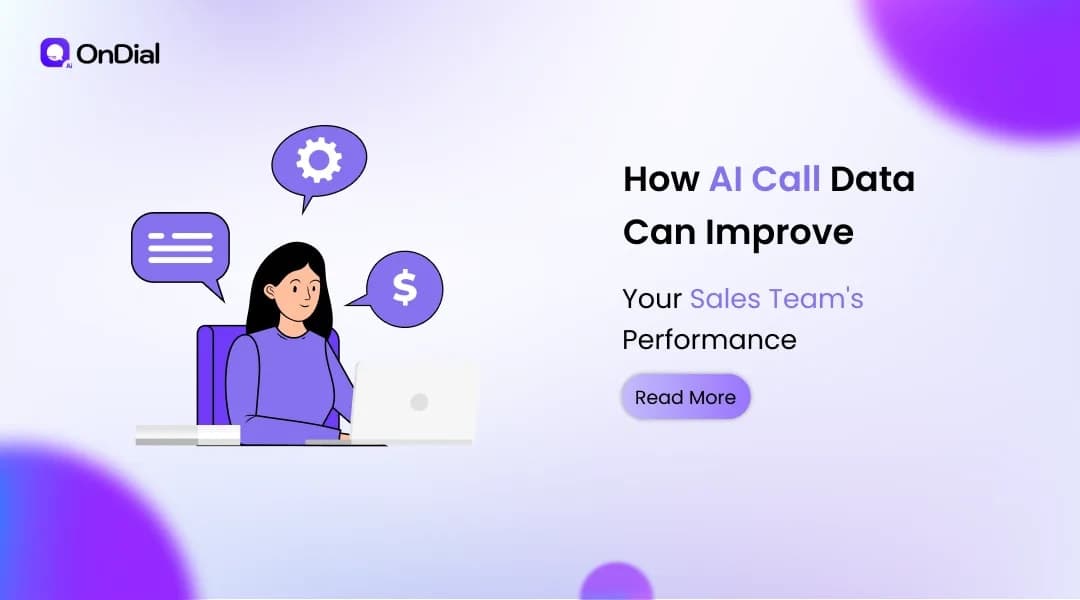
Sales reps spend only 34% of their time actually selling when there is no AI automation supporting their workflow, according to research compiled by WifiTalents in 2026. That means the majority of a rep's day is disappearing into admin, manual note-taking, and CRM updates - not conversations that close deals.
Here's the question most sales leaders never think to ask: of the calls that do happen, how many does your manager actually listen to?
The honest answer, for most organizations, is somewhere below 2%. The rest are a black box. You don't know why your best rep closes at 40% while someone with the same territory closes at 18%. You don't know which objection is silently killing deals in the third call. You don't know what language your top performer uses right before a prospect says yes.
AI call data sales performance tools exist to close that gap. Not by replacing your salespeople - but by giving every manager, every rep, and every new hire access to the intelligence that was always buried inside your calls. At OnDial, we've worked with businesses across industries that had strong sales teams but weak visibility into what was actually happening in their conversations. That visibility problem is what AI call data solves.
In this guide, you'll learn exactly how AI call data works, which specific performance outcomes it drives, how real-time voice analytics differ from post-call analysis, and what honest limitations you need to plan around before investing.
What Is AI Call Data?
AI call data is the structured intelligence extracted automatically from sales conversations using artificial intelligence, including transcription, sentiment analysis, keyword tagging, talk-ratio measurement, and behavior scoring.
Think of it this way: call recording is a filing cabinet. AI call data is an analyst who listens to every recording and tells you exactly what happened, who spoke when, what emotion was present, which objections came up, and whether the rep followed your playbook.
The underlying technologies that make this possible are natural language processing (NLP), machine learning, and sentiment analysis. NLP parses the words spoken. Sentiment analysis reads the emotional tone. Machine learning identifies patterns across hundreds or thousands of calls and tells you what those patterns mean for outcomes.
Tools like Gong, Chorus, and Salesloft have popularized conversation intelligence in enterprise sales. What's changed recently is that voice AI technology has matured enough to deliver this capability at every level - including businesses that don't have 200-person sales floors.
A precise definition matters here: conversation intelligence for sales teams is the application of AI to automatically analyze spoken sales interactions, extract behavioral signals, and generate coaching-ready insights - without a manager having to press play on a single recording.
That distinction is everything.
How AI Call Data Improves Sales Rep Coaching
From Random Sampling to 100% Call Coverage
Before AI, a sales manager's coaching was built on a sample. Maybe one or two calls per rep per week. Maybe fewer. Which calls got reviewed? Often the ones where something obviously went wrong, or the ones from reps who were already improving. The people who needed coaching most were frequently reviewed least.
AI call analytics changes this completely. Every call gets scored. Every call gets tagged. Managers receive automated alerts when a rep misses a discovery question, when a competitor gets mentioned, or when sentiment shifts negatively in the final five minutes of a conversation.
I've personally seen this shift the coaching dynamic in sales environments where managers were excellent at their jobs but simply overwhelmed by volume. The AI doesn't replace their judgment - it focuses it. Instead of spending three hours reviewing calls to find two minutes of relevant coaching material, a manager surfaces the exact conversation moments that matter in a single dashboard view.
The impact is measurable. Teams using AI call analytics for coaching report a 23-35% improvement in quota attainment within six months, according to analysis published by Auto Interview AI based on call data from multiple sales organizations in early 2026.
What Top Performers Actually Do Differently
This is where AI call data gets genuinely interesting. Not just for catching what goes wrong, but for replicating what goes right.
When AI analyzes enough calls, patterns emerge that no human reviewer would spot manually. According to conversation intelligence research, top-performing sales reps ask between 12 and 15 open-ended questions per discovery call. Average reps ask between 4 and 6. Top performers listen for 60-65% of the call. Average reps talk for 65-70%.
(Let that sink in for a moment. The people closing more deals are the ones talking less.)
Top performers also acknowledge objections before responding to them. Average reps counter immediately. Top performers confirm next steps with specific dates and named stakeholders. Average reps say "let me follow up."
AI surfaces these differences not as generalized advice, but as specific, rep-level feedback. When a new hire joins your team, they're no longer learning from a 12-page onboarding deck. They're learning from your best actual calls.
Real-Time AI Voice Analytics: Coaching During the Call
Live Guidance vs. Post-Call Analysis: Which Actually Moves Numbers?
There are two distinct categories of AI call data tools, and the difference matters for how you deploy them.
Post-call analysis platforms - Gong, Chorus, Salesloft - listen, transcribe, score, and report after the conversation ends. They're excellent for coaching programs, playbook development, and identifying pipeline risk across a team. The insight is deep. The timing is retrospective.
Real-time AI voice analytics platforms work during the live conversation. They surface relevant talking points when a prospect asks a tough question. They flag competitor mentions as they happen. They alert a rep when their talk ratio is going the wrong way mid-call.
Both have a role. But real-time coaching is where AI call data moves from insight to behavior change in the moment.
Here's the question worth asking yourself: how many deals has your team lost not because they lacked knowledge, but because they had the right answer 10 minutes too late?
Real-time coaching coaching cues improve live call objection handling by 20%, according to data cited by WifiTalents in 2026. That's not a post-training improvement. That's a within-the-conversation improvement, on calls that are happening right now.
At OnDial, our work in AI voice technology is grounded in exactly this - building voice AI that doesn't just record what happens, but responds intelligently in context. The architecture that powers real-time guidance is the same architecture that enables conversational AI to feel human. When we design AI voice assistants, latency and sentiment detection are non-negotiable. Those same standards apply to real-time sales coaching tools.
Using Conversation Intelligence to Fix Your Sales Playbook
Identifying Objection Patterns at Scale
Your sales playbook is a hypothesis. It was written based on what someone thought prospects cared about. AI call data tells you what they actually care about.
When you analyze hundreds of calls, you start to see objection patterns that don't show up in individual reviews. Maybe 40% of deals that stall at the demo stage include a specific competitor mention. Maybe pricing objections almost always follow a specific type of discovery question. Maybe a particular industry vertical responds to one framing but tunes out another.
Sales call analysis at this scale is not possible manually. A human analyst reviewing 10 calls a week would take a year to process what AI surfaces in hours. And by the time the human insight arrives, the market has already shifted.
One concrete example: iovox, a conversation intelligence platform, worked with a real estate client who discovered through AI transcript analysis that the majority of their sales team wasn't following their script guidelines. The issue had gone undetected across dozens of manual reviews. Once surfaced, the team corrected it within weeks - not months.
That's the operational value of AI call data. Not a dashboard. An action.
Turning Winning Calls Into Team-Wide Playbooks
The most defensible use of conversation intelligence is competitive replication. Not copying a script - but identifying the specific behaviors, question sequences, and conversational rhythms that correlate with closed deals, and building those into your training.
AI can tag and categorize your best calls automatically. It can build a library of winning moments - specific objection responses that worked, specific ways a rep transitioned from discovery to demo, specific closing language that preceded a signed contract.
New reps used to ramp in 6-9 months on average. Teams using AI-assisted onboarding that includes call libraries from top performers are compressing that timeline. Not because the new hires are smarter - but because the knowledge transfer is no longer dependent on shadow-calling and anecdote.
AI Call Data and CRM: Closing the Loop on Sales Performance Metrics
Automated Summaries and Follow-Ups
One of the quietest productivity gains from AI call data has nothing to do with coaching. It's the elimination of post-call admin.
After every call, a rep typically spends 10-20 minutes writing notes, updating the CRM, drafting a follow-up email, and logging action items. Multiply that across a 20-person team making five calls per day. That's 100-200 hours per week of work that adds no direct selling value.
Modern conversation intelligence platforms generate structured call summaries automatically. Key discussion points, agreed-upon next steps, and action items sync directly into your CRM without a rep touching a keyboard. Platforms that support two-way sync can also push follow-up recommendations back to reps based on what the AI detected in the conversation.
For businesses using Salesforce, HubSpot, or similar platforms, this integration closes the loop between what's actually said on calls and what lives in your pipeline data. The CRM becomes a real record - not a collection of whatever a rep remembered to type after their fifth call of the day.
Pipeline Forecasting from Voice Data
This is where AI call data moves from coaching tool to revenue intelligence system.
When AI analyzes enough calls across your pipeline, it can identify deals at risk before your manager spots them in a weekly review. A deal where sentiment has trended negative over three conversations. A deal where the prospect hasn't asked a single commercial question. A deal where a competitor was mentioned three times and the rep deflected without a direct response.
Companies using monday CRM's AI forecasting features have seen a 75% increase in forecast accuracy, according to their published platform data. That's not a marginal improvement - it changes how revenue leaders make decisions about where to focus team energy and resources.
The combination of voice data and CRM data creates something more valuable than either alone: a real-time picture of deal health, grounded in the actual words your customers are speaking.
What to Watch Out For: Honest Limitations of AI Call Analysis
No article on AI call data would be responsible without addressing what it doesn't do well.
First: data privacy and compliance. Recording and analyzing calls involves processing personal data. GDPR in Europe, DPDP in India, and various US state laws impose specific requirements around consent, disclosure, and storage. Most AI call analytics platforms provide consent frameworks, but the implementation responsibility sits with your business. If you're operating across jurisdictions, consult your legal team before deploying any call recording system.
Second: AI does not replace coaching judgment. AI identifies patterns. Humans make meaning. A sentiment dip on a call might signal a real objection - or it might signal that the prospect was distracted for a moment. Context still requires a human who knows the account, the industry, and the rep. AI call data improves coaching efficiency; it doesn't replace a great coach.
Third: quality depends on input data quality. Machine learning amplifies whatever data you feed it. A poorly structured CRM, inconsistent call tagging, or a team that frequently disables call recording produces low-quality signal. AI will find patterns in noise just as readily as it finds patterns in signal. Getting the data infrastructure right is a prerequisite, not an afterthought.
These are real constraints. Acknowledging them isn't pessimism - it's the foundation of using AI call data well.
Conclusion
AI call data sales performance is no longer a competitive advantage reserved for enterprise teams with large budgets and dedicated data science functions. The capability is accessible, the business case is clear, and the performance evidence is consistent: better call data leads to better coaching, better coaching leads to better behaviors, and better behaviors move quota.
The three things worth remembering from this guide: AI call data gives you coverage your manager never had, turning every conversation into a source of coaching intelligence rather than an unreviewed file. Conversation intelligence tells you not just what happened, but why deals closed - and why they didn't. And real-time AI voice analytics closes the loop between insight and action, improving performance in the conversation itself.
At OnDial, we build AI voice technology specifically for businesses that want to connect better with their customers - not just record conversations, but understand them. If you're thinking about where to start, the honest answer is: start with visibility. Let AI show you what's actually happening in your calls. Then build from there.
Ready to see what your call data is telling you? Talk to the team at OnDial to explore how AI voice solutions can bring that intelligence into your sales operation.